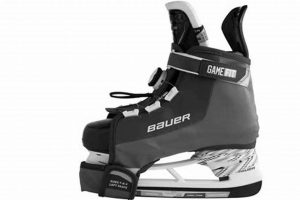
These skates are designed for adult players participating in inline hockey, also known as roller hockey. Typically, they feature a supportive boot, chassis (the frame holding the wheels), wheels optimized for rink surfaces, and bearings to facilitate smooth rolling. A common example would be a size 9 skate with a stiff boot for ankle support, 80mm wheels for maneuverability, and ABEC 7 bearings for speed.
The equipment allows experienced hockey players to translate their skills from ice to roller surfaces, providing a competitive outlet during off-seasons or in areas where ice rinks are unavailable. Their adoption has expanded the accessibility of hockey, enabling participation in diverse environments and age groups. The development of specific wheel compounds and chassis designs has significantly improved performance and responsiveness on sport courts and other playing surfaces.
The following sections will delve into the key considerations when selecting appropriate equipment, including boot construction, chassis materials, wheel durometer, and bearing types. The article will also address fitting guidelines, maintenance procedures, and potential safety concerns related to their use.
Essential Guidelines for Adult Inline Hockey Skates
Selecting appropriate equipment is paramount for performance and safety. The following guidelines are intended to aid in the proper selection and maintenance of inline hockey skates designed for adult players.
Tip 1: Prioritize Proper Fit: Ensure a snug fit without excessive pressure points. Ill-fitting skates can lead to blisters, reduced agility, and potential ankle instability. Professional fitting services are recommended.
Tip 2: Consider Boot Stiffness: Stiffer boots offer superior ankle support and responsiveness, particularly beneficial for aggressive skaters. Softer boots provide greater comfort but may compromise performance for more advanced players.
Tip 3: Evaluate Chassis Material: Aluminum chassis provide greater power transfer and durability compared to plastic or composite options. They are a worthwhile investment for competitive players.
Tip 4: Select Appropriate Wheel Durometer: Wheel hardness, measured in durometer, should be selected based on playing surface. Softer wheels (lower durometer) offer better grip on smooth surfaces, while harder wheels (higher durometer) are more durable on abrasive surfaces.
Tip 5: Maintain Bearings Regularly: Clean and lubricate bearings periodically to ensure smooth rolling and extend their lifespan. Dirty or dry bearings can significantly impede speed and maneuverability.
Tip 6: Replace Wheels as Needed: Wheels wear down unevenly with use. Rotate wheels regularly to promote even wear, and replace them when their diameter is significantly reduced or their shape becomes deformed.
Tip 7: Inspect Fasteners Regularly: Regularly inspect all bolts and screws, especially those securing the chassis to the boot. Tighten any loose fasteners to prevent component failure during play.
Adhering to these guidelines maximizes the lifespan, performance, and safety of inline hockey skates designed for adult players. Proper selection and maintenance are crucial for optimizing the skating experience and mitigating potential injuries.
The following section will cover the impact of skating skills on the “inline hockey skates senior”.
1. Fit

The concept of “fit” is paramount when selecting inline hockey skates. Improper fit can lead to diminished performance, discomfort, and increased risk of injury. Achieving optimal fit requires careful consideration of several interrelated factors.
- Length and Width Dimensions
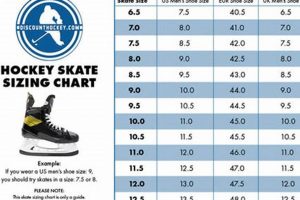
Skate length and width must accurately correspond to the player’s foot measurements. Excessive space allows for unwanted foot movement within the boot, reducing control and power transfer. Conversely, insufficient space can cause painful pressure points, blisters, and impaired circulation. Precise measurement and professional fitting are crucial for determining the correct size. For example, a player with a wide foot should consider skate models specifically designed for wider profiles.
- Ankle Support and Heel Lock
Proper fit extends beyond the forefoot to encompass the ankle and heel. The skate should provide adequate ankle support to prevent excessive pronation or supination during skating. A secure heel lock minimizes heel lift, enhancing energy transfer and reducing the risk of ankle instability. Heat molding or custom fitting may be necessary to achieve optimal ankle and heel fit.
- Lacing System and Tongue Design
The lacing system plays a critical role in achieving a customized and secure fit. Laces should distribute pressure evenly across the instep, allowing for adjustments in tightness based on individual preferences and foot morphology. The tongue should be adequately padded to prevent lace bite and contribute to overall comfort. Power straps can further enhance ankle support and responsiveness.
- Heat Molding and Customization
Many models offer heat-moldable boots that allow the skater to accelerate the break-in process and customize the fit to their unique foot shape. This can significantly improve comfort and reduce the risk of pressure points. Custom footbeds can also enhance support and cushioning, particularly for skaters with specific arch types or foot conditions.
Ultimately, the achievement of correct fit with inline hockey skates represents a balance between comfort, performance, and safety. Prioritizing accurate measurement, professional fitting, and customization options contributes significantly to an enhanced skating experience and reduced risk of injury for adult players.
2. Support

In the context of adult inline hockey skates, “support” refers to the structural elements of the skate boot designed to maintain foot and ankle stability. Inadequate support can lead to compromised skating performance, increased risk of ankle sprains, and potentially more severe injuries. The level of support required varies based on a skater’s ability, playing style, and physical conditioning. Stiffer boots, often constructed with reinforced materials, provide greater support, which is particularly beneficial for aggressive skaters executing rapid turns and abrupt stops. Conversely, less experienced skaters may find moderately supportive boots more comfortable, allowing for a greater range of motion while still providing adequate protection.
The boot’s construction directly impacts the support it provides. High-end skates typically incorporate materials like carbon fiber or advanced polymers in the boot’s shell to maximize stiffness and energy transfer. For instance, a skater performing crossovers relies on the lateral support of the boot to maintain balance and generate power. Insufficient lateral support causes the ankle to roll inward (pronation), diminishing skating efficiency and increasing the likelihood of injury. Similarly, inadequate heel hold, another element of support, can lead to heel lift within the boot, reducing power transfer and causing blisters. Therefore, the design, materials, and construction methods are the primary determinants of the support level in inline hockey skates.
Effective support mechanisms in inline hockey skates are critical for adult players. Factors that degrade support mechanisms over time are important to take into account. Maintaining appropriate boot integrity through careful use and upkeep will ensure safe play. Proper fit is the starting point for a system of support, extending to include the boot’s construction, the heel, and the skates ankle support. Ultimately, selecting skates with an appropriate support level, based on an individual skater’s needs, translates to improved performance, reduced injury risk, and a more enjoyable skating experience.
3. Chassis
The chassis is a critical component of equipment, directly impacting performance characteristics. The chassis, the frame attaching the wheels to the boot, influences responsiveness, stability, and power transfer. A well-designed chassis maximizes energy transfer from the skater to the wheels, contributing to faster acceleration and increased maneuverability. Conversely, a poorly designed or improperly sized chassis can reduce efficiency, making skating more fatiguing and decreasing overall performance. For example, a longer chassis may offer greater stability at high speeds, while a shorter chassis facilitates quicker turns. The choice of chassis length and design is therefore a critical factor in customizing skate performance to individual playing styles.
Chassis material also significantly affects skate performance and durability. Aluminum alloys are commonly used in high-performance chassis due to their stiffness-to-weight ratio. Stiffer chassis materials minimize energy loss during skating, allowing for more efficient power transfer. However, aluminum chassis can be more susceptible to damage from impacts. Composite materials, while generally lighter, may offer less stiffness and durability. The selection of chassis material should consider the skater’s weight, skating style, and the frequency of use. Regular inspection for cracks or deformities is essential to ensure continued safe operation.
In summary, the chassis is an integral element, directly affecting skate responsiveness, stability, and power transfer. Understanding the impact of chassis design and material on skating performance allows adult players to make informed decisions when selecting equipment. Proper maintenance, including regular inspection and replacement when necessary, is vital for maximizing performance and ensuring safety.
4. Wheels
The wheels are a critical determinant of performance and user experience. As the direct point of contact with the playing surface, the wheels directly influence speed, grip, and maneuverability. Wheels designed for inline hockey differ significantly from those used in recreational skating, possessing specialized durometers and profiles to optimize for the specific demands of the sport. For example, a harder wheel durometer (e.g., 88A) is generally preferred for smoother surfaces to maximize speed and reduce rolling resistance, while a softer durometer (e.g., 74A) provides enhanced grip on less pristine surfaces, allowing for sharper turns and quicker stops. Improper wheel selection can result in reduced agility, increased fatigue, and a higher risk of slippage, particularly during aggressive maneuvers.
The interplay between wheel durometer, wheel size, and bearing quality is crucial for achieving optimal skating performance. Larger diameter wheels generally provide higher top speeds but can reduce acceleration. Smaller diameter wheels offer improved acceleration and maneuverability but may sacrifice top-end speed. Bearing quality, rated according to the ABEC scale, influences the smoothness and efficiency of wheel rotation. Higher ABEC ratings indicate tighter tolerances and reduced friction, contributing to greater speed and glide. Combining the correct wheel size, durometer, and bearing specification for the playing surface and the skater’s skill level is essential for maximizing performance potential. Replacing worn or damaged wheels is a necessary maintenance task. Uneven wear can compromise grip and stability, while chipped or cracked wheels pose a safety hazard.
Ultimately, understanding the characteristics and selection criteria of inline hockey skate wheels is paramount. Selecting the appropriate wheel based on surface conditions, skating style, and skater weight enhances performance, prolongs wheel life, and ensures user safety. Wheel selection is not a one-size-fits-all approach. Matching wheels to the individual skater and playing environment is a key component of optimizing the skating experience.
5. Bearings
Bearings are integral to the functionality of adult inline hockey skates, directly impacting the skater’s speed, glide, and overall efficiency. These small, circular components are housed within the wheel hub, facilitating smooth rotation around the axle. The quality and maintenance of bearings are critical, as friction within the bearing assembly impedes performance. A set of well-maintained, high-quality bearings allows for more effortless skating, conserving energy and enabling higher speeds. Conversely, worn or poorly lubricated bearings significantly increase rolling resistance, requiring more effort to maintain a given speed and leading to premature fatigue. For example, a skater using ABEC 9 rated bearings will generally experience a smoother, faster glide compared to one using ABEC 3 rated bearings, assuming both sets are properly maintained. The difference in performance can be particularly noticeable during long skating sessions or when executing rapid accelerations.
The industry standard for rating bearing precision is the Annular Bearing Engineering Committee (ABEC) scale. While a higher ABEC rating generally indicates greater precision and tighter tolerances, other factors, such as material quality and lubrication, also contribute significantly to bearing performance. Stainless steel bearings, for instance, offer better corrosion resistance than carbon steel bearings, making them suitable for use in damp environments. Regular cleaning and lubrication are essential for maintaining bearing performance and extending their lifespan. Dirt and debris can accumulate within the bearing assembly, increasing friction and reducing efficiency. Specialized bearing cleaning kits and lubricants are available to facilitate this maintenance. Proper maintenance prevents premature wear and ensures consistent performance over time.
In conclusion, bearings are a fundamental component, directly influencing the performance and efficiency of adult inline hockey skates. Selecting high-quality bearings and adhering to a regular maintenance schedule significantly enhances the skating experience. Understanding the relationship between bearing quality, maintenance, and skating performance is crucial for maximizing speed, reducing fatigue, and prolonging the lifespan of the skates.
6. Maintenance
Proper maintenance is a determining factor in the longevity, performance, and safety of inline hockey skates used by adult players. The inherent design and usage patterns of these skates expose them to considerable wear and tear. Regular maintenance mitigates degradation, preserving functionality and reducing the risk of equipment failure during play. A failure to maintain chassis bolts, for example, could lead to loosening or complete detachment of the frame, causing a sudden loss of control. Maintenance activities directly impact all components of the skates: boots, chassis, wheels, and bearings. Therefore, neglecting maintenance generates a cascading series of negative consequences affecting both performance and safety.
Specific maintenance procedures for wheels include regular rotation to ensure even wear, maximizing lifespan and maintaining consistent grip. Chassis maintenance involves inspection for cracks or bends, as well as tightening of all bolts and fasteners. Bearing maintenance requires periodic cleaning and lubrication to remove dirt and debris that impede smooth rolling. Boot maintenance involves cleaning and drying the interior to prevent bacterial growth and odor, as well as repairing any tears or abrasions to the outer shell. Neglecting any one of these maintenance areas leads to diminished performance and an increased risk of component failure. Consider the example of a skater who fails to clean and lubricate their bearings. Over time, the bearings become clogged with dirt, increasing friction and reducing speed. This can lead to increased fatigue, decreased agility, and potentially, bearing seizure, resulting in sudden wheel stoppage during play.
In conclusion, maintenance is an indispensable aspect of equipment ownership for adult players. Consistent application of appropriate maintenance procedures safeguards performance, extends the lifespan of the equipment, and minimizes the risk of injuries. The investment in maintenance is demonstrably less costly than the expenses associated with premature equipment replacement or the treatment of injuries resulting from equipment failure. It is advisable that players establish a regular maintenance schedule, allocating time for inspection, cleaning, and repair, in order to maximize their investment and ensure their safety on the rink.
Frequently Asked Questions
This section addresses common inquiries regarding equipment designed for adult inline hockey players. Understanding these points ensures informed purchasing decisions and proper equipment maintenance.
Question 1: What distinguishes from recreational models?
Designed for the specific demands of the sport, equipment features enhanced ankle support, stiffer chassis, and wheels optimized for rink surfaces. Recreational models typically prioritize comfort over performance.
Question 2: How critical is proper fit in selecting equipment?
Proper fit is paramount for performance, comfort, and injury prevention. Ill-fitting skates can cause blisters, reduce agility, and increase the risk of ankle instability.
Question 3: What factors influence the lifespan of wheels?
Wheel lifespan is influenced by wheel durometer, playing surface abrasiveness, skater weight, and skating style. Regular rotation extends wheel lifespan, while aggressive skating on rough surfaces accelerates wear.
Question 4: How frequently should bearings be cleaned and lubricated?
Bearing cleaning and lubrication frequency depend on usage. Frequent players in dusty environments should clean and lubricate bearings monthly. Infrequent players may only require maintenance every few months.
Question 5: What are the potential consequences of neglecting equipment maintenance?
Neglecting maintenance can lead to decreased performance, increased risk of component failure, and potential injuries. Regular maintenance ensures optimal functionality and safety.
Question 6: Can ice hockey skates be converted for use in inline hockey?
While technically possible, converting ice hockey skates for inline use is generally not recommended. Ice hockey boots lack the necessary ventilation, and the chassis attachment may compromise the boot’s integrity.
Proper selection and maintenance ensure optimal performance, safety, and longevity of the equipment. Understanding these key aspects empowers players to make informed decisions.
The following section will delve into advanced techniques and strategies.
Conclusion
This article has explored key facets of inline hockey skates for adult players, from the critical aspects of fit and support to the selection of appropriate chassis, wheels, and bearings. Further, this discussion highlighted the vital role of regular maintenance in ensuring the longevity, performance, and safety. The information presented underscores the necessity of understanding equipment specifications and adopting proactive maintenance practices.
Ultimately, the informed selection and conscientious care of adult inline hockey skates contribute significantly to an enhanced and safer playing experience. Continued advancements in materials and design promise further improvements in performance and durability, emphasizing the importance of staying abreast of industry innovations and best practices to realize the full potential of the equipment.