The appropriate dimensions for a hockey stick are crucial for optimal performance and safety. The process involves determining the distance from the heel of the blade to the top end of the shaft. A player stands without skates, and the stick is placed vertically with the heel touching the ground; the top should generally reach somewhere between the player’s nose and chin. This measurement provides a baseline for selecting a stick that allows for proper puck handling, shooting, and overall control.
Selecting a stick of the correct size offers numerous advantages. It promotes better posture and balance, facilitating more efficient skating and movement. A well-sized stick allows for greater leverage when shooting, potentially increasing power and accuracy. Historically, stick length was less standardized, with players often using whatever was available. As the game evolved, so did the understanding of equipment’s impact on player performance, leading to more refined fitting methods.
Detailed methods for achieving the appropriate stick length involve several considerations. These include the player’s height, skating ability, playing style, and personal preference. Factors such as the desired flex of the stick and whether the player typically skates with a wider or narrower stance will influence the ultimate length decision. Further sections will elaborate on various techniques, including on-ice adjustments and considerations for different player positions.
Guidelines for Determining Appropriate Hockey Stick Length
The following recommendations offer guidance for establishing suitable hockey stick dimensions, enhancing player performance and control.
Tip 1: Height as a Primary Indicator: Initiate the process by referencing the player’s height. With the player standing upright without skates, position the stick vertically; the top end should ideally align between the nose and chin. This constitutes a fundamental starting point.
Tip 2: Consideration of Skating Ability: Evaluate the player’s skating prowess. More proficient skaters often prefer slightly longer sticks, facilitating extended reach and enhanced puck control at higher speeds.
Tip 3: Playing Style Assessment: Differentiate between player positions. Defensemen frequently benefit from longer sticks, aiding in poke checks and defensive zone coverage. Forwards, particularly those emphasizing close puck handling, may opt for shorter sticks.
Tip 4: On-Ice Evaluation: Conduct on-ice testing to fine-tune the stick length. Observe the player’s posture and puck handling during skating drills. A stick that is excessively long will cause the player to stand too upright, while one that is too short will induce excessive bending at the waist.
Tip 5: Flex Point Considerations: Recognize the interdependence of stick length and flex. Shortening a stick increases its stiffness, while lengthening it reduces stiffness. Adjust the flex accordingly to maintain optimal shooting performance.
Tip 6: Experimentation with Extensions: Explore the use of stick extensions to incrementally increase length. This provides a non-permanent method for evaluating the impact of minor length adjustments.
Tip 7: Professional Consultation: Seek guidance from experienced hockey coaches or equipment specialists. Their expertise can provide valuable insights tailored to individual player characteristics.
Adhering to these guidelines offers a structured approach to finding the correct dimensions, ultimately leading to improved puck control, shooting accuracy, and overall on-ice effectiveness.
The subsequent section will explore the implications of stick length on specific skill development.
1. Height benchmark

The height benchmark serves as the initial reference point when determining appropriate hockey stick dimensions. It offers a foundational understanding of the correlation between a player’s physical stature and the stick length necessary for fundamental control and balance.
- Standing Height Measurement
This method involves positioning the stick vertically, with the blade heel resting on the ground. The top of the stick shaft should ideally align between the player’s nose and chin when the player is standing straight without skates. This provides a general approximation of suitable length. For instance, a player standing 5’10” might find a stick length where the shaft reaches just below their nose to be a good starting point. The measurement serves as a rudimentary, easily obtainable indicator.
- Impact on Posture
The height benchmark directly influences a player’s posture on the ice. A stick significantly longer than indicated will force the player to stand more upright, reducing agility and balance. Conversely, a stick shorter than appropriate will necessitate excessive bending at the waist, potentially leading to fatigue and reduced power transfer during shots. Optimal posture facilitates efficient skating and improved puck handling.
- Limitations and Adjustments
While the height benchmark offers a practical starting point, it does not account for individual skating style, playing position, or personal preference. Players with a deeper knee bend or those who favor a more aggressive stance may require a shorter stick despite their height. For example, a forward specializing in close-quarters puck control might prefer a shorter stick for enhanced maneuverability, even if the height benchmark suggests otherwise.
- Developmental Considerations
In young players, the height benchmark remains a valuable tool for monitoring stick length as they grow. Regular adjustments are crucial to ensure the stick continues to support proper technique and prevent the development of detrimental habits. For instance, checking and potentially changing a growing player’s stick length every few months ensures that the player always trains with correctly sized equipment.
In conclusion, the height benchmark establishes a preliminary estimate of hockey stick dimensions. However, it is imperative to consider individual variations and on-ice performance to fine-tune the selection, thereby optimizing player control, balance, and skill development. The height benchmark acts as a consistent, objective starting point upon which further personalized adjustments are made.
2. Skate influence

The use of skates significantly alters a player’s stance, directly impacting how to measure the length of a hockey stick. Specifically, skates elevate the player from the ice surface, increasing overall height and changing the angle at which the stick interacts with the ice. The absence of skates during the initial height-based measurement provides only a baseline; the elevated stance necessitates adjustments to stick length for optimal performance.
Consider a player who, when standing without skates, measures appropriately for a stick with the shaft reaching their nose. Once on skates, the added height may cause that stick to feel too short, requiring excessive bending at the waist to maintain proper puck control. This altered posture can impede efficient skating and reduce shooting power. Conversely, a player with an unusually deep knee bend on skates might still prefer a shorter stick despite the added height from the skates. On-ice experimentation, observing the player’s posture, reach, and puck handling while skating, becomes crucial for fine-tuning the appropriate stick length.
Therefore, while the initial height-based measurement offers a preliminary estimate, it is the influence of skates that necessitates a more nuanced approach. The players on-ice posture and mechanics must be assessed to accurately determine the ideal stick length. Failure to account for the skate influence will likely result in suboptimal stick dimensions, hindering skill development and overall performance. The dynamic relationship between skate height, posture, and stick length is a key consideration in equipment selection.
3. Position adaptation

The role a player assumes on the ice necessitates adjustments in hockey stick length, influencing the measurement process. Positional requirements impact the type of play and, consequently, the ideal stick length for maximizing effectiveness.
- Defensemen and Extended Reach
Defensemen often benefit from longer sticks. The extended reach aids in poke checks, intercepting passes, and clearing the defensive zone. A longer stick provides a wider defensive radius, enabling the player to disrupt opposing plays effectively. When measuring, a defenseman may deliberately choose a length slightly exceeding the standard nose-to-chin range to maximize reach, a strategic decision directly tied to the demands of the position.
- Forwards and Puck Handling
Forwards, particularly those specializing in offensive roles, frequently opt for shorter sticks. A shorter stick facilitates quicker puck handling, tighter control in close quarters, and faster deking maneuvers. A forward focused on agility and puck skills will likely prioritize a stick length that optimizes these attributes, even if it deviates slightly from the standard recommendations. The measurement is adjusted to support enhanced puck manipulation.
- Center and Versatility
Centers, tasked with both offensive and defensive responsibilities, often require a balance in stick length. The ideal length allows for effective face-offs, puck protection, and playmaking in both zones. A center’s measurement may fall closer to the average recommendation, seeking a compromise between reach and puck control to accommodate the multifaceted demands of the position.
- Goaltender’s Stick: A Specialized Case
While technically not a field player, the goaltender’s stick demands a very specific measuring approach. The length of a goaltender’s stick is defined by the paddle length which affects how it is used for blocking shots. The shaft length which will differ depending on if it is a full right or full left handed goalie. Therefore the goalie’s measurements will be taken differently that a field player.
The selection of a stick should be based on the skill sets the positions play and how that affect the length of the stick. It’s clear that position adaptation is key and the proper method of measuring that stick to enhance the player abilities is crucial.
4. Flex correlation

The flex, or stiffness, of a hockey stick is intrinsically linked to its length, influencing both performance and the accuracy of length measurements. The term “flex correlation” highlights the interdependent relationship between these two variables, demanding careful consideration when determining appropriate stick dimensions.
- Flex Ratings and Stick Length
Flex ratings, typically expressed as a number representing the force in pounds required to bend the stick one inch, are calibrated based on the stick’s original length. Shortening a stick effectively increases its stiffness, while lengthening it reduces stiffness. For instance, cutting several inches off a stick with an 85 flex rating will result in a significantly stiffer feel, potentially altering shot mechanics and puck control. Understanding this relationship is crucial when adjusting length; the player must also consider adjusting the flex rating to maintain consistent performance.
- Impact on Shooting Mechanics
The correlation between flex and length significantly affects shooting mechanics. A stick that is too stiff for a given player, either due to an inherently high flex rating or a shortened length, will impede the ability to load the stick properly, reducing shot power and accuracy. Conversely, a stick that is too flexible may feel whippy and uncontrollable, leading to inconsistent shots. Therefore, the length selected must complement the player’s strength and shooting style to optimize load transfer and puck velocity. Measuring and adjusting stick length without considering flex will likely lead to compromised shooting performance.
- Flex Points and Length Adjustments
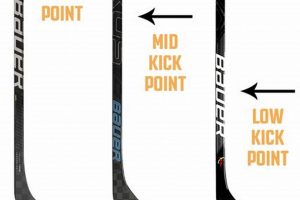
The location of the flex point along the stick shaft, which dictates where the stick bends most readily, is also influenced by length adjustments. Cutting a stick from the top shifts the flex point upwards, potentially altering the release point of shots. Knowing how length adjustments affect the flex point enables players to customize their equipment to match their individual preferences and shooting techniques. The flex point consideration is a key aspect to evaluating the correlation between flex and how to achieve appropriate dimensions.
- Customization and Fine-Tuning
Ultimately, achieving optimal stick performance requires a holistic approach that considers both length and flex. Players may experiment with various combinations to find the precise balance that suits their playing style and physical capabilities. This process often involves iteratively adjusting length and flex, carefully monitoring the impact on on-ice performance. Professional equipment fitting services can provide valuable guidance in navigating the complex interplay between these factors. Accurate initial measurements enable a more refined process.
In conclusion, the correlation between flex and the method to achieve appropriate stick dimensions constitutes a vital consideration. Shortening or lengthening a stick without accounting for the corresponding effect on flex can negatively impact performance. An awareness of this relationship allows players to fine-tune their equipment and optimize their overall on-ice effectiveness. Thus, measurement of stick dimensions must always consider the impact on flex and performance.
5. Personal preference

Individual predilections exert a significant influence on the selection of hockey stick dimensions, overriding standardized measurement guidelines in certain circumstances. While conventional methods provide a starting point, the ultimate determination often reflects a player’s subjective assessment of feel, control, and overall comfort.
- Subjective Comfort and Control
Players often develop preferences based on years of experience, gravitating towards stick lengths that feel most natural and intuitive. This subjective evaluation can override empirically derived measurements. For example, a player with a history of using shorter sticks may continue to favor that length even if recommended measurements suggest otherwise, citing improved puck handling and quicker release as justification. Such personal adaptations highlight the inherent subjectivity in equipment selection.
- Adaptation to Unique Playing Styles
Individual playing styles necessitate personalized equipment choices. A player who relies heavily on close-quarters deking and rapid puck movement may prefer a shorter stick for enhanced maneuverability, irrespective of height-based recommendations. Conversely, a player focused on defensive coverage and long-range passing may opt for a longer stick, prioritizing reach and interception capabilities. Therefore, the ideal stick length becomes an extension of the player’s unique approach to the game, diverging from generalized measurements.
- Impact on Shooting Style and Power
Shooting mechanics and power generation are also subject to individual preference. Some players generate more power with a shorter, stiffer stick, while others prefer a longer, more flexible option. These preferences stem from variations in technique, strength, and body mechanics. The selection process involves an iterative evaluation, where players experiment with different lengths and flexes to determine which combination optimizes their shot velocity and accuracy. This individualized approach underscores the limitations of relying solely on standardized measurement protocols.
- Influence of Habit and Muscle Memory
Habitual use and established muscle memory play a crucial role in determining preferred stick length. Players accustomed to a specific length may experience discomfort and diminished performance when transitioning to a different size, even if that size aligns more closely with recommended measurements. The ingrained motor patterns associated with a particular stick length can be difficult to overcome, leading players to prioritize familiarity and established muscle memory over objective measurement data. The impact of habit underscores the psychological aspect of equipment selection, reinforcing the importance of personal preference.
The multifaceted impact of individual preference on the “how do you measure the length of a hockey stick” highlights the limitations of adhering rigidly to standardized guidelines. While objective measurements provide a valuable starting point, the ultimate determination necessitates considering the subjective factors of comfort, playing style, shooting mechanics, and established habit. The optimal stick dimensions are not solely a function of anthropometric data, but rather a reflection of the player’s unique interaction with the equipment.
6. Skill refinement

The relationship between skill refinement and achieving the correct hockey stick dimensions is a continuous process of adjustment and adaptation. Skill refinement, in this context, refers to the gradual improvement of a player’s technique, puck control, and overall on-ice performance. The feedback derived from using a stick of a specific length informs subsequent adjustments to that length, creating a cyclical process of improvement.
- Enhanced Puck Handling and Stick Adjustment
As a player refines their puck-handling skills, subtle changes in stick length can yield noticeable improvements. A player developing quicker hands may discover that a slightly shorter stick enhances their ability to maneuver the puck in tight spaces, even if previous recommendations suggested a longer option. This adaptation reflects an evolving skillset demanding a different equipment configuration. The player’s skill refines, and equipment dimensions must meet the player’s refined capabilities.
- Shooting Accuracy and Length Modification
Improvements in shooting accuracy often necessitate adjustments to stick length. A player focusing on wrist shots may find that shortening the stick improves their release point and generates more power, while a player emphasizing slap shots may benefit from a longer stick for increased leverage. This adaptation demonstrates how refining specific shooting techniques influences optimal stick dimensions. As the skill improves, there is an adaptation for measurement of the stick for best results.
- Skating Efficiency and Stick Length Correlation
Refining skating stride and technique impacts the ideal stick length. A player who develops a more efficient skating stride may require a longer stick to maintain proper posture and reach without compromising balance. Conversely, a player who adopts a more agile skating style may find a shorter stick provides better maneuverability and quicker transitions. The correlation between skating efficiency and stick length highlights the importance of adapting equipment to accommodate evolving athletic abilities. Equipment and skills are refining hand in hand.
- Positional Play and Incremental Changes
Skill refinement within a specific position may lead to incremental adjustments in stick length. A defenseman improving their poke-checking skills might benefit from a slightly longer stick to disrupt opposing plays more effectively, while a forward honing their net-front presence may prefer a shorter stick for quicker puck retrieval and scoring opportunities. The adaptations reflect how skill refinement within a particular role necessitates a personalized equipment setup.
Skill refinement represents a dynamic process whereby players continually adjust their equipment in response to improvements in technique, skating, and positional play. While standardized measurement guidelines offer a starting point, the ultimate determination of optimal stick dimensions reflects a player’s continuous evaluation and adaptation, creating a symbiotic relationship between skill development and equipment configuration.
Frequently Asked Questions
This section addresses common inquiries regarding hockey stick length, providing definitive information to facilitate informed decision-making.
Question 1: Why is accurate hockey stick length measurement crucial?
Appropriate stick dimensions directly influence on-ice performance, affecting puck control, shooting accuracy, and overall balance. Incorrect length can hinder skill development and increase the risk of injury.
Question 2: What is the baseline method for measuring hockey stick length?
The player stands without skates, and the stick is held vertically with the blade heel on the ground. The top of the stick should ideally reach between the player’s nose and chin. This provides an initial approximation.
Question 3: How do skates impact the hockey stick length measurement?
Skates elevate the player, altering the stance and requiring adjustments to the initial measurement. On-ice assessment with skates is essential to fine-tune the length for optimal posture and reach.
Question 4: How does playing position influence hockey stick length?
Defensemen often benefit from longer sticks for extended reach and defensive coverage, while forwards may prefer shorter sticks for enhanced puck handling. Specific positional requirements necessitate individualized adjustments.
Question 5: What is the relationship between stick length and flex?
Shortening a stick increases its stiffness (flex), and lengthening it reduces stiffness. Adjusting stick length necessitates consideration of flex to maintain consistent shooting performance.
Question 6: How significant is personal preference in determining hockey stick length?
While standardized methods provide a starting point, individual preferences regarding feel, control, and shooting style play a significant role in the final determination. Habitual use and muscle memory also influence preferred length.
Accurate measurements, coupled with consideration of individual factors, facilitate the selection of a stick that optimizes on-ice performance.
The subsequent section will explore best practices for maintaining hockey sticks.
Determining Appropriate Hockey Stick Dimensions
The preceding exploration details the multifaceted approach to achieving appropriate hockey stick dimensions. The process transcends simple linear measurement, incorporating player height, skate influence, positional requirements, flex correlation, personal preference, and skill refinement. Accurately addressing “how do you measure the length of a hockey stick” is critical because it provides a solid foundation. A systematic consideration of these elements optimizes performance and mitigates potential negative impacts stemming from ill-fitting equipment.
The ongoing pursuit of optimal hockey equipment configurations requires diligence and attention to detail. Players and coaches should adopt a comprehensive approach, combining objective measurement techniques with subjective evaluations to achieve the most effective stick dimensions. This commitment to precision ultimately contributes to enhanced player development and improved on-ice success.