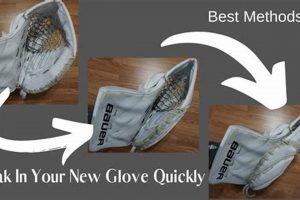
The process of conditioning a new piece of goaltending equipment, specifically the hand covering used for catching pucks, to achieve optimal flexibility and responsiveness is essential. This preparation allows the goaltender to close the glove more easily, secure catches effectively, and react quickly to incoming shots. A poorly conditioned glove can hinder performance, leading to missed catches and increased rebounds.
Properly preparing this piece of equipment is vital for comfort, performance, and injury prevention. A softer, more pliable glove reduces hand fatigue, allowing the goalie to maintain focus and react effectively throughout a game. Historically, goalies have employed various methods, from simple manual manipulation to more advanced techniques, to soften and shape their gloves to their individual preferences. The ultimate goal is to create a customized fit that maximizes the glove’s functionality.
Various approaches can be employed to achieve the desired level of conditioning. These methods range from traditional techniques involving physical manipulation and specialized tools to modern methods that utilize specific products designed to accelerate the softening process. Understanding the benefits and drawbacks of each approach allows goalies to make informed decisions about how to best prepare their gloves for optimal performance on the ice.
Effective Glove Conditioning Methods
The following tips detail proven techniques for optimizing a goaltender’s catching glove. Careful consideration of these methods will contribute to enhanced performance and comfort.
Tip 1: Gradual Manipulation: Consistent, gentle flexing of the glove pocket is recommended. This can be achieved through repeated opening and closing motions, focusing on softening the leather and internal padding over time. Avoid excessive force that could damage the glove’s structure.
Tip 2: Targeted Mallet Use: Employ a specialized mallet to strike the glove’s pocket and palm. This action assists in loosening stiff areas. Apply moderate pressure and monitor the glove’s response to prevent over-softening or damage.
Tip 3: Heat Application (Caution Advised): Use a hairdryer or heat gun on a low setting to apply warmth to the glove’s pocket. This heat can make the leather more pliable. Exercise extreme caution to prevent overheating or scorching, which can compromise the glove’s integrity.
Tip 4: Glove-Specific Conditioners: Apply leather conditioners designed specifically for goaltending gloves. These products help to maintain the leather’s moisture content and prevent cracking. Follow the manufacturer’s instructions for application and frequency.
Tip 5: Puck Impact Simulation: Repeatedly throwing pucks into the glove’s pocket simulates game-like conditions and helps to shape the pocket according to individual catching preferences. Vary the angle and speed of the pucks to ensure comprehensive conditioning.
Tip 6: Proper Storage: Store the glove in a cool, dry place when not in use. Avoid direct sunlight or excessive heat, which can cause the leather to dry out and crack. Use a glove shaper to maintain its form during storage.
By implementing these strategies, goaltenders can effectively prepare their catching gloves, achieving a customized fit and optimized performance. The gradual and consistent application of these methods is crucial to ensure the glove’s longevity and effectiveness.
With a well-conditioned glove, the goaltender is better equipped to handle the demands of the game, contributing to improved confidence and overall performance.
1. Flexibility enhancement

The process of conditioning a goaltender’s glove is significantly reliant on achieving optimal flexibility. This characteristic dictates the ease with which a goalie can close the glove to secure pucks, react to rapidly approaching shots, and maintain hand stamina throughout a game. The enhancement of flexibility is not merely a comfort consideration but a critical performance factor.
- Leather Suppleness
Leather suppleness refers to the pliability of the glove’s exterior material. A stiff, unyielding glove inhibits quick closure, potentially leading to missed catches and rebounds. The application of specialized leather conditioners and controlled manipulation techniques promote the breakdown of rigid fibers, increasing the glove’s ability to conform to the hand’s natural movements. The effect is a quicker, more reliable glove closure, enabling faster reactions.
- Pocket Articulation
Pocket articulation pertains to the range of motion within the glove’s catching area. A deeply articulated pocket allows the goalie to cradle the puck securely, reducing the chances of it popping out upon impact. This can be achieved through targeted flexing and shaping of the pocket using a mallet or similar tool. A well-formed and flexible pocket contributes directly to improved puck retention and reduces the risk of losing control of the rebound.
- Finger Mobility
Finger mobility describes the ease with which the individual fingers within the glove can move. Restricted finger movement hinders the goalie’s ability to adjust the glove’s position to effectively catch pucks deflected off the body or other equipment. Gradual manipulation and specific stretching exercises enhance the finger’s freedom of movement. Enhanced finger mobility allows for more precise adjustments and more secure catches, resulting in fewer missed opportunities.
- Wrist Flexibility
Wrist flexibility allows for the goalie to efficiently rotate and position the glove quickly to make saves. Restricted wrist movement hinders the goalie’s ability to move the glove to block and secure the puck. Gradual manipulation and specific stretching exercises enhance the wrist’s freedom of movement. Enhanced wrist mobility allows for more precise adjustments and more secure catches, resulting in fewer missed opportunities.
In conclusion, flexibility enhancement is not a singular process but a multifaceted approach involving the careful conditioning of various glove components. Each aspect contributes to a more responsive and reliable glove, directly impacting the goaltender’s ability to make saves and control rebounds. The successful execution of these techniques during the initial conditioning phase lays the foundation for optimal glove performance and lasting durability, directly impacting the goalie’s ability to react with speed and precision.
2. Pocket formation

Pocket formation is a critical element within the broader process of preparing a new hockey goalie glove for optimal use. The term refers to the process of shaping and conditioning the glove’s catching area to conform to the goaltender’s individual preferences and playing style. Achieving an effective pocket formation influences puck retention, rebound control, and overall glove performance. The link between pocket formation and the overall glove preparation is one of cause and effect: inadequate attention to pocket formation can lead to inconsistent catching, increased rebounds, and reduced confidence on the ice. In contrast, a well-formed pocket enhances the goalie’s ability to secure pucks cleanly, control rebounds effectively, and react confidently in high-pressure situations.
A practical example of the importance of pocket formation can be seen when comparing two scenarios: a goalie with a properly formed pocket versus one without. The goalie with a well-conditioned pocket will experience pucks naturally settling into the glove, minimizing spin and reducing the likelihood of them popping out. In contrast, a new, unformed pocket may cause pucks to deflect unpredictably, leading to missed catches and increased rebound opportunities for the opposing team. The techniques for achieving effective pocket formation include targeted mallet work, strategic use of heat (with caution), and repeated puck impact simulation. Each method aims to gradually soften and shape the leather and padding within the glove’s catching area.
In summary, pocket formation is not merely a cosmetic adjustment but a functional necessity that directly impacts performance. It is a core component of the overall glove preparation process. The challenges lie in achieving a balance between softening the pocket and maintaining the glove’s structural integrity. By understanding the principles and implementing appropriate techniques, goaltenders can optimize their gloves for maximum effectiveness and protection. This understanding bridges the gap between owning a new glove and wielding a reliable piece of equipment capable of withstanding the rigors of the game.
3. Palm Softening

Palm softening represents a critical stage in the conditioning process for a hockey goaltender’s glove. The pliability of the palm directly influences the goalie’s ability to securely catch and control pucks, absorb impact energy, and maintain a firm grip. Inadequate palm softening can lead to increased stingers, dropped pucks, and a general decrease in catching confidence.
- Impact Absorption Enhancement
A softened palm improves the glove’s capacity to dissipate the force of incoming pucks. Stiff, unyielding palms transmit more energy to the hand, resulting in discomfort or injury. Softening techniques such as mallet work and the application of specialized conditioners, enhance the palm’s cushioning effect. The result is reduced stingers and improved long-term hand health.
- Grip Improvement
A pliable palm allows the goaltender to achieve a more secure grip on the puck. Stiffness can hinder the hand’s ability to conform to the puck’s shape, increasing the likelihood of it popping out. Applying heat carefully and manipulating the palm through repeated flexing helps the glove to mold to the hand, resulting in improved puck retention and enhanced control over rebounds.
- Reduced Closure Force
A softened palm facilitates easier glove closure, allowing the goaltender to react more quickly to shots. Stiffness can require excessive force to close the glove, leading to fatigue and delayed reactions. Gradual flexing and the use of leather conditioners promote a smoother, more natural closure motion, resulting in faster reactions and reduced hand strain.
- Custom Fit Attainment
A properly softened palm allows the glove to conform to the unique contours of the goaltender’s hand. This personalized fit optimizes comfort and control. The proper softening of the glove can occur to the contours and the shape of the goalie hands.
In conclusion, palm softening is not merely a comfort-driven adjustment but a performance-enhancing necessity. The improved impact absorption, grip, closure ease, and customized fit collectively contribute to a more reliable and protective glove, directly impacting the goaltender’s confidence and effectiveness on the ice. A softened palm allows a goaltender to perform to the best of their abilities without any added external or internal stress.
4. Closure ease
The term “Closure ease,” within the context of conditioning a hockey goalie glove, refers to the measure of effort required to close the glove securely around a puck. It is a performance metric influenced directly by the various conditioning techniques applied during the break-in process.
- Impact of Leather Flexibility
Leather flexibility dictates the suppleness of the glove’s material, directly impacting closure ease. A stiff glove requires significant force to close, potentially leading to missed catches and fatigue. Techniques aimed at increasing leather flexibility, such as the application of specialized conditioners, contribute to a more natural and effortless closure.
- Pocket Shape and Depth
The pocket’s shape and depth influence the ease with which the glove can envelop and retain a puck. A properly formed pocket guides the puck towards the center, minimizing the effort needed to close the glove securely. Targeted mallet work and puck impact simulation help shape the pocket to optimize this closure mechanism.
- Padding Compressibility
The compressibility of the padding within the glove affects the required closure force. Dense, unyielding padding resists compression, making it more difficult to achieve a secure closure. Gradual manipulation and strategic heat application (with caution) can soften the padding, improving its compressibility and reducing closure effort.
- Hinge Point Articulation
The hinge point, where the glove folds, must allow for smooth and unrestricted movement. A stiff hinge hinders closure ease. Techniques focused on loosening this area, such as repeated flexing and targeted conditioning, improve articulation and reduce the effort needed to close the glove fully.
Collectively, these facets illustrate that closure ease is not a singular attribute but a culmination of various conditioning factors. Each technique employed during the break-in process contributes to the overall goal of achieving a glove that closes naturally and securely with minimal effort, ultimately enhancing the goaltender’s reaction time and performance.
5. Material conditioning
The phrase “material conditioning,” when applied to the process of breaking in a hockey goalie glove, denotes the methods employed to alter the physical properties of the glove’s constituent materials, primarily leather and internal padding. The objective is to optimize flexibility, impact absorption, and overall comfort, thereby enhancing the glove’s performance and longevity. A direct cause-and-effect relationship exists between the quality of material conditioning and the subsequent performance of the glove; inadequate conditioning can lead to stiffness, reduced protection, and premature wear, while effective conditioning promotes a more responsive, comfortable, and durable piece of equipment.
Material conditioning techniques encompass a range of approaches, from the application of specialized leather treatments to physical manipulation. Leather conditioners work to maintain the material’s natural moisture content, preventing it from becoming brittle and prone to cracking. Physical manipulation, such as targeted mallet strikes and repeated flexing, helps to break down stiff fibers and encourage a more pliable structure. In practice, consider two identical new gloves: one meticulously treated with leather conditioner and properly flexed, and another left untreated. The conditioned glove will exhibit a softer, more responsive feel, allowing for easier closure and improved puck retention, whereas the untreated glove will remain rigid and less forgiving.
Understanding the principles of material conditioning holds practical significance for both amateur and professional goaltenders. It enables goalies to maximize their equipment investment, ensuring that their gloves perform optimally and withstand the rigors of repeated use. While proper conditioning will not compensate for inherent design flaws, it can significantly enhance the performance and lifespan of a well-constructed glove. The key challenge lies in achieving a balance, avoiding over-softening, which can compromise structural integrity, and under-conditioning, which leaves the glove inadequately prepared for game-day demands. Material conditioning becomes a core component to the success for “hockey goalie glove break in”.
6. Custom fit

The achievement of a custom fit is a primary objective within the process of preparing a hockey goalie glove for optimal performance. The phrase denotes the adaptation of the glove’s shape and feel to the unique contours of the goaltender’s hand, thereby maximizing comfort, control, and responsiveness. The significance of a custom fit stems from its direct impact on a goalie’s ability to react quickly, securely catch pucks, and maintain stamina throughout a game. A glove that does not conform properly can lead to discomfort, restricted movement, and compromised performance.
Consider two scenarios: a goalie wearing a glove with a generic, unadjusted fit, and another wearing a glove meticulously shaped to their hand. The first goalie may experience slippage, pressure points, and difficulty closing the glove securely. This lack of precise fit can translate to missed catches, increased rebounds, and a loss of confidence. Conversely, the second goalie benefits from a glove that feels like a natural extension of their hand, allowing for fluid movements, a secure grip, and enhanced control. The techniques used to achieve a custom fit range from simple adjustments like tightening straps to more involved methods such as heat molding and strategic padding adjustments. The goal is to eliminate any gaps or pressure points, ensuring that the glove conforms snugly without restricting movement.
The pursuit of a custom fit within the break-in process is not merely a luxury but a functional imperative. The ultimate outcome should be a glove that enhances the goaltender’s performance, protects their hand, and allows them to react instinctively. Challenges remain in achieving a precise fit without compromising the glove’s structural integrity or protective qualities. Understanding the principles and techniques of custom fitting empowers goalies to optimize their equipment and perform at their best, linking directly to improved outcomes on the ice. This custom fit connects to the overall theme of “hockey goalie glove break in”.
7. Impact absorption
The capacity of a hockey goalie glove to effectively absorb impact is fundamentally linked to the conditioning process. Proper break-in techniques directly influence the glove’s ability to dissipate energy from incoming pucks, mitigating the risk of injury and enhancing the goalie’s control.
- Padding Compressibility
The compressibility of the glove’s internal padding is crucial for effective impact absorption. During the conditioning phase, repeated manipulation and targeted mallet work soften the padding, allowing it to compress more readily upon impact. This increased compressibility reduces the amount of force transmitted to the goaltender’s hand. For example, a new, unconditioned glove with stiff padding may result in a painful stinger when catching a hard shot, whereas a well-conditioned glove with softened padding will absorb much of the impact, minimizing discomfort and potential injury.
- Leather Flexibility and Energy Dissipation
The flexibility of the glove’s leather shell contributes to its ability to dissipate energy. Stiff, unyielding leather transmits impact force directly to the hand. Conditioning methods, such as the application of specialized leather treatments and controlled flexing, enhance the leather’s pliability. This allows the glove to flex and distribute the force of the impact across a wider area, reducing the concentration of energy on any single point. Consider a scenario where a goalie catches a puck off the edge of an unconditioned glove; the resulting impact can be jarring. In contrast, a conditioned glove, with its flexible leather, will bend and absorb more of the energy, resulting in a less severe impact.
- Pocket Formation and Puck Retention
The formation of a deep, well-shaped pocket is essential for secure puck retention and enhanced impact absorption. A properly formed pocket allows the puck to settle securely within the glove, minimizing spin and preventing it from popping out upon impact. Furthermore, the pocket acts as a cushion, absorbing energy and reducing the likelihood of the puck deflecting unpredictably. Goalies must develop the pocket to fully embrace the puck and reduce long rebounds.
- Proper Fit and Glove Stability
A custom fit ensures the glove remains stable and securely positioned on the goaltender’s hand during impact. A loose or ill-fitting glove can shift upon impact, compromising its protective capabilities and increasing the risk of injury. The glove must fit the shape of the hand well so goalies can make acrobatic or reactionary saves.
Effective conditioning techniques not only improve impact absorption but also contribute to the long-term durability of the glove. Softening and flexing the materials prevent them from becoming brittle and prone to cracking, ensuring that the glove continues to provide optimal protection throughout its lifespan. The break in improves padding, leather, flexibility, and glove stability, giving the goalie maximum chance to preform at their optimal level.
Frequently Asked Questions
The following section addresses common inquiries regarding the proper conditioning of a goaltender’s catching glove, providing clear and concise answers to ensure optimal performance and longevity.
Question 1: Is it necessary to condition a new hockey goalie glove?
Yes. Conditioning enhances flexibility, improves pocket formation, and optimizes impact absorption, resulting in improved performance and reduced risk of injury. The glove should not be used in gameplay before the glove is fully conditioned.
Question 2: What are the risks of not properly preparing a new glove?
Failure to properly condition the glove can result in stiffness, restricted movement, difficulty closing the glove, increased stingers, and premature wear. Also improper conditioning can lead to serious injury that could be avoided.
Question 3: How long does the glove conditioning process typically take?
The duration varies depending on the chosen methods and the glove’s initial stiffness, but it typically ranges from several days to several weeks of consistent effort.
Question 4: Can excessive force or heat damage the glove during the conditioning process?
Yes. Excessive force can compromise the glove’s structural integrity, while excessive heat can damage the leather and padding. Gradual and controlled techniques are recommended.
Question 5: What are some signs that a glove is adequately conditioned?
Signs of proper conditioning include increased flexibility, a well-formed pocket, a softened palm, and ease of closure. A visual and physical examination are best to see the current state of the glove.
Question 6: Are there specialized products designed to assist in the glove conditioning process?
Yes. Leather conditioners, glove mallets, and glove shapers are available to aid in the conditioning process. All goalie glove conditioning products come with instructions for safe and proper use.
The careful and consistent application of appropriate techniques is crucial for achieving a well-conditioned glove, ensuring optimal performance and protection for the goaltender.
The next section will explore advanced conditioning techniques and maintenance strategies for experienced goaltenders.
Conclusion
The comprehensive exploration of “hockey goalie glove break in” reveals a critical process for optimizing goaltending equipment. Proper conditioning techniques, encompassing flexibility enhancement, pocket formation, palm softening, and material conditioning, contribute significantly to improved performance and protection. The attainment of a custom fit and enhanced impact absorption are paramount, ultimately leading to a more responsive and reliable glove.
Commitment to diligent glove maintenance and appropriate conditioning practices is essential for all goaltenders. By embracing these strategies, athletes can maximize their equipment investment, reduce the risk of injury, and elevate their performance on the ice. The dedicated pursuit of effective glove preparation represents a critical step towards achieving peak goaltending proficiency.
![Best Hockey Goalie Hats: [Brand] & More! | Your Ultimate Source for Hockey Updates, Training Guides, and Equipment Recommendations](https://ssachockey.com/wp-content/uploads/2026/02/th-262-300x200.jpg "Best Hockey Goalie Hats: [Brand] & More! Your Ultimate Source for Hockey Updates, Training Guides, and Equipment Recommendations")