The manner in which an athlete holds the stick significantly impacts performance in field hockey. This hand placement and pressure distribution are crucial for executing fundamental skills such as dribbling, passing, and shooting. Improper hand positioning can lead to decreased ball control and inaccurate execution of plays.
Optimal hand placement enables power generation, precision, and control. Historically, subtle variations in hand positions have been adapted to suit diverse playing styles and tactical approaches. A secure and functional hold facilitates quick reactions and adaptability in dynamic game situations. Consistent execution, enhanced ball manipulation, and injury prevention are direct benefits.
The subsequent sections will delve into the specifics of different hand positions, their respective advantages, and techniques for developing a secure and effective method for stick handling. Furthermore, the influence of stick selection and individual player preference will be examined.
Grip Optimization Strategies
The following recommendations are designed to enhance control and effectiveness during field hockey gameplay by optimizing the hand-to-stick connection.
Tip 1: Hand Separation. Maintain a separation of approximately one hand’s width between the hands on the stick. This spacing allows for a balance of power and finesse in stick work.
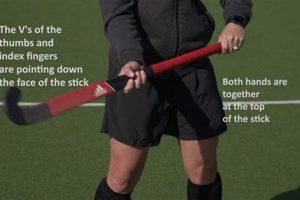
Tip 2: V-Grip Orientation. Observe the “V” formed by the thumb and forefinger of each hand. This “V” should generally align with the top edge of the stick for optimal control during flat hits and pushes.
Tip 3: Top-Hand Pressure Modulation. The top hand should exert a firm, but not rigid, grip. Excessive pressure can restrict wrist movement and hinder delicate ball handling.
Tip 4: Bottom-Hand Role. The bottom hand serves as a guide and pivot point. It should remain relatively relaxed, allowing the top hand to dictate the power and direction of the swing or push.
Tip 5: Dynamic Adjustment. Recognize that the precise hand positioning might need to adapt situationally. For instance, a slightly lower bottom-hand placement can enhance control during close dribbling.
Tip 6: Consistent Practice. Regular drills focusing on the fundamental skills will reinforce correct muscle memory and improve the consistency of the hand placement.
Tip 7: Stick Selection. Ensure the stick length is appropriate. An improperly sized stick can necessitate unnatural hand positioning and compromise performance.
Adherence to these strategies will enhance stick control, improve striking power, and contribute to a more consistent and effective style of play.
The article will now proceed to address the common errors in hand placement and their potential corrective measures.
1. Hand Separation
Hand separation, the distance maintained between the hands on the stick, is a crucial element of a functional hand placement technique. It directly influences stick handling ability, power generation, and overall control. Varying the separation affects leverage, range of motion, and ultimately, the effectiveness of different skills.
- Power Generation and Swing Mechanics
Increased separation generally allows for a wider swing arc, facilitating greater acceleration of the stick head and a more forceful impact with the ball. This is particularly relevant in situations requiring long passes or powerful shots on goal. However, excessive separation can compromise control, especially when executing quick, deceptive movements.
- Fine Motor Control and Dribbling
Reduced separation, conversely, enhances fine motor control and facilitates close dribbling. The proximity of the hands allows for rapid adjustments and subtle stick movements, enabling precise ball manipulation in confined spaces. This configuration is advantageous when navigating tight defenses or executing intricate passing sequences.
- Balance and Stability
The distance between the hands impacts the player’s overall balance and stability during play. A wider stance combined with appropriate hand separation can provide a more stable base, allowing the player to absorb contact and maintain control during physical challenges. Conversely, a narrower stance and hand position may prioritize agility and quick changes of direction.
- Adaptability and Skill-Specific Adjustments
Optimal hand separation is not static; it requires dynamic adjustment based on the specific skill being executed. For example, a player might widen the separation for a powerful hit and then quickly narrow it for a controlled pass or dribbling maneuver. This adaptability demonstrates a mastery of stick handling and reflects an understanding of the interplay between hand placement and skill execution.
In conclusion, hand separation is not merely an arbitrary dimension. Instead, it is a dynamic and critical factor that directly affects a players ability to control the stick, generate power, and execute skills effectively. Optimizing this separation requires a nuanced understanding of its impact on different aspects of the game and the ability to adapt accordingly.
2. Top Hand Pressure
The pressure exerted by the upper hand on the stick is a critical determinant of control, power, and finesse in field hockey. It directly influences the ability to execute various skills effectively and consistently, and therefore its proper management is paramount to effective stick work. Excessive or insufficient pressure can hinder performance, leading to errors in ball control and reduced striking power.
- Control and Accuracy
Appropriate top-hand pressure facilitates precise ball control. Too much pressure restricts wrist movement, inhibiting subtle adjustments necessary for dribbling and passing. Insufficient pressure results in a loss of connection with the stick, reducing accuracy. Players must find a balance that allows for both firm control and responsive handling.
- Power Generation
The upper hand is the primary driver of power during striking motions. A firm, but not rigid, grip allows for optimal transfer of force from the body to the stick. However, clenching the stick restricts the fluidity of the swing, diminishing potential power. Controlled pressure enables the generation of maximum velocity without sacrificing control.
- Shock Absorption and Vibration Dampening
During impact with the ball or ground, the top hand plays a role in absorbing shock and dampening vibrations. Proper pressure allows the hand to act as a buffer, reducing strain on the wrists and elbows. A loose, uncontrolled grip offers minimal protection, increasing the risk of injury and discomfort.
- Adaptation to Game Situations
Optimal top hand pressure can change dynamically based on the circumstance. When performing flat hits or other power shots, a firmer hand hold will improve velocity and range. Close dribbling or receiving requires more gentle contact and responsive adjustment to increase control.
In conclusion, the degree of pressure exerted by the top hand is an integral component of the overall holding technique. Mastery of this aspect allows players to maximize control, generate power efficiently, and adapt to the dynamic demands of the game.
3. Bottom Hand Control

The lower hand’s function as a control point within the complete hand placement construct profoundly impacts stick work execution. The placement and pressure exerted by this hand directly affect a player’s ability to guide the stick, maintain balance, and execute precise movements. Without adequate lower hand control, power generated by the upper hand becomes difficult to modulate, resulting in inaccurate passes, uncontrolled dribbling, and ineffective shots. For example, when executing a controlled push pass, subtle adjustments in lower hand pressure and positioning dictate the direction and velocity of the ball, ensuring accurate delivery to a teammate. Conversely, a rigid or improperly positioned lower hand impedes these adjustments, leading to misdirected passes and lost opportunities.
Further demonstrating its significance, the lower hand acts as a fulcrum during drag-flicking. As the upper hand initiates the flicking motion, the lower hand maintains stability and guides the stick along the desired trajectory. Minor adjustments in lower hand positioning can significantly alter the trajectory and spin of the ball, adding deception and increasing the chances of scoring. Similarly, when defending, a secure lower hand grip enables quick reactions and precise stick movements to intercept passes or dispossess opponents. Loss of control here can result in defensive breakdowns and scoring opportunities for the opposing team. The bottom hand plays a pivotal role in stabilizing stick work that is difficult to control when performing one-handed actions.
In summary, the effectiveness of the field hockey hold hinges on the lower hand’s ability to provide control and stability. It facilitates precise movements, modulates power, and enables quick reactions. Mastering this aspect of the technique requires consistent practice and a keen awareness of how subtle adjustments in lower hand positioning affect overall performance. Overlooking this critical component undermines the potential benefits of a strong upper-hand grip and compromises a player’s ability to execute skills effectively. Effective implementation of the bottom hand is necessary for success.
4. "V" Hand Alignment

The orientation of the hands, specifically the “V” formed by the thumb and forefinger on each hand, is a critical aspect of an effective field hockey hold. Proper alignment of these “V” shapes significantly influences stick control, power transfer, and directional accuracy, impacting overall performance.
- Directional Control and Accuracy
The alignment of the “V” shapes, typically oriented along the top edge of the stick, directly correlates with the direction of the shot or pass. A consistent “V” orientation promotes predictable ball contact and minimizes deviations from the intended target. Deviations from this alignment can result in errant shots and decreased passing accuracy.
- Power Transfer and Efficiency
Proper hand alignment optimizes the transfer of power from the body to the stick and, ultimately, to the ball. Misalignment can lead to inefficient power transfer, reducing the force and velocity of shots. By ensuring the “V” shapes are properly oriented, players can maximize the impact of their swing and generate greater power with less effort.
- Wrist Flexibility and Range of Motion
Correct “V” alignment allows for a greater range of wrist motion, enabling more subtle and controlled stick movements. This enhanced flexibility is crucial for executing intricate dribbling maneuvers and adjusting to rapidly changing game situations. Restricted wrist movement, caused by improper alignment, limits a player’s ability to react and adapt effectively.
- Grip Consistency and Muscle Memory
Maintaining consistent “V” alignment promotes the development of muscle memory, allowing players to instinctively adopt the correct hand positioning. This consistency reduces the need for conscious adjustments during gameplay, enabling faster reactions and more fluid movements. Inconsistent alignment, conversely, can lead to hesitation and errors, hindering performance under pressure.
The “V” Hand Alignment is therefore an integral part of a secure and effective field hockey hold. Players who consciously focus on maintaining the correct orientation of their hands will experience improved control, power, and accuracy, ultimately enhancing their overall performance on the field. It’s the detail that differentiates an effective hold from a standard, error ridden practice.
5. Dynamic Adjustments

Dynamic adjustments, modifications to the basic hand placement during play, are integral to maximizing the efficacy of the stick in field hockey. These adaptations, implemented in response to varying game situations, leverage the fundamental principles of secure hand positioning to optimize ball control, power generation, and maneuverability.
- Response to Ball Trajectory and Height
Subtle shifts in hand positioning are frequently required to address incoming balls at different heights and angles. A lower bottom hand can facilitate scooping a ball off the ground, while a slight upward shift of both hands might be necessary to receive an aerial pass. The grip must adapt fluidly to maintain control, preventing the ball from bouncing away upon contact. Failure to dynamically adjust results in missed receptions and turnovers.
- Adaptation for Different Skill Execution
Specific skills demand modifications to the standard placement. The drag flick, for example, often involves a near overlapping grip to maximize wrist rotation and generate velocity. Similarly, a more separated placement might be adopted for powerful flat hits, prioritizing force over fine control. Predefined placement inhibits the expression of skill and power.
- Accommodation of Defensive Pressure
Under pressure from opposing players, adjustments to the hand position can enhance ball protection and maneuverability. Shortening the separation between the hands, or adopting a tighter placement, can facilitate quicker stick movements and enable tighter control in confined spaces. A static placement increases vulnerability and the likelihood of losing possession.
- Compensation for Fatigue and Injury
As the game progresses, fatigue can compromise technique. Minor adjustments to hand pressure or positioning might be unconsciously implemented to compensate for decreased strength and maintain control. Similarly, players may adapt their placements to avoid exacerbating existing injuries. Adaptive compensation maintains function.
These dynamic adjustments, while often subtle and instinctive, are the hallmark of skilled field hockey players. Proficiency in executing these adaptations, built upon a solid foundation of proper hand placement, distinguishes proficient players, enabling them to respond effectively to the ever-changing demands of the game.
6. Stick Fit
The appropriateness of a field hockey stick, termed “stick fit,” is inextricably linked to the effectiveness of the hand placement technique. A poorly fitted stick can undermine even the most technically sound technique, while a correctly sized stick enhances control, power, and overall performance.
- Stick Length and Posture
The length of the stick directly affects a player’s posture and hand position. A stick that is too long forces the player to stoop, altering the angle of the back and compromising the ability to maintain a proper hold. Conversely, a stick that is too short compels the player to stand too upright, reducing leverage and control. The ideal stick length allows the player to maintain a comfortable, athletic stance with a natural hand position.
- Grip Size and Hand Comfort
The circumference of the stick’s handle, or the grip size, influences hand comfort and security. A grip that is too small can feel insecure and lead to over-gripping, causing fatigue and reduced control. A grip that is too large can hinder finger dexterity and limit the ability to make subtle adjustments. The optimal grip size allows the player to maintain a relaxed yet firm grasp on the stick, promoting tactile feedback and responsiveness.
- Stick Weight and Balance
The weight and balance point of the stick affect its maneuverability and responsiveness. A stick that is too heavy can impede quick stick movements and increase fatigue. A stick that is unbalanced can feel unwieldy and compromise the ability to execute precise passes and shots. A balanced stick with an appropriate weight distribution enhances control and allows for quicker reactions.
- Material Composition and Feel
The material composition of the stick impacts its overall feel and responsiveness. Different materials, such as wood, composite, and carbon fiber, offer varying degrees of stiffness and shock absorption. The optimal material composition provides a balance of feel and performance, allowing the player to confidently execute all necessary skills. The hand placement is impacted by the vibrations of various materials, affecting a players sensitivity.
These aspects of stick fit are not merely matters of preference but are fundamental to achieving a sound holding technique. Players should prioritize finding a stick that complements their individual physical characteristics and playing style, as this contributes directly to the security, comfort, and effectiveness of the chosen method for stick work. Therefore, proper stick selection is an inseparable component of mastering secure technique.
7. Consistent Practice

The cultivation of an effective field hockey technique is intrinsically linked to consistent practice. Repetitive drills, focused on reinforcing proper hand placement, engrain the desired muscle memory necessary for fluid and instinctive execution during gameplay. In the absence of regular, structured practice, the hand placement degrades over time, leading to decreased ball control, reduced power, and compromised accuracy. The development of a high-level technique is a direct result of consistent effort, not innate talent alone.
The integration of specific exercises targeting the different skill-based hand placements accelerates the learning process. For example, dedicating time to drills that emphasize the “V” hold alignment while performing push passes will reinforce correct hand positioning and enhance passing accuracy. Similarly, repeated practice of drag-flicking, focusing on the lower hand’s stabilizing role, develops the necessary control and finesse for this advanced skill. Elite players demonstrate countless hours spent refining these fundamental elements, resulting in their superior performance.
Consistent practice serves not only to solidify correct positioning but also to identify and correct subtle errors that may go unnoticed during casual play. Video analysis, combined with expert coaching feedback, can provide valuable insights into inefficiencies in hand placement, allowing for targeted interventions and technique refinement. Ultimately, it is the commitment to disciplined and consistent training that separates proficient players from those who struggle to achieve their full potential in the sport. Consistent practice ensures consistent play.
Frequently Asked Questions
The subsequent section addresses common inquiries and misconceptions regarding the technique and its impact on gameplay.
Question 1: What constitutes proper hand separation on a field hockey stick?
The optimal distance between the hands typically approximates one hand’s width. This spacing facilitates a balance between power generation for striking and fine motor control for dribbling. Individual preferences and specific skill requirements may necessitate slight variations. Over or under separation will compromise form.
Question 2: How does top-hand pressure affect ball control?
Excessive pressure restricts wrist movement, inhibiting the execution of subtle stick adjustments required for close ball control. Insufficient pressure results in a loss of connection with the stick, reducing accuracy. A firm, yet flexible grip provides the best results. There is no ideal pressure, other than what works best for ball control.
Question 3: What role does the bottom hand play in stick handling?
The lower hand primarily functions as a guide and control point, influencing the stick’s trajectory and stability. It facilitates quick reactions and precise movements, particularly during dribbling and defensive plays. Stability and support is the main function of bottom hand during practice.
Question 4: Why is correct V hand alignment important?
Proper “V” alignment, where the “V” formed by the thumb and forefinger points towards the top edge of the stick, promotes directional accuracy and efficient power transfer. Deviations can result in inconsistent ball contact and reduced shot effectiveness. Proper “V” ensures accurate shots.
Question 5: Can the placement technique be dynamically adjusted during play?
Yes, subtle adaptations to the hand placements are often necessary to respond to varying game situations. These adjustments might involve altering the space between the hands, modifying hand pressure, or adjusting hand height to accommodate different ball heights and angles. A good technique requires the ability to adjust placements during gameplay.
Question 6: How does stick fit influence placement?
An appropriately sized stick allows the player to maintain a comfortable, athletic stance with a natural hand position. A stick that is too long or too short can compromise posture, reduce leverage, and negatively impact overall technique. Appropriate stick fit is a must for proper technique to develop.
Mastery of hand placement is a continuous process that demands dedication and refinement. This technique can make or break a player.
The article will now transition to a discussion of common errors and their potential corrections.
Conclusion
This exploration has detailed the multifaceted nature of hand placement, underlining its critical role in executing fundamental skills and maximizing overall performance. Emphasis has been placed on hand separation, pressure modulation, V-hand alignment, dynamic adjustments, and the indispensable connection between stick fit and effective performance. These elements collectively dictate control, power, and accuracy, significantly impacting a player’s ability to excel. Consistent practice and a nuanced understanding of these principles are paramount.
Achieving mastery of technique demands a continuous commitment to refinement and adaptation. The intricacies of execution, though often subtle, represent the difference between proficiency and mediocrity. It is through diligent application and unwavering focus on these fundamental tenets that athletes unlock their full potential, transforming competence into exceptional performance on the field.
![Top Osaka Field Hockey Bag [Gear Guide] | Your Ultimate Source for Hockey Updates, Training Guides, and Equipment Recommendations](https://ssachockey.com/wp-content/uploads/2026/05/th-44-300x200.jpg "Top Osaka Field Hockey Bag [Gear Guide] Your Ultimate Source for Hockey Updates, Training Guides, and Equipment Recommendations")
![Randolph-Macon Field Hockey: [Adjective] Performance & Legacy | Your Ultimate Source for Hockey Updates, Training Guides, and Equipment Recommendations](https://ssachockey.com/wp-content/uploads/2026/05/th-40-300x200.jpg "Randolph-Macon Field Hockey: [Adjective] Performance & Legacy Your Ultimate Source for Hockey Updates, Training Guides, and Equipment Recommendations")