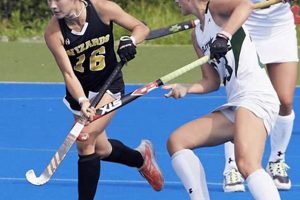
Structured activities designed to improve defensive capabilities in field hockey are crucial for team success. These exercises focus on honing individual skills like tackling, intercepting, and marking, while also developing collective defensive strategies such as pressing, zonal defense, and communication. A well-executed example involves players practicing their stance and stick positioning to effectively block passing lanes and pressure opposing forwards.
The importance of focused defensive training cannot be overstated. Strong defensive play provides a foundation for offensive opportunities, minimizing the opponent’s scoring chances and allowing for quick transitions from defense to attack. Historically, teams renowned for their defensive prowess have consistently achieved significant victories, demonstrating the value of a disciplined and well-organized back line. Effective training regimens enhance players’ anticipation, decision-making, and overall tactical awareness.
The subsequent sections will detail specific exercises targeting core defensive skills. These include tackling techniques, positional play, and set-piece defense. The goal is to provide a structured approach to improve and maintain a solid defensive line.
Enhancing Defensive Performance
The following guidelines provide a framework for optimizing defensive strategies within the context of field hockey. Strict adherence to these principles is paramount for achieving defensive solidity and tactical advantage.
Tip 1: Emphasize Fundamental Tackling Technique: Players must prioritize mastering the jab tackle and block tackle. Repeated drills focusing on proper footwork, low body positioning, and controlled stick placement will significantly improve tackling success rate. Improper technique leads to fouls and scoring opportunities for the opposition.
Tip 2: Reinforce Positional Discipline: Maintain a structured defensive formation. Players should understand their designated zones and responsibilities. Constant shuffling to provide cover and support for teammates is crucial. Avoid unnecessary deviations from the prescribed structure.
Tip 3: Develop Interception Skills: Anticipating passes and effectively intercepting the ball disrupts the opponent’s attack and creates counter-attacking opportunities. Regular drills involving reading the play and intercepting passes at different angles are essential.
Tip 4: Implement an Effective Pressing System: A coordinated pressing strategy forces turnovers and limits the opponent’s time and space. Drills should focus on synchronized movement, communication, and controlled aggression. Ineffective pressing can leave gaps in the defense and create vulnerabilities.
Tip 5: Optimize Defensive Communication: Clear and concise communication is vital for coordinating defensive actions. Players must call out marks, warn of impending threats, and direct teammates into optimal positions. Establish a standardized system of verbal and non-verbal signals.
Tip 6: Practice Set-Piece Defense: Corner defense and free-hit defense require specialized training. Players must be assigned specific roles and responsibilities, and drills should replicate realistic game scenarios. Failure to adequately prepare for set-pieces can result in easily preventable goals.
Tip 7: Enhance Physical Conditioning: Agility, speed, and stamina are crucial for maintaining defensive intensity throughout the game. Incorporate interval training and agility drills into the training regimen. Fatigue leads to diminished concentration and poor decision-making.
The diligent application of these guidelines will contribute significantly to the enhancement of team defensive performance and overall competitive advantage. Consistent practice and adherence to these principles are non-negotiable for achieving defensive excellence.
The subsequent section will examine common pitfalls in defensive play and strategies for addressing them.
1. Tackling Technique
Tackling technique forms a fundamental component of effective field hockey defence drills. These drills aim to instill proper tackling form to dispossess opponents while minimizing the risk of fouls or injuries. The effectiveness of a defensive unit is directly correlated with the players’ ability to execute clean, decisive tackles. Inadequate tackling skills lead to increased opposition possession, scoring opportunities, and potential disciplinary consequences. For instance, a defender who consistently mistimes tackles concedes penalty corners, placing the team at a significant disadvantage.
Specific drills focus on various aspects of tackling, including the jab tackle, block tackle, and reverse tackle. These exercises involve repetitive practice of footwork, stick positioning, and timing. Video analysis often complements these drills, providing visual feedback and allowing players to identify and correct technical flaws. The integration of tackling technique into defence drills ensures that players not only understand the theoretical principles but also develop the muscle memory necessary for consistent execution under pressure.
In summary, tackling technique is an indispensable element of comprehensive field hockey defence drills. Its mastery directly influences a team’s defensive solidity and overall performance. Challenges in improving tackling skills often stem from inconsistent practice or a lack of individualized coaching. Consistent and focused training, coupled with detailed feedback, is essential for developing proficient and reliable tacklers.
2. Positional Awareness

Positional awareness constitutes a critical component of effective field hockey defence drills. It dictates a player’s understanding of their location on the field relative to teammates, opponents, and the ball. The direct consequence of deficient positional sense is a compromised defensive structure, leaving gaps for attacking players to exploit. A well-drilled defensive unit exhibits synchronized movement, ensuring consistent coverage and minimizing vulnerabilities. Real-life examples abound where teams with strong positional discipline consistently nullify offensive threats, forcing errors and creating turnover opportunities. Positional awareness, therefore, is not merely a theoretical concept but a practical skill honed through repetitive drills and tactical instruction.
Defence drills specifically designed to enhance positional awareness include zonal marking exercises, where players practice defending designated areas of the field, and recovery drills, which focus on regaining optimal positioning after a defensive breakdown. Furthermore, drills incorporating passing patterns require defenders to anticipate opponent movements and adjust their positioning accordingly. Game-simulation scenarios further refine positional judgment, forcing players to make rapid decisions under pressure. The practical application extends beyond set plays; during open play, effective positioning enables defenders to intercept passes, force opponents wide, and prevent dangerous crosses into the circle.
In summary, positional awareness is inextricably linked to the success of field hockey defence drills. Its development necessitates a multi-faceted approach incorporating structured exercises, tactical analysis, and practical game application. Challenges in improving positional awareness often stem from a lack of focus during training or an inadequate understanding of tactical principles. Consistent reinforcement of positional responsibilities and detailed feedback on player movement are crucial for cultivating a cohesive and resilient defensive unit.
3. Interception Practice
Interception practice forms a vital element within comprehensive field hockey defence drills. This specialized training concentrates on developing a defender’s ability to anticipate opponent passes, react swiftly, and secure possession of the ball. Effective interception skills disrupt offensive plays, transition defence into attack, and provide the team with critical turnover opportunities. Real-world examples demonstrate the impact; a well-timed interception in the midfield can immediately launch a counter-attack, placing the opposition’s defense under pressure. The significance of interception practice is therefore clear: it directly influences a team’s capacity to control the flow of the game and generate scoring chances.
Specific interception drills frequently involve simulating various passing scenarios, including cross-field passes, through-balls, and aerial passes. Players are trained to read the body language of the passer, anticipate the trajectory of the ball, and position themselves to make a clean interception. Emphasis is placed on both the technical execution of the interception and the immediate follow-up action, such as distributing the ball quickly to a teammate. These drills also incorporate elements of pressure, forcing defenders to make split-second decisions under realistic game conditions. Moreover, they are used to sharpen the decision-making of players during the play.
In conclusion, interception practice stands as a cornerstone of effective field hockey defence drills. The ability to consistently intercept passes not only strengthens a team’s defensive capabilities but also contributes significantly to its offensive potential. Challenges in mastering interception skills often arise from a lack of focus on anticipation and reaction time. Ongoing training, incorporating realistic game scenarios and targeted feedback, is essential for cultivating a defensive unit adept at turning interceptions into scoring opportunities.
4. Pressing Coordination
Pressing coordination represents a sophisticated tactical element within field hockey defence drills. It involves the synchronized application of pressure by multiple players to regain possession of the ball in the opponent’s half. The successful execution of a coordinated press disrupts the opposition’s build-up play, forces turnovers in advantageous positions, and creates scoring opportunities. A poorly coordinated press, however, can leave gaps in the defense, making teams vulnerable to counter-attacks.
- Trigger Identification and Initiation
The activation of a coordinated press relies on recognizing specific triggers, such as a weak pass, a hesitant dribble, or a player receiving the ball in a closed body position. The designated pressing player initiates the movement, signaling teammates to join the coordinated effort. Without clear triggers, the press becomes disjointed and ineffective, allowing the opposition to bypass the defensive pressure with relative ease.
- Angle of Approach and Defensive Lines
The angle of approach by the pressing players is paramount. Players must cut off passing lanes while simultaneously applying pressure to the ball carrier. Subsequent defensive lines must shift in unison to support the initial press and prevent the opposition from finding open space. If the angles are not precise, players can be easily played through, undermining the entire strategy.
- Communication and Rotation
Effective pressing coordination depends on clear and concise communication between players. Verbal cues indicate who is pressing, which passing lanes to cut off, and when to rotate positions. Rotations maintain defensive stability while sustaining pressure on the ball. A silent and static defensive line fails to adjust to the flow of the game and becomes easily exploited.
- Sustained Pressure and Recovery
A coordinated press must be sustained for a specific duration to force errors. If the initial press is unsuccessful, players must quickly recover to their defensive positions to prevent a counter-attack. Lack of stamina or poor decision-making during the recovery phase negates the benefits of the initial pressing effort and leaves the team exposed.
The successful integration of pressing coordination into field hockey defence drills requires meticulous planning, repeated practice, and clear communication. The interplay of these facets is essential for transforming a collection of individual defenders into a cohesive and effective pressing unit. Teams that master pressing coordination gain a significant tactical advantage, dictating the tempo of the game and creating scoring chances through turnovers in dangerous areas.
5. Communication Protocols
Effective communication protocols are integral to successful execution of field hockey defence drills. These protocols establish standardized verbal and non-verbal cues that enable defenders to coordinate their movements, anticipate opponent actions, and maintain a cohesive defensive structure. The absence of clear communication frameworks within defence drills leads to miscommunication, delayed reactions, and ultimately, a breakdown of the defensive line. A team employing well-defined protocols, such as calling out player assignments (“Man on!”), relaying directional movement (“Push right!”), or signalling zone coverage (“Zone left!”), exhibits enhanced synchronization and reduced susceptibility to offensive maneuvers. For instance, during a penalty corner defense, pre-determined verbal cues regarding player positioning and anticipated shot direction are essential for executing a coordinated block.
The practical application of communication protocols extends beyond set-piece situations. During open play, defenders must constantly communicate to maintain spatial awareness, provide cover for teammates, and identify potential threats. These real-time communication exchanges, honed through specific drills that simulate game scenarios, enable a fluid and responsive defensive unit. Drills focusing on transitioning from attack to defense necessitate clearly defined verbal cues to trigger immediate defensive realignment and prevent counter-attacks. Furthermore, non-verbal communication, such as hand signals indicating player marking or positional adjustments, supplements verbal cues and enhances overall communication efficiency, particularly in high-pressure situations.
In summary, communication protocols form a non-negotiable element of effective field hockey defence drills. Their systematic integration into training regimes fosters a cohesive defensive unit capable of anticipating and reacting to dynamic game situations. Challenges to developing robust communication protocols often arise from player unfamiliarity with the designated cues or a lack of consistent reinforcement during training. Regular drills emphasizing the importance of clear, concise, and timely communication, coupled with constructive feedback, are essential for cultivating a resilient and synchronized defensive line. Effective communication can be taught and becomes an instinct to improve their game skills.
6. Set-Piece Execution
Set-piece execution, encompassing penalty corners, free hits within the 25-yard area, and long corners, represents a critical juncture where field hockey defence drills are rigorously tested. The structured nature of these plays demands precise defensive strategies, skilled individual execution, and coordinated team movements. Proficiency in defending set-pieces significantly reduces the likelihood of conceding goals and is directly correlated with a team’s overall defensive performance.
- Penalty Corner Defense: First Runner Strategy
The first runner’s role is to disrupt the injection and initial shot. Drills focus on speed, agility, and accurate stick positioning. The effectiveness of the first runner often dictates the success of the entire defensive setup. Inadequate pressure allows the injector and hitter time and space, increasing the chances of a successful shot on goal. A well-executed first runner strategy forces errors or allows for a controlled deflection.
- Penalty Corner Defense: Goalkeeper Positioning and Saves
Goalkeeper positioning is paramount during penalty corner defense. Drills emphasize reaction time, angle play, and effective communication with the defensive line. Goalkeepers must anticipate the trajectory of the shot and react accordingly. Inefficient positioning or poor save technique can result in goals. Goalkeepers are expected to be able to see the ball as early as possible.
- Defensive Line Coordination during Free Hits
Free hits within the defensive 25-yard area require a coordinated defensive line to prevent quick attacks and maintain shape. Drills focus on spatial awareness, communication, and quick decision-making. The defensive line must prevent the opposition from creating passing opportunities or advancing the ball into the circle. Missed communications in the heat of the game lead to gaps and exploitable opportunities for the opponent. It is important to maintain defensive shape.
- Long Corner Defense: Pressing and Interception Tactics
Long corner defense involves preventing the opposition from entering the circle with a controlled pass. Drills focus on pressing the receiver, intercepting the pass, and quickly transitioning from defense to attack. The effectiveness of long corner defense relies on preventing a clean pass and disrupting the opponent’s attacking formation. Defending these can be the difference between victory and defeat.
These multifaceted aspects of set-piece execution underscore their crucial role in field hockey defence drills. Mastering these skills and strategies can elevate a team’s defensive capabilities, increasing its chances of success. Continued refinement of defensive tactics is essential for maintaining a competitive edge in modern field hockey.
7. Agility Development

Agility development constitutes a cornerstone of effective field hockey defence drills. Agility, defined as the ability to rapidly change direction with speed and control, directly impacts a defender’s capacity to react to dynamic game situations, close down space, and execute tackles effectively. The absence of sufficient agility training within defence drills significantly limits a player’s ability to maintain optimal positioning, track agile opponents, and intercept passes. Real-life examples demonstrate that defenders possessing superior agility consistently outperform their less agile counterparts in one-on-one situations, covering ground quicker to intercept passes, prevent scoring opportunities, and support transitioning out of defence. The practical significance of this understanding lies in the design and implementation of defence-focused training regimens that prioritize agility enhancement.
Agility development within field hockey defence drills typically involves a combination of on-field exercises and supplementary conditioning routines. Shuttle runs, cone drills, and ladder drills are frequently employed to improve footwork, lateral movement, and reaction time. These exercises are often integrated into tackling drills, forcing defenders to quickly adjust their body position and stick angle to execute a successful tackle. Furthermore, reactive agility drills, where defenders must respond to visual or auditory cues to change direction, simulate the unpredictable nature of game situations. The efficacy of agility training is further enhanced through video analysis, allowing players to identify areas for improvement and refine their movement patterns. Effective use of agility enables the ability to stay with quick, smaller players.
In summary, agility development is inextricably linked to the overall effectiveness of field hockey defence drills. The incorporation of targeted agility exercises, designed to improve footwork, reaction time, and lateral movement, is essential for cultivating a resilient and adaptable defensive unit. Challenges in agility training often stem from inadequate focus on proper technique or a lack of structured progression. Consistent and focused training, coupled with individualized feedback, is paramount for developing agile defenders capable of consistently executing defensive skills under pressure. Improvement in agility allows for effective pressure when on defense.
Frequently Asked Questions
The following addresses common inquiries regarding the purpose, implementation, and benefits of structured defensive training in field hockey. These questions aim to clarify misconceptions and provide a deeper understanding of the importance of dedicated defensive exercises.
Question 1: What is the primary objective of field hockey defence drills?
The primary objective is to enhance individual defensive skills (tackling, intercepting, marking) and to develop collective defensive strategies (pressing, zonal defense, communication) to minimize scoring opportunities for the opposition.
Question 2: Why is positional awareness emphasized in defence drills?
Positional awareness is emphasized to ensure a structured and cohesive defensive formation, preventing gaps for attacking players to exploit. Drills focused on zonal marking and defensive recovery enhance positional discipline.
Question 3: How do interception drills benefit the defensive unit?
Interception drills improve a defender’s ability to anticipate passes, react swiftly, and secure possession of the ball, disrupting offensive plays and creating counter-attacking opportunities.
Question 4: What role does communication play in successful defence drills?
Clear and concise communication is vital for coordinating defensive actions, calling out marks, warning of impending threats, and directing teammates into optimal positions. Standardized communication protocols improve reaction time and defensive efficiency.
Question 5: Why is agility development incorporated into defence training?
Agility development enhances a defender’s ability to rapidly change direction with speed and control, enabling them to react to dynamic game situations, close down space, and execute tackles effectively.
Question 6: How do set-piece defence drills contribute to overall defensive solidity?
Set-piece defence drills provide specialized training for corner defense and free-hit defense, assigning specific roles and responsibilities to players and replicating realistic game scenarios. This preparation minimizes vulnerabilities during these critical plays.
The diligent application of these principles will contribute significantly to the enhancement of team defensive performance and overall competitive advantage. Consistent practice and adherence to these principles are non-negotiable for achieving defensive excellence.
The subsequent section provides examples of structured defence drills that are most often used.
Conclusion
The preceding discourse has outlined the critical role of structured “field hockey defence drills” in developing individual player skills and bolstering overall team defensive capabilities. Tackling technique, positional awareness, interception practice, pressing coordination, communication protocols, set-piece execution, and agility development have been identified as core components of an effective defensive training regimen. Mastered through consistent practice and targeted feedback, these elements contribute to a cohesive and resilient defensive unit.
Sustained commitment to these defense drills will yield quantifiable improvements in on-field performance, ultimately enhancing a team’s capacity to minimize scoring opportunities and secure competitive advantages. The diligent application of these training principles is crucial for achieving defensive excellence and realizing sustained success in the sport.