The designated area directly in front of the net is a critical zone in the sport. This semi-circular space, often painted blue, defines the area where attacking players’ actions are restricted, particularly concerning contact with the goaltender. An attacking player cannot impede the goalie’s ability to make a save within this boundary. For instance, if an offensive player interferes with the goalie while attempting to score from close range, the goal may be disallowed.
This zone is essential for protecting the goaltender and maintaining fair play. Its establishment has significantly impacted scoring strategies and the evolution of goaltending techniques. Historically, the rules surrounding this space have been modified to balance offensive opportunities with the need to safeguard the netminder from unnecessary contact.
Understanding the regulations governing this area is fundamental to appreciating the nuances of the game. Subsequent sections will delve into specific rules, common infractions, and strategic implications associated with play around this vital area.
Mastering play around the net requires a comprehensive understanding of its regulations and strategic implications. The following tips offer guidance on optimizing performance within this high-stakes area.
Tip 1: Maintain Spatial Awareness: Offensive players must be acutely aware of their positioning relative to the goaltender and the zone’s boundaries. Avoid unnecessary contact with the goalie, as this will likely result in a penalty or a disallowed goal. For example, a player driving to the net should avoid impeding the goalie’s movement even if unintentionally.
Tip 2: Respect the Goaltender’s Space: Refrain from prolonged stays inside this restricted area unless actively pursuing a loose puck or legitimate scoring opportunity. Lingering in this zone can be construed as interference, particularly if it hinders the goalie’s line of sight or ability to react.
Tip 3: Utilize Screening Effectively: Position oneself strategically to obstruct the goalie’s vision without committing interference. This tactic requires careful positioning and timing. The goal is to create a clear shooting lane for teammates while remaining outside the prohibited area and avoiding contact with the goalie.
Tip 4: Anticipate Rebounds: Be prepared to capitalize on rebounds. However, players must exercise caution when pursuing loose pucks to avoid inadvertently entering the crease or interfering with the goalies ability to recover.
Tip 5: Defensive Positioning is Key: For defensive players, maintaining a strong presence around the zone is vital for clearing rebounds and preventing opponents from gaining advantageous positions near the net. This involves boxing out opponents and effectively utilizing the body to limit scoring chances.
Tip 6: Understand the Rules of Incidental Contact: While incidental contact is sometimes unavoidable, players must strive to minimize any unnecessary collisions with the goalie. Referees often make subjective calls based on the severity and intent of the contact, so erring on the side of caution is always advisable.
Mastering these fundamental strategies can significantly enhance a player’s effectiveness in the offensive and defensive zones. Successfully navigating these rules and tactics leads to increased scoring opportunities and improved defensive capabilities.
The subsequent section will examine penalties commonly associated with infractions committed in this critical area, providing a comprehensive overview of the rules governing gameplay near the net.
1. Goaltender Protection

The primary function of the area in front of the net is to provide a protected zone for the goaltender. Rules pertaining to this area are specifically designed to prevent unnecessary contact and interference, ensuring the goaltender can perform their duties without undue obstruction. These regulations directly influence game strategy and penalty enforcement.
- Impeding Movement and Access
Rules prohibit offensive players from impeding the goaltender’s ability to move freely within the crease. Any action that restricts the goalie’s lateral movement or ability to access different areas of the net can result in an interference penalty. This is exemplified by a forward standing in the crease, preventing the goaltender from sliding across to make a save on a cross-ice pass.
- Physical Contact Restrictions
Deliberate physical contact with the goaltender within the crease is strictly prohibited. Even accidental contact may result in a penalty if it impedes the goaltender’s ability to play their position. An example is a player inadvertently colliding with the goaltender while driving to the net, hindering their ability to react to an incoming shot.
- Visual Obstruction Regulations
Offensive players are prohibited from establishing prolonged presence in the crease with the sole purpose of obstructing the goaltender’s vision. While screening is a legal tactic, it becomes interference if the player is positioned directly in front of the goalie for an extended period, impairing their ability to track the puck. For example, if an offensive player camps out directly in front of the net, preventing the goalie from clearly seeing the shot, the referee can call interference.
- Scoring Implications of Interference
If an offensive player interferes with the goaltender before a goal is scored, the goal will be disallowed. This applies even if the puck subsequently enters the net legally. For instance, if a player pushes the goalie’s pad before the puck crosses the goal line, the goal will be nullified, regardless of whether the push directly caused the puck to enter.
These multifaceted regulations underscore the importance of respecting the goaltender’s designated area. The strict enforcement of these rules ensures fair play and minimizes the risk of injury, thereby preserving the integrity of the sport. The implementation of these crease regulations directly impacts game strategy, influencing how players approach scoring opportunities and defensive plays.
2. Interference Penalties

Interference penalties are intrinsically linked to the designated area. The very purpose of the painted zone is to protect the goaltender. Actions within this space that impede the goaltender’s ability to perform, whether intentional or not, often result in a penalty assessment. These infractions can significantly alter the momentum of a game, impacting power play opportunities and scoring chances. The rules are designed to balance offensive creativity with goaltender safety; strict enforcement ensures neither aspect is unduly compromised. For example, an offensive player who makes contact with the goaltender while attempting to corral a rebound may be penalized, even if the contact appears incidental. The key consideration is whether that contact hindered the goaltender’s ability to make a save or move freely within the net.
The application of interference rules requires nuanced judgment by on-ice officials. Determining whether a player has deliberately impeded the goaltender or was merely involved in a collision incidental to legitimate hockey actions can be challenging. A player positioned directly in front of the net, obscuring the goaltender’s vision, toes a fine line. While establishing a screen is permissible, prolonged presence designed solely to obstruct the view may be penalized. Similarly, contact initiated outside the area that carries into the protected zone can also draw a penalty. Defensemen are tasked with managing their positioning near the zone and preventing offensive players from establishing disruptive positions. One common scenario is a defenseman boxing out an offensive player attempting to gain a shooting position near the net.
A comprehensive understanding of interference penalties is essential for all players. Committing such an infraction not only results in a potential power play for the opposing team but also carries the risk of disqualification and suspension for repeated or egregious offenses. The implementation and interpretation of these rules demonstrate the continuous effort to maintain player safety and a fair competitive balance. Ultimately, the regulations governing the area are fundamental to the structure and flow of gameplay, influencing both offensive and defensive strategies. The delicate balance between protecting the goaltender and allowing offensive freedom continues to shape the game’s evolution.
3. Scoring Restrictions

The interaction between scoring restrictions and the designated area fundamentally shapes offensive strategies. Rules governing permissible actions within this zone directly influence whether a goal is considered legitimate. A primary cause of goal disallowance stems from offensive interference with the goaltender, particularly within the zone. For example, if an attacking player impedes the goalie’s movement or vision before a puck crosses the goal line, the goal will be disallowed, regardless of whether the interference directly caused the puck to enter the net. This principle underscores the importance of understanding scoring restrictions as an integral component of gameplay near the net.
Another critical scoring restriction involves determining whether an attacking player was entirely within the restricted area at the moment of scoring. If any part of the player’s body is inside the zone before the puck crosses the line, and the player impedes the goaltender or affects their ability to make a save, the goal may be disallowed. The rule underscores the importance of spatial awareness and disciplined positioning near the net. The practical significance of this understanding lies in the ability of offensive players to maximize scoring opportunities while adhering to the rules, thereby minimizing the risk of a potentially game-changing goal being nullified. An example of the practical application would be a player pulling back just before entering the painted area to get a better shot, while not interfering with the goaltender.
In summary, scoring restrictions related to the zone serve as a key element in maintaining the integrity of the game, ensuring goaltender safety, and balancing offensive and defensive opportunities. The challenges in enforcing these restrictions often arise from the subjective nature of assessing interference. Awareness of these nuanced rules and their practical implications is essential for all players and coaches. Understanding these rules contributes to strategic decision-making and ultimately influences game outcomes.
4. Spatial Awareness

Spatial awareness is a critical component in effectively navigating the designated area. The tight confines and presence of multiple players necessitate a heightened understanding of one’s position relative to the boundaries, the goaltender, and opposing players. A lack of spatial awareness can lead to interference penalties, disallowed goals, and missed scoring opportunities. For example, an offensive player without sufficient spatial awareness might inadvertently drift into the area, impeding the goaltender’s movement and negating a potential scoring chance. Effective spatial awareness enables a player to optimize positioning for screening, rebound retrieval, and shooting lanes while minimizing the risk of penalty. The ability to perceive and react to the dynamic positioning of other players within this confined space is critical for success.
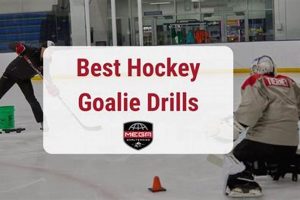
The development of spatial awareness involves both innate abilities and learned techniques. Players can improve spatial awareness through focused practice drills that emphasize puck control, passing accuracy, and anticipatory movements within the vicinity. Coaches often employ drills that simulate game-like scenarios, forcing players to make quick decisions based on the ever-changing positions of teammates and opponents. For instance, a drill might require players to identify and exploit open shooting lanes while maintaining a safe distance from the goaltender. Visual cues, such as markings on the ice or designated zones, can also aid in developing spatial orientation. These training methods aim to hone players’ ability to anticipate movements and make informed decisions under pressure.
In conclusion, spatial awareness is an indispensable skill for players operating in and around the area in front of the net. Its influence extends beyond individual performance, impacting team dynamics and overall success. While some players may possess a natural inclination for spatial perception, targeted training and practice can significantly enhance this critical ability. The ability to maintain a comprehensive understanding of the spatial relationships within this key area is a defining characteristic of skilled and effective players.
5. Rebound Control

Rebound control is intrinsically linked to the dynamics within the designated area. The presence of multiple players in close proximity, combined with the unpredictable nature of deflections and saves, makes control of loose pucks a critical determinant of offensive success and defensive stability. Effective control minimizes scoring opportunities for the opposition while maximizing second-chance attempts for the attacking team. The ability to quickly secure possession of rebounds dictates the flow of play and significantly impacts the outcome of games. For instance, a goaltender who consistently directs rebounds to the corners limits the opponent’s chances, while an offensive player adept at pouncing on rebounds converts seemingly lost opportunities into goals.
Within this high-traffic area, both goaltenders and skaters must prioritize rebound management. Goaltenders are trained to control rebounds by either smothering the puck, directing it towards safe zones, or initiating quick outlet passes. Defensive players focus on clearing rebounds away from the immediate vicinity of the net, preventing opposing forwards from gaining advantageous positioning. Offensive players, conversely, strive to position themselves strategically to capitalize on rebounds, employing techniques such as quick stick work and net-front presence. These strategies are executed under considerable time pressure, requiring rapid decision-making and precise execution. A practical example is a defenseman boxing out an opposing forward while the goaltender freezes a rebound, ensuring the attacking player cannot capitalize on the loose puck.
Mastering rebound control within the designated area requires diligent practice and strategic awareness. Drills that simulate game-like scenarios, focusing on quick transitions and contested puck battles, can significantly enhance a player’s effectiveness. Coaches emphasize the importance of anticipating rebound trajectories, maintaining body positioning, and executing quick plays. The challenges inherent in this aspect of the game underscore the need for specialized training and tactical planning. Ultimately, rebound control is a fundamental skill, directly influencing the outcome of games and solidifying the strategic significance of play within the area in front of the net.
6. Defensive Coverage
Defensive coverage within the vicinity directly influences the probability of scoring chances and goaltender protection. This area requires disciplined positioning, effective communication, and tactical execution. Inadequate defensive coverage routinely leads to high-quality scoring opportunities for the opposition, as unchecked forwards gain unimpeded access to rebounds and scoring lanes. Consequently, a robust defensive strategy is paramount for mitigating risk and safeguarding the net.
Effective defensive coverage near involves a multifaceted approach. Defencemen must prioritize clearing rebounds, boxing out opposing forwards, and disrupting passing lanes. A common scenario involves a defenceman positioning themselves between an attacking player and the net, preventing the player from establishing a screen or capitalizing on loose pucks. Communication between defensive partners is also crucial. Verbal cues enable coordinated efforts, ensuring that all threats are effectively addressed and that gaps in coverage are minimized. Real-world examples include penalty-killing units that rely on tight checking and aggressive clearing tactics to protect the net while short-handed. Success is dependent on stringent execution of defensive principles.
The strategic importance of effective defensive coverage in cannot be overstated. Successful defensive play not only minimizes scoring chances but also provides opportunities for transition to offense. Challenges arise from the dynamic nature of the game, requiring constant adjustments to positioning and tactics. The continuous refinement of defensive strategies, combined with rigorous training, is essential for maximizing the protective measures surrounding the crucial area in front of the goal. Ultimately, the commitment to defensive principles is fundamental to team success.
Frequently Asked Questions
The following addresses common inquiries regarding the rules and strategic implications associated with the area in front of the net.
Question 1: What constitutes interference within the designated area?
Interference is defined as any action that impedes a goaltender’s ability to move freely within the crease or make a save. This includes physical contact, obstruction of vision, and preventing access to different parts of the net.
Question 2: Can a goal be disallowed due to incidental contact with the goaltender?
Yes, even incidental contact can result in a disallowed goal if the contact occurs before the puck crosses the goal line and if it impairs the goaltender’s ability to make the save.
Question 3: How is screening different from goaltender interference?
Screening involves legally positioning oneself to obstruct the goaltender’s vision without making physical contact or impeding movement. Interference occurs when the screen is prolonged, intentional, or involves contact with the goaltender.
Question 4: What are the responsibilities of defensive players regarding coverage near the zone?
Defensive players must clear rebounds, box out opposing forwards, disrupt passing lanes, and communicate effectively to prevent unchecked access and scoring opportunities.
Question 5: How do officials determine whether a player intended to interfere with the goaltender?
Officials consider factors such as the player’s positioning, movements, and the severity of the contact to assess intent. Subjectivity is involved, so erring on the side of caution is generally advisable.
Question 6: What strategies can be employed to improve spatial awareness within the vicinity?
Spatial awareness can be enhanced through targeted practice drills that focus on puck control, passing accuracy, and anticipatory movements. Simulated game scenarios and visual cues can also be beneficial.
Understanding these nuances is critical for informed gameplay and appreciation of the strategic complexity surrounding this pivotal area.
The next section will examine the historical evolution of these rules and their impact on the sport.
Crease Ice Hockey
This exploration has illuminated the multifaceted significance of the zone in professional hockey. The regulations, enforcement, and strategic implications associated with this area are essential elements in balancing goaltender safety with offensive opportunity. Understanding the rules regarding interference, scoring restrictions, spatial awareness, rebound control, and defensive coverage is crucial for players, coaches, and officials alike.
As the sport continues to evolve, ongoing analysis and refinement of these regulations are necessary to maintain competitive balance and ensure player safety. Further research and discussion are encouraged to address potential areas of improvement and promote a comprehensive understanding of the critical role this area plays in the game. The future of the sport hinges, in part, on the judicious application and consistent interpretation of the rules that govern play within this vital area.