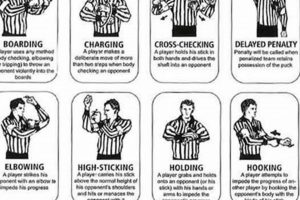
In ice hockey, a situation arises when one team has more players on the ice than the opposing team due to a penalty assessed to the latter. This numerical advantage allows the team with more players to exert greater offensive pressure. For instance, if a player from Team A is penalized, Team B will have an advantage, typically resulting in five skaters against four for a duration determined by the penalty. During this time, Team B aims to capitalize on the additional player by setting up offensive plays and scoring goals.
The occurrence significantly impacts game dynamics. It presents a prime scoring opportunity, potentially shifting the momentum of the game. Historically, proficient teams have developed specialized strategies and formations to maximize their chances of scoring during these advantageous periods. Success in these situations often correlates directly with a team’s overall success in the league.
Understanding the intricacies of offensive formations, defensive strategies employed by the shorthanded team, and the statistical analysis of conversion rates are crucial for a comprehensive grasp of its influence on hockey games. Subsequent sections will delve deeper into these specific aspects.
Power Play Execution
Effective utilization during this advantage requires precision, coordination, and strategic deployment. The following tips outline essential elements for capitalizing on these opportunities.
Tip 1: Establish Puck Possession: Maintaining control of the puck within the offensive zone is paramount. Sustained possession limits the shorthanded team’s ability to clear the zone and allows for greater offensive zone time. For example, cycle the puck along the boards to tire out defenders.
Tip 2: Implement a Clear Offensive Structure: Assign roles and responsibilities within the formation. Common structures include the 1-3-1 or umbrella formation, each designed to create passing lanes and shooting opportunities. A forward in the high slot can serve as a playmaker.
Tip 3: Utilize Quick Puck Movement: Rapid passing forces the shorthanded team to constantly adjust, creating gaps in their defensive coverage. Focus on crisp, accurate passes that exploit open ice. Imagine a cross-ice pass to a winger for a one-timer attempt.
Tip 4: Emphasize Net-Front Presence: A player positioned in front of the opposing goaltender can provide screens, redirect shots, and capitalize on rebounds. This disruptive presence can significantly increase scoring chances. Rebounds are valuable opportunities to score during a power play.
Tip 5: Prioritize Shot Selection: Not all shots are created equal. Focus on generating high-quality scoring chances from advantageous areas. Avoid low-percentage shots from poor angles. High-slot shots, one-timers from the circles, and point shots with screens are all effective.
Tip 6: Adapt to Defensive Adjustments: The shorthanded team will adjust their penalty kill structure based on your attack. Be prepared to react by changing the point of attack or adjusting player positioning. Teams may adjust their formations if the team is being predictable with their plays.
Tip 7: Control the Blue Line: Players positioned at the blue line must maintain puck control and prevent clearing attempts. Quick decision-making and accurate passing are essential in this role. If the team does not have control of the blue line then they may find it difficult to control the game.
Consistent application of these tips enhances offensive efficiency and increases the likelihood of converting on such opportunities. Mastering these fundamentals provides a significant competitive advantage.
The following sections will explore common errors and strategies employed by the penalty-killing unit.
1. Numerical Advantage

The core concept of a power play in ice hockey is predicated on a numerical advantage, established when one team receives a penalty, resulting in fewer players on the ice. This asymmetry is the foundation upon which power play strategies and offensive opportunities are built.
- Enhanced Puck Possession
With an additional skater, the team on the power play experiences increased opportunities to gain and maintain control of the puck. The surplus player can provide support in puck battles, create more passing lanes, and allow for quicker transitions from defense to offense. Sustained puck possession in the offensive zone is a direct outcome, putting pressure on the shorthanded team.
- Increased Offensive Zone Time
The numerical advantage allows the attacking team to establish and maintain a prolonged presence in the offensive zone. Extra time in the offensive zone is pivotal for executing set plays, generating scoring chances, and wearing down the penalty-killing unit. The extended time in the offensive zone requires the shorthanded team to expend energy in order to clear the puck, reducing their chance of scoring when they return to full strength.
- Expanded Passing Lanes and Scoring Opportunities
The additional player opens up passing lanes that would otherwise be unavailable. Defenses must cover more ice, creating gaps and vulnerabilities in their structure. This enhanced space allows for more intricate passing sequences, leading to higher-quality scoring chances. The expanded passing lanes increase the chances of a successful cross-ice pass, one timers and shots from the point.
- Altered Defensive Strategies
The shorthanded team must adjust its defensive strategies to compensate for being a player down. This adjustment typically involves collapsing towards the net, prioritizing shot blocking, and focusing on clearing the puck out of the zone. These strategies, while aimed at limiting scoring chances, can also create opportunities for the power-play unit to exploit weaknesses or capitalize on rebounds.
These facets collectively illustrate how a numerical advantage fundamentally alters the dynamics of a hockey game. It is the catalyst for strategic adjustments, increased offensive pressure, and a heightened potential for scoring. The effectiveness of a power play is intrinsically linked to a team’s ability to leverage this advantage. The greater the ability to leverage the advantage is based on the team’s ability to pass effectively and create the best scoring chances.
2. Offensive Pressure

Offensive pressure constitutes a fundamental element of a power play in ice hockey. The numerical advantage inherent in such a situation provides the attacking team with the opportunity to exert significantly greater offensive force. This heightened pressure is a direct consequence of having more players available to control the puck, establish offensive zone time, and generate scoring opportunities.
The importance of offensive pressure during a power play stems from its ability to force the shorthanded team into a defensive posture. Constant pressure restricts their ability to transition to offense and increases the likelihood of defensive breakdowns. For example, the Tampa Bay Lightning’s consistently potent power play unit historically relies on cycling the puck deep in the offensive zone, wearing down opposing penalty killers and creating high-danger scoring chances. A failure to apply sufficient offensive pressure negates the advantage of the power play, allowing the shorthanded team to effectively clear the zone and kill the penalty.
Ultimately, the objective of a power play is to capitalize on the numerical advantage by scoring a goal. The ability to sustain consistent offensive pressure is paramount to achieving this objective. By maintaining puck possession, creating scoring opportunities, and forcing defensive errors, the attacking team maximizes its chances of converting the power play into a tangible advantage on the scoreboard. A strong offensive presence can sway the game.
3. Scoring Opportunity

The power play in ice hockey fundamentally enhances the potential for scoring opportunities. The presence of an additional skater provides the offensive team with increased space, time, and numerical superiority within the offensive zone. This confluence of factors significantly elevates the probability of generating high-quality scoring chances.
- Increased Shot Volume
The added skater allows for more frequent and diverse shooting opportunities. With more available passing lanes and offensive options, the power-play unit can generate shots from various angles and distances, increasing the likelihood of a goal. A five-on-four advantage often translates to a higher shot rate compared to even-strength play. For example, a defenseman can walk the blue line to draw a penalty killer and create a high danger scoring chance for a forward.
- Enhanced Net-Front Presence
A player stationed near the opposing team’s net can effectively screen the goaltender, redirect shots, and capitalize on rebounds. A strong net-front presence creates chaos and disrupts the goaltender’s vision, increasing the probability of a goal being scored. The Edmonton Oilers are well known for their net-front presence as they have some of the games best power play performers.
- Optimized Puck Movement and Passing Lanes
The extra player opens up passing lanes, enabling quicker puck movement and more intricate offensive plays. Rapid puck circulation forces the shorthanded team to constantly adjust, creating defensive breakdowns and opening up scoring lanes. A well-executed passing play can lead to a clear shooting lane or a tap-in goal. Many NHL teams have seen the increased importance of a solid power play and have added playmakers and solid passers to capitalize on that.
- Exploitation of Defensive Weaknesses
The shorthanded team must focus on defending a smaller area with fewer players, creating vulnerabilities within their defensive structure. The power-play unit can exploit these weaknesses by targeting specific defensive gaps, overloading one side of the ice, or utilizing quick transitions to catch the penalty-killing unit out of position. Power plays tend to isolate one defenseman and will try to make that player make a mistake.
These components demonstrate how the power play’s inherent advantages amplify scoring opportunities. Effective puck movement, a strong net-front presence, and exploiting defensive vulnerabilities are all essential to capitalizing on these opportunities. The degree to which a team can convert these scoring chances significantly influences their overall success. A lack of scoring opportunities on a power play is an area to be worked on, and a possible indication that team does not capitalize when it is most important.
4. Strategic Formations

Strategic formations are integral to the success of a power play in ice hockey. The deployment of specific arrangements of players on the ice is intended to optimize puck movement, create scoring opportunities, and exploit weaknesses in the opposing team’s penalty kill structure. Selection and execution of these formations are key determinants in capitalizing on the numerical advantage.
- Umbrella Formation
The umbrella formation typically features two players positioned at the points (the blue line), one player in the high slot, and two players near the net, creating a semi-circular shape. This configuration emphasizes puck movement along the perimeter, with the high-slot player acting as a playmaker and the net-front players providing screens and rebound opportunities. The Vancouver Canucks, for example, have utilized the umbrella formation, relying on quick puck movement between the points and the high slot to create openings for shots and passes to the net-front. Success with this formation relies on accurate passing and the ability to quickly adjust to the penalty kill unit’s positioning.
- 1-3-1 Formation
The 1-3-1 formation involves one player at the point, three players spread across the high slot and faceoff circles, and one player near the net. This formation is designed to create passing lanes through the middle of the ice and generate cross-ice passing opportunities for one-timers. The Pittsburgh Penguins, known for their skilled forwards, have effectively used the 1-3-1 to create scoring chances from the faceoff circles. The effectiveness of this formation requires strong individual puck-handling skills and the ability to quickly recognize and exploit defensive gaps.
- Overload Formation
The overload formation involves positioning multiple players on one side of the ice, overwhelming the penalty kill unit in that area. This creates numerical advantages in specific zones, opening up passing lanes and shooting opportunities on the opposite side of the ice. Teams like the Boston Bruins have implemented the overload formation to focus pressure on one side, drawing defenders away from the weak side and creating space for a quick pass and shot. Its use hinges on the capacity to quickly transition the puck across the ice and capitalize on the resulting imbalance.
- Power Play Quarterback/Point Man
In many formations, a player, often a defenseman, is positioned at the point (the blue line) and acts as a quarterback, distributing the puck and directing the play. The point man must possess strong skating skills, accurate passing, and the ability to make quick decisions under pressure. Many top defensemen in the NHL are known for quarterbacking their teams’ power plays, such as Roman Josi, who effectively controls the play from the blue line. The ability of the point man to read the play and distribute the puck effectively is critical to the success of the power play.
These strategic formations provide a framework for teams to maximize their offensive potential during a power play. Each formation offers unique advantages and requires specific player skills and coordination to execute effectively. Understanding and adapting these formations based on the opposing team’s penalty kill strategy is vital for converting power play opportunities into goals. The effectiveness of any of the strategic formations is dependent on practice and adaptability from the players.
5. Momentum Shift

A successful power play in ice hockey often precipitates a discernible momentum shift within the game. The cause-and-effect relationship is direct: a goal scored during the numerical advantage elevates the scoring team’s morale and simultaneously deflates the opposing team’s resolve. This psychological swing can manifest in tangible on-ice changes, such as increased offensive pressure from the scoring team and a more cautious, defensive approach from the team that conceded the goal. The importance of this momentum shift lies in its potential to dictate the subsequent flow of the game, influencing player performance, tactical decisions, and ultimately, the outcome. For example, a team trailing by one goal late in the third period may use a power play goal to tie the game and drastically shift the momentum in their favor, providing them with increased energy and a greater likelihood of securing the win.
Conversely, an unsuccessful power play, particularly one where the team fails to generate scoring chances or concedes a shorthanded goal, can also induce a momentum shift, but in the opposite direction. The penalty-killing team gains confidence and energy from successfully defending against the numerical disadvantage, potentially galvanizing their overall performance. A prime example would be a team successfully killing off a four-minute double minor penalty late in the game, preventing the opposing team from gaining any momentum. In addition to the energy gained the successfully killing the penalty gives the team an advantage.
Understanding the interplay between power plays and momentum shifts is practically significant for both players and coaches. Coaches must be adept at recognizing and reacting to these shifts, adjusting their strategies and personnel accordingly. Players must maintain composure and focus, whether riding the wave of positive momentum or battling against a negative shift. A power play’s contribution to the overall game momentum is a crucial consideration for both team strategy and player psychology, and can ultimately determine the game’s outcome. A team that is aware of this interplay is one to be reckoned with.
Frequently Asked Questions
The following section addresses common inquiries regarding the power play in ice hockey, providing clarification and detailed explanations to enhance understanding of this critical game element.
Question 1: What specific penalties lead to a power play?
Minor penalties, such as tripping, hooking, interference, and delay of game, typically result in a power play. Major penalties and match penalties also lead to a power play, often with more severe consequences for the penalized player. A team is also penalized if they shoot the puck over the glass from their own defensive zone.
Question 2: How long does a power play last?
The duration of a power play depends on the type of penalty incurred. A minor penalty results in a two-minute power play, while a major penalty results in a five-minute power play. The power play ends prematurely if the penalized team scores a goal, except in the case of major penalties or certain coincidental minor penalties.
Question 3: What happens if a team commits another penalty while already shorthanded?
If a team commits another penalty while already shorthanded, the penalties are stacked. The team will play with a two-man disadvantage (three skaters versus five) until one of the penalties expires, or a goal is scored by the team with the two-man advantage. At no time will a team play with fewer than three skaters.
Question 4: Can a shorthanded team score?
Yes, a shorthanded team can score a goal. This is referred to as a shorthanded goal. Shorthanded goals can provide a significant momentum boost to the penalty-killing team.
Question 5: What is the most effective strategy for a penalty kill?
Effective penalty killing strategies typically involve aggressive puck pressure, tight defensive positioning, and quick clearing of the puck out of the defensive zone. Communication and disciplined play are crucial for a successful penalty kill. Another strategy is to tire out the players with the advantage so that they are less likely to score when the game returns to even strength.
Question 6: How do coaches prepare their teams for power play and penalty kill situations?
Coaches typically dedicate practice time to specialized power play and penalty kill drills. These drills focus on puck movement, offensive zone positioning, defensive zone coverage, and situational awareness. Coaches also analyze opponent tendencies to develop tailored strategies. Most coaches prepare for a multitude of different power play strategies and penalty kill formations.
These FAQs provide a foundation for understanding the nuances of the power play in hockey. Further exploration of specific team strategies and player roles can offer a more comprehensive perspective.
Subsequent sections will delve into advanced power play tactics and statistical analysis.
What’s a Power Play in Hockey
This exploration has elucidated the multifaceted nature of whats a power play in hockey, from its fundamental reliance on a numerical advantage to its profound impact on game momentum. It is a strategic domain where meticulous formations, skillful execution, and adaptive decision-making converge to create scoring opportunities. Understanding the dynamics of this crucial element is vital for players, coaches, and enthusiasts alike.
Mastery of this facet of the game remains a key differentiator between contending teams and those left behind. The ongoing evolution of power play tactics and penalty-killing strategies necessitates continuous analysis and adaptation. Further research into advanced statistical modeling and real-time strategy adjustments will undoubtedly refine our understanding of its true potential. Teams that will stay ahead will stay adept to changing tactics.