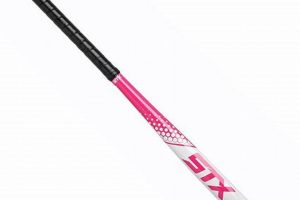
The elongated portion of a hockey stick, extending from the blade to the handle, serves as the primary conduit for transmitting force from the player’s hands to the puck. This component is gripped by the player and is instrumental in stickhandling, shooting, and passing. For example, a player manipulates this part of the stick to control the puck’s movement during a breakaway.
This structural element is crucial for dictating a player’s reach, power transfer, and overall control of the game. Its material composition, flex profile, and geometric design significantly impact performance, enabling players to execute accurate shots and passes. Historically, these components were crafted from wood; however, contemporary models utilize composite materials like carbon fiber and fiberglass to enhance durability and performance.
Understanding the nuances of this critical piece of equipment allows players to optimize their on-ice abilities. Its various attributes influence a player’s style of play and overall effectiveness. Selecting the correct specifications is a critical factor in equipment choice.
Optimizing Hockey Performance
Selecting the correct equipment is crucial for maximizing on-ice effectiveness. Understanding the nuances of this component empowers players to make informed choices that enhance their performance.
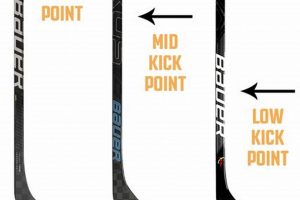
Tip 1: Flex Profile Selection: Choosing an appropriate flex profile is paramount. A lower flex rating facilitates easier loading for players with less strength, while higher flex ratings are better suited for stronger individuals generating more force. Consider the player’s typical shot style and physical build when determining the optimal flex.
Tip 2: Material Composition Considerations: The material impacts durability and performance. Composite materials, such as carbon fiber, offer a superior strength-to-weight ratio compared to traditional wood, allowing for increased responsiveness and power transfer. Evaluate the trade-offs between cost, durability, and performance characteristics when selecting a material.
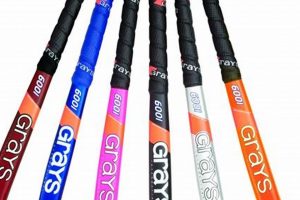
Tip 3: Grip Texture Preference: The grip impacts control and comfort. Various grip textures are available, ranging from tacky to smooth. Experiment with different options to identify the texture that provides optimal grip and feel without causing excessive hand fatigue.
Tip 4: Length Adjustment: Correct length is crucial for stickhandling and shooting posture. Generally, with skates on, the top of the stick should reach approximately to the player’s nose or chin. Adjust the length by cutting the top or using extensions to achieve the appropriate fit.
Tip 5: Lie Angle Evaluation: The lie angle influences blade contact with the ice. A suitable lie angle ensures that the blade sits flush on the ice surface when the player is in their typical skating stance. Experiment with different lie angles to optimize puck control and shooting accuracy.
Tip 6: Balance Point Assessment: The balance point affects stickhandling agility and overall feel. A higher balance point shifts the weight toward the top of the stick, potentially improving stickhandling speed, while a lower balance point provides a more balanced and controlled feel. Consider the player’s playing style and preferences when evaluating the balance point.
These considerations provide a foundation for selecting equipment optimized for individual performance. By understanding the impact of these factors, players can make informed choices that enhance their on-ice capabilities.
Mastering the factors influencing the tool is a critical step towards improving one’s gameplay. The considerations above serves as a foundational element for maximizing on-ice potential.
1. Material Composition

The materials used in constructing the elongated portion of hockey sticks significantly dictate its performance characteristics, durability, and overall feel. Understanding the implications of different material choices is crucial for optimizing a player’s equipment selection.
- Wood Construction
Traditionally, these components were crafted from wood, typically ash or birch. Wood offers a natural feel and impact absorption, but it is generally less durable and exhibits a lower power transfer efficiency compared to composite materials. Wood’s inherent variability in density and grain also results in inconsistent performance. A wooden element is more susceptible to breakage upon high impact.
- Fiberglass Composites
Fiberglass composites offer an increased durability and resistance to moisture compared to wood. Fiberglass components are often used in entry-level or recreational models, providing a balance between affordability and performance. These structures provide a consistent flex profile and a moderate improvement in power transfer. A fiberglass component is also more resistant to cracking than wood.
- Carbon Fiber Composites
Carbon fiber represents the current standard for high-performance hockey sticks. These elements deliver an exceptional strength-to-weight ratio, enabling increased responsiveness, power transfer, and overall performance. Carbon fiber allows for precise control over flex profiles and weight distribution, resulting in a customized feel. Higher grades of carbon fiber contribute to increased durability and reduced weight. Carbon fiber composition increases impact resistance.
- Hybrid Composites
Hybrid composite constructions combine different materials, such as carbon fiber and fiberglass, to achieve a specific balance of performance characteristics. This approach allows manufacturers to tailor stick properties to suit different playing styles and skill levels. For example, a hybrid composition may use carbon fiber in high-stress areas to enhance durability, while fiberglass is incorporated elsewhere to reduce cost. A hybrid design may also offer a balance between feel and responsiveness.
The selection of material composition directly impacts the performance and longevity of the elongated portion of a hockey stick. Contemporary advancements in composite materials have largely supplanted traditional wood constructions, offering players enhanced power, responsiveness, and durability. Understanding these material characteristics is essential for selecting the optimal equipment for a given playing style and skill level.
2. Flex Rating

Flex rating is a numerical value assigned to a hockey stick, directly correlating to the stiffness of the elongated portion. This rating quantifies the amount of force, measured in pounds, required to bend the mid-section of the stick one inch. A lower flex number indicates a more flexible component, requiring less force to bend, while a higher number signifies a stiffer structure demanding greater force to achieve the same degree of bend. The flex rating is an inherent property that fundamentally influences the energy transfer during a shot. For instance, a player with less upper body strength may find a lower flex easier to load, allowing them to generate a quicker release. Conversely, a stronger player might benefit from a higher flex, enabling them to fully load the stick and unleash a more powerful shot.
The selection of the appropriate flex rating is contingent upon factors such as player strength, weight, and shooting style. A player who relies on wrist shots and quick releases often benefits from a more flexible option, facilitating faster loading and unloading of energy. In contrast, a player who primarily takes slap shots or one-timers typically prefers a stiffer selection, allowing for maximum energy transfer and shot power. Professional players often use higher flex ratings to accommodate their increased strength and maximize shot velocity. The position played can also influence flex choice, with defensemen sometimes opting for stiffer configurations for more powerful shots from the point.
In summary, the flex rating is a critical attribute determining the performance characteristics of the stick. Selecting an appropriate flex rating based on individual player attributes optimizes energy transfer and enhances shot power and accuracy. Failure to match the flex rating to the player’s physical capabilities can result in decreased shot performance and an increased risk of injury. Proper understanding and consideration of this feature are paramount for players seeking to maximize their on-ice effectiveness.
3. Grip Texture

Grip texture, applied to the surface of the elongated portion, is a crucial interface between the player’s hands and the stick, directly influencing control, feel, and overall performance. The selection of an appropriate grip texture can significantly impact a player’s ability to maintain a secure hold, execute precise stickhandling maneuvers, and generate powerful shots.
- Tacky Grip
Tacky grips utilize a slightly adhesive surface to maximize friction between the player’s gloves and the stick. This enhanced grip provides a secure hold, particularly advantageous in situations requiring rapid hand movements or forceful shots. Tacky grips are prevalent among players who prioritize control and responsiveness. However, excessive tackiness may lead to increased friction and potential hand fatigue during extended periods of play. An example of a tacky grip is a rubberized coating applied to the shaft.
- Smooth Grip
Smooth grips offer a less abrasive surface, allowing for greater hand mobility and freedom of movement. Players often prefer smooth grips who favor quick stickhandling and precise puck manipulation. A smooth surface reduces friction and enables rapid hand adjustments, facilitating intricate dekes and passes. However, smooth grips may compromise security, particularly in wet or sweaty conditions. An example of a smooth grip is a varnished or lacquered surface with minimal texture.
- Ribbed Grip
Ribbed grips incorporate raised ridges or patterns on the surface to enhance tactile feedback and improve grip security. The ribs provide additional points of contact between the gloves and the shaft, increasing friction and preventing slippage. Ribbed grips are often favored by players who seek a balance between control and maneuverability. The raised texture provides an improved feel for the stick during stick handling. An example is molded rubber grip with raised patterns.
- Tape Grip
Tape grips involve wrapping hockey tape around the upper portion of the shaft to create a customized grip surface. Players can adjust the thickness, texture, and pattern of the tape to achieve a personalized feel. Tape grips offer versatility and affordability, allowing players to experiment with different configurations. However, tape grips may require frequent replacement due to wear and tear. Linen tape is a common example.
Grip texture is a matter of personal preference. Selecting a grip texture that complements individual playing style and hand strength can enhance a player’s control, feel, and overall confidence. Experimentation with different grip textures is crucial for identifying the optimal configuration. The texture selection influences a player’s connection to the shaft, enabling better puck control and powerful play.
4. Length

The length of the elongated component of a hockey stick directly influences a player’s posture, reach, and stickhandling capabilities. The distance from the blade’s heel to the top of the stick determines the overall reach, dictating the player’s ability to retrieve pucks, intercept passes, and maintain possession in various on-ice situations. An improperly sized stick can negatively affect a player’s balance and technique. For example, a component that is too long may force a player into an excessively upright stance, hindering agility and puck control. Conversely, a component that is too short may require the player to excessively bend at the waist, limiting power and increasing the risk of back injury. Therefore the impact that component length has on player stability is high.
The optimal length selection often depends on the player’s height, skating style, and preferred playing position. Typically, with skates on, the top of the component should reach approximately to the player’s nose or chin. This provides a comfortable and balanced stance, allowing for efficient stickhandling and shooting. However, some players may prefer shorter or longer components based on their individual preferences and playing styles. For instance, defensemen may opt for slightly longer configurations to increase their reach and defensive coverage, while forwards often prefer shorter sticks for enhanced agility and puck control in tight spaces. This is not always the case but is a common trend.
In summary, the length of the elongated component is a critical factor influencing player performance and safety. Selecting an appropriate length optimizes posture, reach, and stickhandling ability, enhancing a player’s overall effectiveness on the ice. Failure to properly size the stick can lead to compromised technique, reduced power, and an increased risk of injury. Therefore, careful consideration of length is essential for maximizing a player’s potential and ensuring long-term playing comfort. In selecting equipment, it is a factor to consider greatly.
5. Lie Angle

Lie angle, a critical geometric parameter, quantifies the angle between the plane of the hockey stick’s blade and the elongated portion, dictating how the blade sits relative to the ice surface. This measurement significantly influences a player’s ability to maintain consistent blade contact during various skating stances and shooting motions. The relationship between this measure and the elongated section dictates how efficiently force is transferred to the puck.
- Optimal Blade Contact
An appropriate lie angle ensures the entire blade makes consistent contact with the ice while the player is in their typical skating stance. This complete contact maximizes puck control for passing, shooting, and receiving. Inadequate lie angle results in either the toe or heel of the blade lifting off the ice, causing inaccurate shots and compromised puck handling. For instance, a player with a low skating stance might require a flatter lie angle for proper blade contact.
- Impact on Shooting Accuracy
The lie angle impacts shooting accuracy by affecting the direction in which force is applied to the puck. A correct lie angle ensures that the force is directed along the intended trajectory, resulting in more accurate shots. An incorrect lie angle can cause the puck to be deflected off course, reducing accuracy and power. As a practical example, if the lie angle is too upright, the puck may rise excessively upon contact.
- Influence on Stickhandling
Efficient stickhandling necessitates consistent blade contact. The measure promotes precise puck control, enabling quick dekes and accurate passes. An incorrect lie angle makes it challenging to maintain control of the puck, leading to turnovers and missed opportunities. As an illustration, a player struggling with close-quarters puck control may benefit from adjusting the lie angle to improve blade contact in confined spaces.
- Compensation for Skating Style
Players with different skating styles and body mechanics may require varying lie angles to achieve optimal blade contact. A player with a more upright skating stance might benefit from a more upright lie angle, while a player with a lower, more aggressive stance may require a flatter angle. This customization allows the elongated section to properly position the blade in alignment with the ice, regardless of the player’s unique movements.
In conclusion, the connection between lie angle and the elongated portion is integral to optimizing a player’s performance. Selecting the correct lie angle, in conjunction with other considerations such as length and flex, enhances puck control, shooting accuracy, and overall on-ice effectiveness. Proper adjustment and understanding of this aspect are crucial for players seeking to maximize their potential.
6. Balance Point
Balance point, in relation to hockey equipment, refers to the location along the elongated section of a hockey stick where the weight is evenly distributed. This point significantly influences the stick’s feel, maneuverability, and the ease with which a player can control it. Because it is a component of it, any alteration to the design or material composition of the elongated section inevitably shifts the balance point, affecting how the stick feels in a players hands and influencing the overall dynamics of puck handling and shooting. For example, if weight is added near the blade, the balance point shifts downwards, resulting in a blade-heavy feel. This can improve puck feel for some players but reduce stickhandling speed. Conversely, if weight is concentrated near the handle, the balance point rises, leading to a handle-heavy feel, which may enhance stickhandling speed but reduce the feel for the puck.
The location of the balance point affects the moment of inertia, influencing how easily a player can rotate the stick. A balance point closer to the hands reduces the moment of inertia, making it easier to quickly manipulate the stick for rapid stickhandling and deking maneuvers. A balance point further from the hands increases the moment of inertia, requiring more effort to rotate the stick but potentially increasing power transfer during a shot. For example, a defenseman taking a slap shot might prefer a balance point further up the section to maximize power, whereas a forward stickhandling in tight spaces might prefer a balance point closer to the hands for increased agility. Material composition significantly influences this aspect; carbon fiber, being lighter, allows for manipulating weight distribution and achieving optimal balance.
Understanding the connection between balance point and the elongated section is crucial for equipment selection and customization. Manufacturers strategically adjust weight distribution during the design process to cater to different playing styles and preferences. Players can further fine-tune the balance point by adding weight to specific areas of the stick, such as tape near the blade or handle. While finding the ideal balance point presents a challenge due to subjective preferences and playing styles, awareness of this relationship is fundamental for optimizing on-ice performance and maximizing the potential of the chosen hockey stick. Ultimately it’s the player that finds and chooses the proper feel.
Frequently Asked Questions
This section addresses common inquiries regarding the key characteristics and considerations pertaining to this component, its construction, and its impact on on-ice performance.
Question 1: What material constitutes the typical composition of the structural element?
Contemporary models frequently utilize composite materials such as carbon fiber and fiberglass, offering enhanced strength-to-weight ratios compared to traditional wood. The composition influences durability, responsiveness, and power transfer.
Question 2: How does the flex rating influence performance characteristics?
The flex rating quantifies the stiffness, measured in pounds required to bend the mid-section one inch. Lower ratings offer greater flexibility, while higher ratings provide increased stiffness, impacting energy transfer and shot power.
Question 3: What role does grip texture play in enhancing control?
Grip texture, applied to the outer surface, enhances friction between the player’s hands and the stick, facilitating improved control and stickhandling. Various textures, ranging from tacky to smooth, cater to individual preferences.
Question 4: How does length influence skating posture and stickhandling ability?
The length dictates a player’s reach, impacting posture and stickhandling. Proper sizing, typically reaching the nose or chin with skates on, promotes a balanced stance and enhances control.
Question 5: What is the significance of lie angle for blade contact?
Lie angle quantifies the angle between the blade and the element, influencing blade contact with the ice. Proper adjustment ensures full blade contact, maximizing puck control for passing, shooting, and receiving.
Question 6: How does the balance point affect feel and maneuverability?
The balance point, representing the weight distribution along this element, influences feel and maneuverability. Shifting weight towards the blade or handle affects the moment of inertia, impacting stickhandling speed and power transfer.
A comprehensive understanding of material selection, flex rating, grip texture, length, lie angle, and balance point is essential for optimizing equipment selection and maximizing on-ice performance. Considerations made with these points in mind helps to find the right fit.
The subsequent segment explores advanced customization techniques designed to further refine the equipment and enhance individual player capabilities.
Shaft of Hockey Stick
This exploration has delineated the vital role the “shaft of hockey stick” plays in athletic performance. Material composition, flex rating, grip texture, length, lie angle, and balance point each contribute to the overall efficacy of the equipment. Comprehending these aspects enables informed decision-making, optimizing the connection between athlete and tool.
Continued research and technological advancement promise further refinement of the “shaft of hockey stick,” pushing the boundaries of athletic potential. Awareness of these critical factors remains essential for players striving for peak performance and seeking a competitive advantage on the ice. Ultimately, a deep understanding of this piece of equipment empowers athletes to reach their full potential.