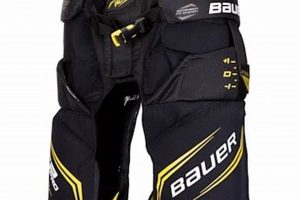
The lower body musculature of ice hockey players undergoes significant development to meet the demands of the sport. This adaptation results in a specific physique characterized by powerful thighs, glutes, and calves, contributing to enhanced skating ability and overall performance. Such development is a hallmark of dedicated players at all levels.
These highly developed muscles provide the strength and stability required for rapid acceleration, quick changes in direction, and maintaining balance during physical contact. Historically, a player’s leg strength has been directly correlated with their on-ice effectiveness, impacting speed, endurance, and the ability to withstand challenges from opponents. This foundation allows for powerful shots and efficient skating throughout extended periods of play.
This article will explore the specific exercises and training regimens necessary to cultivate this muscular development. Furthermore, it will address injury prevention strategies and nutritional considerations that support the unique demands placed on the lower extremities of athletes engaged in this dynamic sport.
Cultivating Enhanced Lower Body Strength and Stability
The development of specialized lower body strength is critical for optimal performance on the ice. The following tips offer guidance on exercises and techniques to enhance power, stability, and endurance.
Tip 1: Prioritize Compound Movements: Exercises such as squats, deadlifts, and lunges engage multiple muscle groups simultaneously, promoting overall strength development and functional fitness. Consistent execution of these movements, with proper form, is fundamental.
Tip 2: Incorporate Plyometric Training: Plyometric exercises, including jump squats, box jumps, and lunge jumps, improve explosive power and agility. These exercises should be introduced gradually to minimize the risk of injury and maximize performance gains.
Tip 3: Emphasize Single-Leg Training: Single-leg exercises, such as pistol squats and single-leg deadlifts, enhance balance and stability while strengthening individual leg muscles. These are crucial for replicating the demands of skating, which involves independent leg action.
Tip 4: Implement Resistance Band Work: Resistance bands provide an effective means of improving hip and glute activation. Exercises such as lateral walks and band-resisted squats target the muscles responsible for stability and power in the skating stride.
Tip 5: Focus on Core Stability: A strong core is essential for transferring power from the lower body to the upper body and maintaining balance. Plank variations, Russian twists, and medicine ball exercises contribute to overall core strength and stability.
Tip 6: Integrate On-Ice Drills: Supplementing gym workouts with sport-specific drills on the ice further refines the connection between strength development and skating performance. Practicing acceleration, agility, and balance drills in full gear is essential.
Tip 7: Employ Periodization Principles: Implement a training plan that cycles through periods of high intensity and lower intensity, allowing for adequate recovery and preventing overtraining. Proper periodization optimizes long-term strength gains and reduces the likelihood of injury.
The consistent application of these training principles, coupled with proper nutrition and recovery, will lead to significant improvements in lower body strength, stability, and overall on-ice performance.
The subsequent sections of this article will delve into specific exercise programs and nutritional strategies to further optimize athletic development.
1. Power

Power, in the context of lower body development for ice hockey, refers to the ability to generate force rapidly. This is a fundamental component, acting as the engine for explosive movements such as accelerating from a standstill, executing powerful strides, and delivering forceful checks. The development of this capacity is a direct result of targeted strength training exercises, focused on increasing both muscle mass and the speed at which those muscles can contract. Without adequate power, a player’s speed, agility, and overall effectiveness on the ice are significantly compromised. A practical example can be observed in elite players, whose ability to win puck battles and generate scoring opportunities often hinges on their superior power output in short bursts of activity.
The development of power is not solely reliant on raw strength. Equally important is the ability to coordinate muscle activation efficiently. Plyometric exercises, such as jump squats and box jumps, are crucial for training the nervous system to recruit muscle fibers more rapidly. These exercises bridge the gap between maximal strength and explosive power, enabling players to translate their strength into dynamic movements on the ice. Consider the difference between a player who can squat a heavy weight slowly versus one who can perform the same movement explosively; the latter will demonstrate greater on-ice acceleration and agility. Moreover, power also enables superior puck protection, allowing players to maintain possession under pressure.
In summary, power constitutes a crucial, trainable element of lower body development for hockey players. Its manifestation extends beyond mere muscle size, encompassing the speed of muscle activation and the efficiency of force generation. Maximizing power output through a combination of strength training, plyometrics, and sport-specific drills is essential for optimizing on-ice performance. A deficiency in lower body power severely limits a player’s ability to excel in the dynamic and physically demanding environment of ice hockey.
2. Endurance
Endurance, in the context of ice hockey, represents the capacity to sustain high-intensity activity for extended durations, a characteristic directly related to the developed musculature of the lower body. These muscles support repeated bursts of skating, pivoting, and physical exertion throughout a game. Without sufficient endurance, a player’s performance diminishes as fatigue sets in, compromising speed, agility, and decision-making. For instance, a player may possess significant power for initial sprints, but without the necessary muscular endurance, effectiveness sharply declines in later periods.
The underlying physiological mechanisms involve efficient energy utilization and lactic acid buffering within the trained leg muscles. Specific training methodologies, such as interval training and longer duration skating drills, enhance the oxidative capacity of these muscles. This adaptation allows for more efficient energy production, delaying the onset of fatigue. Furthermore, adequate endurance allows a player to maintain proper technique and form, reducing the risk of injury during periods of intense exertion. A practical example is seen in players who can maintain speed and agility even in the final minutes of a game, demonstrating superior muscular endurance.
Ultimately, muscular endurance in the legs is not merely a desirable attribute, but a fundamental requirement for sustained high-level performance in ice hockey. Its development necessitates a focused training approach that combines on-ice conditioning with targeted strength and endurance exercises. Neglecting this aspect of lower body development results in premature fatigue, decreased performance, and an increased susceptibility to injury, significantly limiting a player’s overall impact on the game. The successful integration of endurance training is therefore integral to realizing the full potential of specialized leg development.
3. Stability

Stability, within the context of specialized lower body development for ice hockey players, refers to the capacity to maintain control and equilibrium amidst dynamic forces and external perturbations. This is critical for executing precise movements, resisting opposing forces, and minimizing the risk of injury. Enhanced lower body stability allows a player to maintain a strong skating posture, effectively absorb impacts from collisions, and execute powerful strides without compromising balance. For example, a player with superior stability can withstand a check along the boards while maintaining possession of the puck and continuing to skate effectively.
The development of stability hinges on the strength and coordination of core muscles, hip stabilizers, and ankle musculature. Targeted exercises, such as single-leg squats, balance board drills, and lateral band walks, contribute to improved proprioception and neuromuscular control. Proprioception, the body’s sense of its position in space, is crucial for making rapid adjustments and maintaining balance in response to unpredictable forces. Moreover, strong hip abductors and adductors prevent excessive lateral movement, ensuring that energy is transferred efficiently during skating. The integration of these stability-focused exercises into a comprehensive training program provides a robust foundation for enhanced on-ice performance.
In conclusion, stability is not merely an adjunct to lower body strength but rather an essential component of it. Its contribution to balance, control, and injury prevention makes it indispensable for ice hockey players at all levels. By prioritizing stability-focused training, athletes can enhance their on-ice effectiveness, prolong their careers, and minimize the risk of debilitating injuries. Stability, therefore, forms an integral element of a comprehensive approach to building functional lower body strength.
4. Balance
Balance represents a critical neuromuscular skill directly influenced by the development of specialized musculature in ice hockey. Specifically, the strength and coordination of lower body muscles contribute significantly to a player’s ability to maintain equilibrium during skating, maneuvering, and physical contact. The development of “ice hockey legs” provides the necessary foundation for executing swift changes in direction, absorbing impacts from opposing players, and recovering quickly from off-balance situations. Without adequate balance, a player’s performance is severely compromised, leading to decreased agility, increased susceptibility to falls, and a reduced capacity to execute plays effectively. Elite players, for example, consistently demonstrate superior balance, enabling them to maintain puck control and execute passes even under intense pressure.
The neuromuscular connection between lower body musculature and balance involves a complex interplay of sensory input and motor output. Proprioceptors located within muscles, tendons, and joints provide constant feedback to the brain about the body’s position in space. This information is then used to make rapid adjustments in muscle activation, ensuring stability and preventing falls. Targeted training exercises, such as single-leg squats, balance board drills, and agility ladder work, enhance proprioceptive awareness and improve neuromuscular control. These exercises not only strengthen the relevant muscles but also refine the neural pathways responsible for maintaining balance. Furthermore, the development of a strong core is essential, as it provides a stable base of support for movements initiated in the lower body.
In conclusion, balance is an indispensable component of the “ice hockey legs” concept. Its development is intricately linked to the strength, coordination, and proprioceptive awareness of the lower body musculature. While challenges exist in precisely quantifying the contribution of balance to overall performance, its practical significance is undeniable. Ice hockey players who prioritize balance training not only enhance their on-ice effectiveness but also reduce their risk of injury, contributing to a longer and more successful career. Balance training should therefore be considered an integral aspect of a comprehensive lower body conditioning program.
5. Agility
Agility, in the context of ice hockey, is intrinsically linked to the development and functionality of the lower body. The ability to rapidly change direction, accelerate, and decelerate on the ice is a direct consequence of the strength, power, and coordination cultivated through specialized training. Well-developed musculature enables swift transitions between forward and backward skating, lateral movements, and pivoting, all essential for effective puck handling, defensive positioning, and offensive maneuvers. Without adequate agility, a player’s ability to react to dynamic game situations is severely limited. For example, a defenseman with exceptional agility can quickly close gaps on opposing forwards, disrupting scoring opportunities and maintaining defensive integrity.
The physical requirements for agility in ice hockey extend beyond mere leg strength. Neuromuscular efficiency, core stability, and joint mobility play crucial roles. Drills that focus on reactive agility, such as those involving visual or auditory cues, enhance the player’s ability to anticipate and respond to changes in the game. These exercises train the nervous system to rapidly process information and coordinate muscle activation, resulting in faster reaction times and more fluid movements. Additionally, a strong core provides a stable base for generating power and maintaining balance during agile maneuvers. Proper joint mobility ensures that the player can achieve the necessary range of motion for executing complex skating techniques without restriction or risk of injury.
In summary, agility represents a critical component of the skill set required for success in ice hockey. Its development is directly dependent on the comprehensive training of the lower body, encompassing strength, power, coordination, and neuromuscular efficiency. By prioritizing agility-focused training, players can enhance their on-ice performance, improve their ability to react to dynamic game situations, and ultimately contribute more effectively to their team’s success. The practical significance of agility is evident in the performance of elite players, whose superior ability to change direction and evade defenders consistently sets them apart.
6. Protection

In the context of ice hockey, the term “protection” extends beyond simply avoiding injury. It encompasses the capacity of the lower body, particularly the musculature developed in “ice hockey legs”, to mitigate the impact of collisions, withstand repetitive stress, and prevent injuries arising from the demands of the sport. Adequate lower body strength and stability provide a crucial buffer against the physical rigors inherent in ice hockey.
- Impact Absorption
Well-developed quadriceps, hamstrings, and gluteal muscles act as shock absorbers, dissipating the forces generated during collisions with other players or the boards. The ability to effectively absorb these impacts reduces the risk of joint injuries, particularly to the knees and hips. Real-world examples include players who can withstand forceful checks without losing balance or sustaining significant injury, a testament to their capacity for impact absorption.
- Joint Stabilization
Strong muscles surrounding the knee and ankle joints provide critical stabilization, preventing excessive movement and reducing the likelihood of sprains or dislocations. Specific muscles, such as the vastus medialis oblique (VMO) in the quadriceps and the peroneal muscles in the lower leg, play a crucial role in maintaining joint alignment and controlling movement during skating. An example is the reduced incidence of ankle sprains among players with well-conditioned peroneal muscles.
- Repetitive Stress Mitigation
The repetitive nature of skating places considerable stress on the lower body joints and muscles. Adequate lower body strength and endurance help to distribute this stress more evenly, preventing overuse injuries such as tendinitis or stress fractures. Properly conditioned muscles can withstand the cumulative effects of thousands of skating strides throughout a season, reducing the risk of chronic pain and injury.
- Postural Control
Core stability and lower body strength work synergistically to maintain proper posture during skating, reducing the risk of back pain and other postural-related injuries. A strong core provides a stable base of support, allowing the lower body to generate power and maintain balance without compromising spinal alignment. The ability to maintain a proper skating posture, even during periods of fatigue, is a key indicator of effective postural control and lower body conditioning.
The aforementioned facets illustrate the multifaceted relationship between protection and specialized lower body development in ice hockey. The development of “ice hockey legs” not only enhances performance but also provides a crucial layer of protection against the physical demands of the sport. By prioritizing strength, stability, and neuromuscular control, athletes can minimize their risk of injury and prolong their careers, reinforcing the practical significance of comprehensive lower body conditioning.
Frequently Asked Questions
The following questions and answers address common inquiries regarding the development, benefits, and maintenance of specialized lower body musculature in ice hockey players.
Question 1: Is the development of “ice hockey legs” solely a result of genetics, or can targeted training significantly influence lower body musculature?
While genetic predispositions may play a role, targeted training regimens, including strength training, plyometrics, and on-ice conditioning, are demonstrably effective in significantly developing lower body musculature. Consistent and appropriate training methodologies can lead to substantial improvements in strength, power, and endurance, irrespective of initial genetic advantages.
Question 2: What specific types of exercises are most effective for developing the musculature associated with “ice hockey legs”?
Compound exercises such as squats, deadlifts, and lunges, along with plyometric exercises like jump squats and box jumps, are highly effective. Single-leg exercises such as pistol squats and single-leg deadlifts are also crucial for enhancing stability and balance. These exercises, when performed with proper form and progressive overload, stimulate muscle growth and enhance functional strength.
Question 3: How does the development of “ice hockey legs” contribute to on-ice performance?
Enhanced lower body musculature directly contributes to improved skating speed, agility, balance, and power. Stronger legs facilitate more forceful strides, quicker changes in direction, and greater stability during physical contact. This translates to enhanced puck control, defensive effectiveness, and offensive capabilities.
Question 4: Are there specific nutritional considerations that support the development and maintenance of “ice hockey legs”?
Adequate protein intake is crucial for muscle repair and growth. A balanced diet that includes sufficient carbohydrates to fuel intense training sessions and healthy fats for hormone production is also essential. Proper hydration is also vital for optimal muscle function and recovery.
Question 5: What strategies can be employed to prevent injuries associated with the intensive training required to develop “ice hockey legs”?
Proper warm-up routines, including dynamic stretching and light cardio, are essential. Progressive overload principles should be applied to training to avoid overstressing muscles and joints. Adequate rest and recovery periods are crucial for muscle repair and preventing overtraining. Furthermore, addressing any muscle imbalances or weaknesses through targeted exercises can reduce the risk of injury.
Question 6: Can “ice hockey legs” be developed at any age, or is there a critical period for maximizing muscle growth?
While muscle growth potential may be greater during adolescence and early adulthood, targeted training can yield significant results at any age. However, it is essential to tailor training programs to the individual’s age, fitness level, and training history. Prioritizing proper form and gradually increasing intensity are crucial for preventing injuries, particularly in older individuals.
The development of specialized lower body musculature in ice hockey involves a combination of targeted training, proper nutrition, and injury prevention strategies. Consistent effort and adherence to sound training principles are essential for achieving optimal results.
The next section will explore advanced training techniques for further enhancing lower body strength and performance.
Ice Hockey Legs
This exploration has detailed the multifaceted nature of “ice hockey legs,” emphasizing the crucial role of specialized lower body development in optimizing on-ice performance. The attributes of power, endurance, stability, balance, agility, and protection were identified as essential components, each contributing uniquely to an athlete’s capacity to excel in this demanding sport. Effective training strategies, nutritional considerations, and injury prevention methods were presented as integral elements of a comprehensive approach to achieving this physiological adaptation.
The attainment of functional lower body strength is not merely a pursuit of physical aesthetics but a commitment to maximizing athletic potential and ensuring career longevity. Continued research and refinement of training methodologies will undoubtedly further enhance our understanding of the optimal strategies for developing the musculature essential for success on the ice. Athletes and coaches must recognize the paramount importance of prioritizing lower body conditioning, thus solidifying the foundation upon which elite performance is built.