The appropriate fit of hockey skates is a crucial aspect of performance and safety. Skates that are either too loose or too constricting can impede agility, increase the risk of injury, and detract from the overall playing experience. Determining the correct level of snugness ensures optimal power transfer and responsiveness on the ice. For example, a skate that allows excessive foot movement within the boot will diminish a player’s ability to execute quick turns and stops effectively.
Achieving the right fit yields numerous advantages. Enhanced control and maneuverability, reduced fatigue, and a lower likelihood of blisters and other foot ailments are all direct results of properly fitted hockey skates. Historically, achieving this fit was a challenge, relying on general sizing guidelines and subjective assessments. Modern skate technology and fitting processes aim to provide more precise and personalized solutions, recognizing the unique biomechanics of each player’s foot.
Therefore, understanding the nuances of skate fitting, considering factors such as foot volume, arch type, and skating style, becomes paramount. The following sections will delve into the specific aspects of evaluating skate tightness, including heat molding, lacing techniques, and identifying potential fit issues, to help skaters attain the ideal balance of comfort and performance.
Skate Fitting Guidelines
Achieving the optimal level of snugness is paramount for both performance and safety. The following guidelines provide insights into assessing and adjusting skate fit.
Tip 1: Initial Assessment: Prior to lacing, ensure toes lightly brush the front of the skate while standing. When flexed forward in a skating stance, the heel should remain locked in place with minimal lift.
Tip 2: Lacing Pressure: Begin lacing with even pressure across the foot. The tightness should increase progressively towards the ankle to provide support and prevent heel lift.
Tip 3: Ankle Support: The uppermost eyelets should be laced firmly, creating a secure and supportive fit around the ankle. Over-tightening, however, can restrict ankle flexion and hinder skating agility.
Tip 4: Monitor for Pressure Points: While skating, pay attention to any areas of discomfort or pressure. Consistent discomfort indicates a potential fit issue that requires adjustment or professional evaluation.
Tip 5: Heat Molding Considerations: For skates designed for heat molding, follow the manufacturer’s instructions precisely. The heat molding process allows for a more customized fit, but improper execution can damage the skate.
Tip 6: Sock Selection: Use thin, moisture-wicking socks specifically designed for hockey skates. Thick or ill-fitting socks can compromise the fit and lead to blisters.
Tip 7: Professional Fitting: Consulting with a knowledgeable skate fitter is recommended, especially for novice players. A professional can assess foot characteristics and recommend appropriate skate models and sizes.
Adhering to these guidelines can significantly enhance comfort, performance, and reduce the risk of injury. A well-fitted skate allows for optimal power transfer and precise control on the ice.
The following sections will address common fitting problems and provide solutions to ensure a secure and comfortable skating experience.
1. Ankle Lock

Ankle lock, a critical component of hockey skate fit, directly correlates with the extent of snugness required. Ankle lock refers to the degree to which the skate securely holds the ankle in place, preventing excessive forward, backward, or lateral movement within the boot. Insufficient ankle lock results in compromised skating efficiency and an elevated risk of injury. For example, without adequate ankle support, a player may struggle to maintain balance during sharp turns or quick stops, leading to instability and potential falls. A lack of snugness around the ankle diminishes the skater’s ability to translate power effectively from the leg to the blade, reducing acceleration and overall speed.
Achieving effective ankle lock necessitates a careful balance. The skate must be sufficiently snug to eliminate unwanted movement, but not so constricting as to impede ankle flexion. Ankle flexion is crucial for proper skating technique, allowing the skater to bend the knees and generate power. Over-tightening the laces in the ankle region, while initially seeming to enhance support, can actually restrict this essential range of motion. Professional players often adjust their lacing patterns to optimize ankle lock while maintaining the necessary flexibility. The materials and design of the skate itself also play a significant role in achieving appropriate ankle lock. Stiffer skate materials offer greater support but may limit flexibility, while softer materials provide more give but less stability.
Therefore, assessment of ankle lock is paramount during the skate fitting process. It is not solely a matter of lace tightness, but rather a holistic evaluation of how the skate interacts with the individual’s foot and ankle. Skaters should assess their range of motion and stability in the skating stance to determine if adjustments are needed. Consulting with a qualified skate fitter ensures accurate assessment and customization. Addressing ankle lock challenges improves skating performance, minimizes the risk of injury, and ultimately, enhances the overall experience on the ice.
2. Toe Clearance

Toe clearance, the space between the longest toe and the skate’s toe cap when the foot is positioned fully back in the skate, is intrinsically linked to determining the appropriate degree of skate tightness. Insufficient or excessive toe clearance directly impacts comfort, performance, and the potential for foot-related injuries.
- Toe Contact and Circulation
Inadequate toe clearance, where the toes are constantly pressing against the skate’s toe cap, can impede circulation and lead to discomfort, numbness, and even blisters. This necessitates a slightly looser fit in the forefoot to alleviate pressure. Alternatively, skates that are overly tight in other areas to compensate for toe pressure can exacerbate these issues. The key is achieving uniform tightness that provides support without constricting the toes.
- Impact Absorption and Injury Prevention
Adequate toe clearance provides a buffer zone during impacts or sudden stops. When the skate fits properly, the toes have room to retract slightly, minimizing the risk of jamming or bruising. Conversely, a skate that is either too tight or too loose can increase the likelihood of toe injuries. If the skate is too tight, there is no room for movement; if too loose, the foot can slide forward excessively during impacts. Adjusting the overall tightness to accommodate proper toe clearance is therefore essential for injury prevention.
- Power Transfer and Agility
Although toe clearance dictates some room, an overly generous space between toes and toe cap may compromise stability. A foot that slides around inside skate may hinder performance, and decrease power transfer to blades. Toe clearance must enable responsive footwork on the ice, so adjust skate tightness to fit foot to boot correctly without sacrificing maneuverability.
- Skate Size and Model Considerations
Toe clearance is not solely a function of how tightly the skates are laced. Skate size and model are also significant factors. Different skate models offer varying internal volumes and toe box shapes. A skate that is the correct length may still feel too tight in the toes due to a narrow toe box. Adjusting lace tightness alone cannot compensate for an ill-fitting skate. Selecting a model that accommodates the foot’s natural shape and provides adequate toe clearance from the outset is crucial before considering how tightly the skates should be laced. A professional fitting is best.
Therefore, achieving the right toe clearance is a critical aspect of ensuring a comfortable and high-performing skate fit. While tightness plays a role, it is essential to consider the skate’s overall dimensions and how they interact with the individual’s foot. Adjusting skate tightness to accommodate toe clearance, in conjunction with other fitting parameters, maximizes player comfort and performance.
3. Heel Stability

Heel stability within a hockey skate directly influences skating performance and injury prevention, rendering it a critical factor when determining appropriate skate tightness. Insufficient heel hold permits excessive movement of the heel within the boot, diminishing the efficiency of each stride and increasing the risk of blisters and chafing. Conversely, undue tightness in the heel area can constrict circulation and cause discomfort, impairing the skater’s ability to maintain a forward lean and execute sharp turns. The appropriate snugness ensures the heel remains firmly planted against the back of the skate, maximizing power transfer and responsiveness. For example, a player experiencing heel lift may find it difficult to maintain balance during quick stops, compromising their ability to defend effectively or transition rapidly from offense to defense. Therefore, heel stability constitutes a fundamental consideration within the broader scope of skate fitting.
Several factors contribute to achieving optimal heel stability beyond simply increasing lace tightness. Skate selection, including the boot’s internal shape and heel cup design, plays a significant role. Some skate models are specifically designed to accommodate narrower or wider heels, ensuring a more secure fit. Additionally, lacing techniques can be employed to fine-tune heel hold. Utilizing a “lace lock” or tightening the laces more firmly around the ankle area can help to minimize heel movement. Furthermore, custom orthotics or heel wedges can be used to further enhance heel stability by filling any gaps between the foot and the skate’s heel counter. These interventions can correct for anatomical variations and improve overall fit, especially for individuals with high or low arches.
In summary, heel stability is a critical component of achieving a proper hockey skate fit, impacting both performance and comfort. The degree of snugness required to maintain heel lock must be carefully balanced with considerations for circulation and ankle mobility. Through careful skate selection, appropriate lacing techniques, and the potential use of orthotics or wedges, skaters can ensure their heels remain securely positioned within their skates, maximizing their potential on the ice while minimizing the risk of discomfort or injury. A holistic approach that considers all elements ensures optimum fit is crucial.
4. Lacing Pressure

Lacing pressure directly dictates the degree of snugness a hockey skate provides, acting as the primary adjustable mechanism for customizing fit and optimizing performance. The distribution and intensity of lacing pressure profoundly influence foot stability, ankle support, and overall comfort. Improper lacing, characterized by uneven or excessive pressure, can lead to compromised skating technique, discomfort, and potential injuries. A common example involves over-tightening the laces around the ankle, intended to enhance support, but instead restricting ankle flexion and hindering agility. Conversely, insufficient lacing tension fails to secure the foot adequately, resulting in heel lift, reduced power transfer, and an increased susceptibility to blisters. Therefore, mastering the art of controlled and graduated lacing pressure is essential for achieving the desired degree of skate tightness.
The effectiveness of lacing pressure is further influenced by the skate’s construction and materials. Stiffer skate boots may require less lacing pressure to achieve the desired level of support, while more pliable boots may necessitate greater tension. Moreover, the eyelet configuration and lace type contribute to the overall lacing system’s efficacy. For instance, eyelets that are closely spaced and reinforced tend to distribute pressure more evenly, while round laces may provide a more secure grip than flat laces. Skaters frequently experiment with different lacing patterns and techniques to address specific fit concerns, such as narrow heels or high insteps. This iterative process of adjustment underscores the importance of understanding how lacing pressure interacts with the skate’s structural characteristics.
Ultimately, achieving optimal lacing pressure necessitates a keen awareness of individual foot anatomy and skating style. Factors such as arch height, ankle flexibility, and preferred skating position impact the ideal lace tightness. Monitoring for pressure points and making incremental adjustments based on on-ice feedback is crucial for refining the fit. While general guidelines exist, the optimal level of lacing pressure is ultimately subjective and requires a personalized approach. Understanding the interplay between lacing pressure and skate characteristics allows skaters to fine-tune their fit, maximizing both performance and comfort while mitigating the risk of injury.
5. Pressure Points

The occurrence of pressure points within hockey skates is directly linked to the distribution and magnitude of tightness, highlighting their significance in determining appropriate fit. These localized areas of discomfort arise when excessive pressure is exerted on specific regions of the foot due to inadequacies in skate fit or lacing. If skates are laced too tightly in the forefoot, for example, individuals may experience pressure points along the metatarsals, leading to pain, numbness, or even blisters. Conversely, insufficient tightness around the ankle can cause the foot to shift within the skate, generating pressure points on the malleoli or heel. Pressure points serve as indicators of imbalances in fit, signaling a need for adjustment to alleviate discomfort and prevent potential tissue damage. Their presence or absence is a critical consideration in assessing whether skates are adequately, or excessively, tight.
Addressing pressure points requires a multifaceted approach. Initially, lacing techniques should be examined. Varying the tightness across different sections of the skate allows for customized pressure distribution, alleviating specific areas of discomfort. In instances where lacing adjustments prove insufficient, heat molding may offer a solution. By conforming the skate’s internal structure to the unique contours of the foot, pressure points can be minimized or eliminated. Furthermore, the insertion of custom orthotics can redistribute pressure more evenly across the plantar surface, correcting biomechanical imbalances that contribute to pressure point formation. For example, individuals with high arches may benefit from orthotics that provide increased support, reducing pressure on the ball and heel of the foot. The effectiveness of these interventions hinges on accurately identifying the location and underlying cause of the pressure points. Professional fitting and assessment are critical in complex cases.
In conclusion, pressure points represent a tangible manifestation of improper skate fit, intrinsically linked to the determination of appropriate tightness. Their identification and resolution are paramount for maximizing comfort, performance, and safety. Ignoring pressure points can lead to chronic foot problems and impede skating ability. By addressing these localized areas of discomfort through adjustments to lacing, heat molding, or orthotics, skaters can achieve a more harmonious fit, enabling them to perform at their best while minimizing the risk of injury. Prioritizing pressure point management is an essential component of optimizing the overall skate fitting process.
6. Heat Molding
Heat molding represents a critical process in customizing hockey skate fit and, consequently, directly influencing the determination of appropriate tightness. Heat molding involves applying controlled heat to the skate’s boot, rendering the internal materials pliable and allowing them to conform more closely to the unique contours of the skater’s foot. This process is typically performed by a trained professional using a specialized skate oven. The application of heat softens the thermo-formable materials within the boot, enabling them to mold to the shape of the foot as the skater wears the skates during the cooling process. The resulting custom fit minimizes negative space within the boot, enhancing energy transfer, improving responsiveness, and reducing the likelihood of pressure points. A tighter, more anatomical fit is often achievable through heat molding, contributing to a greater sense of control and comfort on the ice. Without heat molding, even a correctly sized skate may exhibit areas of looseness or tightness that detract from performance.
The impact of heat molding extends beyond initial fit. By creating a more precise and consistent interface between the foot and the skate, heat molding can improve the long-term performance and comfort of the skates. This is particularly beneficial for skaters with asymmetrical feet, bony protrusions, or other anatomical variations that make it difficult to achieve a comfortable fit with standard skates. For example, heat molding can alleviate pressure on bunions or tailor’s bunions, common sources of discomfort for many skaters. Moreover, a well-molded skate tends to maintain its shape better over time, providing a more consistent fit throughout the skate’s lifespan. The process also allows for micro-adjustments to address specific fit concerns. Skilled skate fitters can target particular areas of the boot during the molding process to further refine the fit and optimize performance. This targeted approach ensures that the skate’s tightness is precisely tailored to the individual skater’s needs and preferences.
In conclusion, heat molding is an indispensable component of achieving an optimal hockey skate fit and precisely determining the appropriate level of tightness. The process enhances comfort, improves performance, and reduces the risk of injury by creating a customized interface between the foot and the skate. The effectiveness of heat molding relies on proper technique, appropriate skate selection, and a thorough understanding of the skater’s unique foot characteristics. The benefits of heat molding extend beyond the initial fitting, contributing to long-term comfort and performance. It is a crucial step in maximizing the potential of any high-performance hockey skate.
Frequently Asked Questions
This section addresses common inquiries concerning the proper fit of hockey skates, focusing on achieving optimal performance and safety.
Question 1: How does one determine the correct size for hockey skates?
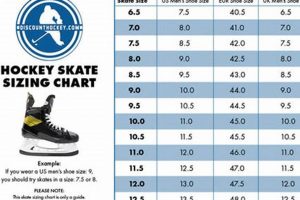
Skate size typically differs from shoe size. A professional fitting is recommended to accurately measure foot length and width, as well as to assess foot volume. Sizing charts specific to the skate manufacturer should then be consulted to determine the appropriate skate size.
Question 2: What are the key indicators of a properly fitted hockey skate?
When standing, the toes should lightly brush the end of the skate. When in a skating stance with flexed knees, the heel should remain securely locked in place with minimal lift. There should be no excessive pressure points or areas of discomfort.
Question 3: How tight should the laces be tied at different points on the skate?
Lacing pressure should be graduated, with lighter pressure over the forefoot to allow for circulation and increased pressure around the ankle to provide support and prevent heel lift. The uppermost eyelets should be laced firmly, but not so tightly as to restrict ankle flexion.
Question 4: Is heat molding necessary for all hockey skates?
Heat molding is beneficial for many skaters, as it allows the skate’s internal materials to conform more precisely to the foot’s unique contours. However, it is not strictly necessary for all skates, particularly those that already provide a comfortable and secure fit. Skates not designed for heat molding should not be subjected to the process.
Question 5: What type of socks are recommended for hockey skates?
Thin, moisture-wicking socks specifically designed for hockey skates are recommended. Thick or ill-fitting socks can compromise the fit and lead to blisters. Cotton socks should be avoided, as they retain moisture and can cause discomfort.
Question 6: How often should hockey skates be sharpened?
The frequency of skate sharpening depends on factors such as ice quality, skating frequency, and individual preference. Generally, skates should be sharpened every 10-20 hours of ice time. A dull blade can compromise edge control and reduce skating efficiency.
Achieving optimal hockey skate fit requires attention to multiple factors, including size, lacing pressure, and individual foot characteristics. Prioritizing comfort and support will enhance performance and minimize the risk of injury.
The following sections provide guidance on troubleshooting common fitting problems and ensuring long-term skate maintenance.
Determining Appropriate Hockey Skate Tightness
The preceding exploration has illuminated the critical factors involved in achieving proper hockey skate fit. It is clear that determining how tight hockey skates should be is not a matter of arbitrary preference, but rather a careful balancing act of performance, comfort, and safety. Precise sizing, graduated lacing pressure, consideration of heel stability and toe clearance, and the potential utilization of heat molding all contribute to an optimal outcome. The presence or absence of pressure points serves as a valuable indicator of fit adequacy.
The information presented underscores the significance of professional assessment and personalized adjustment. A well-fitted skate enhances on-ice agility, minimizes the risk of injury, and ultimately, maximizes a player’s potential. Continued attention to skate maintenance and fit, including regular monitoring for changes in foot condition, remains paramount throughout the lifespan of the equipment. The responsibility rests with each skater to prioritize these considerations for sustained performance and well-being.