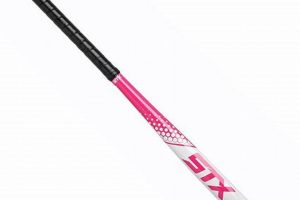
The primary implement for propelling a vulcanized rubber disc across an ice surface in the sport of ice hockey consists of a long, slender shaft, typically crafted from composite materials, wood, or aluminum, terminating in a flattened, curved blade. This tool is utilized in conjunction with a solid, circular disc composed of hardened rubber. The pairing enables players to maneuver and direct the disc with precision and power, facilitating gameplay.
The efficacy of the aforementioned equipment is paramount to the execution and enjoyment of the sport. Its design allows for both delicate puck handling and forceful shots on goal. Historically, the evolution of this equipment has significantly impacted gameplay strategies and player performance. From rudimentary wooden designs to modern composite constructions, advancements have consistently enhanced responsiveness, durability, and overall control.
The following sections will delve deeper into specific aspects, examining the physics governing their interaction, the technological advancements in their manufacturing, and the diverse playing styles influenced by variations in their design and characteristics.
Tips for Optimal Use
Effective utilization of the standard hockey apparatus requires careful consideration of several key factors. Maximizing performance and minimizing risk of injury necessitates adherence to established best practices.
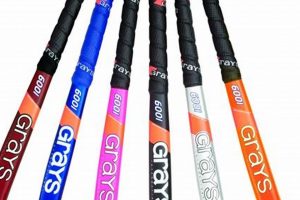
Tip 1: Proper Grip Selection: The choice of grip significantly impacts puck control and shot accuracy. Experimentation with various grip tapes and overgrips allows for a customized feel tailored to individual preferences and hand size. A secure, comfortable grip minimizes slippage and maximizes power transfer.
Tip 2: Blade Curve Assessment: The degree and type of blade curvature affect shot trajectory and puck handling finesse. A more pronounced curve facilitates lifting the puck, while a flatter blade prioritizes accuracy and passing. Selecting the appropriate curve based on playing style is crucial.
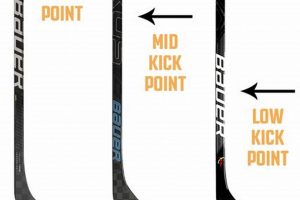
Tip 3: Shaft Flex Determination: Shaft flex dictates the amount of energy stored and released during a shot. A stiffer flex is suitable for players with greater strength and longer shots, while a more flexible shaft provides improved puck feel and quicker release for close-range shots.
Tip 4: Consistent Maintenance Procedures: Regular inspection and maintenance extend the lifespan and performance of the apparatus. Replacing worn grip tape, removing ice buildup from the blade, and storing the stick properly prevent degradation and ensure consistent performance.
Tip 5: Correct Posture and Positioning: Maintaining a balanced stance and appropriate distance from the puck is essential for effective puck handling and shooting. A low center of gravity and bent knees provide stability and facilitate quick movements.
Tip 6: Practice and Repetition: Consistent practice reinforces proper technique and muscle memory. Dedicated drills focusing on puck handling, shooting, and passing enhance overall skill and performance.
Tip 7: Selection by Height: Selection of the apparatus with the appropriate height can prevent back issues and allow for better stick handling abilities.
By implementing these guidelines, players can optimize the effectiveness of the standard hockey apparatus and enhance their overall performance on the ice. Careful attention to detail and consistent practice are essential for realizing the full potential.
The subsequent sections will further explore advanced techniques and strategies related to the use of the standard hockey apparatus in various game situations.
1. Material Composition

The material composition directly influences the performance characteristics and overall lifespan of hockey equipment. The interplay between the materials used in construction determines the transfer of energy, feel, and durability under the stresses of gameplay. This influence is critical to both puck control and shot effectiveness.
- Wood Core Construction
Historically, wood served as the primary material for hockey stick shafts and blades. While offering a traditional feel and a dampening effect on vibrations, wooden sticks are susceptible to moisture absorption, leading to increased weight and decreased performance. They also possess lower durability compared to modern materials, making them more prone to breakage under high-impact conditions. The inherent flexibility of wood allows for good puck feel but limits shot power.
- Aluminum Alloy Shafts
Aluminum alloy shafts offer increased durability and reduced weight compared to wood. These shafts provide a more consistent flex profile, contributing to predictability in shot execution. However, aluminum lacks the vibration-dampening properties of wood, which can result in a harsher feel during puck contact. The increased stiffness can also reduce puck feel for some players, requiring adjustments in technique.
- Fiberglass Composites
Fiberglass composites offer a balance of durability, weight, and performance. These materials allow for customized flex profiles and improved energy transfer compared to traditional materials. Fiberglass is more resistant to moisture damage and offers a wider range of stiffness options, catering to various playing styles. The layered construction of fiberglass provides impact resistance and prevents catastrophic failures common in wooden sticks.
- Carbon Fiber Composites
Carbon fiber composites represent the cutting edge in hockey stick technology. These materials provide the highest strength-to-weight ratio, resulting in lightweight sticks with exceptional power transfer capabilities. Carbon fiber enables precise control over flex profiles and torsional stiffness, optimizing performance for specific shot types. The advanced properties of carbon fiber enhance puck feel and responsiveness, allowing for greater control and precision. However, these sticks are often more expensive than other options.
In conclusion, the progression of materials used in equipment demonstrates a continuous effort to optimize performance and durability. From the traditional feel of wood to the cutting-edge technology of carbon fiber, the selection of materials plays a crucial role in shaping the capabilities and limitations of the equipment.
2. Blade Curvature

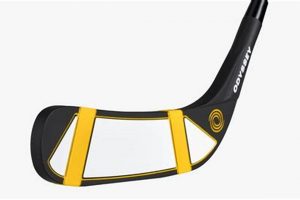
Blade curvature is a critical design element influencing the performance characteristics of hockey equipment. The specific contour of the blade impacts puck control, shot accuracy, and the ability to elevate the puck, thereby significantly affecting a player’s offensive capabilities.
- Heel Curve
A heel curve, characterized by a pronounced bend near the heel of the blade, is conducive to quick release shots and improved puck control in close quarters. The deep curve allows for a more secure cradle of the puck, facilitating rapid puck retrieval and passing. This configuration is often favored by players who prioritize agility and short-range scoring opportunities.
- Mid Curve
A mid curve provides a versatile balance between puck control, shooting accuracy, and puck elevation. The gradual bend along the middle section of the blade offers a comfortable feel for stickhandling and passing while also enabling players to generate sufficient lift for shots from various distances. This blade profile is frequently chosen by players seeking a well-rounded performance.
- Toe Curve
A toe curve, exhibiting a distinct upward bend at the toe of the blade, is designed for deceptive dekes and elevated shots. This curvature allows players to quickly lift the puck over goaltenders or defenders, creating scoring opportunities in tight situations. This configuration is favored by players skilled in stickhandling and adept at executing creative plays.
- Flat Curve
A flat curve provides maximum accuracy and control, as the puck remains in contact with a larger surface area of the blade during shooting and passing. This configuration typically delivers maximum power on slap shots, especially when aiming at an open net. The design provides more accuracy on shots from further distances.
In summary, the selection of a blade curvature is a highly individualized decision, dependent on a player’s style, position, and preferred shooting techniques. Each curve type offers distinct advantages and disadvantages, necessitating careful consideration to optimize on-ice performance. The understanding of these attributes can significantly contribute to enhanced puck handling and scoring proficiency.
3. Shaft Flexibility

Shaft flexibility, often termed “flex,” is a crucial characteristic influencing performance. It directly affects the energy transfer from the player to the puck during shooting and passing. A more flexible shaft bends more easily, storing potential energy that is then released as the shaft straightens during a shot. This can result in increased puck velocity, especially for players with shorter swings or less upper body strength. Conversely, a stiffer shaft bends less, requiring more force to load but delivering a more direct power transfer, potentially advantageous for players with longer, more powerful swings. Examples include a junior player often needing a 50-60 flex, while a professional player may use 100+. Selecting the appropriate flex is crucial to optimize performance.
The measurement of flex ratings quantifies the force (in pounds) required to bend the shaft one inch when supported at two points. The flex rating is stamped on the stick shaft. A lower flex number indicates a more flexible shaft, while a higher number indicates a stiffer shaft. Manufacturers offer a range of flex options to accommodate varying player strength, shooting style, and preferences. Incorrect flex selection can lead to reduced shot power, decreased accuracy, and increased risk of injury. For instance, using a shaft that is too stiff may cause the player to overexert themselves, while a shaft that is too flexible can reduce control and accuracy.
Understanding the relationship between shaft flexibility is essential for equipment selection. The chosen flex should align with the player’s strength, technique, and playing style to maximize shot power, accuracy, and overall performance. It’s important to note, that cutting the shaft increases it’s stiffness. Choosing the right flex depends on the player’s personal preferences.
4. Weight distribution
Weight distribution within the design of a hockey stick significantly influences a player’s ability to control the puck and execute various maneuvers. An optimal balance point facilitates quicker stickhandling, more responsive puck reception, and improved shot accuracy. The distribution of mass along the length of the implement affects its moment of inertia, impacting the rotational force required for actions such as passing, shooting, and checking. A stick with a higher concentration of weight towards the blade may enhance puck feel and quick wrist shots, while a more balanced distribution may favor powerful slap shots. Uneven weight distribution can lead to decreased control and increased fatigue, particularly during prolonged periods of play. For example, a top-heavy stick requires greater effort to control, potentially diminishing puck handling precision.
Consider the modern trend towards lighter, composite sticks. Manufacturers strategically redistribute mass to optimize performance characteristics. This often involves concentrating weight in specific areas of the blade to enhance puck feel or shifting the balance point towards the handle to improve stickhandling speed. Real-world examples include sticks designed for defensive players, which often feature a slightly heavier feel near the blade to facilitate clearing the puck, compared to offensive sticks, which prioritize a lighter, more balanced feel for quick shots and dekes. This understanding is crucial for players when selecting equipment tailored to their playing style and position on the ice.
In summary, weight distribution is a critical design consideration that profoundly affects handling and shooting capabilities. The strategic placement of mass within a hockey stick impacts its moment of inertia, influencing rotational control and energy transfer. Understanding the nuances of weight distribution allows players to make informed equipment choices, optimizing their performance and minimizing fatigue. Balancing weight can have positive or adverse effects. Challenges in achieving optimal weight distribution lie in balancing the need for puck feel, power, and maneuverability, often requiring compromise to suit individual preferences and playing styles.
5. Impact Dynamics
The interaction between a hockey stick and a puck is fundamentally governed by the principles of impact dynamics. Upon contact, kinetic energy from the stick’s swing is transferred to the puck, propelling it forward. The efficiency of this energy transfer is dictated by several factors, including the stick’s material properties (flex, stiffness, and composition), the angle of impact, and the coefficient of restitution between the stick’s blade and the puck. Variations in these parameters directly influence puck velocity, trajectory, and spin. High-speed video analysis of professional players demonstrates the precise synchronization required to maximize energy transfer and achieve optimal shot performance. The duration of contact can measure in milliseconds. Understanding these dynamics allows for optimizing stick design and improving player technique.
The practical applications of understanding impact dynamics extend to equipment design and training methodologies. Manufacturers utilize finite element analysis to simulate the collision between a stick and a puck, optimizing stick geometry and material selection to enhance energy transfer and durability. Coaches and trainers employ video analysis and biomechanical data to refine player technique, emphasizing proper stance, weight transfer, and wrist action to maximize shot power and accuracy. Real-world examples include the development of composite sticks with tailored flex profiles designed to amplify energy transfer for specific shot types, or training drills focused on teaching players to generate maximum puck velocity through proper technique.
In conclusion, impact dynamics constitutes a crucial element in comprehending the interplay between a hockey stick and a puck. The ability to manipulate impact parameters through equipment design and technique optimization directly translates to improved on-ice performance. Challenges in this field include accurately modeling the complex material behavior of both the stick and the puck, as well as accounting for the variability in player technique. Further research into impact dynamics promises to unlock advancements in both equipment technology and player development, leading to enhanced gameplay and reduced risk of injury.
Frequently Asked Questions Regarding the Hockey Stick and Puck
This section addresses common inquiries surrounding equipment, offering comprehensive insights for a clearer understanding.
Question 1: What factors determine optimal flex?
Selection involves analyzing player weight, height, strength, and shot style. A player should achieve maximum shaft bend during shot loading without compromising control.
Question 2: How frequently should grip tape be replaced?
Replacement frequency depends on usage and environmental conditions. Replace when the tape becomes worn, slippery, or loses its tackiness to maintain optimal control.
Question 3: What is the expected lifespan of a composite stick?
Lifespan depends on usage intensity and potential impacts. Regularly inspect for cracks or damage, replacing as soon as performance is negatively affected.
Question 4: How does blade curve affect shot accuracy?
The blade curve influences puck trajectory and lift. Different curves are suitable for various shot types, requiring experimentation for individual optimization.
Question 5: What are the regulations concerning stick length?
Regulations vary by league. Typically, the stick length must not exceed a predetermined maximum, ensuring fair play and safety.
Question 6: Can environmental factors affect stick performance?
Temperature and humidity influence material properties. Extreme conditions can alter stick flexibility, potentially affecting performance and durability.
The preceding responses offer clarity on typical issues. However, specialized issues should be referred to experts.
The following section delves into best practices for equipment care and maintenance.
Conclusion
This exploration of the hockey stick and a puck has illuminated the multifaceted nature of this essential equipment pairing. From the nuances of material composition and blade curvature to the impact of shaft flexibility and weight distribution, each element contributes significantly to the overall performance and effectiveness of the tools employed in the sport of ice hockey. Furthermore, an understanding of impact dynamics provides critical insights into the energy transfer and resulting puck behavior during gameplay.
Continued advancements in material science, engineering, and player training promise further refinements in equipment design and utilization. A deeper comprehension of these interrelating factors will undoubtedly contribute to enhanced player performance, increased safety, and an elevated level of strategic gameplay within the sport. Further study and adaptation within this field is highly encouraged to maximize the utility of this sport.