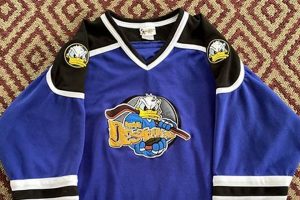
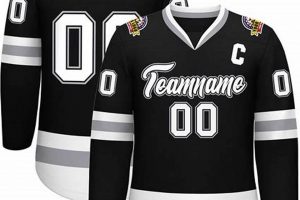
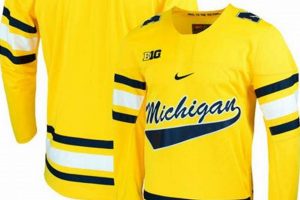
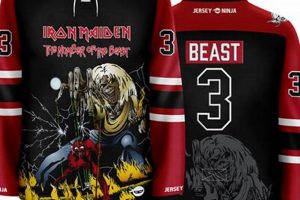
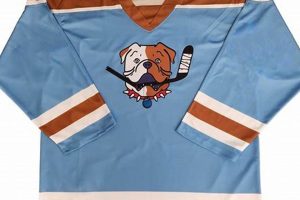
Pre-designed layouts for ice hockey team wear enable efficient creation of customized apparel. These structures offer a starting point for incorporating team colors, logos, player names, and numbers. A standard example might include a vector file with designated areas for front and back team branding, shoulder patches, and numbering placements, readily adaptable within graphic design software.
The utilization of such frameworks significantly reduces design time and costs associated with creating hockey jerseys from scratch. Historically, teams relied on manual drafting and pattern making, a process that was both time-intensive and prone to errors. The advent of digital templates has streamlined production, allowing for greater design flexibility and faster turnaround times, particularly beneficial for leagues with rapid team roster changes or promotional jersey releases. These designs also ensure consistent styling across a teams entire uniform set.
The subsequent sections will delve into the various types of these layouts available, crucial factors to consider when selecting a suitable one, the software utilized for customization, and best practices for achieving professional-quality results in designing athletic apparel.
Design Tips for Hockey Jerseys
Optimizing the look and functionality of ice hockey jerseys requires a strategic approach to template utilization. The following tips provide guidance for achieving professional results.
Tip 1: Vector Graphics are Essential: Prioritize templates supplied as vector files (e.g., .AI, .EPS, .SVG). Vector graphics maintain image quality regardless of scaling, ensuring logos and designs remain sharp even on large jersey sizes.
Tip 2: Consider Fabric and Printing Methods: The material and print technique influence template design. Sublimation printing allows for all-over graphics, while screen printing restricts color gradients and design complexity.
Tip 3: Adhere to League Regulations: Before finalizing a design, consult league guidelines regarding logo size, placement restrictions, and color regulations. Non-compliance can result in penalties or jersey rejection.
Tip 4: Prioritize Readability: Player names and numbers must be easily legible from a distance. Select font styles with clear, bold lettering and ensure sufficient contrast against the jersey background.
Tip 5: Maintain Brand Consistency: The jersey should align with the team’s overall branding. Utilize consistent fonts, colors, and logo placements across all team merchandise and marketing materials.
Tip 6: Utilize Mockups: Before mass production, create digital mockups of the finalized design. This allows for visual confirmation of the jersey’s appearance and facilitates necessary adjustments.
Tip 7: Optimize for Visibility on Ice: Account for the dynamic environment of the ice rink. Consider how lighting and movement affect the visibility of colors and graphics. Brighter colors tend to be more visible, but the overall design needs cohesion.
Employing these strategies during the template adaptation process contributes to a visually appealing and functional hockey jersey design that enhances team identity and performance.
The ensuing discussion will cover the software applications most suited for modifying and customizing these frameworks to achieve optimal results.
1. Vector file format

The use of vector file formats is paramount in the context of team wear design. Vector graphics, defined by mathematical equations rather than pixels, maintain resolution and sharpness irrespective of scaling. When a design framework is provided as a vector file (.AI, .EPS, .SVG), elements such as team logos, player names, and numbers can be resized without degradation. This is critical for hockey team wear, as jersey sizes vary significantly, and the design must remain crisp across all sizes. For example, a team crest provided as a bitmap image might appear blurry when enlarged for a larger jersey, while a vector version remains perfectly defined. The quality of the design is directly linked to the source file type, making vector formats the superior option in team wear.
The selection of a format directly impacts the flexibility of the design process. Vector templates are readily adaptable using industry-standard software like Adobe Illustrator or CorelDRAW, facilitating effortless customization. Colors can be changed, logos repositioned, and text modified without compromising image integrity. Consider a scenario where a team changes sponsors mid-season. With a vector framework, the new sponsor’s logo can be easily integrated without the need to recreate the entire layout from scratch. This adaptability proves invaluable for efficient design workflows and rapid production cycles, mitigating design-related costs and delays.
In summary, the adoption of vector-based templates for team wear directly addresses the challenge of maintaining design integrity across a range of jersey sizes and design alterations. The lossless scaling capabilities and design flexibility inherent in vector formats enhance the overall quality of the final product. The adoption of vector file format is not a luxury but a fundamental requirement for professional, adaptable, and high-quality hockey jersey templates design.
2. Customization Software

Customization software serves as the critical interface for manipulating ready-made layouts into finalized team wear. The effectiveness of ice hockey jersey templates is intrinsically tied to the capabilities of the software used to modify them. The software allows designers to implement team branding, adjust color schemes, insert player names and numbers, and prepare the design for production. Without robust customization software, the utility of even the most well-designed structure is severely limited. For instance, a complex logo might require advanced masking and layering features available in professional software to integrate seamlessly into the framework.
The availability of specific features within the software directly impacts the quality and efficiency of the customization process. Vector editing tools are crucial for preserving the resolution of logos and graphics during resizing, as previously stated, thus preventing pixelation and blurriness. Color management tools enable precise color matching to team specifications, ensuring consistent branding across all jerseys. Layering capabilities facilitate the creation of complex designs with multiple overlapping elements. Specialized functions, such as adding textures or applying effects, allow for unique design elements, improving team identity. The software selection directly determines the range of possible design options and the ease with which they can be implemented. A youth hockey league using basic software may struggle to create complex designs, while a professional team employing advanced software can achieve intricate and customized jerseys.
In summary, customization software is not merely an accessory, but an integral component of the overall team wear design process. The choice of software dictates the level of customization possible, the efficiency of the design workflow, and the overall quality of the finished product. Understanding the capabilities of different software options and selecting the appropriate tool is crucial for realizing the full potential of hockey team wear frameworks and ensuring that the final jerseys accurately represent the team’s brand and identity.
3. Print Method

The chosen print method exerts a profound influence on framework design for hockey jerseys. The method dictates limitations on design complexity, color gradients, and overall image resolution achievable on the final product. Sublimation, screen printing, and heat transfer each present unique constraints that the template must accommodate. For example, sublimation, which infuses ink directly into the fabric, allows for all-over prints and intricate designs. In this case, the template can facilitate the entire jersey surface for design elements. In contrast, screen printing, where ink is applied to the fabric surface through a stencil, typically requires simpler designs with fewer colors to minimize production costs and complexity. Hence, a template designed for screen printing would delineate specific areas for print, avoiding intricate patterns or gradients unsuited for the process. The selection of the printing technique therefore fundamentally influences the complexity and design flexibility afforded to the layout. Templates must be adapted accordingly to suit the demands and constraints of the selected method.
A mismatch between template design and print method can result in compromised quality and increased production costs. If a layout designed for sublimation is used for screen printing, the outcome may suffer from color inaccuracies, banding, or a loss of detail. Similarly, attempting to print complex gradients on a framework designed for heat transfer, which is generally suited for simple designs with solid colors, can result in unsatisfactory results. Real-world applications demonstrate this principle: professional hockey teams utilizing sublimation for their jerseys enjoy intricate designs and vibrant colors, while amateur teams relying on screen printing often opt for simpler designs to minimize costs and production difficulties. Understanding these limitations enables informed decisions during the design process, ensuring visual aesthetic matches the printing capabilities to stay within budgetary and time constraints.
In summary, the interrelationship between print method and template design constitutes a critical consideration in the design process. Templates serve as guides for design application; the print process provides the capability of design production. Failure to account for the limitations of the chosen print method during template creation can lead to design compromises and increased production costs. The choice of print technology dictates design complexity and capabilities of the framework, making the technique a foundational element of design. Templates facilitate optimized design and high-quality jerseys while aligning with budget and design needs.
4. League regulations
Ice hockey league regulations exert a significant influence on the design and implementation of team jerseys. These regulations, often dictated by governing bodies, specify permissible colors, logo sizes and placements, player numbering conventions, and advertising restrictions. A design process that neglects these regulations risks jersey rejection, fines, or even player ineligibility. For instance, the National Hockey League (NHL) mandates specific font styles and sizes for player names and numbers. Frameworks intended for NHL teams must, therefore, adhere to these constraints, incorporating designated areas and parameters for compliant lettering. Deviation from these standards results in the jersey being deemed non-compliant, impacting a teams brand image and potentially incurring penalties.
The impact of league regulations extends beyond aesthetic considerations to encompass player safety and team identification. Regulations concerning contrasting colors between the jersey and player numbers ensure visibility on the ice, aiding referees and spectators. Restrictions on logo placement prevent obstruction of player numbers or names. Frameworks designed without regard for these requirements jeopardize player recognition and potentially compromise safety. For example, The International Ice Hockey Federation (IIHF) enforces strict rules regarding advertising on jerseys, prohibiting placement that could be confused with team insignia or obstruct player identification. Templates must therefore incorporate clearly defined advertising zones conforming to IIHF guidelines, illustrating the practical significance of integrating regulatory considerations into the design.
In summary, adherence to league regulations is not merely a formality but an integral aspect of framework development for hockey team wear. Failure to comply with these rules results in practical consequences ranging from jersey rejection to player safety concerns. Therefore, a thorough understanding of and adherence to specific league guidelines are critical to ensuring the successful design and implementation of compliant and effective team apparel. This compliance forms the backbone of the design process, driving the implementation and overall quality of the jersey.
5. Branding consistency
The application of a team’s established brand identity to hockey jerseys necessitates meticulous alignment between the template and overall brand guidelines. Consistent use of colors, logos, fonts, and design elements across all team assets, including jerseys, reinforces brand recognition and strengthens team identity. Using a framework that deviates from established branding diminishes the team’s visual identity, potentially causing confusion among fans and impacting merchandise sales. For instance, if a team’s primary color is a specific shade of blue defined by a precise Pantone code, the template must accurately reproduce that shade to maintain visual coherence. Similarly, logo placement and size on the jersey must adhere to established brand standards to ensure consistent presentation.
The implementation of branding consistency extends beyond visual aesthetics to encompass the overall message and values associated with the team. A well-designed framework serves as a vehicle for communicating team values, such as tradition, competitiveness, or community involvement. Through deliberate design choices, the jersey can evoke specific emotions or associations, further solidifying the team’s brand identity. Consider the example of a team with a long and storied history. A template incorporating vintage design elements or classic typography can pay homage to the team’s heritage, reinforcing a sense of tradition and continuity. Conversely, a modern, streamlined template can project an image of innovation and progressiveness. Branding consistency ensures that the message conveyed by the jersey aligns with the team’s overall brand strategy, strengthening the connection between the team and its fans.
In conclusion, maintaining branding consistency in the design of hockey jerseys represents a crucial element in reinforcing team identity and strengthening brand recognition. Using templates that accurately reflect and complement the team’s established brand guidelines enables a cohesive visual representation across all platforms. Challenges to branding consistency can emerge from production limitations, cost constraints, and design interpretation. However, the core principle is that the jersey serves as a visual ambassador for the team, and consistent branding ensures that this message is clear, unified, and representative of the team’s values. The overall effect is a stronger fan base, higher merchandise sales, and a more recognizable brand presence, thereby contributing to the long-term success and image of the team.
6. Visual clarity

Visual clarity constitutes a foundational requirement in the design of hockey jerseys. Effective templates facilitate the creation of jerseys that are easily legible and visually distinct, both on the ice and from a distance. Poor visual clarity hinders player identification and diminishes the overall aesthetic appeal of the team’s uniform. The framework acts as the blueprint for ensuring that key elements, such as player numbers and names, are prominent and readily discernible against the background of the jersey. A primary cause of poor visual clarity stems from inadequate contrast between the lettering and the jersey fabric. For example, a dark blue number on a black jersey would be difficult to read, especially during the fast-paced action of a game. Conversely, a template that mandates sufficient contrast, such as a white number outlined in black on a dark jersey, significantly enhances readability. The practical significance is clear: increased player identification for referees, improved spectator experience, and a more professional on-ice appearance.
The structure also influences the placement and size of logos and design elements, which contribute to overall visual harmony. Overcrowded or poorly positioned elements detract from the legibility of player information. For instance, a template that allows for an excessively large logo to obscure a portion of the player’s number compromises visual clarity and violates professional design principles. Instead, effective templates define specific zones for logos and restrict their size to prevent interference with essential information. Moreover, the font selection plays a crucial role. Ornate or overly stylized fonts can be difficult to read, especially at a distance. A template recommending clean, sans-serif fonts ensures maximum legibility. Consider the contrasting examples of professional NHL jerseys, which prioritize visual clarity with simple fonts and contrasting colors, versus amateur league jerseys, which sometimes sacrifice legibility for elaborate designs. The choice impacts readability and fan recognition.
In summary, visual clarity is not merely an aesthetic consideration but a functional imperative in the design of hockey jerseys. Templates serve as critical tools for ensuring that key elements are easily legible, well-positioned, and visually distinct. A lack of emphasis on visual clarity results in compromised player identification, diminished aesthetic appeal, and potential safety concerns. Prioritizing visual clarity through thoughtful framework design enhances both the on-ice functionality and the overall professionalism of the team’s appearance. The visual presentation contributes to the team identity as a whole.
Frequently Asked Questions About Hockey Jersey Template Design
The following section addresses common inquiries regarding the design and utilization of ice hockey team wear layouts.
Question 1: What file format is most suitable for templates intended for customizing hockey jerseys?
Vector file formats, such as .AI, .EPS, and .SVG, are the most appropriate choices. These formats allow for lossless scaling, ensuring that logos, numbers, and other design elements maintain their sharpness and clarity regardless of size adjustments. Raster-based formats, such as .JPG or .PNG, are not recommended due to their tendency to pixelate when enlarged.
Question 2: What software is recommended for customizing hockey team wear layouts?
Industry-standard vector graphics editors, such as Adobe Illustrator and CorelDRAW, are the preferred software options. These programs provide the necessary tools for manipulating vector graphics, adjusting colors, adding text, and preparing designs for print production. Open-source alternatives like Inkscape can also be viable options.
Question 3: How does the chosen print method affect the design of a hockey jersey?
The print method directly influences the complexity and type of designs that can be effectively reproduced on the jersey. Sublimation allows for all-over prints and intricate gradients, while screen printing is better suited for simpler designs with fewer colors. Heat transfer is generally limited to basic designs with solid colors. The framework must be tailored to accommodate the capabilities and limitations of the selected method.
Question 4: What design constraints are imposed by league regulations?
League regulations dictate permissible colors, logo sizes and placements, font styles, and advertising restrictions. Teams must adhere to these regulations to avoid penalties or rejection of their jerseys. It is crucial to consult league guidelines prior to finalizing any design.
Question 5: Why is branding consistency important in the context of hockey team wear?
Branding consistency reinforces team identity, strengthens brand recognition, and fosters fan loyalty. Jerseys should incorporate the team’s established colors, logos, and fonts, maintaining a cohesive visual identity across all team assets.
Question 6: What strategies can be employed to ensure visual clarity on a hockey jersey?
Prioritize high contrast between lettering and the jersey fabric, utilize clean and legible fonts, and avoid overcrowding the design with excessive elements. Proper placement and size limitations of logos contribute to overall legibility.
The answers provided offer guidance for navigating complexities in the design process.
The following sections will delve into specific case studies of successful team wear designs.
Conclusion
The foregoing exploration of layouts for ice hockey jerseys emphasizes their pivotal role in creating effective team apparel. Adherence to vector file formats, utilization of appropriate customization software, consideration of print methods, compliance with league regulations, maintenance of branding consistency, and prioritization of visual clarity represent essential components of a successful design process. Neglecting any of these elements risks compromising the quality, functionality, and overall impact of the final product.
The strategic application of established methods for creating hockey jerseys offers tangible benefits for teams at all levels of competition. It is incumbent upon designers and organizations to recognize the significance of these factors and invest in processes that ensure optimal results. The future success of team branding relies on the continued refinement and conscientious implementation of these design principles.