The component affixed to the lower portion of a hockey stick, crafted typically from composite materials, wood, or a combination thereof, plays a crucial role in directing and propelling the puck. It serves as the primary interface between player and playing surface during puck handling, shooting, and passing. For instance, during a wrist shot, the curvature and angle of this component impart spin and lift to the puck.
This crucial element significantly impacts a player’s performance. Its design characteristics, including curve, lie, and material composition, influence shot accuracy, puck control, and overall agility on the ice. Historically, innovations in its construction and design have consistently improved player capabilities and contributed to the evolution of the sport, influencing everything from offensive strategies to equipment manufacturing techniques.
The following discussion will delve into the various types, construction, and performance factors that characterize this key piece of hockey equipment. Subsequent sections will cover material science considerations, design variations, and practical implications for player selection.
Optimizing Hockey Performance
The following recommendations are intended to enhance on-ice effectiveness through a strategic approach to equipment selection and maintenance.
Tip 1: Select an Appropriate Curve: The degree and type of curvature should align with the player’s shooting style and position. A pronounced curve facilitates elevated shots, whereas a subtle curve may enhance puck control. Evaluate individual playing style to determine the optimal curvature profile.
Tip 2: Determine the Correct Lie: Lie refers to the angle between the component and the shaft. Proper lie ensures the element rests flat on the ice when in a hockey stance. An incorrect lie negatively impacts shot accuracy and puck handling capabilities. Professional fitting is recommended to ascertain the ideal lie.
Tip 3: Consider Material Composition: Composite models offer a balance of weight, durability, and responsiveness. Wooden models provide a traditional feel and can be a cost-effective option. The selected material should reflect budgetary constraints and desired performance characteristics.
Tip 4: Regularly Inspect for Damage: Cracks or chips compromise structural integrity and can lead to breakage during play. Regular inspection, particularly after impacts, is crucial. Damaged components should be replaced to prevent injury and maintain consistent performance.
Tip 5: Adapt to Playing Surface: Ice conditions influence puck behavior. Adjustments to equipment setup, including tape application, may be necessary to optimize puck control and shooting performance on different surfaces. Consider the ambient temperature and humidity’s effect on ice conditions.
Tip 6: Prioritize Consistent Maintenance: Routinely clean the surface after each use to remove ice buildup and debris. This practice maintains puck feel and extends the lifespan. Implementing a consistent maintenance schedule is paramount.
Adherence to these recommendations contributes significantly to improved puck handling, shot accuracy, and overall on-ice performance. Proper selection and diligent maintenance enhance the player’s competitive advantage.
The succeeding section will address advanced customization techniques and specialized equipment options.
1. Curve characteristics

Curve characteristics are a defining attribute of a hockey blade, directly impacting puck trajectory and shot accuracy. The specific bend or curvature present dictates the degree to which a player can elevate the puck, generate spin, and impart different shot types. For instance, a blade featuring a pronounced open curve, often referred to as a “banana blade,” enables players to lift the puck quickly, facilitating shots over goaltenders or clearing obstacles. Conversely, a straighter curve promotes enhanced puck control and more accurate passing, as the puck tends to stay flatter during release.
The significance of curve characteristics extends beyond mere shot elevation. It influences the player’s ability to receive passes, control the puck in tight spaces, and execute deceptive maneuvers. A closed curve, where the toe is angled inwards, can be advantageous for quick releases and backhand shots. Furthermore, the location of the curve along the blade’s length affects shot power and release point. A heel curve, positioned closer to the stick’s shaft, provides more leverage and power, while a toe curve offers a quicker release. The “lie” of the stick and the curve type are interlinked; selecting a curve without considering the appropriate lie can lead to compromised puck handling and shooting inefficiencies. Consider a forward accustomed to a mid-curve using a heel curve. This may cause them to consistently shoot high, highlighting the importance of matching blade geometry to individual technique.
In summary, curve characteristics constitute a pivotal aspect of a hockey blade, shaping a player’s offensive capabilities. Understanding the cause-and-effect relationship between blade curve and puck behavior is paramount for equipment selection and skill development. Matching the curve to a player’s style, position, and ice conditions maximizes performance potential. Ignoring this intricate design element can compromise puck control, shot accuracy, and ultimately, a player’s competitive edge.
2. Lie angle

The lie angle, concerning a hockey blade, denotes the angle formed between the blade and the shaft of the hockey stick. This angle dictates the blade’s orientation relative to the ice surface when a player assumes their typical skating stance. Appropriate lie selection is critical for efficient puck handling and shot execution.
- Blade Contact with Ice
An appropriate lie angle ensures that the entire blade maintains consistent contact with the ice surface. If the lie is too upright, the heel of the blade may be the only point of contact. Conversely, if the lie is too flat, the toe of the blade may be the sole point of contact. Both scenarios compromise puck control, reducing the player’s ability to receive passes cleanly, control the puck effectively, and execute accurate shots.
- Body Posture and Efficiency
The lie angle influences a player’s posture while stickhandling. An incorrect lie may necessitate unnatural adjustments to the player’s stance, such as bending excessively at the waist or reaching too far forward. These postural adaptations reduce efficiency, impede agility, and potentially contribute to fatigue or injury. Proper lie selection promotes a balanced and athletic stance, allowing for fluid movements and optimal energy transfer.
- Shot Accuracy and Power
The lie angle affects a player’s ability to generate power and accuracy when shooting. When the blade makes full and consistent contact with the ice, the player can effectively load the stick and transfer energy into the puck. An improper lie disrupts this energy transfer, leading to decreased shot velocity and reduced accuracy. Furthermore, it can alter the puck’s trajectory, causing shots to be consistently too high or too low.
- Relationship to Player Height and Skating Style
Lie angle selection is not arbitrary; it must be tailored to a player’s height, skating style, and stick length. Taller players generally require flatter lies, while shorter players may benefit from more upright lies. A player’s skating posture and how they hold the stick also influence the ideal lie. Experimentation and professional fitting are often necessary to determine the optimal lie angle for individual players.
In conclusion, the lie angle represents a fundamental aspect of a hockey blade’s functionality. Its correct selection has a direct impact on a player’s puck handling skills, shooting performance, and overall on-ice efficiency. Ignoring this element can compromise a player’s capabilities, while a properly fitted lie contributes significantly to enhanced performance and reduced risk of injury.
3. Material composition

Material composition stands as a defining characteristic of any hockey blade, directly influencing its performance, durability, and feel. The materials employed dictate the energy transfer during puck contact, the overall weight of the stick, and its resistance to wear and tear. The choice of material is, therefore, a critical decision in equipment selection.
- Wood
Historically, wood served as the primary material for hockey sticks, including the blade. Wood offers a traditional feel and is relatively inexpensive. However, wooden blades tend to be heavier and less durable than those constructed from composite materials. They also exhibit less responsiveness, meaning they do not transfer energy as efficiently during shooting. The natural variability in wood density can also lead to inconsistent performance.
- Fiberglass
Fiberglass represents an intermediate material, often used as a reinforcement layer in wood blades or as a component in composite structures. Fiberglass provides increased durability and stiffness compared to wood alone. Blades incorporating fiberglass exhibit improved resistance to moisture and impact damage. However, fiberglass blades still lack the lightweight and high-performance characteristics of advanced composites.
- Composite Materials (Carbon Fiber, Aramid Fibers)
Modern hockey blades predominantly utilize composite materials, such as carbon fiber and aramid fibers (e.g., Kevlar). Carbon fiber offers an exceptional strength-to-weight ratio, resulting in lightweight blades with high stiffness and responsiveness. Aramid fibers enhance impact resistance and vibration damping. Composite blades allow for precise control over flex profiles and weight distribution, enabling manufacturers to tailor performance characteristics to specific player preferences. The layering and orientation of composite fibers during manufacturing determine the blade’s stiffness, torsional resistance, and overall durability.
- Hybrid Constructions
Many hockey blades feature hybrid constructions, combining different materials to optimize specific performance attributes. For example, a blade might incorporate a carbon fiber face for enhanced puck feel and responsiveness, with an aramid fiber core for increased durability. Some manufacturers also integrate dampening materials to reduce vibrations and improve shot accuracy. These hybrid designs represent a sophisticated approach to material selection, balancing performance, durability, and cost considerations.
In summation, the material composition of a hockey blade profoundly influences its performance characteristics. The progression from traditional wooden blades to advanced composite designs reflects a continuous pursuit of enhanced performance, durability, and customization. The ongoing development of new materials and manufacturing techniques ensures that material composition will remain a central focus in the evolution of hockey equipment.
4. Weight distribution
Weight distribution within a hockey blade is a critical design parameter affecting a player’s puck handling, shot power, and overall stick balance. The precise allocation of mass along the blade’s length and within its cross-section dictates how the stick feels in the player’s hands and how efficiently energy is transferred during puck contact. Understanding weight distribution is crucial for optimizing equipment selection to suit individual playing styles and preferences.
- Blade Balance Point
The location of the blade’s balance point influences its perceived weight and swing feel. A blade with a balance point shifted towards the toe may feel heavier and promote quicker stickhandling, while a blade with a balance point closer to the heel offers enhanced stability and control. Players often compensate for balance point variations by adjusting their grip or adding weight to the stick shaft.
- Torsional Stiffness and Weight
Weight distribution impacts the blade’s torsional stiffness, which is its resistance to twisting. A blade with more mass concentrated at the edges tends to be torsionally stiffer, resulting in more accurate shots and improved puck feel. However, increased weight can reduce swing speed and make the blade feel less responsive. Manufacturers strategically distribute weight to achieve an optimal balance between stiffness and responsiveness.
- Impact on Puck Handling
Weight distribution affects a player’s ability to control the puck effectively. A blade with a lightweight feel allows for quicker hand movements and more precise puck placement. However, a blade that is too light may lack the necessary stability to absorb impacts and maintain puck control during physical play. The ideal weight distribution facilitates both agility and stability.
- Influence on Shot Power and Release
The distribution of mass within the blade contributes to shot power and release speed. A blade with a higher concentration of mass near the point of contact can generate more force upon impact with the puck. However, this increased mass may also slow down the release. Manufacturers carefully engineer weight distribution to optimize the transfer of energy from the player’s body to the puck.
The facets discussed above reveal the intricate connection between weight distribution and hockey blade performance. Alterations in weight distribution have tangible effects on stickhandling, shot power, and overall feel. Players should, therefore, consider weight distribution alongside other key characteristics, such as curve, lie, and material composition, when selecting hockey equipment. The optimal weight distribution is subjective and depends on a player’s individual technique and style of play.
5. Flex profile
The flex profile of a hockey blade, intrinsically linked to the overall stick flex, dictates how the blade bends under load during shooting and puck handling. This characteristic significantly influences shot power, accuracy, and the speed of puck release. The flex profile is engineered through strategic variations in blade thickness, material distribution, and internal construction.
- Kick Point Location
The kick point, also known as the flex point, designates the area along the stick where the greatest amount of bending occurs. A low kick point, situated closer to the blade, facilitates a quicker release, ideal for snapshots and close-range shots. Conversely, a high kick point, positioned nearer the top of the stick, maximizes energy storage for powerful slap shots and longer-range shots. A mid-kick point offers a compromise between quick release and power. The location of the kick point is a key determinant of the blade’s flex characteristics and its suitability for specific shooting styles.
- Torsional Flex
Torsional flex refers to the blade’s resistance to twisting. A blade with high torsional stiffness maintains a consistent face angle during shooting, promoting accuracy and preventing the puck from hooking or fluttering. Blades with lower torsional stiffness may offer a softer feel but can compromise shot precision. Manufacturers often utilize specific fiber orientations and reinforcing materials to control torsional flex. High Torsional flex can be extremely helpful in preventing unwanted twists during high force contact.
- Blade Stiffness Profile
The stiffness profile describes how the blade’s stiffness varies along its length. A blade with a stiff toe section enhances accuracy and control when receiving passes and stickhandling. A softer heel section allows for greater flex and energy transfer during shooting. The specific combination of stiffness levels along the blade contributes to its overall feel and performance characteristics. The overall blade stiffness will determine the force on the blade during puck contact.
- Impact Absorption
The flex profile affects the blade’s ability to absorb impacts from pucks and opposing players. A blade with good impact absorption reduces vibrations and minimizes the risk of damage. Materials such as aramid fibers and specialized dampening layers are incorporated to enhance impact resistance and improve player comfort. A blade that can absorb the contact without excess vibration is better controlled.
In summary, the flex profile of a hockey blade is a multifaceted characteristic encompassing kick point location, torsional flex, blade stiffness, and impact absorption. Careful consideration of these elements is crucial for optimizing shot power, accuracy, and overall stick handling performance. Understanding and matching the blade’s flex profile to a player’s individual shooting style and preferences is paramount for maximizing their on-ice effectiveness.
6. Blade length

Blade length, a defining attribute of a hockey blade, refers to the distance from the heel (where the blade connects to the shaft) to the toe (the distal end). This measurement directly influences puck handling capabilities, shot characteristics, and overall player control. Varying blade lengths cater to diverse playing styles and positional requirements.
- Puck Control and Stickhandling
Shorter blades, typically preferred by forwards, enhance puck control in confined spaces. The reduced length allows for quicker hand movements and tighter turns while stickhandling, facilitating deking and rapid changes in direction. Conversely, longer blades offer a larger surface area for receiving passes and intercepting pucks, often favored by defensemen seeking to control the puck along the boards.
- Shot Power and Accuracy
Longer blades generally provide increased leverage, potentially leading to more powerful shots, particularly slap shots. The extended surface area allows for greater energy transfer from the player to the puck. However, this increased power can come at the expense of accuracy. Shorter blades, while potentially sacrificing some power, offer improved control over shot direction and precision, particularly for wrist shots and snapshots.
- Reach and Defensive Coverage
Defensemen often opt for longer blades to maximize their reach, enabling them to disrupt passing lanes, block shots, and poke check opponents effectively. The added length provides a greater defensive presence and allows for broader coverage of the ice. Forwards, prioritizing agility and offensive maneuvers, typically find that the added length of a longer blade hinders their stickhandling and quick movements.
- Skating Style and Body Size
The ideal blade length is influenced by a player’s skating style and body size. Taller players may benefit from slightly longer blades to maintain proper posture and reach. Players with a more upright skating style may also prefer longer blades, while those who skate with a lower center of gravity may find shorter blades more comfortable and responsive. Experimentation and personal preference are crucial in determining the optimal blade length for individual players.
In conclusion, blade length constitutes a significant factor in hockey blade design, directly impacting puck control, shot characteristics, reach, and overall player effectiveness. The selection of an appropriate blade length should align with a player’s position, playing style, and physical attributes to optimize their on-ice performance. Balancing the trade-offs between control, power, and reach is essential for achieving peak performance.
7. Surface texture

Surface texture, in the context of a hockey blade, is the micro-level characteristic of the blade’s outer layer. It profoundly influences the friction coefficient between the blade and the puck, dictating puck feel, control, and ultimately, shot performance. Variations in surface texture, whether intentional or resulting from wear, directly impact a player’s ability to manipulate the puck effectively.
- Coefficient of Friction and Puck Grip
The primary role of surface texture is to modulate the coefficient of friction. A rougher surface texture enhances grip on the puck, promoting superior control during stickhandling and passing. Conversely, an overly smooth surface may lead to the puck slipping off the blade, particularly during rapid movements or changes in direction. The optimal surface texture strikes a balance between grip and release, allowing for both precise control and efficient energy transfer during shooting. Consider the application of grip tape; this intentional roughening of the surface demonstrably increases control, though can decrease release speed.
- Tape Application and Customization
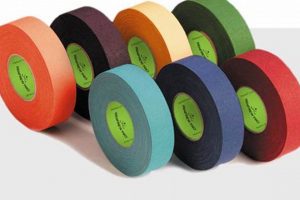
Players frequently customize the surface texture of their blades through the application of tape. Cloth tape, for example, provides a textured surface that enhances puck grip and offers a degree of cushioning upon impact. The pattern and layering of tape can be tailored to individual preferences, influencing puck feel and control characteristics. The type of tape, its application method, and the frequency of replacement all contribute to the overall surface texture and its impact on performance. Experimentation is often done for optimization.
- Wear and Degradation Effects
The surface texture of a hockey blade degrades over time due to wear and tear from ice abrasion, puck impacts, and contact with other players’ equipment. This degradation can alter the friction coefficient, potentially diminishing puck control and shot accuracy. Regular inspection and maintenance are essential to preserve the desired surface texture and ensure consistent performance. This is the reason hockey tape requires regular replacement.
- Material-Specific Textures
The inherent surface texture of a hockey blade is also influenced by the materials used in its construction. Composite blades, for example, often feature a smoother surface than wooden blades, due to the manufacturing processes involved. Manufacturers may intentionally introduce textures or coatings to composite blades to enhance grip or modify puck feel. The choice of materials, therefore, plays a critical role in determining the initial surface texture and its subsequent performance characteristics.
The multifaceted influence of surface texture on hockey blade performance underscores its importance in equipment design and player customization. Controlling surface texture offers an avenue for players to fine-tune their equipment to match their individual playing styles and preferences. Ongoing research into materials and coatings aims to further optimize surface texture for enhanced puck handling, shot accuracy, and overall on-ice effectiveness.
Frequently Asked Questions
This section addresses common inquiries regarding hockey blades, providing clarity on key aspects and dispelling potential misconceptions.
Question 1: What is the optimal method for selecting a curve?
Curve selection should align with a player’s shooting style and on-ice position. Players who frequently elevate the puck may benefit from a more pronounced curve. Those prioritizing puck control may favor a straighter blade. Professional fitting and experimentation are recommended to determine the optimal curve.
Question 2: How does lie angle affect performance?
The lie angle impacts blade contact with the ice. An incorrect lie can compromise puck handling and shot accuracy. The ideal lie ensures that the entire blade maintains consistent contact with the ice surface during stickhandling and shooting. Consideration should be given to the player’s height and skating style.
Question 3: What are the advantages of composite blades over wooden blades?
Composite blades generally offer a superior strength-to-weight ratio compared to wooden blades. They provide enhanced responsiveness, durability, and customizable flex profiles. While wooden blades may offer a traditional feel and lower cost, composite blades typically deliver superior performance characteristics.
Question 4: How often should a hockey blade be replaced?
Replacement frequency depends on usage intensity and playing conditions. Cracks, chips, or significant wear compromise structural integrity and necessitate replacement. Regular inspection is crucial to identify damage and prevent potential equipment failure during play.
Question 5: Can a blade be repaired if damaged?
Minor chips or abrasions may be repairable using specialized epoxy resins or patching materials. However, significant damage, such as cracks or delamination, typically renders the blade irreparable and necessitates replacement. The structural integrity of the blade should always be prioritized.
Question 6: How does blade length affect stickhandling ability?
Shorter blades typically enhance stickhandling agility, particularly in confined spaces. Longer blades offer a larger surface area for receiving passes and intercepting pucks. The optimal blade length depends on a player’s position, playing style, and personal preferences.
Careful consideration of these factors will aid in informed decision-making when selecting and maintaining this key piece of equipment.
The subsequent section will delve into advanced customization techniques and maintenance practices.
Hockey Blade
This comprehensive exploration has elucidated the multifaceted characteristics of the component crucial for effective on-ice performance. Curve, lie, material composition, weight distribution, flex profile, blade length, and surface texture each exert a distinct influence on puck control, shot accuracy, and overall player efficacy. A thorough understanding of these parameters is paramount for informed equipment selection and optimized skill development.
The integration of evolving materials science and advanced manufacturing techniques promises continuous refinement in equipment design, potentially leading to enhanced player capabilities and heightened levels of competition. Continued attention to the parameters detailed herein will remain central to equipment selection processes and player development programs, ensuring the optimization of performance at all competitive levels.