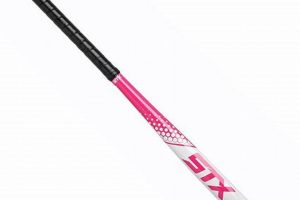
The bend or curve exhibited by a hockey stick during gameplay, specifically when shooting or passing, is a critical factor in performance. This characteristic, measured in numerical values, influences the power and accuracy of puck delivery. For example, a stick rated at ’85’ requires 85 pounds of force to bend it one inch.
This property significantly impacts shot velocity, puck control, and overall player effectiveness. A more flexible implement can store energy during a shot, releasing it upon impact with the puck for greater speed. Understanding and selecting the appropriate level for an individuals size, strength, and playing style is essential for optimizing on-ice performance. Historically, advancements in materials and manufacturing processes have led to a wider range of options catering to diverse player needs.
The subsequent discussion will delve into the key considerations for choosing an appropriate bending characteristic, the various materials used in their construction, and the impact of this characteristic on different aspects of the game.
Selecting the Proper Flex Hockey Stick
Choosing the appropriate bending characteristic is crucial for maximizing performance and preventing injury. Several factors should be considered when making this selection.
Tip 1: Body Weight Correlation: Generally, a higher body weight necessitates a stiffer implement. A heavier player can more easily bend a stiffer stick, maximizing energy transfer during shots.
Tip 2: Height Considerations: Taller players often benefit from longer shafts and potentially stiffer options. The increased leverage generated by a longer stick can effectively load the shaft.
Tip 3: Playing Style Influence: A player who primarily takes wrist shots and snap shots may prefer a more flexible option for quicker release. Conversely, a player known for slap shots may benefit from a stiffer shaft for maximum power.
Tip 4: Cut-Down Considerations: Cutting down a hockey stick increases its stiffness. Account for this change when selecting a new stick intended for modification.
Tip 5: Position on the Ice: Defensive players may prioritize accuracy and puck control, potentially favoring a slightly more flexible option. Forwards, often focused on scoring, may opt for a stiffer option to enhance shot power.
Tip 6: Experimentation is Key: Whenever possible, try different bending characteristics before making a purchase. On-ice testing provides valuable feedback regarding personal preferences and performance impact.
Careful consideration of body weight, height, playing style, and position, along with on-ice testing, will contribute to selecting the characteristic that best optimizes an individuals performance.
The next section will address the impact of different materials on stick performance and durability.
1. Shot Power

Shot power, a critical determinant of offensive success in hockey, is directly influenced by the characteristics of the stick. The interaction between the stick’s bending profile and the player’s technique dictates the efficiency of energy transfer to the puck.
- Energy Storage and Release
The degree to which a shaft bends dictates its capacity to store potential energy. During the loading phase of a shot, the shaft deforms, storing energy. Upon release, this stored energy is transferred to the puck, contributing to increased velocity. A more flexible shaft will generally store more energy, while a stiffer shaft will offer less storage but potentially a more direct transfer for players with significant strength.
- Loading Efficiency
Loading efficiency refers to the percentage of potential energy stored in the shaft that is successfully transferred to the puck. The stick’s bending characteristics must align with the player’s strength and technique to maximize loading efficiency. A stick that is too stiff for a player will not load effectively, resulting in reduced shot power. Conversely, a stick that is too flexible may bottom out, dissipating energy before it can be transferred to the puck.
- Release Point Optimization
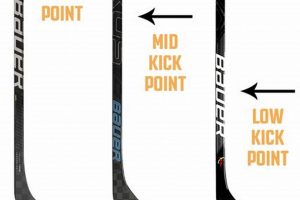
Release point is the location along the shaft where the stick bends most significantly during a shot. Optimizing the release point for a player’s shooting style can enhance both power and accuracy. Different bending profiles offer varying release points, influencing the trajectory and velocity of the puck. Lower kick points are often favored for quick release shots, while higher kick points are better suited for powerful slap shots.
- Material Composition and Dampening
The material composition of a shaft impacts its dampening characteristics. Materials with higher dampening properties absorb more vibration, reducing the amount of energy transferred to the puck. Conversely, materials with lower dampening properties transmit more energy, potentially increasing shot power. The ideal material composition balances energy transfer with control and feel.
These interconnected factors highlight the critical role of the bending characteristics in determining shot power. Proper selection, based on individual player attributes and preferences, is essential for maximizing on-ice performance.
2. Puck Control

The characteristic of a hockey stick directly influences a player’s ability to maintain precise command of the puck. A suitable bending profile enhances responsiveness, facilitating quick maneuvers, accurate passing, and effective puck protection. An implement that is too stiff may feel unwieldy, hindering fine motor control necessary for delicate plays. Conversely, excessive flexibility can result in a loss of feel, making it difficult to gauge puck position and apply the appropriate force. For instance, a player attempting a quick deke in tight quarters requires a stick that responds instantaneously to subtle hand movements, allowing for seamless transitions and controlled puck displacement. The balance between stiffness and give is thus paramount for maximizing stickhandling proficiency.
The relationship between the bending characteristic and puck control extends to receiving passes. A more flexible stick can act as a shock absorber, cushioning the impact of hard passes and preventing the puck from bouncing off the blade. This increased forgiveness allows players to maintain possession even when receiving passes off-center or at high speeds. Furthermore, the bending profile affects a player’s ability to lift the puck quickly for shots or passes. A well-chosen stick enables a player to generate lift with minimal effort, increasing the speed and unpredictability of their plays. The professional defenseman Zdeno Chara uses a very stiff flex stick to block shots. The stiffness gives him the ultimate power that he needs. The players skill level and playing style directly affects the type of stick needed.
Effective puck control is not solely dependent on the stick; technique and experience are also crucial. However, an appropriately chosen implement serves as an extension of the player’s body, enhancing their natural abilities and providing a tangible advantage. The selection of a stick with the right bending characteristic is therefore a critical step in optimizing a player’s performance and maximizing their potential for on-ice success. Neglecting this crucial aspect may hinder even the most skilled players, limiting their ability to execute complex plays and maintain consistent possession of the puck.
3. Energy Transfer
The efficiency with which kinetic energy is transferred from a hockey player to the puck is fundamentally linked to the characteristics of the hockey stick. The degree of bend, or lack thereof, directly influences the magnitude of energy imparted to the puck during a shot. A stick’s bending characteristic acts as a crucial intermediary in the energy transfer process. When a player applies force to the stick, the shaft deforms, storing potential energy. This stored energy is then released upon impact with the puck, propelling it forward. The level of flexibility dictates how much energy can be stored and how efficiently it can be transferred. A real-world example illustrates this principle: a player using a more flexible stick can generate a powerful wrist shot, as the shaft bends significantly, storing a substantial amount of energy that is rapidly released upon puck contact. Conversely, a player employing a stiffer stick may achieve greater power on a slap shot, where the emphasis is on direct force transmission rather than energy storage.
Further, the material composition of the stick influences energy transfer. Composite materials, such as carbon fiber, are designed to maximize energy return while minimizing energy loss due to vibration. This is in contrast to traditional wooden sticks, which tend to absorb more energy, resulting in a less powerful shot. The practical application of this understanding is evident in professional hockey, where players meticulously select sticks based on their bending characteristic and material composition to optimize energy transfer for their specific playing style. This selection process often involves experimentation and detailed analysis of shot metrics to determine the ideal combination for maximum performance.
In summary, the connection between energy transfer and the stick’s bending nature is critical to understanding hockey stick performance. The bending characteristic directly impacts energy storage and release, while material composition influences energy loss. Selecting the correct stick for a given player and situation poses a challenge, requiring careful consideration of strength, technique, and playing style. The ongoing development of advanced materials and stick designs continues to push the boundaries of energy transfer efficiency, further emphasizing the importance of this relationship in the context of modern hockey.
4. Player Height

Player height is a significant factor in determining the optimal characteristics of a hockey stick. A player’s stature influences leverage, reach, and the overall mechanics of shooting and stickhandling, necessitating adjustments in stick length and bending profile.
- Leverage and Force Application
Taller players possess greater leverage due to their longer arms and reach. This increased leverage enables them to generate more force when bending the stick. Consequently, taller players often require a stiffer bending characteristic to effectively transfer their power to the puck. Selecting a bending characteristic that is too flexible may result in the stick bottoming out, reducing shot power and control. Conversely, shorter players may find it difficult to adequately bend a stiffer stick, limiting their ability to load the shaft and generate velocity.
- Stick Length and Balance Point
Player height directly correlates with appropriate stick length. A taller player typically requires a longer stick to maintain proper posture and puck control. However, increasing stick length alters the stick’s balance point, potentially affecting feel and handling. To compensate for this, manufacturers offer sticks with varying balance points, allowing players to customize the stick’s feel to their preference. A longer stick also inherently increases the bending characteristic, requiring careful consideration when selecting the appropriate model.
- Shooting Mechanics and Stride Length
Taller players often exhibit different shooting mechanics compared to their shorter counterparts. Their longer stride length allows them to generate more momentum, which can be transferred to the stick during the shooting motion. This increased momentum further necessitates a stiffer bending characteristic to prevent the stick from flexing excessively. Short players will typically use a shorter stick, which may affect the angle of the blade, their balance and mobility on the ice.
- Puck Protection and Reach
A taller player’s reach provides an advantage in puck protection and retrieval. They can keep opponents at a greater distance, maintain possession more effectively, and intercept passes more readily. The increased reach, however, may require a different bending profile to optimize puck handling in tight spaces. A more flexible bending characteristic may provide improved feel and control for quick maneuvers, while a stiffer bending characteristic offers greater stability for defensive play.
These factors underscore the importance of considering player height when selecting a stick. The interplay between height, leverage, shooting mechanics, and puck control necessitates a tailored approach to stick selection. An optimal pairing will maximize a player’s potential, while an inappropriate choice may hinder performance and increase the risk of injury.
5. Stick Material

The constituent material of a hockey stick is fundamentally linked to its bending characteristic. Different materials exhibit varying degrees of elasticity and resistance to deformation, directly influencing how a stick bends under applied force. For example, a traditional wooden stick, typically made of ash or birch, possesses a relatively high degree of flexibility compared to modern composite sticks. This inherent flexibility results in a lower bending characteristic, making wooden sticks suitable for players who prioritize feel and puck control over sheer shot power. However, wood also tends to dampen energy transfer, potentially reducing shot velocity.
Composite materials, such as carbon fiber and fiberglass, offer a wider range of options regarding the bending characteristics. By varying the ratio of these materials and the layup configuration during manufacturing, stick makers can precisely control the bending profile of a hockey stick. A stick constructed with a high proportion of carbon fiber will typically be stiffer and more responsive than one made primarily of fiberglass. Professional players often rely on composite sticks tailored to their specific needs, reflecting the critical role of material selection in optimizing performance. Furthermore, the durability and weight of a stick are also heavily influenced by its constituent material. Composite sticks generally exhibit superior strength-to-weight ratios compared to wooden sticks, allowing for lighter and more durable designs.
In summary, material selection is a primary determinant of a hockey stick’s bending behavior. Wood provides traditional flexibility, while composite materials offer greater control over the bending profile, durability, and weight. Understanding this relationship is crucial for players seeking to optimize their equipment and maximize their on-ice performance. The continued evolution of composite materials promises further advancements in stick design, enabling even greater customization and performance enhancement. Challenges remain in balancing cost, durability, and performance characteristics, necessitating ongoing research and development in this area.
6. Playing Style

A player’s style fundamentally influences the selection of a suitable hockey stick characteristic. The manner in which a player approaches the game, including preferred shooting techniques, puck handling tendencies, and positional responsibilities, dictates the optimal degree of shaft bend for performance maximization. For instance, a player known for quick wrist shots and snapshots in tight spaces typically benefits from a more flexible stick. The increased bend allows for faster loading and release, facilitating rapid puck delivery in close proximity to the net. Conversely, a player whose style emphasizes powerful slap shots from the point often favors a stiffer stick. The reduced bend provides a more direct energy transfer, maximizing shot velocity from longer distances. Style, therefore, functions as a primary determinant in identifying the characteristic that best complements a player’s natural tendencies and strategic role on the ice.
Furthermore, consider the difference between offensive and defensive playing styles. Offensive players, primarily focused on scoring, often prioritize quick release and puck control. This frequently translates to a preference for a slightly more flexible stick, enabling swift maneuvers and precise puck placement. Defensive players, however, may prioritize shot blocking and clearing the puck from the defensive zone. A stiffer stick can provide added stability for blocking shots and deliver more forceful clearances, reducing the risk of injury and maximizing defensive effectiveness. The players specific style also affects the length of a hockey stick and the angle of the blade to get more control of the puck. A player whose style emphasis control of the puck will need to modify blade or length or flex or all aspects of those mentioned before.
In conclusion, the link between playing style and characteristic is undeniable. From shooting preferences to positional demands, a player’s unique approach to the game dictates the optimal level of shaft bend for performance enhancement. The selection process should involve a careful evaluation of individual tendencies, ensuring that the chosen equipment complements and amplifies a player’s inherent strengths. An improper pairing can hinder performance, while a well-matched stick can provide a tangible competitive advantage. Understanding this connection is therefore crucial for players seeking to maximize their on-ice effectiveness.
Frequently Asked Questions
The following questions address common inquiries regarding the characteristic of hockey sticks, providing detailed explanations to aid in informed equipment selection.
Question 1: What does the numerical value associated with bending characteristic represent?
The numerical value indicates the amount of force, measured in pounds, required to bend the stick one inch when a standardized weight is applied.
Question 2: How does player weight influence the selection of bending characteristic?
Generally, a heavier player generates more force and should utilize a stiffer bending characteristic to maximize energy transfer. Lighter players often benefit from a more flexible stick.
Question 3: Does cutting down a stick affect its bending characteristic?
Yes. Cutting a stick shortens it, effectively increasing its stiffness. Players should account for this when selecting a stick intended for modification.
Question 4: What is the impact of material composition on the bending characteristic?
Different materials, such as wood, fiberglass, and carbon fiber, exhibit varying degrees of stiffness. Composite materials allow for greater control over the bending profile during manufacturing.
Question 5: How does playing style relate to optimal bending characteristic?
Players who rely on quick wrist shots may prefer a more flexible stick, while those who utilize powerful slap shots often benefit from a stiffer option.
Question 6: Is there a universal bending characteristic suitable for all players?
No. The optimal bending characteristic is highly individualized and depends on factors such as weight, height, playing style, and personal preference. On-ice testing is recommended.
Proper understanding of these factors is crucial for selecting a hockey stick that complements individual playing style and maximizes performance.
The next section explores the impact of different bending characteristics on shot accuracy and precision.
Flex Hockey Stick
This article has explored the multifaceted influence of the “flex hockey stick” characteristic on various aspects of the sport. It is evident that the selection of an appropriate bending profile is not a trivial matter, but rather a critical element in optimizing player performance. From enhancing shot power and puck control to accommodating individual playing styles and body mechanics, the “flex hockey stick” directly impacts a player’s effectiveness on the ice. Furthermore, the integration of advanced materials and manufacturing techniques has expanded the range of available options, necessitating a thorough understanding of the underlying principles governing bending behavior.
The information presented herein underscores the importance of informed decision-making when choosing a hockey stick. Players, coaches, and equipment managers are encouraged to consider the discussed factors carefully, recognizing that a well-matched “flex hockey stick” can provide a tangible competitive advantage. Continued research and development in materials science and stick design promise further advancements, offering the potential for even greater customization and performance enhancement in the future. The pursuit of optimal equipment remains an ongoing endeavor, demanding a commitment to knowledge and a dedication to continuous improvement.