![Top Sticks: Best Field Hockey Sticks for Forwards [2024 Guide]](data:image/svg+xml;base64,PHN2ZyB4bWxucz0iaHR0cDovL3d3dy53My5vcmcvMjAwMC9zdmciIHdpZHRoPSI0NzQiIGhlaWdodD0iNjYiIHZpZXdCb3g9IjAgMCA0NzQgNjYiPjxyZWN0IHdpZHRoPSIxMDAlIiBoZWlnaHQ9IjEwMCUiIHN0eWxlPSJmaWxsOiNjZmQ0ZGI7ZmlsbC1vcGFjaXR5OiAwLjE7Ii8+PC9zdmc+ "Top Sticks: Best Field Hockey Sticks for Forwards [2024 Guide] Your Ultimate Source for Hockey Updates, Training Guides, and Equipment Recommendations")
Selecting appropriate equipment is crucial for optimizing performance within any athletic endeavor. In field hockey, the implement used to propel the ball is a key determinant of a player’s efficacy, particularly for those in attacking roles. The characteristics of this equipment, such as weight, length, composition, and head shape, exert a direct influence on a forward’s ability to execute various skills, including dribbling, passing, shooting, and receiving the ball. For example, a stick with a lighter weight may facilitate quicker stickwork, while a specific bow shape could enhance lifting the ball during scoring attempts.
Optimizing the forward’s tool contributes significantly to overall team success. The right equipment can improve speed, control, and power, leading to more scoring opportunities and a more dynamic offensive presence. Historically, field hockey sticks were crafted from wood, limiting design possibilities. However, modern composite materials, such as carbon fiber and fiberglass, allow for greater customization and performance enhancement, reflecting the evolving demands of the sport and the growing emphasis on specialized equipment tailored to specific playing styles and positions.
The following sections will delve into the critical factors that dictate the suitability of sticks for forwards, exploring various stick features and technologies. This analysis aims to provide a detailed guide for selecting equipment that aligns with individual player attributes and tactical roles, enhancing performance on the field.
Tips on Selecting Field Hockey Sticks for Forwards
Choosing an appropriate field hockey stick is essential for forwards seeking to maximize their offensive capabilities. The following tips provide guidance for selecting a stick that aligns with playing style and enhances performance.
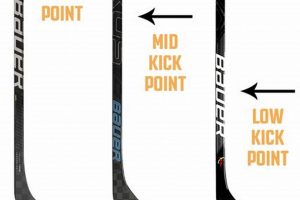
Tip 1: Consider Bow Placement: A lower bow, positioned closer to the head, generally facilitates aerial skills and drag-flicking, techniques frequently employed by attacking players. Evaluate the players skill set and the frequency with which such techniques are utilized to determine the optimal bow placement.
Tip 2: Evaluate Stick Weight: Lighter sticks offer enhanced maneuverability and quicker stickwork, advantageous for forwards who rely on speed and agility. However, a heavier stick may provide greater power behind shots. Balance must be achieved based on individual preference and playing style.
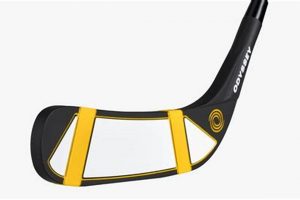
Tip 3: Analyze Head Shape: The head shape affects ball control and receiving. A shorter head can enhance close control for dribbling, while a longer head provides a larger surface area for receiving passes. Consider which aspect of ball handling is prioritized.
Tip 4: Assess Stick Length: Proper stick length is crucial for maintaining correct posture and maximizing reach. The standard guideline is to measure the stick to the players hipbone when standing upright. Adjustments may be necessary based on individual arm length and comfort.
Tip 5: Examine Composition Materials: A higher carbon percentage generally indicates a stiffer stick with greater power potential. However, increased stiffness can reduce feel. Forwards often benefit from a stick with a moderate carbon content that balances power and control.
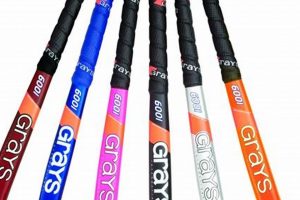
Tip 6: Prioritize Grip Quality: A secure and comfortable grip is paramount for maintaining control of the stick during dynamic movements. Evaluate the grip material and thickness to ensure it suits the players hand size and provides adequate tackiness.
Tip 7: Demo Different Models: Whenever feasible, test various stick models before making a purchase. This allows players to assess the feel and performance characteristics of each stick firsthand, ensuring a more informed decision.
Careful consideration of these factors will contribute significantly to selecting a stick that optimizes a forward’s performance and enhances their offensive contributions.
The subsequent sections of this article will explore specific stick recommendations and provide detailed reviews of popular models available on the market.
1. Bow Shape
Bow shape is a critical determinant of a field hockey stick’s suitability for forwards. The curvature of the stick shaft influences a player’s ability to execute specialized skills, directly impacting offensive performance. Different bow placements and depths cater to varied playing styles and tactical roles within the forward line.
- Low Bow for Aerial Skills
A low bow, positioned closer to the head of the stick, facilitates lifting the ball for aerial passes and shots. This feature is particularly advantageous for forwards who frequently engage in 3D skills, such as overheads and scoops, to evade defenders or create scoring opportunities. A lower bow also enhances drag-flicking technique, allowing for faster and more deceptive shots on goal. The concentration of weight near the stick’s head amplifies the stick’s leverage, enabling players to lift the ball with minimal effort. In matches, forwards may utilize this to lift the ball over a defenders stick and then continue to run to gain possesion of the ball.
- Mid Bow for Versatile Play
A mid bow offers a more balanced profile, suitable for forwards who require versatility in their play. This bow shape allows for proficiency in both flat passes and lifted balls, providing adaptability across various attacking situations. Mid-bow sticks typically offer a larger sweet spot for receiving passes, contributing to enhanced ball control and cleaner connections during quick transitions. It allows for easier ball handling and less extreme techniques as a low bow would allow.
- Standard Bow for Traditional Technique
A standard bow, with a more gradual curvature along the stick’s length, promotes a more traditional style of play. Forwards who prioritize fundamental skills, such as flat passing and controlled dribbling, may find this bow shape more comfortable and predictable. The even distribution of weight contributes to consistent ball striking and accurate distribution, ideal for forwards focusing on precise passing and team play.
- Bow Depth and Ball Control
The depth of the bow, or the degree of curvature, directly affects the level of control a player has over the ball. A deeper bow can facilitate more aggressive aerial play and enhanced drag-flicking, but may compromise control during flat passes. Conversely, a shallower bow offers greater stability and control during dribbling and passing, but may limit the height and power of lifted balls. The optimal bow depth is contingent on a forward’s individual skill set and preferred style of play.
Bow shape profoundly influences a forward’s ability to execute critical skills and dictate offensive plays. Choosing a stick with a bow shape that complements a player’s strengths and aligns with their tactical role is crucial for maximizing their contribution to the team’s attacking efforts. Therefore, in the context of the best field hockey sticks for forwards, bow shape stands as a decisive factor when weighing the various features and attributes of available stick models. As stick models improve, bows change and vary to allow for a more aggressive play style or more control.
2. Weight Distribution

Weight distribution in a field hockey stick exerts a significant influence on a forward’s ability to execute skills with precision and power. A stick’s balance point affects maneuverability, shot power, and overall feel, playing a crucial role in determining its suitability for attacking players.
- Head-Heavy Sticks and Shot Power
A head-heavy stick concentrates more weight toward the blade. This configuration is generally associated with increased power behind shots, enabling forwards to generate higher ball speeds and potentially more forceful strikes on goal. The additional weight at the head can act as a lever, increasing the momentum transferred to the ball. However, this weight distribution may compromise stick handling speed and quickness, which are essential for close-quarters dribbling. A forward playing primarily as a shooter might favor a head-heavy stick to maximize shot potential, even if it means sacrificing some agility.
- Handle-Heavy Sticks and Maneuverability
Conversely, a handle-heavy stick shifts the balance point closer to the grip, resulting in a lighter feel at the head. This distribution promotes quicker stickwork and enhanced maneuverability, facilitating fast dribbling and rapid changes of direction. Forwards who rely on agility and deception to evade defenders may find a handle-heavy stick advantageous. The reduced weight at the head allows for faster reactions and more intricate stick handling patterns. A player who often engages in one-on-one situations may benefit from this configuration, prioritizing control and speed over raw power.
- Evenly Balanced Sticks and Versatility
An evenly balanced stick distributes the weight more uniformly along the shaft, offering a compromise between power and maneuverability. This type of stick caters to forwards who require versatility across different attacking situations. It provides adequate power for shooting while maintaining sufficient agility for dribbling and passing. Forwards who participate in a range of offensive tasks, such as creating scoring opportunities and finishing plays, may find an evenly balanced stick the most suitable option. The even weight distribution allows for consistent performance across a variety of skills.
- Impact of Weight on Fatigue
The overall weight of the stick and its distribution also affect player fatigue. A heavier stick, regardless of its balance point, can lead to increased muscle strain and reduced endurance over the course of a match. It is therefore crucial to consider the weight of the stick in relation to individual strength and stamina levels. Forwards should seek a balance between weight and performance, selecting a stick that optimizes skill execution without unduly compromising their physical condition. Fatigue will ultimately lead to slower movement and decision making that will decrease the players potential.
The optimal weight distribution of a field hockey stick for forwards depends heavily on individual playing style, tactical role, and physical attributes. Selecting equipment that aligns with these factors is crucial for maximizing a player’s offensive contributions. By carefully considering the balance point and overall weight of the stick, forwards can enhance their ability to dribble, pass, and shoot effectively, ultimately contributing to team success.
3. Head Angle

Head angle, the inclination of a field hockey stick’s blade relative to its shaft, constitutes a subtle yet critical parameter influencing a forward’s ball control and striking accuracy. Variations in head angle affect the manner in which the stick interacts with the ball, impacting passing, receiving, and shooting performance. Therefore, evaluating head angle becomes an integral part of selecting equipment optimized for offensive players.
- Open Head Angle and Receiving
An open head angle, where the face of the stick is slightly angled upwards, facilitates easier reception of incoming passes. This configuration provides a larger, more forgiving surface area for trapping the ball, particularly aerial deliveries. The open angle promotes a softer touch, reducing the likelihood of the ball bouncing away upon contact. For forwards frequently receiving passes in motion, an open head angle can enhance control and smooth transitions into attacking plays.
- Closed Head Angle and Driving
A closed head angle, with the face of the stick angled downwards, is often preferred for powerful driving shots. This configuration concentrates force behind the ball, maximizing energy transfer and resulting in increased velocity. A closed angle also helps maintain a lower trajectory, reducing the chance of the ball rising excessively and improving accuracy when shooting from distance. For forwards specializing in long-range strikes, a closed head angle can enhance their ability to generate potent shots on goal.
- Standard Head Angle and Versatility
A standard head angle offers a balanced approach, providing competency in both receiving and striking. This configuration suits forwards who require versatility across different offensive situations. It provides adequate control for receiving passes while still allowing for effective shooting and passing. For forwards participating in diverse offensive tasks, such as creating scoring opportunities and finishing plays, a standard head angle may represent the most adaptable option.
- Head Angle and Ground Contact
The head angle impacts the amount of the stick’s blade that makes contact with the ground. A more extreme angle, whether open or closed, can reduce the contact area, potentially affecting consistency in dribbling and passing. A moderate head angle ensures a more consistent contact patch, promoting stable ball control and accurate distribution. Considering the playing surface and prevailing conditions is essential when selecting a stick with a specific head angle.
The head angle of a field hockey stick influences a forward’s ability to control the ball, pass effectively, and shoot accurately. Selecting a stick with a head angle that complements a player’s strengths and aligns with their tactical role is crucial for maximizing their contribution to the team’s offensive efforts. The best field hockey sticks for forwards will, therefore, have a head angle that serves the player to increase the likelihood of a goal. When weighing the various features and attributes of available stick models, head angle should be a primary consideration for forwards. It also depends on the style that the play would like to use.
4. Material Composition

The selection of materials used in the construction of a field hockey stick significantly influences its performance characteristics, directly impacting a forward’s capabilities on the field. Material composition affects the stick’s weight, stiffness, power transfer, and feel, all of which are critical considerations for offensive players seeking optimal equipment. Different materials and their combinations cater to varied playing styles and performance requirements.
- Carbon Fiber and Power Transfer
Carbon fiber, a high-modulus material known for its strength-to-weight ratio, is a prevalent component in modern field hockey sticks. A higher carbon content generally results in a stiffer stick, facilitating more efficient transfer of energy from the player to the ball during striking. This characteristic is particularly beneficial for forwards seeking to generate powerful shots and passes. For instance, a stick with 90% or greater carbon fiber content may offer superior power compared to one with a lower percentage. However, increased stiffness can reduce the stick’s feel, potentially compromising ball control.
- Fiberglass and Enhanced Feel
Fiberglass, a more flexible material compared to carbon fiber, contributes to a softer feel and improved ball control. Sticks with a higher fiberglass content tend to offer greater responsiveness, allowing forwards to sense the ball more accurately and make finer adjustments during dribbling and receiving. While fiberglass does not provide the same level of power transfer as carbon fiber, it can enhance a player’s ability to manipulate the ball in close quarters. Many beginner to intermediate sticks will be made of entirely or partially fiberglass. This enables the stick to be more forgiving when hitting and controlling the ball.
- Aramid and Vibration Dampening
Aramid fibers, such as Kevlar, are often incorporated into field hockey sticks to dampen vibrations and reduce shock. These materials enhance comfort and minimize the risk of injury, particularly during forceful impacts. Aramid layers strategically positioned within the stick’s construction can absorb vibrations, providing a more comfortable feel and allowing forwards to maintain control even when striking the ball with significant force. Aramid is beneficial when a stick is mostly carbon as it mitigates some of the vibration felt upon striking the ball.
- Wood Core and Traditional Feel
While less common in high-performance sticks, some models still incorporate a wood core, typically made of mulberry or similar hardwoods. Wood provides a traditional feel and can contribute to a more forgiving response. Sticks with a wood core may offer a smoother, more dampened feel compared to those made entirely of composite materials. Wood cores are sometimes combined with composite layers to balance power and feel, catering to players who prefer a more traditional stick response.
The optimal material composition for a field hockey stick depends on a forward’s individual playing style, preferences, and performance priorities. Sticks with a higher carbon content favor power and stiffness, while those with more fiberglass emphasize feel and control. The inclusion of aramid fibers enhances comfort and reduces vibration, and wood cores provide a traditional feel. By carefully considering these material characteristics, forwards can select equipment that best complements their strengths and maximizes their offensive contributions. Thus, the selection of materials forms a cornerstone in identifying the most suitable equipment for forwards seeking to elevate their game.
5. Grip Texture
Grip texture is a significant, yet often overlooked, component in the selection of field hockey sticks, particularly for forwards. The surface characteristics of the grip directly influence a player’s ability to maintain control of the stick, especially during rapid movements and forceful strikes. Insufficient grip can lead to slippage, compromising accuracy and power. Conversely, excessive grip can restrict maneuverability and cause discomfort. Therefore, the optimal grip texture is essential for forwards seeking peak performance.
Different grip textures offer varying levels of tackiness and cushioning. Smooth grips may provide greater freedom of hand movement but can become slippery when wet. Ribbed grips offer enhanced traction, preventing slippage in adverse conditions. Padded grips offer additional comfort, reducing fatigue and improving shock absorption. The selection of grip texture should align with the player’s hand size, grip strength, and playing environment. For instance, a player with smaller hands might benefit from a thinner, ribbed grip, while a player with larger hands may prefer a thicker, padded grip. Proper grip selection directly impacts a player’s confidence and consistency on the field. A player who is confident in the tackiness of their grip will have more aggressive swings to win possession or score a goal. This confidence translates to playing better and scoring more for the team.
Ultimately, the ideal grip texture balances control, comfort, and durability. While personal preference plays a role, forwards should prioritize grip texture that minimizes slippage, maximizes maneuverability, and withstands the rigors of competitive play. A well-chosen grip enhances stick handling, passing accuracy, and shooting power, contributing significantly to overall offensive effectiveness. The investment in a quality grip, tailored to individual needs, represents a tangible advantage for forwards seeking to elevate their game and have confidence in their equipment.
6. Length suitability

Length suitability is a primary determinant of a field hockey stick’s effectiveness, particularly for forwards. The implement’s length dictates a player’s posture, reach, and overall control. Inappropriate length impairs technique, reduces power, and increases the risk of injury. A stick that is too long forces a player to stand too upright, diminishing control during dribbling. Conversely, a stick that is too short requires excessive bending, leading to back strain and reduced reach. Forwards, who require a blend of agility and power, are particularly sensitive to length discrepancies. The standard guideline of measuring the stick to the player’s hip bone offers a starting point, but individual variations in arm length and playing style necessitate fine-tuning. The selection of length profoundly influences a forward’s ability to execute critical skills.
Consider two forwards, one primarily a dribbler and the other a shooter. The dribbler, needing closer ball control, might benefit from a stick slightly shorter than the standard recommendation, promoting a lower center of gravity and increased agility. Conversely, the shooter might require a stick closer to the standard length, or even slightly longer, to maximize reach and leverage during striking. Professional players often make subtle adjustments to their stick length based on their specific role and tactical requirements. Moreover, younger players require frequent re-evaluation of stick length as they grow, preventing the development of improper technique and maximizing their skill development. Failure to account for this growth results in immediate performance deficits, with proper length leading to immediate improvements in performance, stick-handling, striking, and passing.
In conclusion, length suitability is not merely a matter of comfort; it’s a core component of optimizing performance. The best field hockey sticks for forwards are, by definition, those that fit the player’s physical attributes and playing style. The challenges lie in accurately assessing individual needs and adapting standard recommendations accordingly. Prioritizing proper length promotes better technique, reduces injury risk, and maximizes offensive potential, reinforcing its integral role in equipment selection for forwards.
7. Balance point

The balance point of a field hockey stick, the point at which it rests evenly when suspended, significantly influences a forward’s ability to execute various skills. This point affects the perceived weight and maneuverability of the stick, directly impacting dribbling speed, shot power, and overall stick handling efficiency. Forwards, requiring a blend of quickness and striking ability, must carefully consider the balance point to optimize their equipment selection. A stick with a balance point closer to the head provides increased power behind shots, while a balance point nearer the handle facilitates faster stick work and greater agility. Therefore, identifying the ideal balance point is crucial when seeking the best field hockey sticks for forwards.
Consider two distinct forward roles: the first, a primarily passing-oriented player, and the second, a predominantly shooter. The passing-oriented player might benefit from a stick with a balance point closer to the grip, enabling quick changes in direction and deceptive passes. A stick with a balance point closer to the blade might empower the shooting-oriented player to generate more power for shots on goal. These scenarios illustrate how specific roles within the forward line often dictate the most advantageous balance point. Furthermore, a high balance point may exacerbate fatigue over an extended match, as more effort is needed to control the stick. Players must balance the desire for power with the need for sustained maneuverability throughout the game. Understanding the nuances of the balance point allows informed decisions regarding stick choice.
In conclusion, the balance point is not an isolated characteristic but an integral factor that impacts every aspect of a forward’s game. By understanding how the balance point influences performance, forwards can make informed decisions to align their equipment choices with their playing style and tactical role, ultimately maximizing their effectiveness on the field. The challenge lies in finding a balance point that optimizes individual skill sets and meets the demands of the position. This balance, when achieved, contributes significantly to the quest for the “best field hockey sticks for forwards.”
Frequently Asked Questions
The following questions address common inquiries regarding the selection of field hockey sticks for forwards, aiming to clarify key considerations and dispel prevalent misconceptions.
Question 1: What constitutes a “forward-specific” field hockey stick?
A “forward-specific” field hockey stick is characterized by features that complement the skills and requirements of attacking players. These features may include a lower bow for enhanced aerial capabilities, a balanced weight distribution for quick maneuverability, and a head angle that promotes effective receiving and shooting.
Question 2: How does bow placement affect a forward’s performance?
Bow placement significantly influences a forward’s skill execution. A lower bow facilitates lifting the ball for aerial passes and drag-flicking, techniques commonly employed by attacking players. A mid bow offers versatility, while a standard bow promotes traditional techniques.
Question 3: Does stick weight influence shooting power?
Stick weight can affect shooting power. A heavier stick may generate greater force behind shots, but can reduce stick handling speed. Lighter sticks enhance maneuverability. A balance should be considered based on individual preference and playing style. The trade-off depends on the player’s preference between the speed of play vs raw power. Players can also train to adjust to a heavier stick to keep the same speed.
Question 4: How important is stick length for a forward?
Stick length is crucial for maintaining correct posture, maximizing reach, and optimizing control. Inappropriate length impairs technique and increases the risk of injury. The stick length should align to hip bone. If a player wants a stick tailored to their preference, the stick length can be adjusted slightly to increase speed or power.
Question 5: Can material composition affect ball control?
Material composition directly affects ball control. Sticks with a higher fiberglass content typically offer greater responsiveness and a softer feel, enhancing a player’s ability to manipulate the ball in close quarters. Sticks with a higher carbon content offers a harder touch but is more powerful.
Question 6: Is grip texture merely a matter of preference?
Grip texture is more than just a matter of preference; it significantly impacts stick control. The optimal grip texture minimizes slippage, maximizes maneuverability, and withstands the demands of competitive play. A player should have confidence that they won’t lose their grip when they strike.
Selecting the optimal field hockey stick requires careful consideration of multiple factors, from bow placement and weight distribution to material composition and grip texture. These elements, when aligned with individual playing style and tactical role, contribute significantly to enhanced performance on the field.
The next section will transition from theoretical considerations to practical recommendations, offering insights into specific stick models that cater to the diverse needs of forwards.
Conclusion
This exploration of “best field hockey sticks for forwards” has underscored the multifaceted nature of equipment selection. The analysis has detailed how bow shape, weight distribution, head angle, material composition, grip texture, and length suitability collectively influence a forward’s capacity to execute crucial skills. A recurring theme has been the necessity of aligning these attributes with individual playing styles and tactical roles, emphasizing that no single stick universally qualifies as “best.” Instead, optimal performance arises from a synergistic match between player characteristics and equipment features.
Ultimately, the selection process demands diligence, informed assessment, and practical testing. As technology continues to advance and playing styles evolve, the pursuit of optimized equipment remains a dynamic endeavor. The information provided herein serves as a foundation for ongoing evaluation and adaptation, empowering forwards to make well-informed decisions and continually refine their equipment choices to achieve peak performance on the field.