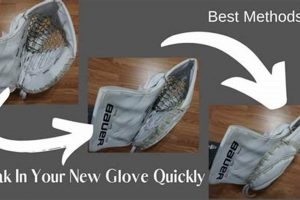
The process of preparing a goaltender’s catching mitt for optimal performance involves softening the leather and shaping the pocket to facilitate easy closure and secure puck retention. A new piece of equipment, stiff from manufacturing, requires manipulation to conform to the goalie’s hand and playing style.
Properly conditioning the glove enhances reaction time, reduces rebounds, and minimizes hand fatigue. A well-formed pocket allows for confident catches, contributing to improved save percentages and overall performance. Historically, goaltenders have employed various methods, from simple repetition to specialized treatments, to achieve a game-ready feel.
The subsequent sections detail techniques used to accelerate the softening and shaping of this critical piece of equipment, ensuring it is fully prepared for competitive play. These methods encompass both traditional approaches and contemporary advancements in glove preparation.
Techniques for Conditioning a Goaltending Mitt
The following techniques are designed to accelerate the break-in process, ensuring optimal performance and comfort. Consistent application of these methods will yield a glove that is game-ready and responsive.
Tip 1: Repetitive Motion. Consistent squeezing of the glove mimics game-like catching motions. This process helps to soften the leather and develop the pocket’s shape. Execute this exercise in short, frequent sessions.
Tip 2: Mallet Use. A rubber mallet can be used to gently strike the pocket area. This facilitates the loosening of stiff leather fibers. Exercise caution to avoid excessive force, which can damage the glove’s structure.
Tip 3: Strategic Moisture Application. Applying a small amount of glove-specific conditioner to the leather softens it and improves flexibility. Avoid over-saturation, as excessive moisture can lead to degradation. Allow the glove to air dry naturally.
Tip 4: Puck Impact. Repeatedly catching pucks, even in a controlled environment, gradually molds the pocket to the shape required for gameplay. Start with softer pucks and gradually increase the hardness as the glove softens.
Tip 5: Glove Steaming. A professional equipment steaming service can expedite the process by evenly distributing heat and moisture. This method requires careful monitoring to prevent damage to the glove’s internal padding and structure.
Tip 6: Proper Storage. When not in use, store the glove with a ball or puck in the pocket to maintain its shape. Avoid storing the glove in excessively hot or humid environments, as this can degrade the leather and stitching.
Regular application of these methods, combined with consistent use, will significantly improve the glove’s performance and feel. The key is consistent, gradual conditioning to mold the glove to the goaltender’s specific needs.
The subsequent section will address maintenance and care procedures to ensure the longevity and optimal performance of the broken-in glove.
1. Pocket Formation
Pocket formation is a central element in the process of preparing a goaltender’s catching glove. The goal is to create a deep, well-defined recess within the glove’s palm to facilitate secure puck retention. The process is directly linked to overall glove break-in, with insufficient pocket formation leading to increased rebounds and diminished control.
Effective pocket formation techniques involve applying consistent pressure and shaping to the glove’s leather and internal padding. This can be achieved through repeated catching motions, the use of a mallet to soften specific areas, and strategic application of glove conditioner. The lack of proper pocket development can lead to pucks popping out of the glove, creating scoring opportunities for the opposing team. A well-formed pocket acts as a crucial shock absorber, minimizing the impact felt by the goaltender.
In summation, pocket formation is not merely a superficial step but an integral part of the glove preparation. The resulting secure and responsive catching area significantly affects a goaltender’s ability to confidently control rebounds and protect the net. Neglecting this aspect compromises the overall functionality and effectiveness of the glove, negatively impacting performance.
2. Leather Softening

Leather softening constitutes a critical phase in preparing a hockey goaltender’s glove for optimal performance. The inherent stiffness of new leather inhibits proper closure and pocket formation, directly impacting a goalie’s ability to make secure catches.
- Enhancement of Glove Closure
Leather softening directly influences the ease with which a goaltender can close the glove. Supple leather allows for a quicker and more complete closure around the puck, reducing the likelihood of rebounds. Stiff leather resists bending, requiring more force to close and potentially resulting in missed catches.
- Promotion of Pocket Formation
Softening the leather allows for the creation of a deeper and more defined pocket. This pocket serves to cradle the puck upon impact, preventing it from bouncing out. A pliable leather material more readily molds to the desired pocket shape through repetitive use and conditioning techniques.
- Improved Shock Absorption
Softer leather contributes to enhanced shock absorption upon impact with the puck. Flexible leather conforms to the shape of the puck, dispersing the energy across a wider area and minimizing the force transmitted to the goaltender’s hand. Stiff leather transmits more force, potentially leading to discomfort or injury.
- Increased Glove Longevity
Proper leather softening, achieved through appropriate conditioning methods, can contribute to the overall longevity of the glove. Supple leather is less prone to cracking or tearing, extending the lifespan of the equipment. Harsh treatments can degrade the leather, diminishing its structural integrity.
In conclusion, effective leather softening is not merely a cosmetic consideration but a fundamental step in preparing a goaltender’s glove for the rigors of gameplay. Achieving the correct balance of suppleness and structural integrity ensures optimal performance, protection, and durability.
3. Palm Protection
Palm protection is an intrinsic element of hockey goaltender glove preparation. While the break-in process focuses on leather softening and pocket formation, maintaining adequate palm padding is paramount for mitigating impact forces and preventing injury.
- Padding Integrity
The break-in process must not compromise the integrity of the palm padding. Over-softening the leather can thin out or compress the internal padding, diminishing its ability to absorb puck impacts. Maintaining original padding density is crucial for optimal protection.
- Impact Distribution
Palm protection is directly related to impact distribution. Effective padding spreads the force of the puck across a wider area, reducing the concentration of energy on any single point. A well-broken-in glove should allow for a degree of flex, but not at the expense of distributing the impact effectively.
- Material Durability
The materials used in palm construction are selected for their ability to withstand repeated impacts. During the break-in process, these materials must be treated with care. Abrasive cleaning methods or excessive heat can degrade these materials, reducing their protective capabilities.
- Proper Fit
A properly fitted glove ensures that the palm padding aligns correctly with the goaltender’s hand. An ill-fitting glove can result in misalignment, leaving certain areas of the palm vulnerable to injury. The break-in process should not distort the original shape or fit of the glove, ensuring consistent palm protection.
In summary, while softening the leather is essential for glove responsiveness, it is critical to maintain the structural integrity and protective qualities of the palm padding. A balance must be struck between flexibility and impact absorption to ensure both optimal performance and injury prevention.
4. Closure Ease
Achieving closure ease is a critical objective during the glove preparation. The ability to rapidly and completely close the glove around a puck directly affects a goaltender’s save percentage and control over rebounds. The stiffness inherent in a new glove necessitates a structured approach to softening the leather and molding the internal structure to facilitate this ease of closure.
The relationship between glove preparation and closure ease is causal. A glove that has undergone a thorough break-in process will naturally exhibit superior closure compared to a new, unconditioned glove. Consider a scenario where a goaltender faces a quick wrist shot; a glove with poor closure requires extra force and time to secure the puck, increasing the likelihood of a rebound. Conversely, a well-prepared glove closes almost instinctively, trapping the puck securely and minimizing rebound opportunities. Repetitive motion exercises, strategic use of a mallet, and careful application of leather conditioner all contribute to enhancing closure ease.
In conclusion, closure ease is not merely a desirable attribute but a fundamental performance requirement for a hockey goaltender’s glove. Effective preparation techniques specifically target this aspect, ensuring the glove responds optimally in game situations. Failing to prioritize closure ease compromises the glove’s overall effectiveness and potentially increases the risk of allowing goals. The investment in proper break-in procedures is directly proportional to the goaltender’s improved on-ice performance.
5. Wrist Mobility

Wrist mobility is an integral component of a properly prepared goaltender’s glove. The break-in process should facilitate, not hinder, the range of motion required for effective puck handling and save execution. A stiff, unyielding glove restricts wrist movement, impeding a goaltender’s ability to quickly adjust hand position and react to unpredictable shots. The connection between wrist mobility and the break-in process centers on achieving a balance between glove suppleness and structural support.
The execution of common save techniques, such as catching high shots or deflecting pucks to the side, relies heavily on unrestricted wrist movement. A goaltender unable to fully extend or flex the wrist is at a distinct disadvantage, potentially leading to missed saves and increased rebound opportunities. Therefore, the break-in regimen should incorporate exercises and techniques designed to increase the flexibility of the glove’s wrist area without compromising its protective capabilities. For example, gentle bending and flexing motions, combined with strategic application of leather conditioner, can gradually loosen the wrist area while maintaining its structural integrity. The failure to address wrist mobility during the break-in process can result in a glove that is functionally restrictive, hindering the goaltender’s performance despite other aspects of the break-in being properly addressed.
In summary, wrist mobility represents a key performance attribute directly influenced by the method employed to prepare the glove for play. The break-in process should aim to maximize wrist flexibility while preserving the necessary support and protection. A restrictive glove impairs a goaltender’s ability to react effectively, underscoring the significance of prioritizing wrist mobility during the preparation phase. The challenge lies in achieving a glove that is both responsive and protective, allowing for the full range of wrist motion essential for successful goaltending.
6. Consistent Use
Consistent use constitutes an indispensable element in the comprehensive preparation of a hockey goaltender’s catching glove. While targeted techniques such as mallet application, leather conditioning, and strategic flexing contribute to the initial break-in, sustained, regular use serves as the catalyst for molding the glove to the goaltender’s specific hand shape and playing style. The inherent variability in hand anatomy and goaltending techniques underscores the necessity of consistent use to achieve optimal glove responsiveness and comfort.
Consider a scenario where a goaltender meticulously applies all recommended break-in methods but fails to use the glove regularly thereafter. The glove, while initially softened, will not fully conform to the goaltender’s unique grip or catching style. Conversely, a goaltender who uses the glove consistently during practices and games gradually shapes the pocket, softens key flex points, and develops a personalized feel for the equipment. Each practice session, each shot faced, refines the glove’s fit and responsiveness, resulting in improved performance and reduced hand fatigue. The principle is analogous to breaking in a new pair of leather boots; initial treatments soften the leather, but consistent wear molds the boots to the wearer’s foot, creating a customized fit that enhances comfort and performance. Consistent use also ensures the glove retains its broken-in characteristics over time. Infrequent use can lead to the leather stiffening and the pocket losing its shape, necessitating repeated break-in efforts.
In conclusion, consistent use functions as the final and arguably most crucial stage in the preparation process. While initial break-in methods provide a foundation, it is sustained, regular use that truly transforms the glove into a personalized and highly effective piece of equipment. This approach requires commitment and discipline, but the resulting improvements in comfort, responsiveness, and overall performance make consistent use an indispensable investment for any serious goaltender. The challenge lies in balancing the need for consistent use with proper glove maintenance to ensure longevity and continued peak performance.
Frequently Asked Questions
The following addresses common inquiries regarding the conditioning of a hockey goalie glove, providing clarity on best practices and potential pitfalls.
Question 1: Is it necessary to break in a new goaltender’s glove?
Yes. A new glove is typically stiff and requires softening to facilitate proper closure, pocket formation, and overall responsiveness. Neglecting this process can hinder performance.
Question 2: Can a microwave be used to accelerate the glove break-in process?
No. Microwaving a glove can damage the leather and internal padding, compromising its structural integrity and protective capabilities. It is not a recommended method.
Question 3: How often should glove conditioner be applied?
Glove conditioner should be applied sparingly and infrequently, typically every few weeks, depending on usage. Over-conditioning can lead to excessive softening and reduced padding effectiveness.
Question 4: What type of mallet is recommended for shaping the glove pocket?
A rubber mallet is recommended. A metal or hard plastic mallet can damage the leather and padding. The rubber mallet provides a softer impact, allowing for controlled shaping.
Question 5: Does consistent use negate the need for other break-in methods?
No. While consistent use is essential, it is most effective when combined with other methods such as mallet use, leather conditioning, and strategic flexing. These methods expedite the process and optimize results.
Question 6: How does humidity affect the glove break-in process?
High humidity can soften the leather and make it more pliable, but it can also lead to mold or mildew growth if the glove is not properly dried. Low humidity can cause the leather to dry out and crack. Proper storage is crucial.
Proper glove preparation balances targeted techniques with consistent use and careful maintenance. These FAQs provide guidance on avoiding common mistakes and optimizing the break-in process.
The subsequent section will delve into specific strategies for maintaining the glove in peak condition after the break-in process is complete.
Conclusion
This exploration of how to break in a hockey goalie glove has detailed methodologies designed to optimize performance. Techniques encompassing leather softening, pocket formation, palm protection maintenance, closure ease enhancement, wrist mobility optimization, and the crucial role of consistent use have been presented. Each element contributes to transforming a new, inflexible piece of equipment into a responsive and protective extension of the goaltender.
Mastering these techniques is paramount for goaltenders at all levels. The investment in proper glove preparation directly translates to improved on-ice performance, reduced risk of injury, and enhanced confidence in net. Continued diligence in glove maintenance will ensure longevity and sustained peak performance, reinforcing the significance of a well-executed break-in process.

![Best Hockey Goalie Hats: [Brand] & More! | Your Ultimate Source for Hockey Updates, Training Guides, and Equipment Recommendations](https://ssachockey.com/wp-content/uploads/2026/02/th-262-300x200.jpg "Best Hockey Goalie Hats: [Brand] & More! Your Ultimate Source for Hockey Updates, Training Guides, and Equipment Recommendations")