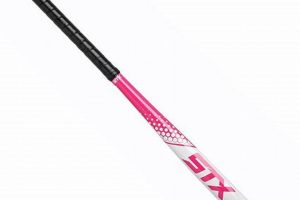
Selection of appropriate equipment is paramount for optimal performance in ice hockey. The implements used directly impact a player’s ability to control the puck, execute passes, and generate shots. High-quality gear, preferred by many athletes, often exhibits superior construction and design intended to enhance the playing experience. These products are often rigorously tested and evaluated based on durability, responsiveness, and overall performance metrics.
The advantages of using premium equipment extend beyond immediate performance gains. Such tools can contribute to improved player confidence, leading to more assertive and strategic gameplay. Historically, advancements in materials and manufacturing techniques have consistently driven improvements in performance and safety standards within the sport, with the tools representing a key facet of this evolution. They also can last a long time with proper care, thus, making it a good investment.
Therefore, a discussion concerning the leading options available is warranted. The following analysis will delve into the various categories, brands, and features to consider when choosing equipment, aiding in informed decision-making. This resource aims to provide a balanced perspective, enabling players to find the right tools for their individual needs and skill levels.
Considerations for Optimized Selection
Selecting appropriate equipment requires careful consideration of several key factors. Individual playing style, skill level, and specific performance goals should inform the decision-making process. Prioritizing these aspects ensures a good choice tailored to individual needs.
Tip 1: Flex Profile Evaluation: Flex refers to the shaft’s stiffness and how easily it bends. Lower flex numbers (e.g., 50-60) are suitable for younger or smaller players, allowing easier loading for shots. Higher flex numbers (e.g., 85-100+) cater to stronger players who require more resistance for powerful shots. Mismatched flex can hinder shot accuracy and power.
Tip 2: Curve and Blade Pattern: The curve impacts shot trajectory, puck control, and passing accuracy. A deeper curve may enhance lifting the puck for shots, while a straighter blade can facilitate backhand shots and precise passing. Experimenting with different patterns is advisable to identify the most suitable option.
Tip 3: Material Composition Analysis: The materials, often carbon fiber composites, affect weight, durability, and responsiveness. Higher-end models typically employ advanced carbon fiber layering techniques, resulting in lighter weight and improved energy transfer. Assessing material quality ensures longevity and enhanced performance.
Tip 4: Grip Enhancement Features: Grip affects puck control, especially during quick maneuvers. Models with enhanced grip coatings offer improved tactile feedback and prevent slippage. Evaluate the grip material’s texture and tackiness to ensure secure hand placement.
Tip 5: Weight Distribution Assessment: Balance influences handling speed and overall feel. A well-balanced option allows for quicker stickhandling and smoother transitions. Assessing the balance point is crucial for optimal control and maneuverability.
Tip 6: Durability Considerations: Look for features that enhance durability, such as reinforced blade construction and impact-resistant shaft materials. Durability contributes to cost-effectiveness, ensuring a prolonged lifespan and minimizing the need for frequent replacements.
Tip 7: Brand Reputation and Warranty: Established brands often invest in research and development, resulting in higher-quality products. Checking the manufacturer’s warranty provides additional assurance of product reliability and customer support.
Careful assessment of these factors leads to a more informed and strategic approach to equipment procurement. A well-chosen implement enhances performance potential and overall playing experience.
The subsequent sections will delve into specific product categories and reviews, providing additional context for informed decision-making. This comprehensive approach aims to assist players in identifying optimal choices.
1. Material Composition

The material composition of a hockey stick directly influences its performance characteristics and overall quality, acting as a key determinant of whether a product achieves a designation as a leading product. Carbon fiber is ubiquitously used in modern hockey sticks due to its high strength-to-weight ratio. The grade and layering technique of the carbon fiber significantly impacts the stick’s responsiveness, durability, and energy transfer. For instance, sticks employing unidirectional carbon fiber tend to exhibit greater stiffness and power transfer compared to those using woven fiber patterns.
The resin system binding the carbon fibers is equally crucial. High-quality resins enhance impact resistance and prevent premature cracking or delamination. Moreover, some sticks incorporate additional materials, such as Kevlar or graphene, in high-stress areas to further augment durability. The specific composition and construction techniques employed are often proprietary and represent a significant differentiator among premium products. An example is a stick that uses a specific resin that allows more energy transfer leading to increase in shot power. In contrast, lower-end sticks often utilize fiberglass or lower-grade carbon fiber, resulting in diminished performance and reduced longevity.
In summary, the strategic selection and integration of materials directly impact the stick’s performance, durability, and overall value. Understanding material composition empowers players and equipment managers to make informed decisions, ultimately leading to a superior playing experience. The composition should be a primary consideration when assessing a hockey stick’s quality and suitability for the demands of the sport.
2. Flex and Kick Point

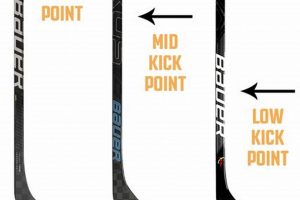
The flex and kick point of a hockey stick are crucial determinants of its performance capabilities, significantly influencing its rating. Flex refers to the stick’s stiffness, quantified by a numerical value representing the force required to bend it by a specific amount. A properly matched flex optimizes energy transfer during a shot, enhancing both power and accuracy. The kick point, the area where the stick bends most during a shot, dictates shot trajectory and release speed. A low kick point facilitates a quicker release, advantageous for close-range shots, while a high kick point provides more power for distance shots. Top-rated sticks offer a range of flex options and kick point designs to cater to various player styles and preferences. Failure to select the appropriate flex and kick point can negatively impact performance, hindering a player’s ability to execute shots effectively. An example is a player with a whippy shot, the puck come up slowly and less power in terms of speed.
Manufacturers of high-performing hockey sticks often employ advanced construction techniques to fine-tune flex profiles and kick points. Composite materials, such as carbon fiber, are strategically layered to create specific bending characteristics. Some premium sticks feature variable kick points, allowing the stick to adapt to different shooting styles. The precise engineering of the flex and kick point directly impacts energy transfer, shot accuracy, and overall feel. Premium sticks optimize these variables, offering players enhanced control and responsiveness. The wrong flex will mean that the player is unable to transfer and control the energy, causing decrease shot speed or inaccurate shot.
In summary, flex and kick point are integral components of a top-performing hockey stick. Matching these characteristics to a player’s skill set and playing style is essential for maximizing performance. Manufacturers’ commitment to optimizing flex profiles and kick points through advanced material selection and construction techniques distinguishes superior sticks from inferior alternatives. This understanding is crucial for players seeking to enhance their shooting capabilities and overall effectiveness on the ice, and contributes significantly to the overall perceived quality.
3. Blade Design

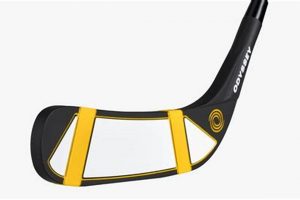
Blade design is an elemental factor in determining whether a hockey stick merits a designation as a top-rated product. It impacts puck control, shot accuracy, and overall feel. The blade’s curvature, face angle, and core material directly influence a player’s ability to receive passes, elevate the puck, and generate precise shots. For instance, a blade with a pronounced curve facilitates lifting the puck quickly, advantageous in close-quarters situations. Conversely, a flatter blade offers enhanced control for puck handling and passing accuracy. Premium products employ advanced composite materials in the blade core, optimizing stiffness and responsiveness. Blades incorporating dampening technologies can reduce vibration, providing a more tactile and controlled feel. The selection of design attributes affects the performance in terms of quality.
Different blade designs cater to specific player styles and positions. Defensive players often favor blades with flatter profiles for improved passing and defensive zone puck clearing. Offensive players, conversely, frequently opt for more curved blades to enhance shooting capabilities. Manufacturers conduct extensive research and development to optimize blade designs, considering factors such as impact resistance, weight distribution, and puck feel. The integration of advanced materials, such as high-modulus carbon fiber and specialized foam cores, enhances energy transfer and puck control. An example might be a curved blade with an injection molded core will deliver better puck handling and also power when taking a slap shot. Failure to optimize blade design can result in diminished performance, hindering a player’s ability to execute fundamental skills effectively.
In summary, blade design significantly influences a hockey stick’s performance characteristics, thereby impacting its overall quality. Optimizing blade curvature, face angle, and core material are crucial for enhancing puck control, shot accuracy, and overall feel. Understanding blade design principles enables players to make informed decisions, ultimately selecting a product that aligns with their individual playing style and enhances their on-ice capabilities. The focus on blade design underscores the level of engineering and performance optimization that is characteristic of top-rated hockey equipment, making it a vital area of focus for any serious player.
4. Weight and Balance
The weight and balance characteristics of a hockey stick are pivotal attributes that significantly contribute to its overall performance and subsequently, its classification among superior-rated equipment. These features directly impact a player’s ability to handle the stick effectively, influencing stickhandling speed, shot release quickness, and overall agility on the ice. Therefore, careful consideration of weight and balance is paramount when assessing a hockey stick’s suitability for competitive play.
- Swing Weight and Moment of Inertia
Swing weight refers to the distribution of mass along the length of the stick, impacting how easily it can be maneuvered. A lower swing weight, indicating a concentration of mass closer to the hands, facilitates quicker stickhandling and faster shot releases. Moment of inertia, a related concept, quantifies the resistance to rotational acceleration. Top-rated sticks minimize both swing weight and moment of inertia through advanced material selection and strategic weight distribution. As an example, sticks incorporating lightweight carbon fiber in the blade reduce the swing weight, making the stick feel lighter and more responsive in the player’s hands. High performance is closely linked to optimizing these inertial properties.
- Balance Point and Equilibrium
The balance point is the location along the shaft where the stick remains horizontal when supported. A well-balanced stick, with the balance point closer to the center, offers enhanced control and reduces fatigue during extended periods of play. Conversely, a stick that is blade-heavy or handle-heavy can lead to compromised handling and increased strain on the wrists and forearms. Manufacturers of leading sticks carefully engineer the balance point to optimize feel and maneuverability. Adjusting this point means adjusting your playing style.
- Material Density and Distribution
The density of materials used in the construction of a hockey stick, and how they are distributed, significantly influences its weight and balance. Lighter materials, such as carbon fiber composites, reduce overall weight while maintaining structural integrity. Strategic placement of denser materials, such as reinforced polymers, in high-stress areas enhances durability without compromising balance. Top-rated sticks employ advanced material mapping techniques to optimize weight distribution for peak performance. Distributing equal amounts of weight will increase durability.
- Impact on Stickhandling and Shooting
Weight and balance directly affect a player’s ability to execute fundamental skills, such as stickhandling and shooting. A lighter, well-balanced stick allows for quicker hand movements and more precise puck control. It also enables a faster shot release, increasing the likelihood of scoring. Conversely, a heavy or poorly balanced stick can hinder stickhandling agility and reduce shot power and accuracy. Therefore, top-rated sticks prioritize weight and balance to enhance overall performance capabilities.
In summary, the weight and balance of a hockey stick are critical performance attributes that significantly contribute to its overall quality and classification among top-rated equipment. By optimizing swing weight, balance point, material density, and weight distribution, manufacturers can enhance stickhandling agility, shot release quickness, and overall control on the ice. The emphasis on weight and balance underscores the level of engineering and performance optimization that is characteristic of leading hockey equipment.
5. Durability Assessment

Durability assessment constitutes a cornerstone in the evaluation process for determining whether a hockey stick qualifies as top-rated. The inherent nature of ice hockey subjects equipment to repetitive and forceful impacts, stresses from bending during shots, and abrasive contact with the ice surface. Consequently, the capacity of a stick to withstand these conditions directly correlates with its longevity and overall value proposition. Rigorous durability testing protocols, employing standardized impact tests, flex tests, and material fatigue analysis, are critical for objectively measuring the stick’s resistance to failure under typical playing conditions.
The direct correlation between durability and performance stems from the stick’s ability to maintain its intended flex profile and structural integrity over time. A stick that prematurely loses its stiffness or develops micro-fractures will inevitably exhibit diminished performance characteristics, including reduced shot power, decreased accuracy, and compromised puck control. Real-world examples abound; elite-level players demand equipment that can withstand the rigors of intense training and competitive gameplay, necessitating superior durability. Furthermore, equipment managers prioritize durability to minimize replacement costs and ensure consistent performance across their team’s equipment inventory.
In conclusion, durability assessment is not merely an ancillary consideration but an indispensable component of the overall evaluation of hockey sticks. Products that consistently demonstrate superior resistance to damage and degradation in controlled testing scenarios, coupled with positive feedback from players regarding their real-world resilience, are more likely to achieve recognition as top-rated. Understanding the practical significance of durability enables informed decision-making, ensuring that equipment investments yield maximum performance and longevity. The lack of durability assessment leads to a product that, no matter how fancy in design, is not considered a high-quality product.
Frequently Asked Questions About Top Rated Hockey Sticks
This section addresses common inquiries regarding equipment selection. It provides concise answers to facilitate informed purchasing decisions.
Question 1: What constitutes the defining characteristics of equipment recognized in its class?
Attributes such as superior material composition, optimized flex profiles, innovative blade designs, balanced weight distribution, and demonstrated durability are essential determinants.
Question 2: How does material composition influence overall performance?
Premium materials, such as high-grade carbon fiber, enhance energy transfer, reduce weight, and increase responsiveness, thereby improving shot power and puck control.
Question 3: What role does flex play in a player’s shot?
Flex dictates how a shaft bends, influencing energy transfer. The optimal flex is contingent upon player size, strength, and shooting style.
Question 4: Why is blade design a critical factor to consider?
Blade curvature, face angle, and core material affect puck reception, elevation, and shot accuracy. Different designs cater to specific player positions and styles.
Question 5: How do weight and balance affect handling?
A lighter, well-balanced item facilitates quicker stickhandling, faster shot release, and reduced fatigue. Optimal weight distribution enhances overall control.
Question 6: Why is durability a primary concern in equipment selection?
Durability ensures prolonged lifespan and consistent performance under demanding playing conditions, minimizing replacement costs and maintaining reliability.
In summary, recognizing the critical factors that define superior equipment materials, flex, blade design, weight, balance, and durability is crucial for making informed choices that enhance performance and longevity.
The following sections will delve into specific product recommendations, providing additional context for informed decision-making.
Conclusion
This exploration of considerations vital to selection, has underscored the importance of evaluating material composition, flex profile, blade design, weight distribution, and overall durability. Each of these characteristics contributes significantly to the implement’s performance potential and longevity, influencing player effectiveness and satisfaction. A comprehensive understanding of these factors enables informed decision-making, leading to optimized on-ice performance. Prioritize your needs to achieve the desired results.
The pursuit of high-quality products represents an investment in performance and skill development. Continued advancements in materials and manufacturing techniques promise further refinements in gear technology. The careful application of the knowledge presented here will empower players and equipment managers to navigate the evolving landscape, ensuring access to resources that meet the demands of competitive hockey, and maximizing potential.