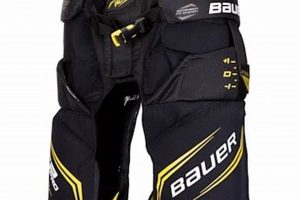
Protective gear and implements are essential for participation in the sport played on ice. These collections typically include a helmet, shoulder pads, elbow pads, gloves, pants, shin guards, and skates. A player requires this ensemble to engage in the activity safely and effectively. As an example, a complete youth offering would contain scaled-down versions of all the aforementioned components tailored for smaller body sizes.
The availability of a complete collection ensures that participants possess all the necessary defenses against potential injuries inherent in this high-impact athletic pursuit. These collections have evolved over time, reflecting advances in materials science and a greater understanding of athlete safety. Historically, amateur players often assembled their protection individually, but the convenience and standardized protection offered by unified packages have led to their widespread adoption across all skill levels.
The subsequent sections will delve into the individual constituents of these protective collections, exploring their specific features, technological advancements, and considerations for optimal fit and performance, ensuring adequate safeguards during the sport.
Essential Considerations for Equipping a Hockey Player
Selecting the proper protective articles for a hockey player requires careful attention to detail. Prioritizing safety and performance through informed choices is paramount.
Tip 1: Prioritize Fit: Accurate sizing is non-negotiable. Ill-fitting components impede mobility and compromise protection. A helmet, for example, should fit snugly without restricting vision.
Tip 2: Adhere to Safety Standards: Ensure that all components meet the established certification standards, such as those set by HECC and CSA. These certifications guarantee a minimum level of impact resistance.
Tip 3: Consider Skill Level: A novice player may require more robust protection than a seasoned professional. Padding thickness and coverage area should align with the player’s experience and potential exposure to impacts.
Tip 4: Account for Growth (Youth): When selecting for younger players, opt for adjustable features where possible. Components with adjustable straps and extendable lengths can accommodate growth spurts without requiring immediate replacement.
Tip 5: Inspect Regularly: Routine inspection for wear and tear is crucial. Cracks, tears, or loose straps can significantly reduce the effectiveness of the protective articles. Replace compromised components immediately.
Tip 6: Layer Appropriately: Base layers designed for moisture wicking enhance comfort and regulate body temperature. Proper layering also prevents chafing and irritation from direct contact with the protective articles.
Tip 7: Consult Experts: Seek guidance from experienced retailers or coaches. Their expertise can prove invaluable in navigating the vast array of options and ensuring proper fit and functionality.
Adherence to these guidelines enhances player safety and performance. Informed decisions regarding component selection are critical for mitigating the risks associated with the sport.
The subsequent conclusion will summarize the key elements discussed and emphasize the enduring importance of investing in quality protective articles.
1. Protection against impacts

The capacity to mitigate physical trauma is a primary function of apparatus intended for use on the ice. The assembly of protective articles is fundamentally defined by its ability to absorb and disperse impact forces, thereby reducing the risk of injury.
- Material Composition and Energy Absorption
The selection of materials directly dictates the efficacy of impact attenuation. High-density foams, such as expanded polypropylene (EPP) and expanded polystyrene (EPS), are commonly employed for their ability to deform upon impact, converting kinetic energy into thermal energy and minimizing force transmission to the body. The specific density and thickness of these foams are engineered to withstand the anticipated impact forces associated with the sport.
- Structural Design and Force Distribution
The architecture of the protective article plays a crucial role in distributing impact forces across a broader surface area. Helmets, for instance, often incorporate a multi-layered construction that includes a hard outer shell and an energy-absorbing liner. This configuration serves to deflect and dissipate impact energy, reducing the likelihood of localized trauma. Shoulder pads and shin guards utilize similar principles, employing contoured designs and strategically placed padding to maximize protection while minimizing restriction of movement.
- Standards and Certification Compliance
Adherence to established safety standards, such as those promulgated by the Hockey Equipment Certification Council (HECC) and the Canadian Standards Association (CSA), is paramount. These standards prescribe rigorous testing protocols to ensure that protective articles meet minimum performance criteria for impact resistance. Certification marks provide assurance that the apparatus has been subjected to independent evaluation and meets the requisite safety thresholds.
- Dynamic Testing and Performance Metrics
The effectiveness of components is evaluated through dynamic testing methodologies that simulate real-world impact scenarios. These tests involve measuring the forces transmitted to a surrogate head or body form under specified impact conditions. Performance metrics, such as peak acceleration and head injury criterion (HIC), are used to quantify the level of protection afforded by the apparatus. These data inform the design and refinement of protective articles, leading to continuous improvements in impact attenuation capabilities.
Collectively, these facets highlight the critical interplay between material science, engineering design, and regulatory compliance in ensuring that collections provide robust defense against impacts. The continued evolution of these aspects reflects a commitment to enhancing player safety and mitigating the inherent risks associated with the sport.
2. Ergonomic Design

Ergonomic design is an indispensable attribute in collections, influencing not only player comfort but also athletic performance and injury prevention. The configuration of these protective articles must account for the biomechanics of skating, stickhandling, and physical contact to facilitate optimal movement and dexterity.
- Anatomical Conformity and Range of Motion
Ergonomic design prioritizes the alignment of protective articles with the natural contours of the human body. Shoulder pads, for example, are sculpted to conform to the shoulder girdle, allowing for unrestricted arm movement during skating and shooting. Similarly, shin guards are designed to articulate with the knee joint, facilitating a full range of motion while providing comprehensive coverage. Gloves are designed with pre-curved fingers to aid with stickhandling.
- Weight Distribution and Reduced Fatigue
Minimizing the weight of protective articles and optimizing weight distribution are crucial for reducing player fatigue and enhancing agility. Lightweight materials, such as advanced composite plastics and high-density foams, are strategically incorporated to reduce the overall burden on the athlete. Thoughtful weight distribution ensures that the protective articles do not impede movement or create imbalances that could compromise performance.
- Ventilation and Thermal Regulation
Ergonomic design extends beyond physical fit to encompass thermal comfort. Ventilation channels and moisture-wicking fabrics are integrated into protective articles to promote airflow and dissipate heat. This helps to regulate body temperature, prevent overheating, and minimize the accumulation of sweat, which can contribute to discomfort and reduced performance. Perspiration and heat build-up can lead to fatigue and reduced player performance.
- Customization and Adjustability
Ergonomic design acknowledges the diversity of body shapes and sizes among players. Adjustable straps, buckles, and padding systems are incorporated to allow for a customized fit. This ensures that protective articles can be tailored to individual needs, optimizing both comfort and protection. Helmets are typically adjustable at the rear to accommodate various head sizes. Many gloves feature adjustable wrist closures.
These considerations underscore the importance of ergonomic design in maximizing the functionality and effectiveness of collections. By optimizing fit, weight distribution, ventilation, and adjustability, ergonomic design contributes to enhanced player comfort, improved performance, and a reduced risk of injury. Ergonomically designed assemblies increase confidence in one’s defensive protection.
3. Material Durability

Material durability represents a critical determinant of the lifespan, performance, and safety of protective articles used in ice sports. The inherent physical demands of the sport, characterized by high-speed impacts, abrasive surfaces, and repetitive stress, necessitate that materials exhibit exceptional resistance to degradation. The integrity of each component within the ensemble hinges on the selection and processing of robust substances.
- Abrasion Resistance and Surface Integrity
The outer layers of padding, particularly in areas of frequent contact with the ice or other players (e.g., knee pads, elbow pads, gloves), must withstand significant abrasion. Materials such as high-denier nylons, reinforced polymers, and strategically placed abrasion-resistant panels are employed to mitigate wear and tear. The continued surface integrity directly correlates with the long-term protective capabilities of the assembly.
- Impact Resistance and Energy Absorption
Internal padding materials, responsible for absorbing and dissipating impact energy, require both flexibility and resilience. Expanded polypropylene (EPP) and expanded polystyrene (EPS) foams are commonly used due to their cellular structure, which allows for controlled deformation upon impact. These materials must maintain their energy-absorbing properties over extended use to provide consistent protection against concussions and other injuries.
- Structural Integrity and Load-Bearing Capacity
Components that provide structural support, such as helmet shells and skate boots, demand materials with high tensile strength and resistance to deformation under load. Polycarbonate, fiberglass composites, and advanced polymers are selected for their ability to withstand significant forces without fracturing or losing shape. The structural integrity of these components directly impacts the overall protection afforded to the player.
- Environmental Resistance and Material Degradation
Protective articles are frequently exposed to moisture, temperature fluctuations, and ultraviolet radiation, all of which can contribute to material degradation. The selection of materials resistant to these environmental factors is crucial for preserving their long-term performance. Water-resistant fabrics, UV-resistant coatings, and antimicrobial treatments are often incorporated to extend the lifespan and maintain the hygienic properties of the assembly.
The interplay between abrasion resistance, impact resilience, structural integrity, and environmental stability dictates the overall effectiveness and longevity of each assembly. The judicious selection of appropriate materials and manufacturing processes directly influences player safety and equipment lifecycle costs.
4. Regulatory compliance

Regulatory compliance serves as a cornerstone in the production and distribution of articles used in the sport played on ice, ensuring a baseline level of safety and performance. These standards are established by governing bodies and certification organizations to mitigate the risk of injury associated with the activity. Non-adherence to these regulations can result in severe consequences, ranging from product recalls to legal liabilities. The presence of a certification mark, such as those issued by HECC or CSA, indicates that the item has undergone rigorous testing and meets the minimum safety requirements.
The impact of regulatory compliance is evident in the evolution of helmet design. Prior to the widespread adoption of safety standards, head injuries were significantly more prevalent. The introduction of mandatory certification requirements for helmets prompted manufacturers to develop more effective energy-absorbing materials and structural designs. Similar advancements can be observed in other articles, such as shoulder pads and shin guards, driven by the need to meet increasingly stringent performance criteria. These improvements reflect the ongoing commitment to enhance player safety through regulatory oversight.
In summary, regulatory compliance plays a pivotal role in shaping the design, manufacturing, and distribution of ice articles. It provides a framework for ensuring that these collections meet minimum safety standards, thereby reducing the risk of injury and promoting a safer playing environment. While challenges remain in enforcing these regulations and adapting to technological advancements, the fundamental importance of regulatory compliance in safeguarding player welfare remains undeniable.
5. Proper Fit
The correlation between a well-suited protection collection and player safety is direct and undeniable. Inadequate fit compromises the protective capabilities inherent in the design. For example, a helmet that is too large will not effectively absorb impact forces during a collision, potentially leading to head trauma. Conversely, a helmet that is too small may cause discomfort and restrict blood flow, hindering performance. Similarly, shoulder pads that are excessively loose will shift during play, leaving vulnerable areas of the torso exposed to injury. The intended protective functionality is contingent upon correct sizing and secure positioning.
The economic ramifications of improperly fitted articles extend beyond the immediate risk of injury. Ill-fitting pieces can accelerate wear and tear, necessitating more frequent replacements. A skate that is too small, for instance, will place undue stress on the seams and support structures, reducing its lifespan. Furthermore, discomfort caused by incorrectly sized items can lead to reduced playing time and decreased performance, impacting player development and team success. Selecting the proper size from the outset represents a cost-effective strategy in the long run. In addition to saving money, the correct size contributes to a safer, more comfortable and productive athletic experience.
Achieving optimal fit requires meticulous measurement and careful consideration of individual body dimensions. Manufacturers typically provide sizing charts that correlate height, weight, and chest measurements with appropriate article sizes. However, these charts serve only as guidelines, and it is imperative to try on the protection collection whenever possible to ensure a secure and comfortable fit. Consultation with experienced equipment specialists can further assist in the selection process. Ultimately, proper fit is not merely a matter of comfort; it is an indispensable component of an effective, protective collection designed to mitigate injury risks.
6. Mobility Enhancement

The design of an “ice hockey equipment set” significantly impacts a player’s ability to move freely and efficiently on the ice. Mobility enhancement, therefore, is a crucial consideration in the selection and development of such collections. The integration of ergonomic principles and advanced materials aims to provide comprehensive protection without hindering agility or range of motion.
- Streamlined Design and Reduced Bulk
Modern “ice hockey equipment sets” prioritize a streamlined profile to minimize resistance and maximize freedom of movement. Bulky or ill-fitting components can impede a player’s stride, reduce agility, and increase fatigue. Manufacturers strive to create form-fitting designs that conform to the body’s natural contours, allowing for unrestricted movement while maintaining adequate protection. Examples include tapered shoulder pads and contoured elbow pads that allow for a full range of arm motion during stickhandling and shooting.
- Lightweight Materials and Reduced Weight
The weight of “ice hockey equipment sets” can significantly affect a player’s speed and endurance. Lightweight materials, such as advanced composite plastics and high-density foams, are increasingly utilized to reduce the overall weight of protective articles. This allows players to move more quickly and efficiently on the ice, conserve energy, and maintain agility throughout the game. Skates are a prime example, where advancements in blade materials and boot construction have dramatically reduced weight without compromising performance or protection.
- Flexible Construction and Articulated Joints
The construction of “ice hockey equipment sets” incorporates flexible materials and articulated joints to enhance range of motion. Hinged elbow pads and segmented shin guards allow for a greater degree of flexibility, enabling players to perform complex maneuvers and maintain a dynamic posture. The strategic placement of flex zones in gloves and pants further enhances mobility, allowing for greater dexterity and responsiveness. These design features contribute to a more natural and unrestricted skating experience.
- Moisture-Wicking Liners and Enhanced Comfort
Moisture accumulation within “ice hockey equipment sets” can lead to discomfort, chafing, and reduced mobility. Advanced moisture-wicking liners are integrated into many collections to draw sweat away from the body, keeping players dry and comfortable. This not only enhances performance but also prevents skin irritation and reduces the risk of bacterial growth. Well-ventilated designs further promote airflow, preventing overheating and maintaining a comfortable microclimate within the collection. This contributes to ease and fluidity of movement by preventing discomfort.
The pursuit of mobility enhancement in “ice hockey equipment sets” represents a continuous cycle of innovation and refinement. By prioritizing ergonomic design, lightweight materials, flexible construction, and moisture-wicking technology, manufacturers strive to create collections that empower players to perform at their peak without compromising safety. The benefits of this are improved agility and control, and ultimately a more competitive performance.
7. Moisture management

Effective mitigation of perspiration within protective apparatus is integral to the overall performance and hygiene. During strenuous physical exertion, players generate substantial amounts of sweat, which can accumulate within the fabric and padding. This moisture build-up not only creates discomfort but also fosters an environment conducive to bacterial growth and unpleasant odors. The incorporation of moisture-wicking materials and ventilation systems within this ensemble is crucial for maintaining a dry, comfortable, and sanitary environment.
Consider the practical implications of inadequate mitigation. A player whose protective garments become saturated with perspiration experiences a significant decrease in mobility. The added weight of the moisture-laden apparatus restricts agility and contributes to premature fatigue. Furthermore, prolonged exposure to damp conditions can lead to skin irritation and an increased risk of infection. In contrast, a set that effectively manages moisture allows players to maintain optimal performance throughout extended periods of intense activity. Moisture-wicking materials such as polyester and microfiber draw perspiration away from the skin, promoting evaporation and reducing the risk of discomfort and hygiene-related issues. Ventilation channels strategically positioned within the apparatus further enhance airflow, facilitating heat dissipation and moisture removal.
Ultimately, moisture management is not merely a matter of comfort; it is a critical component of the apparatus’ overall functionality and a significant factor in preserving player health and hygiene. Effective dissipation prevents the accumulation of sweat, mitigating discomfort, reducing the risk of bacterial growth, and enabling players to maintain peak performance. The inclusion of advanced ventilation and moisture-wicking technologies in modern apparatus reflects an understanding of the importance of these factors.
Frequently Asked Questions
The following section addresses common inquiries regarding the selection, maintenance, and utilization of protection collections, with the intent of providing comprehensive and unbiased information.
Question 1: What constitutes a complete ice hockey equipment set?
A complete offering typically includes a helmet with face mask or shield, shoulder pads, elbow pads, gloves, protective jock or jill shorts, hockey pants, shin guards, and skates. A neck guard is recommended for added protection. The inclusion of a mouthguard is advisable to protect against dental injuries.
Question 2: How should proper sizing be determined?
Sizing varies among manufacturers, but generally correlates with height, weight, and chest measurements. It is advisable to consult sizing charts provided by individual manufacturers and to try on components whenever possible. A snug but not constricting fit is generally desirable.
Question 3: What safety certifications are relevant to ice hockey protection?
In North America, the Hockey Equipment Certification Council (HECC) and the Canadian Standards Association (CSA) are the primary certification bodies. These organizations establish performance standards for helmets and other protective articles. Certification marks indicate compliance with these standards.
Question 4: How frequently should protection be inspected and replaced?
Routine inspection for signs of wear and tear is essential. Cracks, tears, and loose straps can compromise the protection effectiveness. Components should be replaced immediately if damage is detected. The lifespan of an item depends on usage frequency and intensity, but helmets generally require replacement every five years, regardless of visible damage.
Question 5: What is the recommended procedure for cleaning and maintaining this equipment?
After each use, protective articles should be aired out to prevent moisture accumulation and bacterial growth. Removable liners can be machine washed according to the manufacturer’s instructions. The outer surfaces can be wiped down with a damp cloth and mild detergent. Avoid using harsh chemicals or abrasive cleaners, as these can damage materials and compromise their protective properties.
Question 6: How does the protective collection impact mobility and performance?
A well-fitted collection should provide adequate protection without unduly restricting movement. Look for components with ergonomic designs and lightweight materials to enhance agility and reduce fatigue. Proper sizing and adjustment are crucial for optimizing both protection and performance.
In conclusion, informed decisions regarding protection collection selection, maintenance, and utilization are paramount for ensuring player safety and maximizing performance. Adherence to safety standards, proper sizing, and routine inspection are essential for mitigating injury risks.
Conclusion
This exploration of protective collections highlights their multifaceted nature, encompassing critical aspects such as impact resistance, ergonomic design, material durability, regulatory compliance, proper fit, mobility enhancement, and moisture management. The comprehensive understanding of these elements is paramount for informed decision-making when selecting and maintaining such assemblages. A deficiency in any of these areas can compromise player safety and hinder on-ice performance. The stringent adherence to established safety standards and the implementation of routine inspection protocols are non-negotiable prerequisites for mitigating potential risks.
The continuous advancement in materials science and design engineering necessitates ongoing vigilance in evaluating and upgrading protective equipment. Prioritizing player welfare through the provision of appropriate and well-maintained ice ensembles remains an ethical and practical imperative, demanding a commitment to safety from players, coaches, and organizations alike. The investment in quality collections is not merely an expenditure but a crucial safeguarding measure, contributing to the longevity and well-being of athletes participating in the sport.