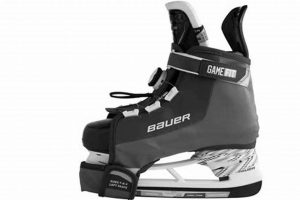
The vertical dimension of hockey footwear is a significant factor in performance and protection. This measurement, taken from the bottom of the blade to the highest point of the boot, varies based on skate size and design. A higher profile provides increased ankle support, while a lower profile may offer greater agility.
This height is crucial for stability, maneuverability, and safeguarding the ankle joint. Historically, designs have evolved to balance protection with the range of motion required for optimal skating. Proper height contributes to efficient energy transfer during strides and reduces the risk of injury from impacts or twists.
Understanding the different factors that influence the vertical size of these skates, including the player’s age, skill level, and preferred playing style, is key to selecting the appropriate equipment. Detailed examination of junior versus senior sizes, variations in boot construction, and the impact of blade holders on overall measurement are essential for informed decision-making.
Optimizing Hockey Skate Height
Selecting hockey skates requires careful consideration of the boot’s vertical dimension. The following tips offer guidance on choosing equipment that balances protection, performance, and comfort.
Tip 1: Consider Player Age and Size: Junior skates generally feature a lower profile compared to senior models. Matching the boot height to the player’s age and physical stature ensures appropriate support without restricting movement.
Tip 2: Evaluate Playing Style: Players who prioritize agility may benefit from a lower-cut boot, which allows for increased ankle flexion. Conversely, those seeking maximum stability and protection should consider a taller boot.
Tip 3: Account for Blade Holder Height: The blade holder contributes to the overall height. Different holder designs can subtly alter the skate’s center of gravity, influencing balance and stride efficiency. Research holder specifications prior to purchase.
Tip 4: Prioritize Ankle Support: Insufficient ankle support can lead to instability and increase the risk of injury. Ensure the boot provides adequate support to prevent excessive lateral movement during skating. Stiffer materials and integrated support systems can be beneficial.
Tip 5: Assess Boot Stiffness: Boot stiffness directly correlates with the level of support provided. Beginner players often benefit from a more flexible boot, while advanced players typically require a stiffer boot for enhanced power transfer and control.
Tip 6: Recognize the Impact on Agility: A taller profile can sometimes limit agility, particularly for players who rely on quick turns and rapid changes in direction. Finding the right balance between support and flexibility is crucial for optimal performance.
Tip 7: Consider Customization Options: Some skate models offer customization options, such as adjustable ankle support or heat-moldable boots. These features allow for a more personalized fit, optimizing both comfort and performance.
By carefully evaluating these factors, players can select hockey skates that provide the ideal balance of protection, performance, and comfort, minimizing the risk of injury and maximizing on-ice effectiveness.
Further research into specific skate models and consultations with experienced skate technicians are recommended to ensure proper equipment selection.
1. Ankle Support

The vertical dimension of hockey skates directly correlates with the level of ankle support provided. A taller boot typically extends higher up the ankle, offering greater stabilization and reducing the likelihood of sprains or other injuries. This heightened support is achieved through the increased surface area of the boot that makes contact with and reinforces the ankle joint. For instance, skates designed for novice players or those recovering from ankle injuries often feature a higher cut to provide maximum support. Conversely, experienced players may opt for skates with a slightly lower cut to gain increased flexibility and range of motion, although this can compromise some degree of ankle support.
The design and materials employed in the boot’s construction further contribute to ankle support. Stiffer materials, such as reinforced polymers or composite materials, provide a more rigid structure that limits excessive ankle movement. Lacing systems also play a critical role. A properly tightened lacing system distributes pressure evenly across the boot, ensuring a snug and secure fit that prevents the ankle from shifting within the skate. In professional hockey, players frequently customize their lacing patterns to achieve a desired balance of support and flexibility tailored to their individual needs.
Therefore, the boot’s vertical measurement should be considered in conjunction with material stiffness and lacing system effectiveness when evaluating ankle support. While a taller boot generally implies greater support, the overall design must work in harmony to deliver optimal protection. Failure to adequately support the ankle can lead to injuries that impair performance and potentially shorten a player’s career. The selection of hockey skates should prioritize a balance of comfort, support, and flexibility based on the player’s skill level, playing style, and injury history.
2. Blade Holder

The blade holder significantly influences the overall vertical dimension of hockey skates. It is the component attaching the steel blade to the boot, adding height beneath the foot. Different blade holder designs and sizes directly impact the distance from the ice surface to the player’s foot, thus contributing to the total height of the skate. For instance, a taller blade holder will inevitably result in a greater overall skate height compared to a shorter one, assuming identical boots are used.
Variations in blade holder design, such as those optimized for forward lean or increased agility, also affect the resultant skate height. A blade holder designed to promote a more aggressive forward lean might incorporate a ramped profile, effectively raising the heel relative to the toe. This deliberate alteration in the holder’s geometry changes the skater’s posture and affects the distribution of weight, and, as a direct consequence, modifies the effective height and angle of the skate in contact with the ice. Similarly, a holder designed for rapid turns may feature a shorter length or altered curvature, impacting the overall height and maneuverability.
Understanding the interplay between blade holder design and overall skate height is crucial for selecting appropriate equipment. The combined height influences the player’s center of gravity, stride efficiency, and stability. Ignoring this relationship can lead to suboptimal performance or increased risk of injury. Therefore, consideration of the blade holder is an integral part of assessing the dimensions and suitability of hockey skates, ensuring a balance between comfort, performance, and protection.
3. Boot Height
Boot height is a primary determinant of the overall vertical dimension of hockey skates. It represents the distance from the sole of the skate to the upper edge of the boot, excluding the blade holder and blade. Variations in boot height are designed to influence factors such as ankle support, range of motion, and protection.
- Ankle Support and Stability
A taller boot height typically provides enhanced ankle support, restricting lateral movement and reducing the risk of ankle injuries. This increased stability is beneficial for novice skaters or those who require additional support due to previous injuries. Conversely, a shorter boot height offers less restriction, potentially increasing agility but decreasing support. An example is seen in recreational skates which tend to have more boot height.
- Range of Motion and Agility
The height of the boot directly affects the skater’s range of motion. Lower boot heights allow for greater ankle flexion and extension, facilitating more agile movements and quicker turns. Professional hockey players often favor skates with a slightly lower boot height to maximize their maneuverability on the ice. The design trade-off prioritizes agility at the expense of some ankle support.
- Protection
Higher boot heights offer increased protection to the lower leg, guarding against impacts from pucks, sticks, or other players. The extended coverage helps to distribute the force of collisions, reducing the likelihood of bruises or more serious injuries. Goalies often use skates that have additional protection in their boot height to protect themselves.
- Skate Stiffness and Performance
The boot’s height contributes to its overall stiffness. A taller boot, especially when constructed with rigid materials, provides greater torsional stiffness, enhancing power transfer during skating strides. Stiffer boots enable more efficient energy transfer, allowing for increased speed and acceleration. The overall boot height is the foundation where the other elements of stiffness are applied.
In summary, boot height is a fundamental aspect of the overall vertical dimension of hockey skates. It directly influences ankle support, range of motion, protection, and skate stiffness. The optimal boot height depends on the player’s skill level, playing style, and individual preferences. Selecting the appropriate boot height is crucial for maximizing performance and minimizing the risk of injury.
4. Player Size

Player size is a critical factor influencing the selection of hockey skate dimensions, particularly the overall height. Matching skate size, including its vertical measurement, to the player’s physical stature is essential for ensuring both performance and safety. Discrepancies between skate height and player size can compromise stability, maneuverability, and protection.
- Age and Developmental Stage
Youth hockey skates are specifically designed with lower profiles to accommodate smaller anatomies and developing motor skills. The reduced height facilitates greater agility and control for younger players. As players mature and their skating abilities advance, they transition to taller skates that offer increased support and power transfer. Adult skates are engineered to withstand the greater forces generated by larger, more powerful skaters.
- Foot Length and Width
While not directly influencing height, foot dimensions are intrinsically linked to overall skate size. Proper fit is paramount. A skate that is too long or too wide can result in instability and reduced control, negating any perceived advantages of a particular height. Manufacturers offer a range of sizes and widths to accommodate various foot shapes. Improperly fitted skates increase the risk of blisters, calluses, and other foot-related injuries.
- Weight and Strength
Heavier players generally require skates with more robust construction, including a taller and stiffer boot. The increased height and rigidity provide enhanced support and prevent excessive flexing, particularly during powerful skating strides. Conversely, lighter players may benefit from more flexible skates with lower profiles, which allow for greater agility and responsiveness. The trade-off is that a lighter player will have increased range of motion in their ankle which may lead to an injury.
- Position and Playing Style
Player size often correlates with the assigned position and playing style. For example, larger defensemen may favor taller skates that offer maximum protection and stability during physical play. Smaller, more agile forwards might opt for skates with a slightly lower profile to enhance their maneuverability and speed. However, these are general trends, and individual preferences and skating styles can significantly influence skate selection.
In conclusion, player size is an indispensable consideration when determining the appropriate dimensions of hockey skates. Age, foot size, weight, and playing style all interact to dictate the optimal skate height. A well-fitted skate that complements the player’s physical attributes and on-ice role is crucial for maximizing performance and minimizing the risk of injury. Therefore, a careful evaluation of player size should be a prerequisite for selecting hockey skates.
5. Skating Style

Skating style significantly influences the optimal vertical dimension of hockey skates. Different skating techniques and on-ice roles necessitate varying degrees of ankle support, flexibility, and protection, all of which are directly related to the height of the skate boot.
- Agility-Focused Skating
Skaters prioritizing agility, such as offensive forwards, often benefit from skates with a lower boot height. This design permits greater ankle flexion and extension, facilitating quicker turns, faster acceleration, and more responsive maneuvering. However, the trade-off is a reduction in ankle support, potentially increasing the risk of injury from impacts or sudden directional changes. For example, a player known for their speed and agility may prefer a lower-cut skate to maximize their ability to navigate tight spaces and evade defenders.
- Power Skating
Skaters emphasizing power and stability, such as defensive players or those focused on physical play, typically require skates with a taller boot height. The increased vertical dimension provides enhanced ankle support, minimizing the risk of injury during collisions or when applying forceful skating strides. This additional support is crucial for maintaining balance and stability when engaging in physical battles along the boards or in front of the net. A defenseman, for example, might opt for a taller skate to provide the necessary support and protection when absorbing checks and blocking shots.
- Hybrid Skating Styles
Many players adopt a hybrid skating style, combining elements of both agility and power. These players may benefit from skates with a moderate boot height that balances support and flexibility. The specific height will depend on the individual’s relative emphasis on agility versus power. A two-way forward, who contributes both offensively and defensively, might choose a skate that offers a compromise between maneuverability and stability, allowing them to effectively perform in various game situations.
- Goalie Skating Style
Goaltenders exhibit a distinct skating style characterized by lateral movements, rapid adjustments, and a low center of gravity. Goalie skates typically feature a taller boot height to provide maximum ankle support and protection, compensating for the unique stresses placed on the ankle joint during goaltending movements. Additionally, goalie skates often incorporate reinforced materials and padding to protect against puck impacts and collisions. The taller profile will support the goalie in his various stance positions.
In conclusion, skating style dictates the optimal balance between ankle support, flexibility, and protection, which is directly influenced by the height of the hockey skate. Selecting the appropriate skate height based on skating style is essential for maximizing performance and minimizing the risk of injury. The choice of height should align with the player’s on-ice role, skating technique, and individual preferences.
6. Injury Prevention
The vertical dimension of hockey skates plays a critical role in mitigating the risk of lower extremity injuries. Selecting an appropriate height is essential for providing adequate support, stability, and protection, thereby minimizing the potential for ankle sprains, fractures, and other common hockey-related injuries.
- Ankle Sprain Mitigation
The height of the skate boot directly influences the degree of ankle support. A taller boot restricts excessive lateral movement, reducing the likelihood of ankle sprains. This is particularly important for novice skaters or individuals with a history of ankle instability. Conversely, a boot that is too short may not provide sufficient support, increasing the vulnerability to ankle injuries. The selection of boot height should align with the skater’s skill level, playing style, and injury history. A higher boot cut is best for mitigating ankle sprains.
- Fracture Prevention
The height of the skate contributes to the overall protection of the lower leg. A taller boot provides greater coverage, dispersing the impact of collisions with pucks, sticks, or other players. This helps to prevent fractures of the tibia or fibula. Skates designed for defensive players or those who engage in frequent physical contact often feature a taller boot height to maximize protection. The height of the skate boot is a main factor in fracture prevention.
- Tendon Strain Reduction
Proper skate fit, including appropriate height, can reduce the risk of tendon strains in the lower leg. A skate that is too tall or too stiff can restrict ankle mobility, leading to strain on the Achilles tendon or other tendons in the foot and ankle. Conversely, a skate that is too short may not provide sufficient support, increasing the stress on these tendons during skating strides. The skate should allow for a natural range of motion while still providing adequate support. The height of the boot must be correct to prevent this injury.
- Impact Force Distribution
The vertical dimension of the skate boot contributes to the distribution of impact forces during collisions. A taller boot spreads the force over a larger area, reducing the concentration of stress on any one point. This can help to prevent contusions, bruises, and other soft tissue injuries. Skates incorporating advanced materials and construction techniques further enhance impact force distribution. Taller heights can distribute the impact force to prevent major injury.
In conclusion, the height of hockey skates is a crucial factor in injury prevention. Selecting a skate with an appropriate height, based on individual needs and playing style, is essential for minimizing the risk of ankle sprains, fractures, tendon strains, and other common hockey-related injuries. Careful consideration of skate height, in conjunction with other factors such as fit, stiffness, and material construction, is paramount for ensuring player safety and maximizing on-ice performance.
7. Performance Impact
The vertical dimension of hockey skates exerts a significant influence on a player’s on-ice capabilities. This dimension impacts crucial elements of skating performance, including agility, power transfer, stability, and control. The interplay between skate height and these performance parameters warrants careful consideration when selecting equipment.
- Agility and Maneuverability
Lower skate boots generally permit greater ankle flexion, enhancing agility and maneuverability. This configuration allows players to execute quicker turns, tighter pivots, and more rapid changes in direction. However, this increased agility comes at the cost of reduced ankle support. For instance, forwards known for their speed and deftness often favor lower-cut skates to maximize their agility in offensive zones. The trade-off for agility needs to be accounted for.
- Power Transfer and Efficiency
Taller skate boots, particularly those constructed with stiff materials, facilitate more efficient power transfer during skating strides. The increased rigidity minimizes energy loss due to boot flexing, enabling players to generate greater thrust and acceleration. Defensemen or power forwards who rely on strong skating strides often benefit from taller boots that optimize power transfer. The height of the boot makes power transfer possible.
- Stability and Balance
A taller boot height contributes to enhanced ankle stability, which is critical for maintaining balance during skating maneuvers. This is particularly important when absorbing impacts, battling for puck possession, or executing high-speed turns. Players who prioritize stability may prefer taller skates to minimize the risk of ankle roll or loss of control. Having a taller boot enables more support in the player’s balance.
- Control and Precision
Skate height influences the precision with which players can execute various skating techniques. A well-fitted skate, with an appropriate height, allows for more precise control over blade angle, edge engagement, and weight distribution. This is essential for executing accurate passes, shooting with power and accuracy, and maintaining control during complex skating sequences. Having the correct height and proper weight distribution enables control of the skate.
The performance impact of skate height is multifaceted and dependent on individual playing styles and preferences. Selecting the optimal skate height requires careful consideration of the trade-offs between agility, power, stability, and control. The chosen height influences nearly every aspect of a player’s on-ice performance, underscoring the importance of proper equipment selection. Players need to choose a skate that optimizes performance.
Frequently Asked Questions
This section addresses common queries regarding the vertical dimension of hockey skates, providing factual information to clarify key aspects of skate height and its impact on performance and safety.
Question 1: Does height vary based on player age and size?
Skate height typically corresponds to player age and size. Junior skates generally feature a lower profile compared to senior models. This adjustment accommodates the anatomical differences and developmental needs of younger players.
Question 2: How does skate height affect ankle support?
Skate height and ankle support are directly related. A taller boot generally provides greater ankle support, minimizing the risk of sprains and other injuries. A shorter boot allows for increased ankle flexibility, potentially compromising some degree of support.
Question 3: Is height influenced by the player’s skating style?
Skating style influences the preferred skate height. Players prioritizing agility often opt for skates with a lower profile, while those emphasizing power and stability may prefer taller skates for enhanced support.
Question 4: Does blade holder design affect the overall height?
Blade holder design contributes to the overall vertical measurement. Different blade holder styles and sizes impact the distance from the ice surface to the player’s foot, thereby affecting the total skate height.
Question 5: How does height impact a player’s performance?
Skate height can influence agility, power transfer, and stability. Lower skates may enhance agility, while taller skates can improve power transfer and ankle stability. The optimal height balances these performance attributes.
Question 6: Should height be considered for injury prevention?
Height is a crucial consideration for injury prevention. Selecting an appropriate skate height based on individual needs and playing style is essential for minimizing the risk of ankle sprains, fractures, and other lower extremity injuries.
In summary, the vertical dimension of hockey skates is a multifaceted aspect with implications for performance, safety, and comfort. Informed decision-making requires careful consideration of individual needs and preferences.
Proceeding to further exploration of related topics is recommended for a comprehensive understanding of hockey skate selection.
How Tall Are Hockey Skates
This exploration has underscored that the vertical dimension of hockey skates is not merely a superficial attribute but a fundamental aspect influencing performance, protection, and player development. Factors such as ankle support, blade holder design, boot construction, player size, and skating style converge to dictate the optimal height for a given individual. Disregarding these interdependencies can lead to suboptimal performance, increased risk of injury, and compromised player potential.
The significance of understanding the variables influencing skate height cannot be overstated. Further research into specific models and consultation with qualified skate technicians remain vital for informed equipment selection. The continued evolution of skate design and manufacturing promises enhanced performance and safety for athletes at all levels. A comprehensive awareness of “how tall are hockey skates” empowers players and equipment managers to make data-driven decisions that optimize on-ice success and longevity.