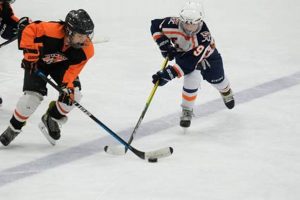
A common offensive strategy in ice hockey involves three forwards entering the opposing team’s zone to pressure the puck carrier and disrupt the breakout. This tactic, characterized by two players positioned high in the zone and one player aggressively pursuing the puck, aims to force turnovers and create scoring opportunities. As an example, the strong-side winger pressures the puck carrier, while the center supports and cuts off passing lanes. The weak-side winger positions themself to intercept potential cross-ice passes or support the play if the puck is moved to their side.
The effective implementation of this strategy can lead to increased offensive zone time and a higher likelihood of regaining possession of the puck. Historically, this approach has been utilized by teams seeking to dictate the pace of the game and apply sustained pressure on the opposition. Its benefits include creating confusion among the defending team, forcing rushed decisions, and potentially generating scoring chances off turnovers. The strategic positioning inherent in the approach provides a framework for coordinated pressure.
Understanding the nuances of this pressure system is crucial for analyzing game strategies and player performance. Subsequent sections will delve into specific applications of this system, its variations, and effective counter-strategies employed by opposing teams.
Strategic Execution Tips
Optimizing offensive zone pressure requires disciplined execution and a thorough understanding of positional responsibilities. The following recommendations are intended to enhance the effectiveness of an offensive pressure system.
Tip 1: Angling the Puck Carrier: Direct the opponent towards the boards or a designated area to limit their options and create predictable situations for support.
Tip 2: Maintaining Positional Discipline: Players must adhere to their assigned roles within the structure to prevent defensive breakdowns and maintain coverage.
Tip 3: Quick Transition Support: Upon a turnover, forwards should immediately transition to offense, exploiting the opponent’s disorganization.
Tip 4: Anticipating Passing Lanes: Forecheckers must proactively anticipate potential passing lanes to intercept passes and regain possession.
Tip 5: Applying Consistent Pressure: Sustained pressure on the opposing defense forces errors and increases the likelihood of turnovers.
Tip 6: Reading Defensive Schemes: Adjust the angle of attack based on the opponents defensive structure. Recognizing patterns will lead to optimized pressure.
Tip 7: Utilize Body Positioning: Effective use of body positioning when engaging with the puck carrier limits their space and ability to make plays.
Consistent application of these principles will contribute to a more effective and disruptive offensive presence. Success relies on a coordinated effort and intelligent adaptation to game situations.
The subsequent analysis will address potential weaknesses and vulnerabilities within the described offensive strategy and defensive countermeasures.
1. Pressure angle

The pressure angle constitutes a critical element within an offensive strategy. In this context, it refers to the approach trajectory taken by the first forechecker when pursuing the puck carrier in the opposing zone. The angle directly influences the direction the puck carrier is forced to move, dictating subsequent play development and limiting the opponent’s options. An effective pressure angle steers the puck carrier towards the boards, the middle of the ice (into coverage), or away from high-danger areas. This deliberate direction enables supporting players to anticipate the play and effectively cut off passing lanes or create turnovers.
For instance, if the first forechecker approaches the puck carrier from an outside-in angle near the boards, the defender is compelled to either attempt a pass towards the middle of the ice or skate along the boards. This allows the supporting forechecker to anticipate the pass, intercept it, or apply pressure on the boards, further restricting the defender’s movement. Conversely, a poor pressure angle might allow the puck carrier to skate freely up the ice, negating any advantage gained by the pressure. The initial angle therefore, dictates the success or failure of the system.
In summary, the pressure angle is not merely a directional choice but a deliberate tactic designed to control the opponent’s breakout, create predictable situations, and ultimately lead to puck possession or scoring opportunities. Understanding its importance is crucial for both players executing the pressure and coaches designing effective offensive strategies. The angle of attack shapes the play’s trajectory, influencing subsequent support and outcomes of possession.
2. Support Depth

Within a 2-1-2 offensive pressure system, support depth refers to the positioning and spacing of the supporting forwards relative to the initial forechecker. This element is vital for maintaining pressure, intercepting passes, and capitalizing on turnovers. Insufficient support depth renders the initial pressure ineffective, as the puck carrier can easily evade or pass around the first forechecker. Conversely, excessive depth can create large gaps and allow the opposing team to break out of their zone unimpeded.
Optimal support depth allows the supporting forwards to quickly react to the play’s development, whether by intercepting a pass, challenging the puck carrier, or providing a passing option after a turnover. For example, if the first forechecker angles the puck carrier towards the boards, the supporting forward should be positioned to cut off the passing lane to the center of the ice. If the puck carrier attempts a pass along the boards, the supporting forward can step up and challenge, aiming to force a turnover. The proximity of supporting players allows for quick puck retrieval following an initial challenge. Correct positioning necessitates a constant evaluation of the play’s development. The support players needs to be ready to engage, not just watching the play unfold.
In conclusion, support depth is a key determinant of the effectiveness of the aggressive forecheck. Without proper support, the initial pressure is easily circumvented, neutralizing the offensive strategy. Proper support depth can create more pressure, interceptions and scoring opportunities. Maintaining appropriate positioning contributes significantly to maintaining possession of the puck in the offensive zone. As a practical application, coaches emphasize the importance of maintaining tight gaps between forwards in training drills, promoting synchronized movement and appropriate spacing on the ice.
3. Puck Containment in the 2-1-2 Hockey Forecheck
Puck containment is a foundational principle within the 2-1-2 offensive strategy. It involves strategically limiting the opposing team’s options when in possession of the puck within their defensive zone. Effective puck containment enhances the overall efficacy of this high-pressure approach.
- Forced Turnovers Through Limited Space
Puck containment aims to reduce the space available to the puck carrier, making it more challenging to execute a clean pass or breakout. By angling the puck carrier towards the boards or into a cluster of forecheckers, opponents are forced into making hurried decisions and increasing the likelihood of turnovers. An example occurs when a forechecker seals off the boards, preventing the defender from skating laterally and forcing a risky pass up the middle. This increases pressure and can lead to possession change.
- Strategic Angling Techniques
Effective puck containment relies on precise angling techniques. Forecheckers utilize body positioning and skating angles to guide the puck carrier into areas where supporting players can intercept passes or apply further pressure. An example is a forward cutting off the passing lane to the center of the ice, compelling the opposing defenseman to attempt a longer, more difficult pass to the winger along the boards. Poor angle can easily allow the other team to skate away with puck possession.
- Controlled Aggression
While aggressive pressure is a hallmark of the 2-1-2 system, successful puck containment requires controlled aggression. Overly aggressive forechecking without proper support or positioning can lead to defensive breakdowns and scoring opportunities for the opposition. Smart forechecking would be cutting off an angle but not committing to a check allowing the supporting player to make the play.
- Synchronization with Support Players
Puck containment is not solely the responsibility of the first forechecker; it demands synchronization with supporting players. Supporting forwards must anticipate the puck carrier’s movements and proactively position themselves to intercept passes or apply further pressure. If the puck carrier is forced to one side of the ice, the support is to come in with pressure as well which leads to puck containment. If there is not support the puck containment will not be successful.
In summary, puck containment is crucial for a successful application of the 2-1-2 offensive strategy. Through limited space, strategic angles, controlled aggression, and synchronized support, teams can effectively disrupt opposing breakouts and generate scoring chances. The focus on strategically limiting the options of the puck carrier is what sets this strategy apart.
4. Transition Speed

Transition speed, the rapidity with which players switch from offense to defense and vice versa, is a critical determinant of the effectiveness of the 2-1-2 offensive pressure system. This system aims to disrupt the opposing team’s breakout and generate scoring opportunities through sustained pressure in the offensive zone. However, the aggressive nature of the strategy can leave a team vulnerable to counterattacks if transition speed is inadequate. For example, if the forechecking unit commits too deeply into the offensive zone without a swift return to defensive positioning after a turnover, the opposing team can exploit the resulting gaps for quick offensive chances. An immediate and coordinated retreat is crucial to prevent such scenarios.
The importance of transition speed manifests in several practical applications. Firstly, quick transitions allow the forechecking unit to maintain relentless pressure on the opposing defense, minimizing their time and space to make plays. Secondly, rapid defensive transitions effectively negate any scoring opportunities arising from turnovers or failed offensive attempts. The strategic value is evident in scenarios where, after a turnover, players immediately shift their focus, disrupting developing plays. Transition speed, in this context, is not merely about skating speed; it encompasses anticipatory awareness, disciplined positioning, and coordinated movement as a unit. These traits allow players to react instantly to changes in puck possession and initiate the next phase of play.
In summary, transition speed is integral to the success of the 2-1-2 hockey forecheck. It serves as both a defensive safeguard, preventing counterattacks, and an offensive catalyst, maintaining sustained pressure in the opposing zone. Challenges in implementing this strategy often stem from a lack of conditioning, poor communication, or insufficient emphasis on defensive responsibility. Therefore, mastering transition speed is paramount for any team seeking to effectively utilize the aggressive pressure approach. The lack of transition speed will ultimately make or break a successful high pressure team.
5. Defensive Awareness

Defensive awareness is a critical, yet often understated, component of the 2-1-2 hockey forecheck. The aggressive nature of this offensive strategy inherently increases a team’s susceptibility to counterattacks if defensive responsibilities are neglected. In this system, forwards penetrate deep into the offensive zone, applying pressure on the opposing defense. If these players lack sufficient defensive awareness, they can become overextended, creating gaps and vulnerabilities that the opposing team can exploit upon gaining possession. A concrete example involves a forechecker aggressively pursuing the puck carrier without accounting for potential passing lanes; this lack of awareness can lead to a breakaway opportunity for the opposition.
Effective defensive awareness within the 2-1-2 system requires forwards to maintain constant vigilance regarding their positioning and the positioning of their teammates. Upon a turnover, forecheckers must immediately transition into defensive roles, prioritizing the disruption of developing plays and the prevention of odd-man rushes. This necessitates a clear understanding of defensive zone coverage responsibilities and the ability to anticipate the opposing team’s offensive intentions. For instance, the high forwards in the 2-1-2 must be prepared to quickly drop back and support the defense in preventing zone entries or disrupting cycles. The absence of this defensive acuity can undermine the entire strategy, turning an offensive advantage into a defensive liability. The success of the pressure hinges on both offensive pressure and defensive diligence.
In conclusion, defensive awareness is not merely an adjunct to the 2-1-2; it is an integral element that determines the strategy’s viability. Without it, the aggressive forecheck becomes a high-risk gamble, trading potential offensive gains for increased defensive exposure. Understanding and implementing strong defensive principles is therefore crucial for coaches and players seeking to effectively utilize the pressure system. A balanced approach is the key, combining relentless offensive pressure with responsible defensive positioning and awareness. This balanced application will lead to a stronger, less volatile pressure system.
6. Lane Control and the 2-1-2 Hockey Forecheck
Lane control is an intrinsic component of the 2-1-2 hockey forecheck. This aggressive system aims to disrupt the opposing team’s breakout, and its effectiveness is directly proportional to the level of lane control exerted by the forechecking players. The objective is to strategically restrict passing and skating lanes available to the puck carrier, thereby forcing turnovers and maintaining offensive zone possession. Without effective lane control, the forecheck becomes disjointed, allowing the defending team to execute controlled breakouts and neutralize the pressure. For example, if a forechecker fails to adequately cut off a passing lane to the center of the ice, the puck carrier gains a viable option, potentially leading to a successful zone exit and a counterattack. Lane control is not merely passive positioning; it requires active anticipation and aggressive closure of space.
The application of lane control within the 2-1-2 manifests through several practical techniques. Forecheckers must angle their pursuit to steer the puck carrier toward the boards or away from open ice, effectively limiting their options. This involves anticipating the puck carrier’s movements and strategically positioning oneself to intercept passes or force turnovers. Further, supporting players must vigilantly guard potential passing lanes, preventing the opposing team from executing quick breakouts. Consider a scenario where the first forechecker applies pressure along the boards. The supporting forward must simultaneously seal off the passing lane to the center, creating a situation where the puck carrier’s only viable option is a difficult pass along the boards. Effective lane control transforms the offensive zone into a confined space, increasing the likelihood of turnovers and sustained offensive pressure.
In summary, lane control is not merely a tactical consideration within the 2-1-2 hockey forecheck; it is a fundamental prerequisite for its success. It is a direct cause of turnovers. By effectively restricting passing and skating lanes, teams can disrupt the opposing team’s breakout, maintain offensive zone possession, and generate scoring opportunities. The ability to anticipate, react, and proactively control the lanes available to the puck carrier is a hallmark of successful teams utilizing the aggressive pressure system. Coaches emphasize lane control drills to instill good habits in players. Thus, lane control should be viewed as a tactical cornerstone and not an optional add-on to the forechecking strategy.
Frequently Asked Questions
This section addresses common inquiries regarding the execution, benefits, and potential pitfalls associated with the 2 1 2 hockey forecheck.
Question 1: What distinguishes the 2 1 2 hockey forecheck from other forechecking systems?
The 2 1 2 is characterized by its zone coverage in the neutral zone and aggressive pressure from three forwards upon entering the offensive zone. This contrasts with systems that may utilize a more passive neutral zone trap or a more conservative single-forechecker approach.
Question 2: What are the primary benefits of implementing the 2 1 2?
The chief advantages include increased offensive zone time, forced turnovers in the defensive zone, and the potential to disrupt the opposing team’s breakout strategy. Effective implementation can lead to more scoring opportunities and a higher probability of regaining possession.
Question 3: What are the main weaknesses or vulnerabilities associated with the 2 1 2?
The aggressive nature of the 2 1 2 can leave a team susceptible to counterattacks if the forecheckers overcommit or fail to transition quickly back to a defensive posture. It also requires significant conditioning and disciplined positional play.
Question 4: What types of players are best suited for executing the 2 1 2 effectively?
Successful execution relies on forwards with a combination of speed, agility, strong skating ability, and exceptional anticipation skills. Players must also demonstrate a high level of defensive awareness and a commitment to positional discipline.
Question 5: How can a team effectively counter the 2 1 2 strategy?
Countermeasures include quick, accurate passing to bypass the forecheckers, strong puck support in the defensive zone to provide breakout options, and utilizing stretch passes to exploit the gaps created by the aggressive forecheck.
Question 6: What are some common mistakes teams make when attempting to utilize the 2 1 2?
Common errors include a lack of communication among forecheckers, inadequate support depth, neglecting defensive responsibilities, and failing to adjust the pressure based on the game situation and the opposing team’s tendencies.
The successful implementation of the 2 1 2 strategy necessitates a comprehensive understanding of its strengths, weaknesses, and required player attributes. Constant practice and adaptation are essential for optimal performance.
The following section provides guidance on training drills designed to enhance specific aspects of the 2 1 2 system.
Conclusion
This exploration of the 2 1 2 hockey forecheck highlights its multifaceted nature and strategic importance. Success hinges on a nuanced understanding of pressure angles, support depth, puck containment, transition speed, defensive awareness, and lane control. Each element contributes to the system’s overall effectiveness, and deficiencies in any area can compromise its potential.
Mastery of the 2 1 2 hockey forecheck demands continuous refinement and adaptation. Coaches and players must consistently analyze game situations, adjust tactics, and hone their skills to maximize its disruptive capabilities. The continued study and strategic application of this approach are essential for competitive success in modern hockey.