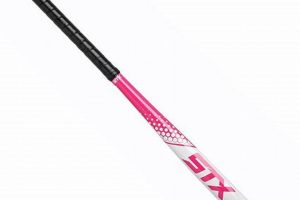
An implement used in the sport of hockey, specifically designed to aid defensive players, is a crucial tool. This equipment helps players intercept passes, block shots, and clear the puck from their defensive zone. Selection is based on factors like length, lie, flex, blade curve, and material composition, each contributing to performance. For example, a longer model might be favored by players who prioritize reach and poke-checking, while a shorter one could improve close-quarters puck handling.
The selection of appropriate equipment significantly impacts a defender’s ability to protect their goal and contribute to the team’s success. A well-chosen implement can improve reaction time, increase power when clearing the puck, and enhance overall control. Historically, the materials and construction methods have evolved from primarily wood to composite materials, offering improved durability and performance characteristics. These advancements have led to lighter, stronger, and more responsive equipment.
The following sections will delve into the key characteristics that define high-performing implements for defensive players, examine specific features to consider during the selection process, and provide insights into how those implements influence on-ice performance.
Tips for Selecting Defensive Hockey Equipment
This section provides guidance on the selection process, highlighting crucial elements to consider when choosing the appropriate equipment for defensive play.
Tip 1: Consider Shaft Length: A longer shaft provides extended reach for poke-checking and intercepting passes, but may compromise puck-handling in tight spaces. Evaluate personal playing style to determine the optimal length.
Tip 2: Evaluate Flex Rating: A lower flex rating allows for easier loading and release of the puck, beneficial for quick passes and clearing attempts from the defensive zone. Experiment with different flex ratings to find the level that best suits the player’s strength and technique.
Tip 3: Analyze Blade Curve: A flatter blade curve facilitates easier backhand passes and clearing the puck along the boards, which are essential for defensive play. A deeper curve offers more puck control but may hinder quick releases.
Tip 4: Examine Material Composition: Composite materials offer a balance of lightweight feel, durability, and responsiveness. While more expensive, they generally outperform traditional wood models in terms of performance and longevity.
Tip 5: Assess Lie Angle: The lie angle determines how the blade sits flat on the ice when the player is in their natural stance. An incorrect lie angle can lead to inaccurate shots and passes. Seek professional assistance to determine the appropriate lie angle for the player’s height and skating style.
Tip 6: Prioritize Balance and Weight: A well-balanced model provides improved feel and control, reducing fatigue during extended periods of play. Opt for a lightweight model that allows for quick reactions and effortless maneuvering.
These tips emphasize the importance of tailoring equipment selection to individual playing styles and physical attributes. A well-informed selection process can contribute significantly to improved defensive performance on the ice.
The subsequent sections will provide a comprehensive analysis on performance benchmarks and how to maintain your equipment’s top condition.
1. Shaft Length

Shaft length is a critical determinant in identifying equipment that suits defensive play. It directly influences a player’s reach, ability to disrupt passing lanes, and effectiveness in initiating poke checks. A longer shaft generally extends the player’s defensive zone, allowing them to intercept passes and impede opponents with greater ease. Conversely, excessive length can hinder close-quarters puck handling and quick transitions. Therefore, selecting a shaft length that balances reach with maneuverability is essential for optimizing defensive capabilities.
A notable example is Zdeno Chara, a defenseman known for his exceptional reach, who used a longer shaft. This allowed him to effectively close gaps, disrupt plays, and maintain a significant presence in the defensive zone. However, a shorter defenseman might find a shorter shaft more suitable, improving their ability to handle the puck in tight situations and make quick passes out of the zone. The precise correlation between shaft length and performance underscores the need for individual customization, aligning equipment specifications with a player’s unique physical attributes and playing style.
In summary, shaft length’s contribution to effective defensive play cannot be overstated. While longer shafts offer extended reach, a balanced approach is crucial. The challenge lies in identifying the specific length that maximizes a player’s defensive reach without compromising their ability to handle the puck efficiently. This understanding serves as a foundational element in the broader quest to equip defensive players with the best tools for their role.
2. Flex Profile

Flex profile significantly influences the performance characteristics of equipment, specifically for defensive hockey players. It defines how the shaft bends and transfers energy during shooting and passing, directly impacting accuracy, power, and puck control.
- Kick Point Location
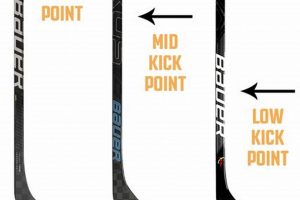
The kick point, or flex point, represents the area along the shaft where the greatest amount of bending occurs. A low kick point allows for quicker release, beneficial for defensive players needing rapid puck clearance. Conversely, a high kick point can generate more power for longer shots, but sacrifices quick release. The optimal kick point depends on the player’s shooting style and defensive responsibilities.
- Flex Consistency
Flex consistency refers to how uniformly the shaft bends along its length. Consistent flex promotes predictable energy transfer, leading to more accurate passes and shots. Inconsistency can result in erratic performance and reduced puck control. High-quality models are engineered for consistent flex, enhancing a defender’s ability to make precise plays under pressure.
- Torsional Stiffness
Torsional stiffness describes the shaft’s resistance to twisting. Greater torsional stiffness improves accuracy by minimizing energy loss during shooting and passing. This attribute is particularly valuable for defensemen, who often need to make accurate outlet passes from challenging angles. Equipment with high torsional stiffness maintains blade alignment, enhancing precision.
- Loading Efficiency
Loading efficiency concerns how effectively a player can transfer their energy into the shaft to generate power and speed in a shot or pass. A flex profile optimized for loading efficiency maximizes the energy transfer, resulting in more powerful clearances and more accurate passing, vital attributes for a defensive player.
In conclusion, flex profile plays a pivotal role in determining the suitability of equipment for defensive players. Kick point location, flex consistency, torsional stiffness and loading efficiency all contribute to the optimal model for the player’s personal attributes and preferences and the needs of the player.
3. Blade Curve

The blade curve directly impacts puck control, shot accuracy, and the ability to execute passes, making it a critical factor in the selection of the equipment for defensive players. The specific curvature of the blade influences how the puck interacts with it, affecting a defenseman’s capacity to clear the zone, make accurate outlet passes, and control the puck under pressure.
- Heel Curve
A heel curve, characterized by a curvature concentrated near the heel of the blade, facilitates powerful shots and elevated puck trajectories. Defensemen may utilize a heel curve to lift the puck quickly when clearing the zone, avoiding blocked shots and initiating breakout passes. While offering power, this curve type may compromise close-quarters puck handling and precise passing. For instance, Shea Weber, known for his powerful slapshot, has historically favored a blade with a pronounced heel curve.
- Mid-Curve
A mid-curve provides a balance between puck control, shooting accuracy, and passing proficiency. The curvature is located near the middle of the blade, offering versatility for a variety of defensive tasks. A mid-curve enables defensemen to execute both accurate passes and moderately powerful shots, making it suitable for players who need to contribute in multiple zones. For example, many defensemen who play a two-way game often select a mid-curve for its adaptability.
- Toe Curve
A toe curve, with the curvature located near the toe of the blade, enhances puck handling and quick releases. This curve type is beneficial for defensemen who prioritize puck control and deceptive passing. The toe curve allows players to quickly elevate the puck and execute short, accurate passes, which are valuable for breaking out of the defensive zone and initiating offensive plays. Erik Karlsson, known for his puck-moving skills, exemplifies a defenseman who may benefit from a toe curve.
- Flat Curve
A flat curve, lacking significant curvature, emphasizes backhand shots and puck control along the boards. Defensemen who frequently engage in board battles and need to make quick backhand passes may prefer a flat curve. This curve type facilitates efficient puck retrieval and clearing attempts from tight spaces, although it may limit shot power and elevation. Many stay-at-home defensemen who prioritize defensive responsibilities and physical play around the net may find a flat curve advantageous.
The selection of the blade curve for defensive hockey equipment is a nuanced decision that requires careful consideration of individual playing styles, defensive responsibilities, and on-ice scenarios. Each curve type offers unique advantages and disadvantages, influencing a defenseman’s ability to contribute effectively in various aspects of the game. Balancing puck control, shooting power, and passing accuracy is crucial when determining the optimal blade curve for defensive play.
4. Material Composition

The materials used in crafting defensive hockey equipment significantly influence its performance, durability, and overall suitability for the demands of the defensive position. Material selection affects weight, balance, and the ability to withstand the rigors of high-impact play. The choice of materials directly impacts a player’s capacity to execute defensive responsibilities effectively.
- Carbon Fiber Composites
Carbon fiber composites offer an optimal blend of lightweight construction and high strength. These materials enhance responsiveness, allowing defensemen to react quickly and efficiently. Advanced carbon fiber layering techniques provide increased durability, resisting the wear and tear associated with blocking shots and engaging in physical play. Many high-end defensive models incorporate carbon fiber composites to maximize performance and longevity. An example is the use of unidirectional carbon fiber for improved energy transfer and reduced weight.
- Fiberglass Reinforcements
Fiberglass reinforcements are often integrated into hockey equipment to enhance structural integrity and impact resistance. While not as lightweight as carbon fiber, fiberglass provides added durability, protecting against cracking and delamination. The strategic placement of fiberglass layers can reinforce critical areas, such as the blade and shaft, improving the equipment’s ability to withstand high-stress situations. Entry-level and mid-range equipment often incorporates fiberglass reinforcements to balance performance and cost. An example is the reinforcement of the blade to resist impacts from shots.
- Resin Systems
The resin system used in conjunction with carbon fiber and fiberglass plays a crucial role in bonding the materials together and influencing the overall performance characteristics. Advanced resin systems enhance impact resistance, improve energy transfer, and contribute to the equipment’s durability. High-quality resins minimize voids and inconsistencies within the composite structure, resulting in a more robust and responsive product. Examples include epoxy resins and toughened epoxy resins, each offering varying levels of performance and durability.
- Core Materials
Core materials within the blade influence puck feel, control, and shot accuracy. Lightweight foams, such as polyurethane or expanded polystyrene (EPS), are often used to reduce weight and enhance responsiveness. These core materials contribute to a balanced feel, allowing defensemen to maintain better control and make accurate passes. Higher-density core materials may improve shot power, but can also reduce puck feel. An example is the use of a dampening core material to reduce vibrations and enhance puck control.
In summary, material composition is a defining characteristic of equipment tailored for defensive play. Carbon fiber composites, fiberglass reinforcements, resin systems and core materials work in concert to provide the optimal balance of performance, durability, and feel. The selection of these materials directly affects a defenseman’s ability to execute their responsibilities effectively, highlighting the importance of understanding material science in the equipment selection process.
5. Balance Point

The balance point, or center of gravity, plays a crucial role in determining the handling characteristics and overall feel, influencing a defensive player’s ability to react quickly and efficiently. The distribution of weight along the length significantly impacts maneuverability, puck control, and the reduction of fatigue during gameplay. A properly balanced model enhances a defenseman’s capacity to execute their responsibilities effectively.
- Impact on Puck Handling
A balance point closer to the blade enhances puck feel and control, allowing for quicker dekes and more precise passes. This is particularly beneficial for defensemen who prioritize puck-moving skills and need to make accurate breakout passes under pressure. An example is a defenseman maneuvering through traffic in the defensive zone, requiring enhanced puck control to avoid turnovers. The optimal balance point facilitates confident handling and quick decision-making.
- Influence on Quickness and Reaction Time
Equipment with a balanced feel, neither excessively blade-heavy nor handle-heavy, allows for faster reactions and quicker transitions. This is crucial for defensemen who need to react swiftly to changing plays and intercept passes. An example is a defenseman reacting to a sudden change in direction by an opposing forward, requiring rapid adjustments to maintain defensive positioning. The appropriate balance point enables effortless maneuvering and contributes to enhanced reaction time.
- Effect on Fatigue Reduction
A well-balanced model minimizes strain on the hands and wrists, reducing fatigue during extended periods of play. This is particularly important for defensemen who often log significant ice time and need to maintain consistent performance throughout the game. An example is a defenseman playing long minutes during penalty kills, requiring sustained focus and physical endurance. An optimized balance point promotes comfort and reduces the risk of fatigue-related errors.
- Trade-offs in Shot Power
While a blade-heavy model might enhance shot power, it can compromise puck handling and quickness. Conversely, a handle-heavy model may improve puck control but reduce the ability to generate powerful shots from the point. Defensemen must consider these trade-offs when selecting equipment, balancing the need for shot power with the demands of puck handling and defensive responsiveness. For example, a defenseman known for their booming slapshot may prefer a slightly blade-heavy model, while a puck-moving defenseman might prioritize a more balanced feel.
In conclusion, the balance point is a crucial determinant in selecting the optimal defensive hockey equipment. Its impact on puck handling, quickness, fatigue reduction, and shot power requires defensemen to carefully consider their playing style and defensive responsibilities. By understanding the interplay between these factors, defensemen can select equipment that enhances their performance and contributes to overall team success.
Frequently Asked Questions
The following questions address common inquiries concerning hockey equipment designed for defensive players, offering insights into key features and selection criteria.
Question 1: What shaft length is optimal for defensive players?
Shaft length should be selected to balance reach and puck-handling ability. A longer shaft provides extended reach for poke-checking and intercepting passes, while a shorter shaft facilitates quicker puck handling in tight spaces. The optimal length depends on individual playing style and physical attributes.
Question 2: How does flex profile influence defensive performance?
Flex profile affects the energy transfer during shooting and passing. A lower flex rating allows for quicker releases, beneficial for clearing the puck from the defensive zone. A higher flex rating can generate more power, but may sacrifice quick release. Selection should align with the players strength and technique.
Question 3: What blade curve is most suitable for defensemen?
Blade curve influences puck control and passing accuracy. A flatter curve facilitates backhand shots and board play, while a deeper curve enhances puck handling. The ideal curve depends on the defenseman’s role, balancing the need for puck control with clearing capabilities.
Question 4: What materials are preferred in the construction of defensive equipment?
Carbon fiber composites offer a balance of lightweight construction and high strength, enhancing responsiveness and durability. Fiberglass reinforcements can add structural integrity and impact resistance. The specific materials used influence weight, balance, and the ability to withstand the rigors of defensive play.
Question 5: How does the balance point affect a defensemans performance?
The balance point influences handling characteristics and overall feel. A balance point closer to the blade enhances puck control, while a balanced feel promotes quicker reactions. Optimizing the balance point minimizes strain and reduces fatigue during extended periods of play.
Question 6: What is the importance of Lie in Defensive Hockey Equipment Selection?
Lie refers to the angle at which the blade sits on the ice. An appropriate Lie ensures that the entire blade surface makes contact with the ice while the player is in their natural stance. An incorrect Lie can lead to poor puck control, inaccurate passes, and compromised shooting ability.
Understanding these key aspects of hockey equipment selection can contribute significantly to improved defensive performance. Each factor requires careful consideration to align with individual playing styles and physical attributes.
The subsequent section will discuss maintenance and care strategies.
Conclusion
The preceding analysis has explored the multifaceted considerations inherent in selecting equipment conducive to optimal defensive performance. Key elements such as shaft length, flex profile, blade curve, material composition, and balance point exert significant influence on a player’s ability to execute defensive responsibilities effectively. A comprehensive understanding of these factors is paramount.
The selection of the best defense hockey stick is not a matter of arbitrary preference but rather a calculated decision based on individual playing style, physical attributes, and on-ice demands. The investment in a carefully chosen and properly maintained implement can significantly enhance a player’s defensive capabilities and overall contribution to the team’s success. Continued advancements in materials science and equipment design promise further refinements in defensive hockey equipment, underscoring the importance of staying informed and adapting to evolving technologies within the sport.