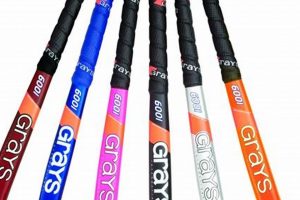
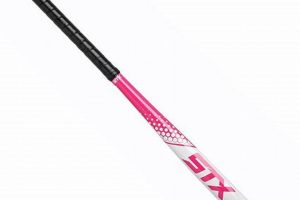
Determining the correct implement length is vital for optimal performance and player safety in field hockey. The process involves assessing the distance from the ground to the player’s hip joint while standing upright. This measurement, typically expressed in inches, dictates the appropriate equipment dimension required for comfortable and effective gameplay. For instance, a player with a ground-to-hip measurement of 34 inches would generally require a 34-inch implement.
Proper equipment size contributes significantly to improved ball control, striking power, and overall agility on the field. Using an incorrectly sized implement can lead to poor technique, reduced effectiveness, and a higher risk of injury. Historically, players relied on less precise methods for determining suitability, but modern techniques offer a more accurate and personalized approach. This precision contributes to a more enjoyable and safer playing experience.
Understanding the correct method for determining equipment length is crucial for players of all levels. The following sections will detail the step-by-step procedure, explore various sizing considerations, and discuss the implications of using improperly sized equipment.
Tips for Accurate Implement Length Assessment
Ensuring precise equipment dimension requires careful attention to detail and adherence to established best practices. The following tips offer guidance for obtaining the most accurate measurement and selecting the appropriately sized field hockey stick.
Tip 1: Maintain an upright posture. The player should stand straight with feet shoulder-width apart, looking directly ahead. This ensures an accurate measurement from the ground to the hip joint.
Tip 2: Locate the greater trochanter. Identify the bony prominence on the outside of the hip, known as the greater trochanter. This serves as the reference point for measurement.
Tip 3: Utilize a measuring tape or stick. A rigid measuring stick or a flexible measuring tape can be used. Ensure the tool is held vertically against the players body.
Tip 4: Take multiple measurements. To minimize error, take several measurements and calculate the average. This provides a more reliable indication of the required equipment length.
Tip 5: Account for footwear. Measurements should be taken while wearing field hockey shoes or sneakers. The added height of the footwear impacts the ground-to-hip distance.
Tip 6: Consider playing position. Certain playing positions may benefit from slight variations in implement length. Consult with a coach or experienced player for position-specific recommendations.
Tip 7: Account for personal preference. While the ground-to-hip measurement provides a starting point, individual players may prefer slightly longer or shorter implements based on personal comfort and playing style.
Accurate equipment dimension directly contributes to improved performance, reduces the risk of injury, and enhances the overall playing experience. Paying close attention to these tips can help ensure that the appropriate size is selected.
With a solid understanding of the measurement process and these helpful tips, the article will now shift to address potential sizing considerations and the impact of using incorrectly sized implements on performance and safety.
1. Standing posture assessment

Correct standing posture is paramount when determining appropriate field hockey stick length. Variations in posture directly influence the measured distance between the ground and the player’s hip, leading to inaccurate equipment selection. Consequently, a flawed posture assessment undermines the entire measurement process, potentially resulting in a stick that is either too long or too short for the individual.
- Spinal Alignment
Deviations from a neutral spinal alignment, such as slouching or exaggerated lumbar lordosis, alter the vertical distance to the hip joint. A slouched posture artificially shortens this distance, leading to the selection of a stick that is too short. Conversely, an excessively arched back may elongate the distance, resulting in an oversized implement. Accurate measurement necessitates a straight, neutral spine.
- Shoulder Position
The position of the shoulders, whether rounded forward or pulled back, affects the overall upper body alignment. Rounded shoulders often accompany a forward head posture, further contributing to spinal misalignment and impacting the accuracy of the ground-to-hip measurement. Proper posture involves relaxed, level shoulders.
- Knee Lockout
Hyperextension, or locking out the knees, can subtly alter the standing height and affect the measurement. While seemingly minor, this can lead to inconsistencies, especially if the assessment is repeated multiple times. Knees should be slightly flexed to maintain a stable and consistent posture.
- Head Position
The position of the head, specifically whether it is forward or in line with the shoulders, impacts spinal alignment. A forward head posture is often associated with rounded shoulders and increased thoracic kyphosis, all of which can compromise the accuracy of the measurement. The head should be level, with the ears aligned over the shoulders.
In conclusion, a comprehensive assessment of standing posture is indispensable for precisely determining implement length. Failure to address postural imbalances can introduce significant errors into the measurement process, ultimately impacting player performance and increasing the risk of injury. Therefore, meticulous attention to spinal alignment, shoulder position, knee stability, and head position is critical when aiming to appropriately size a field hockey stick.
2. Hip joint identification

Accurate determination of the hip joint location is fundamental to the process of establishing the appropriate implement length. Without precise identification, the measurement becomes subjective and prone to error, impacting the suitability of the selected equipment.
- The Greater Trochanter as Reference
The greater trochanter, a bony prominence located on the lateral aspect of the femur, serves as the primary anatomical landmark for measurement. Its consistent and palpable location allows for a reliable reference point. Failure to accurately locate the greater trochanter introduces variability, directly affecting the measured length and leading to incorrect implement sizing. For example, if the measurement is taken above or below the greater trochanter, the final result will not reflect the true distance to the hip joint.
- Palpation Technique and Precision
Effective palpation is critical for accurate identification. This involves using the fingers to locate and confirm the position of the greater trochanter through the overlying soft tissues. Inaccurate palpation, due to inadequate technique or misinterpretation of anatomical features, results in a measurement that deviates from the actual hip joint height. Experienced practitioners utilize specific palpation techniques to ensure accuracy, especially in individuals with varying body compositions.
- Impact of Body Composition
Variations in body composition, particularly the amount of subcutaneous fat around the hip, can complicate the process of identifying the greater trochanter. Excess adipose tissue obscures the bony landmark, making palpation more challenging. In such cases, careful and deliberate palpation techniques are essential to ensure accuracy. Failure to account for body composition can lead to underestimation of the required stick length.
- Consequences of Misidentification
An improperly sized implement can negatively impact a players technique and performance. A stick that is too long may hinder close ball control and increase the risk of tripping, while one that is too short can lead to back strain and reduced striking power. Accurate identification of the hip joint is therefore crucial to prevent these adverse effects and optimize playing ability.
In summary, precise hip joint identification, primarily through accurate palpation of the greater trochanter, is an indispensable element in determining proper implement length. Recognizing the influence of body composition and employing refined palpation techniques are crucial for ensuring accurate measurement, which directly translates to improved player performance and reduced risk of injury.
3. Measurement tool utilization

The selection and proper application of measurement tools are critical for accurate determination of implement length. The precision of the chosen tool directly affects the reliability of the measurement, influencing the overall suitability of the selected equipment and impacting player performance and safety.
- Rigid Measuring Sticks
Rigid measuring sticks, typically made of wood or metal, offer a fixed and unyielding length, providing a stable reference for measurement. Their inherent rigidity minimizes the potential for bending or distortion, thereby enhancing accuracy. For instance, a calibrated metal measuring stick, held vertically against the player’s body, ensures a consistent and repeatable measurement from the ground to the hip joint. Utilizing a rigid stick with clearly marked increments facilitates precise readings, reducing the likelihood of human error. However, it’s essential to ensure the stick is placed on a flat, even surface to avoid skewing the result. Any slight incline or unevenness can introduce inaccuracies, compromising the integrity of the measurement.
- Flexible Measuring Tapes
Flexible measuring tapes, commonly constructed from fabric or fiberglass, offer versatility and ease of use in conforming to the contours of the body. This flexibility allows for accurate measurement even when slight variations in body shape are present. Consider the scenario where a player has a slightly curved posture; a flexible tape can adapt to the curvature, providing a more accurate reading than a rigid stick. However, the flexibility of the tape also presents a potential source of error. Over-tensioning or allowing the tape to sag can significantly alter the measurement. Maintaining consistent tension and ensuring the tape is held straight against the body are crucial for obtaining reliable results.
- Laser Measurement Devices
Laser measurement devices, while less common in this specific application, offer a non-contact method of determining distance. These devices project a laser beam onto the target area and calculate the distance based on the reflected light. In the context of determining implement length, a laser device could be used to measure the distance from the ground to the hip joint with high precision. However, the accuracy of laser devices can be affected by environmental factors such as ambient light and the reflectivity of the target surface. Proper calibration and understanding of the device’s limitations are essential for reliable results.
- Digital Levels with Height Measurement
Digital levels with height measurement capabilities provide a modern approach to assessing implement length. These tools combine the functions of a traditional level with a digital display that shows the measured height. They ensure vertical alignment while simultaneously providing a precise digital reading. This dual functionality reduces the reliance on visual estimation and minimizes potential for parallax error. However, the reliance on electronic components means that battery life and potential malfunctions must be considered. Ensuring the device is calibrated and functioning correctly is vital for dependable results.
The correct tool selection and proficiency in its use directly impact the reliability of the measured value. These examples demonstrate how the chosen tool and technique must be aligned to minimize error and ensure that the final implement selection supports player performance and safety.
4. Accuracy verification process

The accuracy verification process is an indispensable component of the method for determining implement length. Its primary function is to ensure the reliability and consistency of measurements, thereby minimizing the likelihood of selecting an incorrectly sized implement. This process provides a structured approach to identifying and correcting potential errors, ultimately contributing to improved player performance and safety.
- Multiple Measurements
Taking multiple measurements and calculating the average is a fundamental step in verifying accuracy. This approach mitigates the impact of random errors that may occur during individual measurements. For instance, a single measurement may be skewed due to slight variations in posture or tool placement. By averaging multiple measurements, these random errors are minimized, providing a more representative value of the actual distance. This technique is especially valuable when utilizing manual measurement tools where human error is more likely.
- Inter-Rater Reliability
Employing multiple individuals to perform independent measurements and subsequently comparing the results enhances the reliability of the process. Discrepancies between measurements taken by different individuals highlight potential sources of error, such as inconsistencies in palpation technique or variations in the interpretation of anatomical landmarks. Establishing inter-rater reliability ensures that the method is consistent and not solely dependent on the skill of a single individual.
- Calibration of Measurement Tools
Regular calibration of measurement tools is essential for ensuring their accuracy and precision. Measurement tools, whether rigid sticks or flexible tapes, may drift over time due to wear and tear or environmental factors. Calibration involves comparing the tool’s readings against a known standard and making necessary adjustments to ensure that the tool provides accurate measurements. Neglecting calibration can lead to systematic errors, where all measurements are consistently either too high or too low.
- Comparison with Established Standards
Comparing the obtained measurement against established normative data or manufacturer guidelines can serve as an external validation of accuracy. If the measurement significantly deviates from expected values, it raises a red flag, prompting further investigation into the potential source of error. These standards provide a benchmark for evaluating the reasonableness of the measurement and help identify gross errors that may have occurred during the process.
In conclusion, the accuracy verification process is integral to ensuring the reliability of the method for determining implement length. Employing techniques such as multiple measurements, inter-rater reliability checks, tool calibration, and comparison with established standards minimizes the risk of error and contributes to the selection of appropriately sized equipment, ultimately optimizing player performance and reducing the risk of injury.
5. Footwear considerations effects

The impact of footwear on the accurate determination of implement length is significant. Footwear alters the player’s standing height, thereby influencing the measurement from the ground to the hip joint. This factor must be accounted for to ensure the selected implement aligns with the player’s anatomical needs during gameplay.
- Elevation Influence
Footwear introduces a vertical elevation, effectively increasing the player’s overall height. The heel and sole thickness directly contribute to this elevation, affecting the distance between the ground and the greater trochanter. Failing to account for footwear height results in an underestimated measurement, potentially leading to a implement that is too short and compromises the player’s posture and technique.
- Types of Footwear
Different types of athletic footwear, such as field hockey shoes versus running shoes, exhibit varying sole thicknesses. Field hockey shoes typically feature a relatively flat sole for optimal ground contact and stability, while running shoes often incorporate thicker cushioning. This variation necessitates that measurements be taken with the specific type of footwear the player intends to use during gameplay. Using generic footwear for measurement introduces inaccuracy.
- Impact on Posture and Stance
The type of footwear affects the player’s posture and stance. Footwear with excessive cushioning or an elevated heel can shift the player’s center of gravity, altering spinal alignment. This altered posture can affect measurement precision and lead to an implement length that does not optimally support the player’s natural stance on the field. Proper measurement must therefore reflect the typical playing stance within the selected footwear.
- Compensating for Footwear Height
To mitigate the effects of footwear, the most accurate approach involves taking measurements while the player is wearing their field hockey shoes. Alternatively, if this is not feasible, the height of the footwear should be precisely measured and added to the initial measurement taken without shoes. This ensures the final measurement accurately reflects the player’s standing height with footwear, leading to a more appropriate implement selection.
Therefore, careful consideration of footwear is essential during the measurement process. By recognizing the elevation influence, accounting for different footwear types, understanding the impact on posture, and employing appropriate compensation techniques, a more accurate implement length can be determined, ultimately enhancing player performance and reducing the risk of injury.
Frequently Asked Questions
The following addresses common inquiries regarding the methodology for ascertaining the correct implement length. Accurate determination is crucial for optimal player performance and injury prevention.
Question 1: Is it acceptable to estimate the required implement length instead of performing a precise measurement?
Estimating implement length is not advisable. Precise measurement, utilizing the method outlined in previous sections, is essential for ensuring optimal fit and performance. Estimation introduces subjectivity and increases the likelihood of selecting an incorrectly sized implement, leading to suboptimal gameplay and increased risk of injury.
Question 2: How frequently should implement length be reassessed, especially for growing players?
Implement length should be reassessed periodically, particularly for adolescents experiencing growth spurts. A general guideline suggests re-evaluation every three to six months during periods of rapid growth. Consistent monitoring ensures that the implement remains appropriately sized as the player’s body changes.
Question 3: Can implement length be adjusted by cutting or extending an existing implement?
Altering the length of an existing implement is generally not recommended. Such modifications can compromise the structural integrity and balance of the implement, potentially affecting its performance and increasing the risk of breakage. It is preferable to select a new implement that matches the player’s current measurements.
Question 4: What are the potential consequences of using a implement that is either too long or too short?
An implement that is too long can hinder close ball control and increase the risk of tripping. Conversely, an implement that is too short can lead to back strain, compromised posture, and reduced striking power. Selecting the correct implement length is crucial for optimizing performance and preventing injuries.
Question 5: Are there specific implement length recommendations based on playing position?
While the fundamental measurement principle remains consistent across all playing positions, slight variations in implement length may be preferred based on positional demands. For instance, defensive players may benefit from a slightly longer implement for extended reach, while forwards may prioritize a shorter implement for enhanced maneuverability. Consulting with a coach or experienced player is advisable.
Question 6: What measuring tool provides the most accurate results?
Both rigid measuring sticks and flexible measuring tapes can provide accurate results when used correctly. The key to accuracy lies in proper technique and attention to detail, rather than the inherent superiority of one tool over another. Laser measurement devices can provide accuracy when properly calibrated.
This FAQ section emphasizes the importance of precise measurement, regular reassessment, and adherence to established best practices when determining implement length. Prioritizing accuracy ensures optimal performance and minimizes the risk of injury.
With a comprehensive understanding of the measurement procedure, relevant considerations, and frequently asked questions, the subsequent section will explore the long-term implications of appropriate sizing on player development and career longevity.
Conclusion
The accurate determination of equipment length is paramount for optimizing player performance and minimizing injury risk in field hockey. As has been explored, meticulous attention to measurement technique, including posture assessment, anatomical landmark identification, appropriate tool utilization, and footwear considerations, is essential. Neglecting these factors compromises the reliability of the measurement and increases the likelihood of selecting an unsuitable implement.
The information presented here underscores the importance of a methodical approach to equipment selection. Consistent application of these principles will contribute to player development and long-term career sustainability, maximizing potential while safeguarding physical well-being.