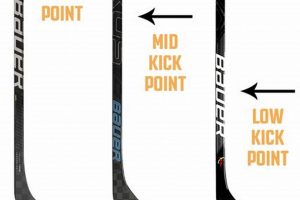
A hockey stick’s flex point, or kick point, refers to the area along the shaft that bends most when a player applies force during a shot. A design where this flex occurs closer to the blade is engineered for quick release. This characteristic is achieved through strategically varying the stiffness along the shaft’s length, concentrating flexibility in the lower portion. As an illustration, consider a forward in a tight scoring position who needs to get a shot off rapidly before a defender can intervene; this type of stick construction can facilitate that action.
The importance of this design lies in its ability to enhance the speed with which a player can release the puck. The faster release can lead to improved accuracy in close-range scenarios, making it beneficial for players who frequently find themselves near the net. Historically, stick designs favored a higher flex point, prioritizing power over release speed. The shift toward a lower flex point represents an evolution in hockey equipment, driven by a greater emphasis on quick puck handling and scoring in modern gameplay.
The following sections will delve deeper into the performance advantages associated with this design, the types of players who benefit most, and the key factors to consider when selecting the appropriate stick.
Tips for Optimizing Performance
This section outlines several key considerations to maximize the benefits of a hockey stick designed for a quick release. Proper technique and informed equipment selection are crucial for realizing its full potential.
Tip 1: Focus on Weight Transfer: Effective utilization requires a pronounced weight transfer from the back foot to the front foot during the shooting motion. This amplifies the flex and leverages the design for a faster, more accurate release. Players should practice consciously shifting their weight while shooting.
Tip 2: Short, Compact Shooting Motion: The design is most effective with a shorter, more compact shooting motion. Avoid long, sweeping movements that are more suited for sticks designed for maximum power. A quick flick of the wrists generates the desired effect.
Tip 3: Proper Hand Positioning: Maintaining correct hand positioning is crucial for control and accuracy. The top hand should be positioned slightly forward, providing stability and guiding the shot. Experimentation with hand placement can optimize individual shooting style.
Tip 4: Consider Stick Length: The appropriate stick length contributes significantly to performance. A stick that is too long or too short can hinder proper technique and reduce shot power. A general guideline is that the stick should reach between the player’s chin and nose while standing in skates.
Tip 5: Match Flex to Strength: Selecting the correct flex is essential for maximizing performance. A flex that is too stiff will prevent the player from adequately bending the stick, while a flex that is too soft will result in a loss of power and control. Seek expert advice for determining the optimal flex.
Tip 6: Practice Release Points: Mastering various release points enhances versatility and deception. Practicing quick shots from different positions, such as toe drags and snap shots, maximizes the benefits of a quick release stick.
Tip 7: Regularly Inspect the Blade: Consistent performance relies on a well-maintained blade. Check for any damage, such as cracks or chips, and replace the blade if necessary. Regular taping also provides additional protection and grip.
By implementing these tips, players can enhance their shooting accuracy, velocity, and overall performance. Consistent practice and attention to detail are essential for realizing the full benefits.
The subsequent section will address common misconceptions and further refine the understanding of optimal stick selection.
1. Quick Release
In hockey, a rapid puck release is often the differentiating factor between a scoring opportunity and a missed chance. The interplay between stick design and release speed is paramount, and the design plays a crucial role in achieving this objective. Its engineering is specifically tailored to facilitate a faster shot release.
- Enhanced Energy Transfer
The location of the flex point near the blade allows for a more direct transfer of energy from the player to the puck. This minimizes energy loss during the shooting motion, resulting in increased puck velocity and a quicker release. For example, a player executing a wrist shot will find that the stick loads and unloads energy more efficiently, propelling the puck forward with greater speed.
- Optimized Loading Zone
The lower flex point creates a more defined loading zone closer to the puck, allowing for a shorter and more efficient loading process. This is particularly beneficial in close-quarters situations where players have limited time and space to execute a shot. Consider a scenario near the net where a player needs to quickly receive a pass and fire the puck on goal; the stick design facilitates this rapid loading and release.
- Reduced Torque
The design minimizes torque or twisting of the stick during the shooting motion. This enhances shot accuracy by ensuring that the blade remains square to the target. A player attempting a snap shot will experience greater stability and control, leading to a more precise shot placement.
- Improved Puck Feel
The proximity of the flex point to the blade enhances puck feel, providing the player with greater control and responsiveness. This allows for quicker adjustments to shot trajectory and improved puck handling in tight spaces. A player deking around a defender can use the enhanced puck feel to maintain control and quickly release a shot before the defender can recover.
In summary, the strategic placement of the flex point enhances energy transfer, optimizes loading, reduces torque, and improves puck feel, all of which contribute to a faster, more accurate release. These design characteristics directly address the needs of players who prioritize quick shots in high-pressure situations, making it a valuable tool for offensive players.
2. Shot Accuracy
Shot accuracy in hockey is fundamentally linked to the equipment used, particularly the stick’s design. A hockey stick with the flex point closer to the blade directly influences the precision and targeting of shots, making it a critical factor for players seeking enhanced control over puck placement.
- Optimized Blade Control
The flex point facilitates a more direct connection between the player’s hands and the blade, translating to enhanced control over the puck’s trajectory. During a wrist shot, for example, the stick’s flex allows for a more sensitive adjustment of the blade angle, enabling the player to fine-tune the shot’s direction. This is particularly advantageous when aiming for specific areas of the net, such as the top corners or between the goalie’s pads.
- Reduced Torsional Flex
Torsional flex, or twisting of the stick during the shooting motion, can negatively impact accuracy. The design minimizes this twisting, ensuring that the blade remains square to the target throughout the shot. A player taking a snapshot will experience greater stability, leading to more consistent and accurate shot placement. This reduction in torsional flex is particularly beneficial in high-pressure situations where maintaining composure is crucial.
- Enhanced Puck Feel and Responsiveness
The design provides enhanced feel for the puck. This responsiveness allows players to make quick adjustments to their shot based on the puck’s position and movement. For instance, if a player receives a pass slightly off-center, the enhanced feel allows for a subtle adjustment of the blade to compensate, maintaining accuracy despite the imperfect pass.
- Consistent Energy Transfer
The design ensures a more consistent transfer of energy from the player to the puck, which contributes to accuracy by reducing variability in shot power and direction. A player who consistently transfers energy to the puck can develop a more predictable shooting motion, enhancing the ability to repeat accurate shots over time. This consistent energy transfer is especially valuable during power plays where precise puck placement is essential.
In summary, shot accuracy is substantially enhanced by design characteristics that improve blade control, reduce torsional flex, heighten puck feel, and ensure consistent energy transfer. These attributes empower players to execute more precise and targeted shots, increasing scoring opportunities and contributing to overall team success. The relationship between stick design and shot accuracy underscores the importance of selecting equipment tailored to individual playing styles and preferences.
3. Close Quarters
In the context of ice hockey, “close quarters” refers to situations where players are in close proximity to each other, typically near the net or along the boards. These scenarios demand rapid reactions and efficient puck handling. A hockey stick with a flex point near the blade is particularly advantageous in such conditions due to its impact on release speed and maneuverability. The reduced time and space available to execute shots in close quarters necessitate equipment optimized for quick puck release, directly influencing a player’s ability to capitalize on scoring opportunities. An example is a forward positioned near the goal crease; the ability to quickly elevate the puck over a sprawling goaltender or react to a rebound before a defender intervenes hinges significantly on the stick’s characteristics.
The reduced shaft length involved in achieving a quicker release with this type of stick design also enhances puck control within confined areas. This enables players to maintain possession and execute passes or shots with greater precision when surrounded by opponents. Consider a scenario in which a player is battling for position in front of the net; the enhanced control allows for quicker adjustments to the puck’s trajectory, maximizing the probability of a successful shot despite the physical pressure. Furthermore, the responsiveness afforded by the design translates to enhanced agility in stickhandling, enabling players to navigate tight spaces more effectively and create scoring chances even under duress.
The practical significance of understanding this relationship lies in optimizing equipment selection for specific playing styles and game situations. Players who frequently operate in close proximity to the net will likely benefit from a stick engineered for rapid release and maneuverability. Conversely, players who rely more on long-range shots may prioritize other stick characteristics. Therefore, recognizing the importance of the flex point in the context of “close quarters” contributes to informed decision-making regarding equipment choices, ultimately enhancing a player’s overall performance and effectiveness.
4. Puck Handling

Efficient puck handling is intrinsically linked to stick design, particularly the positioning of the flex point. A hockey stick engineered with a low flex point directly influences a player’s ability to control and manipulate the puck with precision. This connection is not merely correlative; it reflects a cause-and-effect relationship where the stick’s architecture facilitates improved dexterity. The design allows for quicker reactions and more nuanced adjustments to puck movement, which are essential components of proficient puck handling. For instance, a forward attempting a toe drag requires a stick that responds rapidly to subtle wrist movements; the design enhances this responsiveness, enabling the player to execute the maneuver with greater control.
The improved puck handling capabilities afforded by this design translate into tangible benefits on the ice. Players can maintain possession more effectively, execute deceptive plays with greater ease, and transition between skating, stickhandling, and shooting more fluidly. A defenseman breaking out of their own zone, for example, may use the stick to quickly deke around an opponent before initiating a pass to a teammate. The enhanced responsiveness allows for tighter control of the puck during the deke, increasing the likelihood of a successful breakout. The practical significance of this relationship underscores the importance of selecting equipment that aligns with a player’s skill set and positional requirements.
In summary, the design promotes superior puck handling through enhanced responsiveness and control. This advantage is particularly evident in situations demanding quick reactions and precise stick work. Recognizing this connection allows players to make informed equipment choices, ultimately contributing to improved on-ice performance. While other factors, such as player skill and training, also play a critical role, the stick design serves as a facilitator, amplifying the impact of these attributes.
5. Forward Position

The forward position in hockey is characterized by a focus on offensive play, requiring quick decision-making, puck handling proficiency, and a rapid shot release. The demands of this position often align favorably with the characteristics of a hockey stick engineered for a lower flex point, influencing equipment selection and playing style.
- Quick Release for Scoring Opportunities
Forwards frequently find themselves in scoring positions within close proximity to the net, where reaction time is limited. A stick designed for quick release allows forwards to capitalize on these fleeting opportunities by getting shots off before defenders can intervene or goalies can react. Examples include wrist shots in tight spaces or snap shots off a rebound, both requiring minimal time to execute.
- Enhanced Puck Handling in Tight Areas
Forwards often operate in congested areas, battling for puck possession and attempting to create scoring chances. This design facilitates superior puck handling in these tight spaces, enabling forwards to maintain control and execute passes or shots despite pressure from opposing players. Quick dekes and agile stickhandling are essential skills that are complemented by the stick’s responsiveness.
- Optimized for Agile Shooting Styles
Unlike defensemen, who may prioritize powerful slap shots from the blue line, forwards typically rely on quicker, more agile shooting styles such as wrist shots, snap shots, and backhanders. The lower flex point is engineered to maximize the efficiency of these shooting styles, providing a faster release and improved accuracy compared to sticks designed for high-power shots.
- Adaptability to Various Offensive Roles
Within the forward position, players may specialize in different roles, such as playmakers, snipers, or power forwards. While the stick benefits all forward types, it is particularly advantageous for playmakers and snipers who rely on quick puck movement and accurate shots. The stick allows them to swiftly distribute the puck to teammates or accurately target the net based on the requirements of the play.
The inherent demands of the forward position, namely the need for quick shots, agile puck handling, and adaptability, render a stick designed for a lower flex point a suitable choice for many forwards. While individual preferences and playing styles will ultimately dictate equipment selection, the correlation between the positional requirements and stick characteristics is evident.
6. Energy Transfer

Energy transfer, the efficient conversion and transmission of a player’s physical exertion into puck velocity, is a critical performance metric in hockey. The design of a hockey stick, particularly the positioning of the flex point, plays a substantial role in optimizing this process. The design seeks to maximize the transfer of energy, thereby enhancing shot speed and effectiveness.
- Optimized Loading and Unloading
The location of the flex point nearer the blade facilitates a more efficient loading and subsequent unloading of energy during the shooting motion. As a player initiates a shot, the stick bends, storing potential energy. When the stick unbends, this stored energy is released, propelling the puck forward. The proximity of the flex point to the blade reduces the distance over which the energy must travel, minimizing losses due to friction or vibration. Consider a wrist shot: the stick bends rapidly near the blade, storing energy, which is then efficiently transferred to the puck upon release.
- Reduced Torque and Twisting
Energy loss can occur through undesirable movements such as torque or twisting of the stick during the shot. The design minimizes this torsional flex, ensuring that the majority of the applied energy is directed towards propelling the puck forward rather than being dissipated in unwanted motion. A player executing a snap shot benefits from the stick’s stability, as the reduced twisting enhances the direct transfer of energy to the puck.
- Enhanced Energy Focus
The design helps to focus the player’s energy towards the puck, improving the overall efficiency of the shooting motion. A more efficient transfer of energy results in a harder and faster shot, and is beneficial in situations where quick reactions and minimal wind-up are essential, such as when a player is battling in front of the net and has to release the puck quickly to beat the goalie or a defender.
- Direct Response
The design offers a more direct response to the player’s actions, translating effort into measurable results. The lower the flex point, the quicker energy is transferred to the puck. When a player initiates a shot, the stick responds almost instantly, ensuring that the maximum amount of energy is delivered to the puck. This can be particularly useful for players who need to make quick adjustments to their shot to outsmart the opponent.
In conclusion, the design enhances energy transfer through optimized loading and unloading, reduced torque, and improved energy focus. These characteristics translate into increased puck velocity and improved shot accuracy, making it a beneficial choice for players seeking to maximize their offensive capabilities. The efficiency of energy transfer, therefore, stands as a critical factor in evaluating the performance benefits. These can be clearly seen when comparing with mid-kick or high-kick points, emphasizing how each flex point changes the shot dynamic.
7. Flex Profile
The flex profile of a hockey stick describes the manner in which the stick bends when force is applied during a shot. It is not merely a characteristic but a fundamental design element dictating performance. In a hockey stick engineered for a low kick point, the flex profile is specifically configured to concentrate the bending in the lower third of the shaft, near the blade. This design aims to facilitate a quicker release of the puck. The cause-and-effect relationship is direct: the strategically lowered flex point causes the stick to bend more readily in that zone, leading to an accelerated transfer of energy to the puck. Without this specific flex profile, the benefits of a low kick point enhanced shot speed and reduced wind-up time would be significantly diminished. As an illustration, consider a player executing a wrist shot from close range; the stick bends sharply near the blade, enabling the player to elevate the puck quickly before the goaltender can react. This maneuver is only possible because of the engineered flex profile.
The flex profile in a low kick point stick also influences shot accuracy. The concentrated bending near the blade enhances the player’s feel for the puck, allowing for more precise control over the shot’s direction. The reduced torque in the upper shaft minimizes unwanted twisting, ensuring a more consistent and predictable shot trajectory. In a real-game scenario, a player attempting a snap shot from the face-off circle relies on the flex profile to maintain blade stability, ensuring the puck is directed accurately towards the intended target. The practical application extends to stick selection: understanding the flex profile helps players choose a stick that complements their individual shooting style and positional requirements. For example, a forward who frequently scores from close range typically benefits from the enhanced release speed and puck feel offered by the flex profile.
In summary, the flex profile is an indispensable component of a hockey stick engineered for a low kick point. It determines the stick’s bending characteristics, which in turn influence release speed, shot accuracy, and overall puck handling. While other factors, such as stick material and blade curvature, also play a role, the flex profile remains a primary determinant of performance. Selecting a stick with an appropriate flex profile that suits the player’s needs and skills can lead to significant improvements in on-ice effectiveness. The integration of the flex profile and low-kick point synergizes together, enabling the shot capabilities.
Frequently Asked Questions
The following section addresses common inquiries regarding the functionality and selection considerations for sticks engineered with a lower flex point.
Question 1: What defines a low kick point in a hockey stick?
The flex point, or kick point, indicates the location along the stick shaft that bends most during a shot. A low kick point signifies that this bending occurs closer to the blade, facilitating a quicker release.
Question 2: How does the design impact shot velocity?
The design is engineered to prioritize a rapid release over maximal shot power. While shot velocity may not be as high as with a stick featuring a higher flex point, the reduced wind-up time often compensates in close-quarters situations.
Question 3: Is this stick construction suitable for all player positions?
While individual preferences vary, forwards, who frequently engage in close-range shooting, often benefit most from this design. Defensemen, who may prioritize powerful slapshots, may prefer a stick with a higher flex point.
Question 4: What factors should be considered when selecting the appropriate flex?
Player weight, strength, and shooting style are crucial determinants. A flex that is too stiff will inhibit proper bending, while a flex that is too soft will compromise control. Consultation with a knowledgeable equipment specialist is recommended.
Question 5: How does this stick design influence puck handling?
The proximity of the flex point to the blade enhances puck feel, providing improved control and responsiveness. This can be particularly beneficial in tight spaces where quick adjustments are necessary.
Question 6: Are there any maintenance considerations specific to this type of stick?
Regular inspection of the blade for damage, such as cracks or chips, is essential. Proper taping also provides additional protection and grip, contributing to consistent performance.
In summary, this design enhances quick release and puck handling. The player has to remember that their selection depends on individual needs and playing style. Seeking professional advice is always a good idea.
The following section is about finding the right selection depending on the different flex characteristics.
Conclusion
The preceding analysis clarifies the performance characteristics of low kick point hockey stick designs. These designs prioritize a rapid release and enhanced puck handling, making them advantageous for forwards and players specializing in close-range shooting. Engineering principles, such as the strategic positioning of the flex point and the optimization of energy transfer, contribute to the overall efficacy. Understanding these principles allows for informed equipment selection.
Continued advancements in materials science and manufacturing processes are expected to further refine hockey stick design, potentially leading to even more specialized equipment tailored to individual player needs. Therefore, remaining informed about the latest technological developments is essential for maximizing on-ice performance and gaining a competitive advantage. The informed player and the equipment supplier will remain connected and communicative to ensure that equipment advances support better player performance.