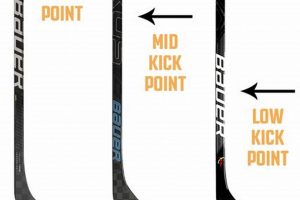
A hockey stick’s flex point, also known as the kick point, dictates where the stick bends most when a player applies force during a shot. A model with a versatile flex profile allows for varied shot releases. It provides a blend of attributes from both low and mid-kick point sticks, facilitating quick wrist shots and powerful slap shots.
This design offers a player increased adaptability on the ice. The sticks flex characteristics can contribute to improved puck control and shot accuracy, regardless of the player’s position or shooting style. The emergence of this technology represents an evolution in hockey equipment, catering to the increasingly diverse needs of players at all levels of the sport.
The following sections will explore the specific performance characteristics of this stick design, comparing it to other flex point options and offering guidance on selecting the optimal model based on individual playing styles and preferences.
Tips for Optimizing Performance with Adaptable Flex Hockey Sticks
Selecting and utilizing a stick with a variable flex profile requires understanding its characteristics and adjusting technique accordingly. The following tips can assist in maximizing its potential on the ice.
Tip 1: Select the Appropriate Flex: The stick’s flex rating should align with the player’s weight and strength. A flex rating too high may inhibit proper loading of the stick, reducing shot power. A flex rating too low may result in inaccurate shots.
Tip 2: Experiment with Different Shooting Styles: A central benefit of a stick with a adaptable kick point is its versatility. Experiment with wrist shots, snap shots, and slap shots to discover which shot types are most effectively executed with this design.
Tip 3: Maintain Proper Hand Placement: Hand positioning influences the location of the flex point. For quicker releases, maintain a lower hand position. For increased power, a higher hand position may be beneficial.
Tip 4: Focus on Puck Control: The responsive nature of these sticks can improve puck handling abilities. Practice stickhandling drills to enhance puck control and maximize the stick’s feel.
Tip 5: Adjust to the Release: The release point may differ slightly from sticks with fixed flex points. Pay attention to the puck’s trajectory and adjust technique to ensure accuracy.
Tip 6: Consider Blade Curve and Lie: While the kick point is crucial, the blade curve and lie also significantly affect shot performance. Select a blade that complements the stick’s flex characteristics and suits the player’s preferred shooting style.
Tip 7: Regular Practice is Essential: Consistent practice is paramount to maximizing the benefits of these sticks. The more familiar a player becomes with the stick’s feel and performance, the better equipped they will be to utilize its capabilities in game situations.
Mastering the use of adaptable flex hockey sticks involves selecting the correct specifications, experimenting with different shooting styles, and diligently refining technique. The result is a more adaptable and effective player on the ice.
The subsequent sections will delve into the maintenance and care of this hockey stick design, ensuring longevity and consistent performance.
1. Adaptable Flex Zone

The Adaptable Flex Zone represents a critical engineering feature within hockey sticks possessing a flexible kick point. This zone, engineered into the stick shaft, enables the stick to bend at varying points depending on the player’s hand positioning and the force applied during a shot. Its presence directly impacts the performance characteristics of the stick, providing a degree of versatility absent in traditional single-kick point designs. For example, a player executing a quick wrist shot will cause the stick to flex lower on the shaft, resulting in a rapid release. Conversely, a slapshot, generated with more force and a higher hand placement, will induce a flex higher up on the shaft, maximizing power. The success of a flexible kick point model hinges on the efficacy of its flexible flex zone to respond to these varied inputs.
The design of the flexible flex zone typically involves strategic layering of composite materials with varying degrees of stiffness. This allows for a progressive flexing action, avoiding the creation of abrupt “hinge points” that could compromise the stick’s structural integrity or negatively impact shot accuracy. Some manufacturers incorporate resin systems that further enhance the responsiveness of the zone, allowing the stick to efficiently store and release energy during the shooting motion. Understanding the materials science behind the flexible flex zone, and how it contributes to the stick’s overall performance, is crucial for both players and equipment specialists.
In summary, the Adaptable Flex Zone is an indispensable component of hockey sticks designed with a adaptable kick point. Its presence allows for versatility in shot release and caters to a broad range of playing styles. While the design and materials employed in constructing the zone vary across different models, the underlying principle remains the same: to provide players with a stick that can adapt to the demands of the game, optimizing both power and quickness in shooting. The effectiveness of this component determines the overall performance and feel of the stick.
2. Release Versatility

Release Versatility, in the context of hockey stick performance, refers to the capacity of a stick to facilitate varied shot types with optimized efficiency. This is intrinsically linked to sticks with adaptable kick points, which are designed to accommodate diverse shooting styles and scenarios encountered during gameplay.
- Adaptability to Shot Type
Adaptable kick points enable players to execute snapshots, wrist shots, and slapshots with relative ease and effectiveness. A low hand position promotes a lower flex point for quick-release wrist shots, while a higher hand position leverages a higher flex point for powerful slapshots. This contrasts with fixed-kick point sticks, which are optimized for a narrower range of shot types.
- Puck Trajectory Control
The flexible nature of the kick point can influence the trajectory of the puck upon release. Players can adjust their hand position and shooting technique to achieve varying launch angles and target specific areas of the net. This level of control is particularly advantageous in close-range scoring situations.
- Reduced Shot Telegraphing
The variable flex profile allows for quicker shot releases, reducing the opponent’s ability to anticipate and react. This can be particularly effective in scenarios where deception and speed are paramount, such as breakaways or offensive zone cycles. Fixed-kick point sticks may telegraph shot intentions due to their more predictable flex patterns.
- Enhanced Deception
The ability to alter the shot release point creates opportunities for deceptive plays. Players can mimic the motion of a slapshot while executing a quick wrist shot, or vice versa, to confuse the goalie. This element of unpredictability can significantly increase scoring chances.
The combined effects of these facets result in a stick that caters to a wider range of playing styles and tactical situations. This adaptability enhances a player’s overall offensive capabilities. Compared to traditional stick designs, flexible kick points represent a significant advancement in optimizing release versatility. The resulting increase in shot options and deception can be a crucial advantage on the ice.
3. Energy Transfer Efficiency

Energy Transfer Efficiency is a critical determinant of performance in hockey sticks, and it exhibits a strong correlation with sticks possessing a flexible kick point. This efficiency refers to the proportion of energy applied by the player during a shot that is successfully transferred to the puck, directly influencing puck velocity and, consequently, shot power. A stick design that maximizes this efficiency will enable a player to generate more forceful shots with the same amount of effort.
In the context of flexible kick point sticks, Energy Transfer Efficiency is influenced by several factors. The variable flex profile allows the stick to bend optimally for a range of shot types, minimizing energy loss through vibration or inefficient deformation. The strategic layering of composite materials, often including carbon fiber and specialized resins, contributes to stiffness and responsiveness, facilitating a rapid and complete transfer of energy to the puck. For instance, a well-constructed stick will exhibit minimal “whipping” or oscillation after the shot, indicating efficient energy transmission. Material choices must be combined with specific construction to optimize performance. If improperly constructed with superior materials, the energy transferred to the puck will suffer, with a loss of puck velocity.
Understanding the interplay between Energy Transfer Efficiency and the flexible kick point design is essential for both players and equipment manufacturers. For players, selecting a stick optimized for energy transfer can result in tangible improvements in shot power and accuracy. For manufacturers, prioritizing materials and construction techniques that maximize efficiency is paramount to creating high-performance equipment. Though Energy Transfer Efficiency is an important element, the overall stick must be balanced in terms of stick weight, feel, and durability, providing value for the player.
4. Player Adaptability

Player Adaptability, in the context of hockey equipment, relates to a player’s capacity to effectively utilize gear designed for versatile performance. Sticks with flexible kick points inherently demand a degree of adaptability from the player, as the stick’s performance characteristics vary depending on shooting technique and hand placement. The effectiveness of a stick with a adaptable kick point is contingent upon the player’s ability to adjust their approach and leverage the stick’s dynamic flex profile.
For example, a player transitioning from a traditional mid-kick stick may initially struggle to maximize the benefits of a flexible kick point model. The variable flex requires a more nuanced understanding of hand positioning and force application to achieve optimal shot power and accuracy. Players who excel with sticks of this type typically demonstrate a willingness to experiment with different shooting styles and adapt their technique based on the specific game situation. Young players are more likely to adapt to the stick compared to veterans who have engrained habits with a specific stick type. A key component of a team sport is adaptability to new situations that arise during competition. A versatile kick-point stick is another element of the game the player must learn to utilize successfully. If a player has a high degree of adaptability, the more likely they will be to contribute to their teams success.
Ultimately, the connection between player adaptability and sticks with variable kick points is symbiotic. The stick’s design facilitates versatility, but the player’s ability to exploit that versatility dictates the ultimate performance outcome. This interplay underscores the importance of player training and coaching in maximizing the benefits of technologically advanced hockey equipment. A better understanding of the importance of player adaptability contributes to the improved development of training and evaluation of player performance.
5. Shooting Style Variety

Shooting style variety, in the context of hockey, encompasses the range of different shooting techniques a player can effectively execute. This includes wrist shots, snap shots, slap shots, backhand shots, and various deceptions used to mislead the goaltender. A hockey stick with a adaptable kick point is designed to facilitate such a variety of shooting styles by allowing the stick to flex differently depending on the type of shot and the player’s hand position. This contrasts with sticks with fixed kick points, which are optimized for a narrower range of shooting techniques.
The connection between shooting style variety and a flexible kick point is causal. A player with a broader repertoire of shots becomes more unpredictable and difficult for defenders and goalies to counter. For instance, a player who can seamlessly transition from a slapshot motion to a quick wrist shot can exploit defensive weaknesses more effectively. The versatility afforded by these sticks enables players to adapt their shooting approach based on the game situation, such as quickly releasing a wrist shot in tight spaces or unleashing a powerful slapshot from the point. The significance of adaptable kick points becomes evident in scenarios where quick decision-making and adaptability are paramount.
In summary, shooting style variety is a critical component of a adaptable kick point. This variety empowers players with enhanced versatility and adaptability on the ice. This allows them to be more effective in different game situations. The stick serves as a tool to broaden the player’s offensive capabilities, provided the player possesses the skill and adaptability to leverage its potential.
Frequently Asked Questions
The following addresses common inquiries regarding hockey sticks engineered with a variable flex profile, providing clarity on their functionality and application.
Question 1: What distinguishes a stick with a adaptable kick point from those with fixed kick points?
Sticks with adaptable kick points allow the stick to flex at different locations along the shaft, depending on hand placement and applied force. Fixed-kick point sticks are designed to flex predominantly at a single, predetermined location.
Question 2: Does this type of stick increase shot power?
The potential for increased shot power is contingent on player technique. When the player optimally loads the stick, the energy transferred to the puck can lead to a more powerful shot.
Question 3: Are sticks with adaptable kick points suitable for all player positions?
Due to their versatile nature, these sticks are suitable for players in various positions. Defensemen can benefit from the ability to generate powerful slapshots, while forwards can leverage the quick release for snapshots and wrist shots.
Question 4: How does hand placement affect the performance of this stick design?
Hand placement significantly influences the flex point. A lower hand position generally results in a lower flex point, facilitating quicker releases. A higher hand position promotes a higher flex point, maximizing power.
Question 5: Are these sticks more difficult to control than traditional models?
The learning curve associated with this stick design is moderate. Some players may require an adjustment period to fully realize the benefits of the variable flex profile.
Question 6: Do sticks with adaptable kick points require specialized maintenance?
No, the maintenance requirements are generally the same as for any composite hockey stick. Regular inspection for cracks or damage is recommended.
In summary, sticks with a flexible flex point offer versatility in shot release and cater to a wide range of playing styles. Maximizing the potential of these sticks requires a degree of player adaptability and technical proficiency.
The following section will discuss factors to consider when selecting a suitable model.
In Conclusion
The preceding discussion explored the characteristics, benefits, and nuances of hybrid kick point hockey sticks. This analysis detailed the adaptable flex zone, release versatility, energy transfer efficiency, player adaptability, and shooting style variety associated with this equipment design. The importance of understanding these elements for optimal performance has been underscored.
The selection and utilization of hybrid kick point hockey sticks represent a commitment to versatility and adaptability within the sport. The ongoing evolution of hockey equipment suggests that advancements in variable flex profiles will continue to shape player performance. The judicious integration of this technology may afford players a competitive advantage. Further research into specific playing styles is important to determine if a hybrid kick point hockey stick is right for you.