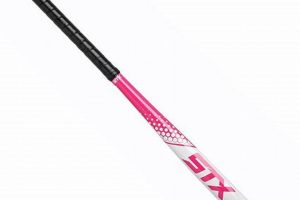
The directional preference for hockey equipment describes the side of the body on which a player holds the lower portion of the stick. This choice dictates the blade’s position relative to the players body and influences puck-handling and shooting techniques. For instance, a player who shoots with the blade on the left side would be considered a “left” shot, while the opposite configuration denotes a “right” shot.
Selecting the correct configuration is fundamental to a players development and performance. A proper fit allows for optimal control, power, and accuracy. Throughout the sport’s history, players have chosen their preferred side based on comfort, perceived advantages in specific game situations, and even imitation of admired players. The orientation impacts a player’s ability to receive passes, control the puck in tight spaces, and effectively launch shots towards the net.
The ensuing article delves into the process of determining individual preference, the impact of the selected side on game strategy, stick construction considerations, and common misconceptions surrounding side selection. Understanding these elements is critical for both aspiring and established hockey players to maximize their potential on the ice.
Selecting a Directional Preference
Choosing the correct directional preference for a hockey stick is a foundational decision that impacts a player’s ability to control the puck and execute plays effectively. The following tips offer guidance to assist in selecting the appropriate configuration.
Tip 1: Dominant Hand Evaluation: Determine the dominant hand, typically the one used for writing or throwing a ball. While not a definitive indicator, this provides a starting point. The dominant hand generally controls the upper portion of the stick.
Tip 2: On-Ice Experimentation: Spend time on the ice with both configurations. Focus on puck control, passing, and shooting from various positions. Observe which orientation feels more natural and allows for greater precision.
Tip 3: Forehand and Backhand Considerations: Assess comfort and power on both the forehand and backhand. Many players find one orientation provides an advantage on one side of the stick but not the other. Finding a balance is key.
Tip 4: Stick Handling Drills: Perform basic stickhandling drills with both configurations. Evaluate the ease of moving the puck around obstacles and maintaining control while skating at different speeds.
Tip 5: Consider Skating Style: Analyze the player’s skating style. A more defensive player might prioritize backhand control, while an offensive player might focus on forehand power and accuracy. The directional preference should complement skating habits.
Tip 6: Professional Guidance: Consult with experienced coaches or hockey professionals. They can offer personalized recommendations based on individual skills and playing style.
Tip 7: Seek Comfort and Natural Feel: Prioritize the configuration that feels most comfortable and natural. Overthinking the decision can be detrimental. Trusting instinct is essential.
By carefully considering these factors, players can make an informed decision about their directional preference, leading to improved puck control, enhanced shooting ability, and ultimately, greater success on the ice.
The subsequent sections of this article will explore the impact of configuration choice on game strategy and the selection of appropriate stick specifications.
1. Shooting Hand Dominance

Shooting hand dominance serves as an initial, though not definitive, indicator in selecting a stick configuration. While a player’s dominant hand often influences their initial inclination, on-ice performance and comfort ultimately dictate the appropriate choice.
- Upper Hand Control and Power:
The hand positioned higher on the stick, typically the dominant hand, exerts greater control during stickhandling and contributes significantly to shot power. A right-handed individual might naturally favor having their right hand higher, leading to a left-hand shot configuration. However, this correlation is not absolute; many players deviate from this pattern based on individual comfort and playing style.
- Fine Motor Skills and Puck Handling:
The dominant hand facilitates intricate puck handling maneuvers. Players often find that their dominant hand provides superior dexterity for cradling the puck, executing dekes, and making quick adjustments. This increased level of control can be advantageous regardless of the directional preference chosen.
- Wrist Shot Mechanics:
The execution of wrist shots relies heavily on wrist strength and control, attributes often associated with the dominant hand. Transferring energy from the dominant hand through the stick and into the puck can enhance the speed and accuracy of wrist shots, making this a critical consideration during configuration selection.
- Snap Shot Execution:
Like wrist shots, snap shots benefit from the fine motor control offered by the dominant hand. The quick, deceptive nature of a snap shot is enhanced by the coordination between the upper and lower hands, with the dominant hand playing a crucial role in generating power and accuracy in a short amount of time.
While shooting hand dominance provides a valuable starting point, it should be considered in conjunction with other factors such as skating style, puck control preferences, and on-ice experimentation. Ultimately, the optimal configuration is the one that allows the player to maximize their potential on the ice, regardless of their dominant hand.
2. Puck Control Dynamics

The configuration of a hockey stick directly influences a player’s puck control capabilities. A player’s ability to cradle, protect, and manipulate the puck is intimately tied to the side of the stick they choose. A configuration aligned with an individual’s physical mechanics and comfort level facilitates smoother transitions, quicker reactions, and enhanced puck retention. For instance, a player with a “left” orientation will naturally develop superior control on their forehand when skating to their left, allowing for more effective puck protection along the boards or during offensive zone entries. Conversely, a “right” orientation provides the same advantage when skating to the right.
The impact extends beyond simple puck retention. The directional preference influences the ability to execute complex maneuvers such as dekes, quick changes of direction, and effective passing under pressure. A poorly chosen configuration can lead to awkward movements, reduced reaction time, and an increased risk of turnovers. Consider the example of a defenseman retrieving the puck deep in their own zone; a defender with a well-suited orientation can quickly pivot and make a crisp breakout pass, minimizing the risk of an offensive chance for the opposing team. This emphasizes the importance of selecting the configuration that allows for fluid, instinctive movements.
In summary, the selection profoundly impacts the intricacies of puck control. A proper fit enhances a player’s ability to protect, manipulate, and distribute the puck effectively, leading to improved offensive and defensive performance. While various factors contribute to a player’s overall skill, the foundational impact of the chosen configuration on puck control cannot be overstated, highlighting its significance in skill development and on-ice success.
3. Forehand/Backhand Balance

The selection of a “left or right handed hockey stick” directly influences the balance between a player’s forehand and backhand capabilities. Ideally, a player strives for proficiency on both sides of the stick, enabling versatility in game situations. However, the chosen configuration often creates a natural bias toward one side, requiring conscious effort to develop the weaker side. For example, a player adopting a “left” orientation may initially exhibit a stronger forehand shot and puck control when moving to their left, but could face challenges executing quick backhand passes or shots when pressured on their right. This imbalance can be exploited by opponents who force the player onto their weaker side, limiting their options and potentially leading to turnovers. The pursuit of forehand/backhand balance is therefore a critical aspect of player development, often necessitating targeted training drills and strategic positioning adjustments.
Consider professional hockey players: those with pronounced imbalances are frequently neutralized by opposing teams. A defenseman with a weak backhand pass, for instance, may be repeatedly pressured to force a turnover. Conversely, players recognized for their balanced skill set are more adaptable and difficult to defend. They possess the option to make plays from either side of the ice, creating opportunities for themselves and their teammates. Effective coaching often emphasizes strengthening the weaker side through targeted drills and game simulations, allowing players to overcome their natural inclinations and achieve a more symmetrical skill set. This approach not only enhances individual performance, but also contributes to a team’s overall tactical flexibility.
Achieving forehand/backhand balance represents an ongoing challenge in hockey. While the initial selection of a “left or right handed hockey stick” creates a foundational preference, dedicated practice and strategic awareness are essential to mitigate imbalances. A player’s ability to perform effectively on both sides of the stick expands their tactical options, increases their value to the team, and ultimately, enhances their overall performance. Overcoming this challenge requires a commitment to continuous improvement and a recognition of the strategic importance of balanced skill development.
4. Skating Style Integration

The selection of a hockey stick orientation, often described as “left or right,” is inextricably linked to a player’s skating style. Effective skating is not merely about speed and agility; it encompasses a complex interplay of balance, edge work, and body positioning. The chosen stick orientation must complement these elements to facilitate seamless puck control and efficient energy transfer. A skater who favors a particular turning direction, for example, might find that a specific stick orientation allows for greater puck protection and more powerful shots while executing that turn. Conversely, an incompatible configuration could hinder their natural movements, reducing their effectiveness and potentially increasing the risk of turnovers. The integration of skating style and stick orientation is therefore paramount for optimizing on-ice performance.
Consider the scenario of a defenseman who frequently pivots from forward to backward skating to defend against a rush. A “right” orientation might allow this player to more easily control the puck on their forehand while transitioning from skating backwards on the right side of the ice to skating forward. However, if the player favors pivoting to the left, a “left” orientation could provide a similar advantage. The key is to analyze which stick orientation best supports the player’s most common skating maneuvers and allows them to maintain puck control and balance throughout those movements. This understanding extends beyond defensive play. Offensive players who utilize quick cuts and changes of direction to create scoring opportunities must also select a stick orientation that aligns with their skating style to maximize their agility and puck-handling capabilities. Examples of players who integrated their configuration effectively with their skating abilities are evident at all levels, from recreational leagues to the professional ranks, and highlights the significance of aligning equipment with physical movement.
In conclusion, skating style integration is a crucial component of selecting the optimal stick orientation. While factors such as dominant hand and forehand/backhand balance are important considerations, the chosen configuration must ultimately support and enhance the player’s unique skating style. Failure to properly integrate these elements can lead to decreased puck control, inefficient skating, and a reduction in overall on-ice effectiveness. Therefore, a thorough assessment of skating habits and a deliberate effort to align stick orientation with those habits are essential steps in maximizing a player’s potential.
5. Stick Handling Proficiency

Stick handling proficiency, the ability to control and manipulate the puck effectively with the stick, is intrinsically linked to the selected directional preference. The chosen side, whether “left or right,” influences the ease and effectiveness with which a player executes various stick handling techniques. A player’s capability to quickly deke, protect the puck, and make accurate passes hinges significantly on the compatibility between their skill level and the configuration. Improper equipment selection may hinder progress and limit the player’s potential. A skilled player with an incompatible setup will invariably experience challenges that limit overall effectiveness. Real-world examples exist at all levels of play, with novice players struggling to develop fundamental skills due to ill-suited equipment and seasoned professionals optimizing performance by tailoring their setup to their unique handling style.
The alignment between stick handling skill and selected side affects more than just individual performance. It impacts a player’s ability to contribute to team strategies, execute plays with precision, and adapt to changing game situations. A player proficient in stick handling, possessing mastery over their equipment, becomes a valuable asset, capable of creating scoring opportunities, disrupting opposing plays, and maintaining possession under pressure. Furthermore, the development of advanced skills such as quick puck retrieval, one-handed control, and deceptive maneuvers relies heavily on having equipment that feels natural and responsive. A player who switches to a configuration counter to their style finds it nearly impossible to implement advanced strategies.
In summation, the connection between proficiency and the selected directional preference is undeniable. Stick handling ability requires carefully considered and proper directional preference. A failure to recognize its significance can impede skill development and limit a player’s overall effectiveness. A thoughtful evaluation of skill levels, styles, and equipment properties provides the best basis to make an appropriate selection. Recognizing the impact of configuration enables players to refine their abilities, increase their competitiveness, and optimize performance on the ice.
Frequently Asked Questions
The following section addresses common inquiries regarding the selection and impact of directional preference, often described by the terms “left or right handed hockey stick,” on player performance and skill development.
Question 1: Is there a definitive method for determining the correct directional preference?
While dominant hand provides an initial indication, on-ice experimentation is crucial. A player should test both configurations during stickhandling and shooting drills to ascertain which feels more natural and allows for greater puck control.
Question 2: Does directional preference significantly impact shot power?
Yes. The chosen configuration influences the biomechanics of shooting, affecting the transfer of energy from the player to the stick and, subsequently, to the puck. A well-suited configuration optimizes leverage and control, enhancing shot power.
Question 3: Can a player switch directional preference after years of playing?
While possible, changing the preferred direction after prolonged use of a specific configuration is generally discouraged. The player has developed muscle memory and skill around the original style, and attempting to alter this can hinder performance. The change requires substantial effort and a period of adjustment.
Question 4: Are there inherent advantages to either a “left” or “right” configuration?
No. Neither offers an inherent advantage. The optimal choice is dictated by individual preferences and skill characteristics, not by any intrinsic superiority of one configuration over the other.
Question 5: Does directional preference affect defensive play?
Yes. The choice of configuration impacts a player’s ability to retrieve pucks, make defensive zone exits, and effectively defend against opposing players. A configuration that complements a player’s skating style and positioning enhances defensive capabilities.
Question 6: Should the dominant eye be considered when determining directional preference?
While less critical than other factors, some coaches and players believe the dominant eye can influence aiming and depth perception, potentially impacting shot accuracy. However, this remains a less emphasized element compared to dominant hand and on-ice comfort.
In summary, selecting the correct directional preference is a nuanced process involving careful consideration of individual strengths, weaknesses, and skating style. There is no universal “right” answer; the optimal choice is the one that maximizes a player’s potential on the ice.
The following section will explore stick construction and customization options, offering insights into how players can further refine their equipment to optimize performance.
Directional Preference
This exploration has underscored the critical role directional preference, denoted by “left or right handed hockey stick,” plays in a player’s development and on-ice performance. The selection significantly influences puck control, shooting mechanics, skating integration, and overall gameplay effectiveness. A thorough understanding of these interdependencies is essential for players, coaches, and equipment specialists.
The informed choice of directional preference serves as the bedrock upon which individual skill and team success are built. Continued research and individualized fitting processes remain vital to optimize performance at all levels of the sport. The future of player development hinges, in part, on a refined understanding and application of the principles outlined herein, emphasizing the lasting significance of directional preference within the realm of hockey equipment and technique.