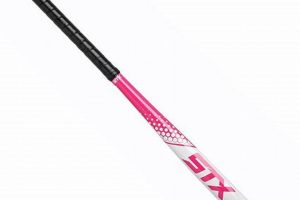
The length and weight of the implement used in field hockey are critical factors influencing a player’s performance. These dimensions vary, primarily based on the player’s height, allowing for optimal control and striking ability. For example, a taller player generally requires a longer implement to maintain proper posture and leverage during play.
Appropriate equipment dimensions directly impact the player’s agility, power, and accuracy. A correctly sized implement facilitates better ball handling, more forceful hits, and reduces the risk of injury associated with improper form. Historically, materials and construction have evolved significantly, influencing the weight distribution and overall feel, further emphasizing the importance of a suitable fit.
Understanding the nuances of implement dimensions is foundational to selecting the right equipment. Consequently, the subsequent sections will detail the specific measurement guidelines, age-related recommendations, material considerations, and the process of choosing an implement tailored to individual player needs.
Guidelines for Optimal Implement Selection
Selecting the correct implement is crucial for developing skill and preventing injury. The following guidelines provide essential considerations when determining the appropriate specifications for a field hockey implement.
Tip 1: Prioritize Height-Based Selection: A general rule suggests the top of the implement, when held upright, should reach approximately to the player’s hip bone. This correlation provides a solid starting point for selection.
Tip 2: Consider Playing Position: Different positions may benefit from subtle variations. For example, defensive players might favor a longer implement for reach and tackling, while attacking players could opt for a shorter implement for quicker maneuvering.
Tip 3: Evaluate Weight Distribution: The balance point influences handling and striking power. A heavier head can generate more power, but may reduce agility. Lighter heads offer quicker handling but might sacrifice power.
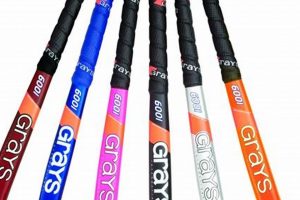
Tip 4: Assess Grip Comfort: The grip should feel secure and comfortable in the player’s hand, allowing for a firm hold without excessive strain. Experiment with different grip thicknesses and materials.
Tip 5: Factor in Strength and Skill Level: Younger or less experienced players might find a lighter implement easier to control, while more experienced and stronger players can handle a heavier one.
Tip 6: Seek Expert Advice: Consult with coaches or experienced retailers who can offer personalized recommendations based on playing style and physical attributes.
Tip 7: Test Before Purchase: Whenever possible, test different implements during practice or informal games to assess comfort and performance.
Adhering to these guidelines facilitates the selection of an implement that optimizes player performance, reduces the risk of injury, and supports skill development.
The following sections will delve into specific manufacturers, price points, and maintenance strategies.
1. Length
The linear dimension of a field hockey implement, commonly referred to as its length, forms a primary component of its overall “size.” This dimension is directly proportional to the player’s height and plays a crucial role in determining the player’s posture, reach, and striking mechanics. A hockey player, for instance, who uses a implement that is too long may develop an awkward stance and inefficient ball-striking motion, hindering performance and increasing the likelihood of injury.
The length affects a player’s ability to maintain control, execute passes, and deliver effective shots. A shorter implement allows for quicker maneuvering and tighter control in close-quarters situations, while a longer implement offers extended reach for tackling and intercepting passes. Field hockey coaches often adjust players’ implement length based on their position and playing style, highlighting the practical significance of understanding this connection between the length and implements overall suitability for individual needs. Choosing the wrong dimension can lead to technical deficiencies and a reduction in overall effectiveness on the field.
In summary, length is an essential parameter dictating the “size” of a field hockey implement. Selecting the appropriate length is paramount for promoting proper technique, optimizing performance, and mitigating the risk of physical strain. While other factors such as weight and grip diameter also contribute to the overall fit and feel, length serves as the foundational measurement from which other adjustments are made, ultimately shaping the player’s interaction with the game.
2. Weight
The mass of a field hockey implement, or its weight, is an integral component of its overall dimensions and is intrinsically linked to its utility. The weight directly influences a player’s capacity to control the implement effectively, generate power when striking the ball, and maintain stamina throughout the duration of play. An implement that is excessively heavy can impede maneuverability and lead to premature fatigue, while one that is too light may lack the necessary force for effective hitting and tackling.
Weight distribution further complicates the matter. A head-heavy implement generates more power, advantageous for defensive players executing long passes or forceful tackles. Conversely, a lighter head facilitates quicker stick work and tighter control, beneficial for offensive players in close-quarters situations. Implement materials and construction techniques directly impact weight. For instance, composite implements allow for customizable weight distribution not achievable with traditional wooden implements. Athletes must carefully consider their playing position, strength, and skill level when choosing an implement to ensure the selected weight optimizes their performance.
In conclusion, weight is a crucial factor impacting the functionality of a field hockey implement. Its interplay with length and balance influences control, power, and endurance. Informed selection, based on individual player attributes and style, is essential to maximizing potential. A lack of awareness regarding weight characteristics can undermine a player’s ability to effectively execute fundamental skills.
3. Grip Diameter

Grip diameter represents a critical, yet often overlooked, element of a field hockey implement’s overall dimensions. This dimension dictates the comfort and control a player maintains during gameplay, significantly impacting their technical execution and performance. Incorrect grip diameter can lead to compromised ball control, increased fatigue, and potential injury.
- Hand Size and Comfort
Grip diameter must correlate with the player’s hand size to ensure a comfortable and secure hold. A grip that is too thick may lead to hand fatigue and reduced dexterity, while a grip that is too thin may cause the player to over-grip, leading to blisters and a loss of control. Manufacturers offer various grip sizes to accommodate different hand dimensions.
- Impact on Control and Maneuverability
The diameter of the grip directly influences the ability to manipulate the implement effectively. A properly sized grip facilitates quick changes in direction and precise ball handling, allowing players to maintain possession and execute complex maneuvers. A grip that is too large or too small can hinder these movements, impacting overall agility and responsiveness on the field.
- Material and Texture Influence
While the diameter itself is crucial, the material and texture of the grip also play a significant role. Grips made from absorbent materials can improve comfort and control in wet conditions. Textured surfaces can enhance grip security, preventing slippage during forceful movements. These factors, in conjunction with the diameter, contribute to the overall feel and effectiveness of the implement.
- Relationship to Implement Weight and Balance
Grip diameter, though seemingly independent, can indirectly affect the perceived weight and balance of the implement. A thicker grip may add a slight amount of weight to the handle, potentially altering the balance point. Players must consider this subtle influence when selecting an implement, ensuring that the grip diameter complements the other dimensions and contributes to a well-balanced feel.
Grip diameter is an essential element in determining the overall suitability of a field hockey implement. Its interplay with hand size, material, and the player’s style of play determines the comfort, control, and maneuverability experienced. Therefore, careful consideration should be given to the grip diameter to maximize performance and prevent potential injuries.
4. Head Angle

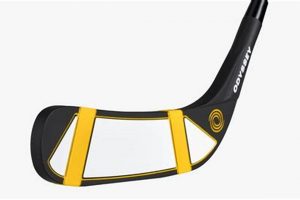
Head angle, referring to the angle at which the head of the field hockey implement is oriented relative to its shaft, is intrinsically linked to the overall dimensions of the implement and significantly impacts gameplay. This angle, typically ranging from slight curves to more pronounced bends, influences the player’s ability to effectively control the ball, execute passes, and generate power during strikes. A more acute angle facilitates close ball control and finesse maneuvers, while a less acute angle promotes powerful hits and sweeping actions. For example, an attacker prioritizing dribbling and quick passes might favor a head angle that provides enhanced ball control, whereas a defender focused on clearing the ball from the defensive zone may benefit from a head angle conducive to powerful hits. The specific head angle should complement the player’s height, style, and preferred playing position.
Variations in head angle directly affect the player’s posture and striking technique. A head angle that is mismatched to the player’s stature can lead to awkward positioning, reducing the efficiency of their movements and increasing the risk of injury. Furthermore, the head angle influences the point of contact with the ball, affecting the direction and trajectory of passes and shots. Improper head angle selection can compromise the accuracy and power of these essential skills, diminishing the player’s effectiveness on the field. For instance, an implement with an unsuitable head angle might make it difficult to lift the ball accurately, hindering the player’s ability to execute aerial passes or shots on goal.
In summation, head angle, as a critical dimension, significantly influences the overall efficacy of a field hockey implement. Correct selection based on individual player characteristics and playing style is paramount. Choosing an improper head angle can negatively impact ball control, striking technique, and overall performance, highlighting the necessity for careful consideration of this factor when selecting an implement. Challenges in determining the optimal angle often arise from a lack of standardized measurement systems and inconsistencies across different manufacturers, underscoring the need for players to seek expert guidance and experiment with various options to find the best fit.
5. Balance Point

The balance point of a field hockey implement, while not a direct linear measurement, is intrinsically linked to the overall “size” and perceived weight distribution, significantly influencing handling and performance. It represents the point along the implement’s length at which it would balance perfectly, reflecting the distribution of mass.
- Impact on Handling and Control
The location of the balance point dictates the maneuverability of the implement. A balance point closer to the head makes the implement feel heavier and potentially more powerful for hitting, but can reduce agility and quickness. Conversely, a balance point closer to the grip creates a lighter feel, facilitating quicker stick work and tighter control during dribbling and close passing situations. Skilled players adjust their grip and technique based on the position of balance point.
- Relationship to Implement Length and Weight
Longer implements tend to have balance points further from the grip, naturally increasing the perceived swing weight. The material composition, such as the use of composite materials versus traditional wood, can dramatically alter the balance point independent of the length. A longer, lighter implement may have a similar balance point to a shorter, heavier one, creating distinct handling characteristics.
- Influence on Striking Power and Technique
A balance point shifted towards the head can enhance the power generated during strikes, as it effectively increases the moment of inertia. This, however, demands greater strength and control from the player to manage the heavier swing weight. Players must coordinate power generation to have the proper balance point as well as a strong core.
- Adjustment Through Grip and Weight Modification
Players can subtly adjust the effective balance point by adding weight to the grip or the head of the implement. Over-grips or weighted end caps are commonly used to shift the balance point towards the hand, improving control and quickness. Altering the balance in a field hockey match can give the team an advantage to push the outcome toward a more favorable outcome.
The balance point, therefore, is not merely a static property but a dynamic characteristic that interacts with length, weight, and material composition. Understanding this interplay is essential for selecting an implement that complements a player’s style and optimizes performance. Manipulation of the balance point can give players more control over how their stick feels during gameplay, and can directly improve the outcome of a match.
6. Shaft Stiffness

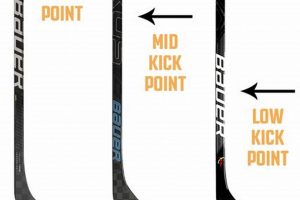
Shaft stiffness, a critical attribute of a field hockey implement, directly influences its performance characteristics and is inextricably linked to its dimensions. This stiffness, determined by the material properties and construction of the shaft, affects the power transfer, control, and feel experienced by the player. It also has a direct bearing on how to select the proper size of the implement.
- Energy Transfer Efficiency
Shaft stiffness governs the efficiency with which energy is transferred from the player to the ball upon impact. A stiffer shaft minimizes energy loss due to flex, resulting in more powerful hits. For example, a player executing a slap shot relies on the shaft’s ability to store and release energy efficiently, a characteristic directly tied to its stiffness. This facet of shaft stiffness becomes particularly important when choosing the correct size, as a larger implement often requires a stiffer shaft to prevent excessive flex and maintain power.
- Control and Accuracy
While a stiffer shaft enhances power, it can also impact control and accuracy. A more flexible shaft offers greater feel for the ball, allowing for subtle adjustments during dribbling and passing. For instance, a player executing a delicate chip shot may prefer a more flexible shaft for enhanced control. The size of an implement can influence perceived stiffness; a longer implement, even with the same material properties, may feel more flexible than a shorter one, necessitating careful consideration of shaft stiffness in relation to overall dimensions.
- Player Strength and Skill Level
The ideal shaft stiffness is contingent upon the player’s strength and skill level. Stronger players can effectively utilize a stiffer shaft to maximize power, while less experienced players may find a more flexible shaft easier to control. Smaller athletes may not have the upper body strength to effectively leverage a stiffer shaft.
- Material Composition and Construction
Shaft stiffness is determined by the materials used in construction, such as wood, fiberglass, carbon fiber, or composites, as well as the manufacturing process. Composite implements allow for customized stiffness profiles, enabling manufacturers to fine-tune the performance characteristics for different playing styles. A player might consider using composites for shaft stiffness as they get into more serious play.
The interplay between shaft stiffness and other dimensions, such as length and weight, is crucial for optimizing performance. A larger, stiffer implement may suit a powerful player, while a smaller, more flexible implement might benefit a player prioritizing control and finesse. Considering shaft stiffness in conjunction with the “size” of the field hockey implement allows for informed equipment selection that enhances a player’s strengths and minimizes limitations.
Frequently Asked Questions
The following section addresses common inquiries regarding the dimensions of field hockey implements, providing insights into their impact on performance and selection considerations.
Question 1: What constitutes the appropriate length for a field hockey implement?
The proper length typically corresponds to the player’s height, with the top of the implement reaching approximately to the hip bone when held upright. Adjustments may be necessary based on individual playing style and position.
Question 2: How does implement weight affect ball control and striking power?
Implement weight influences maneuverability and power generation. A heavier implement can enhance striking power but may reduce agility, while a lighter implement facilitates quicker stick work but might compromise power.
Question 3: Why is grip diameter an important consideration when selecting a field hockey implement?
Grip diameter directly impacts comfort and control. A grip that is too thick or too thin can lead to hand fatigue, blisters, and compromised ball handling.
Question 4: How does head angle influence a player’s technique?
Head angle affects the player’s ability to control the ball, execute passes, and generate power. A more acute angle enhances ball control, while a less acute angle promotes powerful hits.
Question 5: What is the significance of the balance point in a field hockey implement?
The balance point influences the overall feel and handling characteristics. A balance point closer to the head increases the perceived swing weight, while a balance point closer to the grip enhances maneuverability.
Question 6: How does shaft stiffness impact a player’s performance?
Shaft stiffness affects the power transfer and control. A stiffer shaft maximizes power transfer, while a more flexible shaft provides greater feel for the ball.
Selecting the right implement involves careful consideration of these dimensions, ensuring optimal performance and minimizing the risk of injury.
The subsequent sections will examine specific brands and models of field hockey implements, along with their respective size and performance characteristics.
Conclusion
This exploration has underscored the critical importance of implement dimensions, summarized as “size of field hockey stick,” in optimizing athletic performance and mitigating potential injury. Length, weight, grip diameter, head angle, balance point, and shaft stiffness are identified as key variables influencing a player’s control, power, and overall effectiveness on the field. Precise measurement and thoughtful consideration of individual player attributes are paramount for informed equipment selection.
A comprehensive understanding of these dimensional relationships empowers players and coaches to make strategic equipment choices. Continued research and technological advancements promise further refinement in implement design, potentially leading to even greater precision in tailoring equipment to individual needs. Therefore, a commitment to ongoing education and a discerning approach to equipment selection remain essential for maximizing potential in field hockey.