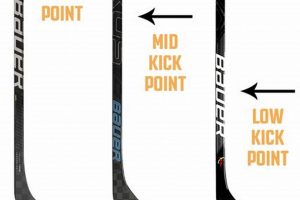
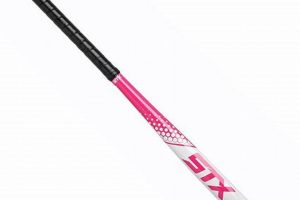
Hockey sticks designed with a low kick point feature a flex point located closer to the blade. This design facilitates a quicker release of the puck, primarily benefiting players who specialize in quick snapshots and close-range shots. For example, a forward positioned near the net often prefers this type of stick to capitalize on scoring opportunities arising from rebounds or deflections.
The advantage of a low kick point lies in its capacity to load energy rapidly, allowing for shots to be executed with minimal wind-up. This is particularly useful in fast-paced game situations where reaction time is paramount. Historically, players seeking an edge in tight spaces and rapid shooting scenarios have gravitated towards sticks with this characteristic, contributing to a shift in design and manufacturing techniques within the hockey equipment industry.
Subsequent sections will delve into the specific criteria for evaluating the performance of hockey sticks with this design, covering aspects such as material composition, shaft shape, blade construction, and overall weight distribution. Furthermore, a comparative analysis of leading models currently available on the market will be presented, providing a comprehensive overview for informed decision-making.
Considerations for Selecting High-Performance Hockey Sticks
Selecting hockey sticks optimized for quick release and enhanced puck control requires careful consideration of several key factors. Evaluating these elements ensures the chosen equipment aligns with individual playing style and performance objectives.
Tip 1: Flex Profile Assessment: Determine the appropriate flex rating based on body weight, strength, and shooting style. A flex rating that is too stiff can impede shot power, while one that is too flexible may compromise accuracy.
Tip 2: Material Composition Evaluation: Examine the materials used in the shaft and blade construction. Composite materials, such as carbon fiber, offer a balance of lightweight design and durability, influencing overall responsiveness and energy transfer.
Tip 3: Blade Design Analysis: Analyze the blade curve, face angle, and construction. A deeper curve facilitates puck handling and elevation, whereas a more open face angle can enhance shot velocity. Blade stiffness impacts puck feel and accuracy.
Tip 4: Grip Texture Inspection: Evaluate the grip texture to ensure secure handling. A textured grip provides enhanced control and prevents slippage, particularly in wet or high-pressure game situations.
Tip 5: Weight Distribution Examination: Assess the stick’s balance point. A balanced stick promotes maneuverability, while a blade-heavy stick can enhance shot power. Consider personal preferences regarding weight distribution to optimize performance.
Tip 6: Kick Point Precision: Confirm the stick’s kick point is genuinely low, as marketed. A higher-than-advertised kick point will impede quick release benefits. Assess through on-ice testing or detailed product specifications.
Selecting suitable hockey equipment necessitates a comprehensive understanding of personal skill level, playing style, and performance requirements. Diligent evaluation ensures that the selected gear effectively contributes to achieving individual objectives on the ice.
The subsequent section will explore specific models and brands recognized for exceptional low kick point performance, providing further guidance for informed selection.
1. Quick Release

In the context of hockey stick performance, “quick release” refers to the ability to transfer energy efficiently from the player to the puck, resulting in a rapid shot execution. A hockey stick’s design directly impacts the speed and efficiency of this energy transfer, making “quick release” a critical consideration when evaluating equipment.
- Low Kick Point Efficiency
A low kick point, common in specific hockey stick designs, facilitates a quicker release by concentrating the flex closer to the blade. This design minimizes the loading distance, enabling players to generate a shot with less backswing. For example, a player in a crowded scoring area benefits from a low kick point’s ability to deliver a shot before defenders can react. The efficiency of the low kick point directly translates to faster shot execution.
- Tapered Shaft Contribution
The taper profile of the stick shaft also contributes to release speed. A more aggressive taper, often found in conjunction with a low kick point, further enhances the energy transfer to the blade. This results in a more responsive feel and a faster puck launch. A player executing a wrist shot from the faceoff circle experiences improved puck velocity due to the combined effect of the low kick point and aggressive taper.
- Blade Stiffness Influence
Blade stiffness affects puck control and release characteristics. A stiffer blade transmits energy more directly, leading to a more accurate shot with a quicker release. Conversely, a softer blade may offer enhanced puck feel but could compromise shot speed. Professional players often experiment with varying blade stiffness levels to optimize for personal shooting preferences, balancing feel with release velocity.
- Weight Distribution Optimization
The overall weight and balance point of the stick influence the ease and speed with which a player can maneuver and shoot. A well-balanced stick allows for quicker hand movements and facilitates a more fluid shooting motion, contributing to a faster release. A stick that is too blade-heavy, for example, may slow down the release, negating some of the benefits of a low kick point. Achieving optimal weight distribution is crucial for maximizing quick release potential.
The synergy between a low kick point, tapered shaft, blade stiffness, and optimized weight distribution defines a hockey stick’s capacity for quick release. Players selecting equipment should consider these interconnected elements to maximize their shooting performance in game situations. The overall objective is to find a stick that complements individual playing style and enhances shot velocity and accuracy.
2. Enhanced Accuracy
The integration of enhanced accuracy into hockey stick design, particularly within the best low kick point models, is not merely an ancillary benefit but a core functional attribute. Enhanced accuracy with such equipment arises from a confluence of design elements that collectively influence the direction and precision of the puck’s trajectory. The low kick point itself contributes indirectly by facilitating a quicker release, reducing the time available for defensive interference and enabling the shooter to capitalize on fleeting scoring opportunities with greater accuracy.
A contributing factor to enhanced accuracy is the blade’s construction and lie. A well-designed blade, optimized for stiffness and curvature, ensures consistent puck contact, minimizing unwanted deflection or deviation during the shot. The lie of the blade, which determines the angle at which the blade rests on the ice, further contributes to accuracy by enabling a player to maintain a consistent and controlled shooting posture. Furthermore, the stick’s overall balance and weight distribution play a critical role. A balanced stick allows for finer adjustments and greater control during the shooting motion, translating to increased accuracy in shot placement. Professional hockey players often fine-tune these aspects of their sticks, aligning equipment specifications with their individual shooting techniques to maximize accuracy. The practical significance of this is evident in game situations where precise shot placement can be the difference between scoring a goal and missing an opportunity.
In summary, the accuracy achieved through hockey sticks is interwoven with its construction and design elements. While a low kick point assists in rapid shot execution, the blade’s design, lie, and overall stick balance are key determinants of precision. The ability to accurately place shots is of paramount importance, allowing players to exploit scoring opportunities and elevate their overall performance. Continued refinement of these design factors remains a focal point in hockey equipment development, with the ultimate goal of providing players with the tools necessary to achieve optimal precision and control on the ice.
3. Optimal Flex

The connection between optimal flex and the performance of hockey sticks centers on energy transfer and shot mechanics. A hockey stick’s flex rating signifies its stiffness; a lower number indicates greater flexibility, while a higher number denotes increased stiffness. Optimal flex, therefore, represents the flex rating that best complements a player’s physical strength, shooting style, and the specific design characteristics of the stick. When paired with a low kick point, optimal flex becomes particularly critical for maximizing shot velocity and quick release. A stick with a flex rating too high for the player’s strength will not load efficiently, reducing shot power, while a rating too low may compromise accuracy and control due to excessive bending. Consequently, selecting the appropriate flex enables players to capitalize on the quick release benefits of low kick point sticks, enhancing overall shooting performance.
For example, a smaller, agile forward who relies on quick snapshots in tight spaces may benefit from a stick with a lower flex rating. This facilitates easier loading and a faster release in close proximity to the net. Conversely, a larger, more powerful defenseman who prefers taking slap shots from the point may require a stiffer flex to handle the increased force and maintain accuracy. The interplay between flex and technique is also evident in wrist shots, where a properly matched flex allows players to generate maximum velocity with minimal windup. Therefore, optimal flex is not a universal value but rather a personalized attribute that depends on individual player characteristics and playing style. A mismatch can negate the advantages offered by the low kick point design, resulting in decreased shot power and accuracy. This illustrates the practical importance of understanding and selecting the appropriate flex rating.
In conclusion, the concept of optimal flex is integral to realizing the full potential of hockey sticks, particularly those with a low kick point. It is a personalized attribute that must align with individual player characteristics and playing style. Effective selection of flex empowers players to capitalize on the quick release and enhanced puck control features associated with low kick point designs, leading to improved on-ice performance. Achieving optimal flex, therefore, necessitates careful consideration of a player’s strength, shooting technique, and preferred playing position to ensure the equipment effectively contributes to performance objectives.
4. Balanced Weight

The attribute of balanced weight in hockey stick design significantly influences performance characteristics, particularly in models with a low kick point. Achieving equilibrium in weight distribution impacts a player’s ability to maneuver the stick effectively, control the puck, and execute shots with precision.
- Swing Weight and Puck Handling
Swing weight, the perceived weight during motion, affects puck handling. A stick with a lower swing weight allows for quicker stick handling and rapid adjustments, beneficial in fast-paced scenarios near the net. For example, a forward executing quick dekes requires a stick that feels light and responsive. In best low kick hockey sticks, a balanced swing weight complements the quick release feature, enabling efficient puck movement and shot execution in tight spaces.
- Balance Point and Shot Accuracy
The balance point, the point at which the stick is evenly weighted, affects shot accuracy. A balance point closer to the hands offers enhanced control and precision, while one further toward the blade may increase shot power but reduce accuracy. Defensemen taking long-range shots might prefer a slightly blade-heavy balance, whereas forwards prioritizing accuracy benefit from a more centrally balanced stick. Balanced weight in best low kick hockey sticks allows players to maintain control while leveraging the stick’s design for rapid shot release.
- Weight Distribution and Fatigue Reduction
Even weight distribution across the stick minimizes fatigue during extended play. An unbalanced stick requires additional effort to control, leading to quicker exhaustion. A well-balanced stick reduces strain on the hands and wrists, enabling players to maintain consistent performance throughout a game. For example, during a long shift, a player with a balanced stick can maintain puck control and shooting accuracy longer than one with an improperly balanced stick.
- Material Composition and Weight Management
The selection of composite materials, such as carbon fiber, dictates the overall weight. Advanced manufacturing techniques optimize material placement to achieve a balance between durability and weight reduction. Lighter materials and optimized weight distribution enhance maneuverability and responsiveness, directly impacting performance. Best low kick hockey sticks leverage material innovations to minimize weight while maintaining structural integrity, contributing to improved balance and overall performance.
In conclusion, balanced weight is an integral factor in optimizing hockey stick performance, particularly for models with a low kick point. It impacts puck handling, shot accuracy, fatigue reduction, and overall maneuverability. The integration of advanced materials and design techniques aims to achieve optimal weight distribution, contributing to enhanced performance and control for players across various skill levels and playing styles. The objective is to find a stick that complements individual playing characteristics, enabling players to capitalize on scoring opportunities and maintain consistent performance.
5. Blade Responsiveness
Blade responsiveness, in the context of hockey equipment, directly impacts a player’s capacity to control the puck and execute shots with precision. When considering hockey sticks designed with a low kick point, the blade’s responsiveness becomes a critical factor influencing overall performance. The following points delineate key facets of blade responsiveness and their interrelation with the characteristics of low kick point stick designs.
- Material Composition and Puck Feel
The materials used in blade construction, such as carbon fiber or composite blends, significantly influence puck feel. A highly responsive blade transmits tactile feedback, allowing players to sense the puck’s position and adjust their grip accordingly. With low kick point sticks, this heightened sensitivity becomes particularly crucial for executing quick snapshots and deflections in close proximity to the net. A blade that lacks responsiveness may compromise puck control, hindering the player’s ability to capitalize on scoring opportunities.
- Blade Stiffness and Shot Accuracy
Blade stiffness affects shot accuracy and the transfer of energy during shooting. A stiffer blade generally provides greater accuracy by minimizing deflection upon impact with the puck. However, excessive stiffness can reduce puck feel and make it more difficult to control passes and receive pucks cleanly. In the context of hockey sticks designed with a low kick point, an optimized balance between stiffness and responsiveness is essential for maximizing shot velocity and accuracy. A blade that is too soft may compromise shot power, while one that is too stiff may reduce puck control.
- Blade Curve and Puck Elevation
The curvature of the blade influences the player’s ability to elevate the puck. A more pronounced curve facilitates quicker elevation, enabling players to lift the puck over defenders or goalies. With low kick point sticks, a blade curve that complements the stick’s flex profile can enhance shot versatility, allowing players to execute a range of shots with varying trajectories and velocities. A well-designed blade curve optimizes puck control and shot placement, contributing to overall scoring effectiveness.
- Torsional Stiffness and Off-Axis Stability
Torsional stiffness, the blade’s resistance to twisting, affects stability during off-axis impacts. A blade with high torsional stiffness maintains its shape upon contact with the puck, minimizing energy loss and ensuring consistent shot direction. With low kick point sticks, this stability is especially important for maintaining accuracy when shooting from unconventional angles or under pressure from opposing players. A blade that lacks torsional stiffness may exhibit unpredictable behavior, compromising shot accuracy and puck control.
In summation, blade responsiveness is a multifaceted attribute that encompasses material composition, stiffness, curve, and torsional stability. Its interrelation with the characteristics of hockey sticks featuring a low kick point significantly impacts a player’s ability to control the puck, execute accurate shots, and maximize scoring opportunities. Therefore, a thorough evaluation of blade responsiveness is essential when selecting equipment designed for optimal performance.
6. Durability

Durability is a crucial factor in the evaluation of hockey sticks, particularly when considering models with a low kick point. The structural integrity of these sticks directly affects their longevity and performance consistency under the rigorous conditions of gameplay. The following points detail the relationship between durability and hockey sticks designed for a quick release.
- Material Strength and Impact Resistance
The primary determinant of a hockey stick’s durability is the strength and composition of its construction materials. Composite materials, such as carbon fiber and fiberglass blends, are commonly used to balance weight and impact resistance. High-quality materials contribute to a stick’s ability to withstand repeated collisions with pucks, boards, and other players. Best low kick hockey sticks are expected to maintain their structural integrity, resisting cracks and fractures that can compromise performance and safety. For example, a stick used extensively in competitive games must retain its original flex profile to ensure consistent shot execution.
- Manufacturing Processes and Bonding Techniques
The manufacturing techniques used to assemble a hockey stick significantly influence its overall durability. Advanced processes, such as compression molding and resin transfer molding (RTM), ensure uniform material distribution and minimize weak points. Bonding techniques, which join the shaft and blade, are critical for preventing separation under stress. Durable low kick point sticks feature robust bonding, maintaining structural integrity at the connection point. A poorly manufactured stick may exhibit premature failure at the joint, impacting its lifespan and performance.
- Stress Distribution and Design Optimization
Effective stress distribution is a key consideration in designing durable hockey sticks. Reinforcements in high-stress areas, such as the kick point and blade heel, enhance the stick’s ability to withstand bending and torsional forces. Design optimization aims to minimize stress concentrations that can lead to crack initiation and propagation. Low kick point sticks, which undergo significant stress near the blade during shooting, benefit from optimized design features that improve durability. A well-engineered stick evenly distributes stress, reducing the likelihood of failure under intense gameplay conditions.
- Wear Resistance and Protective Coatings
Surface coatings and treatments enhance a hockey stick’s resistance to abrasion and environmental factors. Protective coatings shield the composite materials from moisture, UV radiation, and impacts that can degrade performance over time. Wear-resistant finishes minimize scratches and scuffs, maintaining the stick’s aesthetic appeal and structural integrity. Durable best low kick hockey sticks incorporate protective coatings to withstand the rigors of on-ice use, extending their lifespan and ensuring consistent performance characteristics. A high-quality coating can significantly reduce wear and tear, preserving the stick’s original condition.
The interplay between material strength, manufacturing processes, stress distribution, and wear resistance collectively determines the durability of hockey sticks. Selecting best low kick hockey sticks necessitates careful consideration of these factors to ensure that the chosen equipment can withstand the demands of competitive play while maintaining consistent performance characteristics over time. Durable sticks provide long-term value, reducing the need for frequent replacements and ensuring reliable performance on the ice.
7. Player Preference
The alignment of player preference with the selection of hockey sticks significantly influences performance and satisfaction. While objective metrics such as flex, kick point, and blade curve are critical, the subjective feel and handling of a stick determine its suitability for a given individual. Regarding low kick point models, player preference dictates whether the design characteristics effectively translate to improved performance. A player accustomed to mid-kick point sticks may find the quick release of a low kick point beneficial, while another may struggle with the reduced power typically associated with this design. Therefore, a thorough understanding of personal playing style and a willingness to experiment are essential in determining the most effective equipment.
Several factors contribute to player preference, including prior experience, physical attributes, and on-ice role. A forward primarily focused on scoring in close proximity to the net may strongly prefer the quick release of a low kick point stick, even if it means sacrificing some power on long-range shots. Conversely, a defenseman whose role emphasizes clearing the zone and taking slapshots from the blue line may find a stiffer, higher kick point stick more suitable. Equipment manufacturers recognize this diversity in player preference and offer a range of customizable options, including grip texture, blade pattern, and shaft shape. These adjustments allow players to fine-tune their sticks to match their unique playing styles and physical characteristics. For example, some players prefer a thicker shaft for increased grip and control, while others opt for a thinner profile to enhance wrist mobility.
Ultimately, the integration of player preference is paramount in selecting equipment that optimizes performance and enhances enjoyment of the sport. While technical specifications provide valuable guidance, the final decision rests on the individual’s subjective assessment of how a stick feels and performs in their hands. By carefully considering playing style, physical attributes, and personal preferences, players can select equipment that complements their abilities and contributes to improved on-ice success. This process ensures that the chosen equipment not only meets technical requirements but also aligns with individual playing characteristics and preferences, maximizing the benefits of the low kick point design.
Frequently Asked Questions
This section addresses common inquiries regarding the selection and use of hockey sticks designed with a low kick point. Understanding these aspects aids in making informed decisions to optimize on-ice performance.
Question 1: What defines a “low kick point” in hockey stick design?
A low kick point signifies that the area of maximum flex is located closer to the blade of the stick. This design facilitates a quicker release of the puck, typically favored by players who prioritize rapid shots in close proximity to the net.
Question 2: What are the performance benefits associated with using hockey sticks featuring a low kick point?
These sticks offer enhanced puck control and quicker shot release. The low flex point enables players to load the stick rapidly, allowing for snapshots and wrist shots with minimal wind-up, advantageous in fast-paced game scenarios.
Question 3: Are there any drawbacks to utilizing hockey sticks with a low kick point?
The design may compromise overall shot power, particularly in slap shots and long-range shots, due to the lower flex point. Players who predominantly rely on powerful shots from the blue line may find this design less suitable.
Question 4: How does flex rating impact the performance of hockey sticks with a low kick point?
Selecting an appropriate flex rating is critical. A flex rating that is too stiff may hinder the ability to load the stick effectively, diminishing the quick release advantage. Conversely, a rating that is too flexible may compromise shot accuracy and control. The optimal flex rating is contingent on player strength and shooting style.
Question 5: Do all hockey stick brands offer models with a low kick point?
Most major hockey equipment manufacturers provide a range of stick models incorporating a low kick point. Variations exist in material composition, blade design, and flex profiles; therefore, comparative analysis is essential to determine the most suitable option.
Question 6: How does blade design affect the overall performance of hockey sticks featuring a low kick point?
Blade design, including curve, face angle, and stiffness, significantly impacts puck control and shot accuracy. A deeper curve facilitates puck handling and elevation, while a stiffer blade enhances shot precision. These elements should complement the low kick point to optimize performance.
Effective utilization of hockey equipment requires a comprehensive understanding of its design and performance characteristics. Careful consideration of these factors contributes to informed decision-making.
The subsequent section will offer a comparative analysis of leading brands and models to provide further guidance for prospective purchasers.
Concluding Remarks
The preceding analysis has dissected various aspects of hockey stick design, with a specific focus on models incorporating a low kick point. Key considerations encompass material composition, blade design, flex characteristics, weight distribution, durability, and alignment with individual player preferences. Each element contributes to the overall performance of these specialized implements, influencing shot quickness, accuracy, and puck control.
Selection of equipment necessitates a rigorous assessment of performance requirements. Players must consider playing style, physical attributes, and on-ice role. Informed decision-making is paramount in maximizing the benefits derived from advanced hockey stick technology and enhancing performance capabilities. Continued innovation and refinement within the industry hold the potential for further advancements in hockey stick design, offering players enhanced tools for achieving competitive success.