The term denotes the amount a hockey stick bends when force is applied. Represented numerically, this measurement indicates how many inches a stick will deflect under a specific weight. For instance, a stick rated at 85 will bend further under the same load than a stick rated at 100. This characteristic is crucial in determining how efficiently energy is transferred during a shot.
Understanding the appropriate level offers several advantages. Players can maximize their shot power, improve accuracy, and reduce the risk of injury. Historically, selecting a stick was based primarily on length and material. However, with advancements in materials science and biomechanics, the bend characteristic has become a key performance indicator in modern hockey equipment selection, contributing significantly to player performance and comfort.
The correct level is essential for optimal performance. Factors influencing its selection include player weight, height, strength, and shooting style. Subsequent sections will delve into choosing the correct value, the impact on different shot types, and how advancements in composite materials influence this critical characteristic.
Tips for Understanding Hockey Stick Bend Characteristics
Properly understanding the bend characteristic of a hockey stick enhances performance and reduces injury risk. The following tips outline key considerations.
Tip 1: Determine Appropriate Level Based on Weight. Generally, heavier players require higher values. A guideline suggests dividing body weight (in pounds) by two to estimate an appropriate value. However, this is merely a starting point.
Tip 2: Consider Height and Leverage. Taller players may require higher values to effectively load the stick during a shot. The longer lever arm necessitates more resistance for optimal energy transfer.
Tip 3: Evaluate Shooting Style. Players who primarily take wrist shots might benefit from a lower rating, allowing for quicker release and more puck feel. Players favoring slap shots or powerful shots from the point typically require a higher value.
Tip 4: Experiment with Different Values. The ideal level is subjective and depends on individual preferences. Test different sticks to determine what feels most comfortable and produces the best results.
Tip 5: Account for Stick Length. Cutting a stick shorter increases its stiffness, effectively raising the numerical rating. Adding an extension decreases stiffness, lowering the numerical rating. Adjust accordingly to maintain the desired feel.
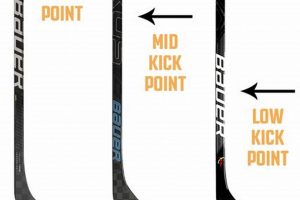
Tip 6: Understand Kick Point Influence. The kick point, or the location where the stick bends most, interacts with the rating. A lower kick point often pairs well with a lower rating for quick releases, while a higher kick point may suit a higher rating for maximum power.
Selecting the optimal hockey stick bend characteristic involves considering a combination of physical attributes, shooting style, and personal preference. By understanding these factors, players can significantly improve their on-ice performance and reduce the likelihood of injury.
The subsequent section will explore the impact of different levels on specific shot types, providing a deeper understanding of how this characteristic influences overall game play.
1. Bend under force

The degree to which a hockey stick bends under force is the defining characteristic that quantifies what this characteristic signifies. This physical property dictates how efficiently a player can load and release energy during a shot, directly impacting performance.
- Energy Storage Capacity
The extent to which a stick deforms when force is applied determines its capacity to store potential energy. Greater deformation, up to a certain point, translates to a larger reservoir of stored energy. This energy is subsequently released during the shot, propelling the puck forward. If a stick offers too little bend, the user may not load the shot effectively; if it offers too much, their energy will be absorbed. This is crucial for understanding the meaning of numerical rating.
- Impact on Shot Power
A stick’s ability to bend under force directly influences the power of a shot. The stored energy, when released, is transferred to the puck, increasing its velocity. A properly matched bend characteristic, based on the player’s strength and technique, optimizes this energy transfer, resulting in a more powerful shot. A mismatch may lead to wasted energy and reduced shot power.
- Influence on Release Speed
The rate at which a stick returns to its original shape after bending contributes to the speed of the shot release. A stick that bends readily and recovers quickly facilitates a faster release, making it more difficult for the goaltender to react. Conversely, a stiffer stick may offer more power but at the expense of a slower release. This highlights the trade-offs involved in equipment selection.
- Correlation with Stick Durability
The material composition and design of a hockey stick dictate its ability to withstand repeated bending forces without fracturing. Excessive bending beyond the stick’s designed capacity can lead to material fatigue and eventual breakage. Therefore, understanding a stick’s bend characteristic is also linked to its long-term durability and performance consistency. This is a practical consideration for players at all levels.
In summary, a stick’s inherent property to “bend under force” forms the foundation of its performance characteristics. Its capacity to store energy, impart power, influence release speed, and endure repeated stress are all intrinsically tied to this fundamental trait. Selecting the appropriate level requires careful consideration of these factors to optimize player performance and equipment longevity.
2. Numerical rating indicator

The numerical rating serves as a standardized metric to quantify the bend characteristic of a hockey stick. This indicator provides a tangible value representing the force, typically measured in pounds, required to deflect the stick by one inch when a specific testing method is applied. A lower number signifies greater flexibility, implying less force is needed to achieve the same degree of bend. Conversely, a higher number denotes a stiffer stick demanding more force for deflection. The numerical rating is not merely an abstract value; it directly reflects the stick’s responsiveness and potential energy transfer capabilities. For example, a stick rated at 75 will exhibit more give than a stick rated at 95 under identical loading conditions, impacting shot power and release speed.
The rating is essential for players to match equipment to their physical attributes and playing style. A younger, lighter player may benefit from a lower-rated stick to maximize energy transfer and shot velocity, while a larger, stronger player could necessitate a higher-rated stick to handle the increased force they generate. Misalignment between the rating and the player’s capabilities can lead to inefficient energy transfer, reduced shot power, and an increased risk of injury. For instance, a powerful player using a too-flexible stick might experience excessive bending, resulting in a “whipping” action that diminishes accuracy and control. This measurement has become an industry standard, appearing on nearly every stick produced and influencing purchasing decisions at all levels of play.
In conclusion, the numerical rating provides a crucial, objective measure of a stick’s bending properties, directly informing player equipment selection and impacting on-ice performance. Understanding this indicator enables players to optimize their equipment for maximum energy transfer, shot power, and overall playing effectiveness. Challenges may arise from variations in testing methodologies across manufacturers. However, the rating remains a fundamental tool for assessing a stick’s flexibility and is central to the science of hockey equipment selection.
3. Energy transfer efficiency

The bend characteristic of a hockey stick is fundamentally linked to energy transfer efficiency during a shot. The capacity of a stick to bend, quantified by its numerical rating, dictates its ability to store potential energy generated by the player’s motion. This stored energy is then released upon puck impact, contributing to shot velocity. High energy transfer efficiency signifies that a greater proportion of the player’s applied force is effectively converted into kinetic energy imparted to the puck, resulting in a faster and more powerful shot. Conversely, a low efficiency rating indicates that a significant portion of the player’s energy is dissipated, leading to diminished shot performance. Optimal energy transfer is achieved when the bend characteristic aligns with the player’s physical attributes and shooting style. For example, a player with a powerful slapshot requires a stiffer stick (higher rating) to efficiently transfer the substantial force generated, preventing excessive bending and wasted energy. This relationship underscores the significance of selecting a stick with a bend characteristic that matches the individual’s biomechanics and play style.
Energy transfer efficiency is significantly influenced by the stick’s material composition and design. Modern composite materials, such as carbon fiber, are engineered to maximize energy return, minimizing energy loss due to internal friction and deformation. Furthermore, the stick’s kick point, the location where the stick bends most prominently, plays a critical role. A lower kick point facilitates quicker energy transfer, ideal for rapid wrist shots, while a higher kick point allows for greater energy storage and release, suitable for powerful slapshots. The selection of materials and kick point is, therefore, inseparable from the understanding of the bend characteristic and its influence on energy transfer. Professional players often collaborate with equipment manufacturers to develop custom sticks that optimize energy transfer for their unique shooting techniques.
In summary, the inherent property to bend defined by its numerical rating directly determines its energy transfer efficiency. Maximizing this efficiency requires careful consideration of player characteristics, stick material, and design features. Understanding this interrelationship is crucial for optimizing shot power, accuracy, and overall on-ice performance. Variations in manufacturing processes and individual player preferences present ongoing challenges in achieving perfect energy transfer, highlighting the continuing evolution of hockey stick technology and fitting practices.
4. Shooting style compatibility

A hockey stick’s bend characteristic, quantified by its flex rating, directly influences its suitability for various shooting styles. The manner in which a player loads and releases a shot dictates the optimal bend profile for maximizing puck velocity and accuracy. Players who favor quick-release wrist shots generally benefit from sticks with lower flex ratings, allowing for easier loading and a rapid transfer of energy. Conversely, those who rely on powerful slap shots or heavy shots from the point typically require higher flex ratings to accommodate the greater forces involved. Mismatches between the bend characteristic and shooting style can lead to inefficient energy transfer, compromised shot accuracy, and an increased risk of injury. For example, a player attempting a slap shot with a stick possessing insufficient stiffness might experience excessive bending, resulting in a loss of control and diminished power.
The interaction between shooting style and bend characteristic is further nuanced by individual biomechanics and playing position. Defensemen, who frequently employ powerful slap shots from the blue line, often prefer stiffer sticks to handle the increased force and maintain accuracy over longer distances. Forwards, particularly those specializing in close-range scoring, may opt for more flexible sticks to facilitate quick releases and improved puck handling in tight spaces. Real-world examples abound in professional hockey, where players often experiment with various bend profiles to find the optimal match for their specific role and shooting preferences. The use of specialized equipment to capture detailed data on shot mechanics has also improved players’ understanding to choose proper bend profile. The practical significance of this understanding lies in the ability to tailor equipment to individual needs, thereby maximizing performance and reducing the potential for injury.
In conclusion, the selection of a hockey stick requires careful consideration of shooting style compatibility. The bend characteristic plays a pivotal role in determining the efficiency of energy transfer and the overall effectiveness of a shot. Recognizing the connection between shooting style and flex is fundamental to optimizing performance and minimizing the risk of injury. While individual preferences and evolving techniques continue to shape equipment choices, the core principle of aligning bend with shooting style remains paramount in the selection of hockey sticks. The importance of coaching and guidance in assisting players, especially younger athletes, to understand the relationship between shooting style and equipment bend, cannot be overstated.
5. Player strength factor
The player strength factor is a pivotal determinant in selecting a hockey stick. The ability of a player to effectively load, bend, and release a stick is directly influenced by their physical strength. This interaction significantly impacts energy transfer, shot power, and overall performance, making it essential to consider when understanding this stick characteristic.
- Loading Capacity and Muscle Strength
A player’s muscular strength dictates their capacity to bend the stick during a shot. Insufficient strength may prevent adequate loading, rendering a stiffer stick ineffective. For instance, a smaller player may struggle to bend a stick rated at 100, thereby negating any potential benefits of increased stiffness. This underscores the importance of matching rating to a player’s physical capabilities.
- Shot Power Generation
Greater strength enables players to generate more force during a shot, requiring a correspondingly stiffer stick to efficiently transfer energy. Conversely, using a stick that is too flexible will result in the energy being dissipated rather than transferred to the puck, reducing shot power. Players like Zdeno Chara, known for their exceptional strength, historically used very stiff sticks to maximize shot velocity.
- Impact on Shot Accuracy
The ability to control the stick’s bend during the shot affects accuracy. A stick that bends excessively due to insufficient player strength can lead to inconsistent shots and reduced control. A more appropriate rating, matched to the player’s strength level, provides greater stability and control during the shooting motion, enhancing precision.
- Injury Prevention Considerations
Using a stick that is too stiff for a player’s strength level can increase the risk of wrist and shoulder injuries. The added strain of trying to bend an unyielding stick can lead to overuse injuries and muscle fatigue. Conversely, a stick that bends too easily may not provide sufficient support, leading to awkward movements and potential for injury. Matching rating to a player’s strength is crucial for injury prevention.
In summary, the player strength factor is inextricably linked to understanding a hockey stick’s flexibility. Selecting a stick that aligns with a player’s strength level is essential for maximizing energy transfer, enhancing shot accuracy, and mitigating the risk of injury. These considerations are especially important for young players developing their skills and physical strength.
6. Injury risk reduction
The bend characteristic of a hockey stick is intrinsically linked to injury risk reduction. Employing a stick with an unsuitable rating can contribute to both acute and chronic injuries. A stick that is too stiff for a player’s strength profile necessitates excessive force to achieve adequate bend, increasing the likelihood of wrist sprains, shoulder strains, and elbow discomfort. Conversely, a stick that is too flexible may not provide sufficient support during impact, leading to instability and potential injuries to the hands and arms. The numerical rating, therefore, functions as a critical safety parameter. An example is the prevalence of wrist injuries among younger players using adult-sized, stiffer sticks, highlighting the importance of age-appropriate equipment. Understanding this parameter is crucial for injury prevention.
Implementing proper stick fitting protocols is essential to injury risk reduction. Coaches and equipment managers should emphasize the importance of selecting sticks that align with a player’s strength, size, and skill level. Periodic assessments and adjustments are necessary as players develop and their physical attributes change. Furthermore, players should be educated about the potential risks associated with using improperly sized or overly stiff equipment. The adoption of standardized fitting guidelines across leagues and organizations can significantly contribute to minimizing injury rates related to improper stick selection. The understanding of how proper bending affects injury can increase a player’s performance.
In conclusion, the appropriate stick bend is not merely a performance enhancement consideration but a significant factor in preventing hockey-related injuries. Aligning stick characteristics with player attributes reduces strain and promotes safer playing mechanics. Challenges remain in ensuring widespread adoption of appropriate fitting practices, but the practical significance of reducing injuries through proper equipment selection cannot be overstated. Consistent monitoring of injury trends and ongoing education are vital components of a comprehensive injury prevention strategy in hockey. Injury risk reduction as a result of the what does flex mean in hockey sticks is crucial to player success.
Frequently Asked Questions About Hockey Stick Bend Characteristics
This section addresses common inquiries regarding the significance of bend characteristics in hockey sticks, providing factual and objective information.
Question 1: What does flex mean in hockey sticks?
It refers to the stiffness of the stick’s shaft and indicates how much the stick will bend when force is applied. A lower value denotes greater flexibility, while a higher value signifies increased stiffness.
Question 2: How is the number determined?
The numerical rating is typically determined by measuring the weight (in pounds) required to deflect the stick one inch when supported at two specific points. This is the standard measure for what does flex mean in hockey sticks.
Question 3: How does a too-stiff stick affect performance?
A stick that is too stiff may prevent a player from effectively loading the shot, reducing energy transfer and shot power. It can also increase the risk of wrist and shoulder injuries due to the added strain required to bend the stick. This directly diminishes how this concept affects the player.
Question 4: Conversely, what are the consequences of a too-flexible stick?
A stick that is too flexible may result in a loss of control and diminished accuracy. The energy may be dissipated excessively, reducing shot velocity. Additionally, a too-flexible stick can lead to instability during stickhandling and shooting.
Question 5: Can the ideal value change as a player develops?
Yes, as players grow stronger and refine their shooting techniques, their equipment preferences may evolve. What does flex mean in hockey sticks for them will change over time. Periodic re-evaluation of bend characteristic is recommended to ensure optimal performance and minimize injury risk.
Question 6: Are there differences in testing methodologies between manufacturers?
While a standardized testing protocol exists, some variations in methodology may exist across manufacturers. It is advisable to consider the overall feel and performance of the stick rather than relying solely on the numerical rating. A deeper understanding can be attained with this question about what does flex mean in hockey sticks.
These FAQs provide a foundational understanding of what does flex mean in hockey sticks, helping players make informed decisions about their equipment. Proper selection improves on-ice performance and safety.
The subsequent section will address advanced considerations in stick selection, including the impact of kick point and material composition.
In conclusion
Throughout this exploration, the fundamental role of bending characteristics in hockey stick performance has been illuminated. It is not merely a numerical rating; it represents a pivotal interface between player biomechanics, shooting style, and equipment efficacy. The careful calibration of bending stiffness impacts energy transfer, shot accuracy, and, critically, injury prevention. Understanding and correctly applying the concept represents a decisive element in optimizing athletic potential.
Continued research and technological advancements promise even greater customization and precision in hockey equipment. Recognizing this concept as an integral component of skill development, rather than a mere product specification, is essential. Players, coaches, and equipment professionals must collaborate to ensure informed decision-making, fostering a safer and more effective playing environment. Only through a deep appreciation of its implications can individuals fully harness the capabilities offered by modern hockey equipment and achieve peak performance levels.