An intermediate hockey stick, often shortened to “int,” is a piece of sports equipment designed for players transitioning between junior and senior levels. These sticks are generally shorter and have a smaller shaft circumference than those used by adults, offering improved handling and control for players with smaller frames and developing strength. For example, a 60-inch stick might be designated as intermediate, while an adult stick could be 63 inches or longer.
The use of this equipment allows growing athletes to continue refining their technique without being hindered by a stick that is too large or heavy. This can translate to improved puck control, shot accuracy, and overall on-ice performance. The historical context reveals a response to the need for equipment tailored to the specific physical development stage of athletes, fostering better skill progression and reducing the risk of injury associated with using ill-fitting gear.
Understanding the specific properties of these tools, including flex ratings and blade curves, is crucial for players aiming to optimize their game. Further analysis will explore the different materials used in manufacturing, the range of available flex options, and how these factors contribute to a player’s individual performance on the ice.
Guidelines for Equipment Selection
This section offers practical advice for selecting the optimal hockey stick, ensuring enhanced performance and safety on the ice.
Tip 1: Consider Player Height and Weight: Match stick length to the player’s stature. The top of the stick should generally reach between the player’s chin and nose when standing in skates. A stick that is too long can hinder puck control and agility.
Tip 2: Evaluate Flex Rating: The flex rating indicates how easily the stick bends. Lower flex ratings are suitable for smaller players who require less force to bend the stick for optimal shot power. Higher flex ratings are appropriate for stronger players.
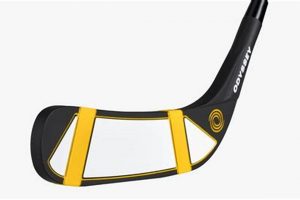
Tip 3: Analyze Blade Curve: Blade curve affects shot trajectory and puck handling. A deeper curve facilitates lifting the puck, while a flatter curve provides more control for stickhandling and passing.
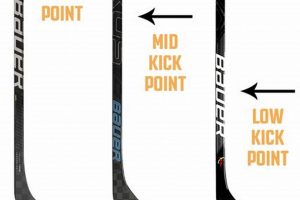
Tip 4: Assess Kick Point: The kick point is the location where the stick bends the most. A low kick point is ideal for quick release shots, while a high kick point provides more power for slapshots.
Tip 5: Examine Material Composition: Sticks are constructed from various materials, including wood, composite, and carbon fiber. Composite and carbon fiber sticks offer a balance of weight, durability, and performance.
Tip 6: Test Before Purchase: Whenever feasible, test different sticks on the ice or in a designated testing area to determine the best fit and feel. This allows for a practical evaluation of handling and shot performance.
Tip 7: Consider Player Position: A defenseman might favor a stick with a higher flex and a more open blade for clearing the puck, whereas a forward might prefer a lower flex and a closed blade for quick shots.
Proper selection contributes significantly to skill development and overall enjoyment of the sport, while also minimizing the risk of injury.
By following these recommendations, players can ensure their equipment complements their playing style and enhances their on-ice capabilities.
1. Appropriate length

The significance of correct dimensions in intermediate hockey sticks cannot be overstated; it is a primary determinant of a player’s ability to effectively control the puck, execute passes, and generate powerful shots. A stick that is too long hinders puck handling, as the player must extend the arms too far, reducing agility and increasing the likelihood of turnovers. Conversely, a stick that is too short forces the player to hunch over, impeding skating efficiency and potentially leading to back strain. For instance, a 5’4″ player using a stick designed for someone 5’8″ will struggle to maintain a low center of gravity and precise stickhandling.
The relationship between stick length and player height directly influences mechanical efficiency. When a stick’s length aligns with the player’s stature, the player can maintain proper posture, maximizing the transfer of energy from the body to the stick during shots. Consider the example of a wrist shot: with an appropriately sized stick, the player can effectively load the flex and release the puck with greater velocity and accuracy. Professional coaches often emphasize the importance of customization, adjusting stick length by inches to fine-tune a player’s mechanics. The length customization allow them to perform at their optimal capabilities.
Ultimately, determining and maintaining appropriate length is not merely a matter of comfort, it’s a fundamental element that directly impacts the development and execution of essential hockey skills. Disregarding this detail compromises a player’s potential and increases the risk of improper technique and physical strain. By prioritizing the correct length, coaches and players invest in a foundation for improved performance and long-term player development.
2. Optimal Flex
Optimal flex, in the context of an intermediate hockey stick, represents a critical parameter influencing shot power, accuracy, and overall puck control. The flex rating, measured numerically, indicates the stiffness of the stick; a lower number signifies greater flexibility, while a higher number denotes increased stiffness. The selection of the appropriate flex rating is essential for maximizing a player’s on-ice performance with an intermediate stick.
- Role of Player Strength and Size
A player’s physical attributes, particularly strength and weight, directly correlate with the optimal flex rating. Smaller, less powerful players typically benefit from lower flex ratings, allowing them to bend the stick more easily and generate sufficient power for shots. Conversely, larger, stronger players require higher flex ratings to prevent the stick from bending excessively, ensuring efficient energy transfer. For example, a 14-year-old player weighing 120 pounds might find a flex rating of 50-55 optimal, while a 16-year-old player weighing 160 pounds may require a flex rating of 65-70. The mismatch between player strength and flex can lead to ineffective shots and decreased puck control.
- Impact on Shot Mechanics
The flex rating influences shot mechanics by dictating how the stick loads and releases energy. When a player applies force to the stick during a shot, the shaft bends, storing potential energy. An appropriately matched flex rating allows the player to efficiently load this energy and release it into the puck, generating greater velocity and accuracy. An improper flex rating can disrupt this process, leading to weak or erratic shots. Consider the scenario where a player attempts a slap shot with a flex rating that is too stiff; the player will struggle to bend the stick adequately, resulting in a loss of power and control. Proper flex facilitates a smooth and controlled shot motion, maximizing puck speed and placement.
- Influence on Puck Control and Handling
Beyond shot performance, flex also impacts puck control and handling. A more flexible stick provides a softer feel for the puck, facilitating improved stickhandling and passing accuracy. This is particularly important for intermediate players who are still developing their puck-handling skills. A stiffer stick can feel less responsive, making it more difficult to control the puck effectively. For instance, a player attempting a quick pass with a stiff stick may struggle to deliver the puck with the necessary precision. Optimal flex, therefore, contributes to overall puck control and enhances a player’s ability to make quick decisions on the ice.
- Adaptation to Playing Style and Position
The choice of flex can also be influenced by a player’s preferred playing style and position. Forwards, who often prioritize quick release shots and puck handling in tight spaces, may prefer a slightly more flexible stick. Defensemen, who frequently require powerful slap shots and clearing passes, might opt for a stiffer stick. The optimal flex should complement the player’s typical actions on the ice. Example: A defenseman focused on blocking shots and making long passes may prioritize a higher flex for increased power and stiffness. These stylistic considerations fine-tune the stick’s suitability for specific game situations.
In conclusion, optimal flex, within the domain of intermediate hockey sticks, represents a nuanced interplay between player characteristics, shot mechanics, puck handling, and playing style. The selection of an appropriate flex rating is crucial for maximizing a player’s potential and enhancing their overall performance. An informed understanding of these factors allows players and coaches to make strategic equipment choices that contribute to skill development and on-ice success.
3. Blade Curve

The blade curve is a defining characteristic of an intermediate hockey stick, fundamentally influencing puck control, shot trajectory, and overall playing style. This curve, the bend along the blade’s surface, dictates how the puck interacts with the stick during shooting, passing, and stickhandling. A deeper curve imparts greater lift to the puck, facilitating quicker elevation for shots and passes, while a shallower curve typically offers increased accuracy and control for stickhandling. The selection of an appropriate blade curve is therefore critical for optimizing an intermediate player’s performance. For example, a player who favors wrist shots and quick releases might benefit from a more pronounced curve, whereas a player focused on passing accuracy might prefer a flatter blade. The interplay between blade curve and individual technique determines the effectiveness of puck manipulation.
The impact of blade curve extends beyond individual skill execution to affect tactical play. The ability to elevate the puck quickly, achieved through a deeper curve, is essential for clearing the puck out of defensive zones or executing lofted passes over opposing players. Conversely, the precision offered by a flatter curve aids in maintaining possession and making accurate passes in tight spaces. The specific curve also influences shot accuracy; a curve that is not suited to a player’s technique can lead to inconsistent shot placement. Many coaching strategies incorporate explicit instruction on blade curve selection based on a player’s role and preferred style. Understanding the nuances of various curves is therefore crucial for developing a well-rounded game.
The selection of an appropriate blade curvature enhances puck control, shot accuracy, and playmaking capability. A mismatch can lead to inhibited performance and improper skill development. A player and a coach should put into consideration the playing style and the role. By understanding the impact, both players and coaches invest into improving game performance and the chance of successful outcomes.
4. Kick Point

The kick point, or flex point, of an intermediate hockey stick defines the location along the shaft where the stick bends most during a shot. This characteristic significantly influences the speed and trajectory of the puck. Intermediate sticks, designed for developing players, often feature specific kick point designs to accommodate varying strength levels and shooting techniques. For instance, a lower kick point, nearer the blade, allows for a quicker release, beneficial for players who rely on snap shots and quick wrist shots in close proximity to the net. This design facilitates a faster transfer of energy to the puck, even with less force applied, as compared to a stick with a higher kick point.
Conversely, a higher kick point, closer to the handle, typically requires more force to load but can generate more power for slap shots and longer-range shots. However, for intermediate players, the additional force required may be a limiting factor, making a mid-kick point a more versatile option. A mid-kick point provides a balance between quick release and power, suitable for players developing a range of shooting skills. The practical implication is that selecting the appropriate kick point is not merely a matter of preference but a critical factor in optimizing a player’s shooting performance, aligning with their physical capabilities and playing style. The design of the kick point influences energy transfer during the shot and the release time.
In summary, understanding the relationship between kick point and shooting mechanics is essential for maximizing the effectiveness of an intermediate hockey stick. The choice of kick point should align with a player’s strength, shooting style, and on-ice position to enhance their overall performance. Failure to consider this aspect may lead to suboptimal shot velocity and accuracy, hindering a player’s development. Future development may lead to customization. By considering kick point, power and accuracy can be improved.
5. Material Composition

The material composition of an intermediate hockey stick fundamentally determines its weight, durability, flex characteristics, and overall performance. Traditionally, wooden sticks were prevalent; however, modern intermediate sticks predominantly utilize composite materials, such as fiberglass, carbon fiber, and various resin systems. This shift arises from the superior strength-to-weight ratio offered by composites, enabling manufacturers to produce lighter sticks that maintain structural integrity under the stresses of gameplay. For instance, a stick composed primarily of carbon fiber exhibits significantly reduced weight compared to a wooden stick, thereby enhancing a player’s stickhandling speed and responsiveness. The specific arrangement and grade of these materials influence the stick’s flex profile and impact resistance, thus tailoring its suitability for different playing styles and skill levels. A higher concentration of carbon fiber typically results in increased stiffness and responsiveness, while fiberglass adds durability and reduces cost.
The selection of materials directly affects the stick’s longevity and performance consistency. Wooden sticks, while providing a traditional feel, are prone to moisture absorption and breakage, leading to performance degradation over time. Composite sticks, on the other hand, exhibit greater resistance to environmental factors and impacts, maintaining their flex and responsiveness for a longer duration. The manufacturing processes employed also play a crucial role; advanced techniques like layering and braiding optimize the distribution of materials to enhance specific performance characteristics. For example, strategic placement of carbon fiber in high-stress areas can significantly improve the stick’s resistance to breakage during intense gameplay. The composition influences shot power and precision, affecting how quickly a player release the shot. The understanding of this relationship allows you to make an informed decision that fit your needs.
Ultimately, the material composition of an intermediate hockey stick represents a critical determinant of its performance and durability. The transition from traditional wooden sticks to advanced composites reflects a continuous pursuit of enhanced strength-to-weight ratios, improved responsiveness, and increased longevity. Players and coaches should consider these material properties when selecting equipment to optimize performance and skill development. Choosing the correct combination of materials improves the play. The consideration of what material to use is very important.
Frequently Asked Questions
This section addresses common inquiries regarding intermediate hockey sticks, providing clarity on selection, usage, and maintenance.
Question 1: What defines an intermediate hockey stick, and how does it differ from junior or senior models?
An intermediate hockey stick is designed for players transitioning between junior and senior levels, typically aged 13-16. These sticks generally feature a shorter length and smaller shaft circumference compared to senior models, offering enhanced control for players with developing strength and smaller frames. Junior sticks are even smaller and more flexible, catering to younger, less experienced players.
Question 2: How does one determine the appropriate flex rating for an intermediate hockey stick?
The ideal flex rating corresponds to the player’s weight and strength. A general guideline is to select a flex rating approximately half the player’s weight in pounds. However, individual preference and playing style also influence this decision. Trial and error, if possible, can further refine the choice.
Question 3: What are the common materials used in manufacturing intermediate hockey sticks, and how do they affect performance?
Composite materials, such as carbon fiber and fiberglass, are prevalent due to their lightweight and durable nature. Carbon fiber offers superior stiffness and responsiveness, while fiberglass provides increased durability. The specific blend of materials impacts the stick’s flex, feel, and overall performance characteristics.
Question 4: How does the blade curve of an intermediate hockey stick influence shot performance?
The blade curve significantly affects shot trajectory and puck control. A deeper curve facilitates lifting the puck quickly, while a flatter curve offers greater accuracy for passing and shooting. The optimal curve depends on individual playing style and preferred shot types.
Question 5: What is the significance of the kick point in an intermediate hockey stick, and how does it impact shot release?
The kick point is the location along the shaft where the stick bends most during a shot. A lower kick point provides a quicker release, suitable for snap shots and wrist shots. A higher kick point requires more force but can generate greater power for slap shots. A mid-kick point offers a balance between release speed and power.
Question 6: How should an intermediate hockey stick be properly maintained to ensure longevity and optimal performance?
Regular inspection for cracks or damage is crucial. Avoid storing the stick in extreme temperatures or direct sunlight. Taping the blade properly provides protection and enhances puck control. Replacing the grip tape as needed maintains a secure hold.
In summary, the selection and maintenance of intermediate hockey sticks require careful consideration of individual player attributes and performance goals. Understanding the various features and materials involved enables informed decision-making.
Further exploration into advanced stick technologies and customization options will be presented in the subsequent article segment.
Conclusion
This exploration has delineated the critical attributes of the intermediate hockey stick, emphasizing the confluence of length, flex, blade curve, kick point, and material composition. Each element contributes uniquely to a player’s on-ice performance, requiring careful consideration to optimize skill development and competitive effectiveness. The discussion has underscored the importance of aligning equipment specifications with individual physical characteristics and playing styles, rather than adhering to generic recommendations.
The informed selection and conscientious maintenance of an int hockey stick represent a commitment to fostering potential and mitigating injury risk. As technology advances and customization options expand, a continued focus on understanding these fundamental principles will remain paramount for players, coaches, and equipment specialists alike. Future endeavors should prioritize empirical research and biomechanical analysis to refine fitting methodologies and maximize the benefits derived from this essential piece of equipment.