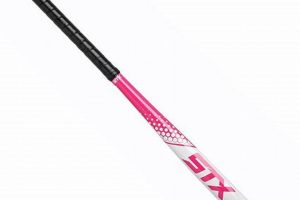
The distinctive bend at the end of a field hockey stick is a critical design element. It is not merely aesthetic; it fundamentally affects how players control, maneuver, and strike the ball. The curve allows for greater surface area on the striking face, facilitating better ball control when dribbling and receiving passes. This feature enables players to lift the ball more easily for aerial passes and shots on goal.
This design significantly enhances gameplay by providing several key advantages. It permits quicker and more deceptive stick work, allowing players to maintain possession under pressure and execute intricate plays. Historically, the evolution of the curve has been driven by the need for improved offensive capabilities. A more pronounced curve generally allows for more powerful shots and the ability to generate greater angles, increasing the likelihood of scoring. However, regulations govern the maximum degree of the curve to ensure fair play and prevent excessive lifting of the ball, which could be dangerous.
Therefore, the curvature is integral to understanding the mechanics and strategies within the sport. The subsequent discussion will delve into specific benefits, regulations, and the impact of the curvature on various playing styles.
Considerations Regarding Field Hockey Stick Curvature
Optimizing performance with a field hockey stick involves understanding how the curvature affects gameplay. These tips provide insights into leveraging this design element effectively.
Tip 1: Dribbling Proficiency: Utilize the curved portion of the stick to maintain close control of the ball while dribbling. The bend facilitates quick changes in direction and protects the ball from opponents.
Tip 2: Ball Lifting Technique: Employ the curvature to lift the ball for aerial passes and shots. A controlled scooping motion, using the curve as a lever, is crucial for accuracy and avoiding penalties for dangerous play.
Tip 3: Shooting Power and Angle: Exploit the curve to generate greater power and alter the angle of shots on goal. Practice striking the ball from various positions along the curve to maximize offensive opportunities.
Tip 4: Stick Selection Based on Position: Choose a stick with a curvature profile that complements your playing style and position. Defenders may prefer a straighter stick for blocking, while forwards often benefit from a more pronounced curve for offensive maneuvers.
Tip 5: Understanding FIH Regulations: Be aware of the regulations governing the maximum curvature allowed on field hockey sticks. Exceeding these limits can result in penalties and equipment disqualification.
Tip 6: Practice Drills: Incorporate drills that specifically target the skills enhanced by the sticks curve. Examples include dribbling courses, lifting exercises, and shooting practice focused on generating different angles.
Mastering the use of the curve improves ball control, passing accuracy, and shot power. These improvements translate to a more impactful presence on the field and enhanced team performance.
Further exploration of equipment regulations and advanced techniques will provide a deeper understanding of optimizing play with a curved field hockey stick.
1. Ball Control
The curved design directly impacts ball control in field hockey. The increase in surface area presented by the curvature provides a larger, more receptive face for receiving passes and trapping the ball. This enlarged surface area minimizes the chance of the ball glancing off the stick, which frequently occurs when using a straight stick, especially during fast-paced play. Consequently, the curve grants players a greater ability to bring the ball under immediate and precise control, a prerequisite for initiating offensive plays or transitioning from defense.
Furthermore, the curvature enhances dribbling proficiency. The player can cradle the ball within the curve, allowing for quicker changes in direction and tighter control while navigating opponents. A straight stick requires more constant and forceful contact to maintain possession, potentially sacrificing speed and agility. A curved stick permits subtle adjustments and protects the ball from challenges. For example, a player weaving through defenders can use the curve to shield the ball, making it significantly more difficult for opponents to dispossess them without committing a foul.
In essence, the curved design is integral to effective ball control, which significantly impacts overall field hockey performance. Understanding this relationship allows players to fully leverage the stick’s capabilities for improved ball handling, agility, and ultimately, strategic advantage on the field. While other factors, such as player skill and tactical awareness, contribute to ball control, the curve remains a primary facilitator.
2. Lifting Ability
The curved design of a field hockey stick is intrinsically linked to its ability to lift the ball effectively. This capability is not merely a stylistic element but a fundamental component of modern field hockey strategy and execution. The curve provides the necessary leverage and surface area to elevate the ball for aerial passes, shots on goal, and tactical maneuvers.
- Leverage and Trajectory Control
The curve acts as a fulcrum, allowing players to generate upward force on the ball with greater efficiency. The curved shape redirects the energy from the swing into vertical lift, enabling the ball to be elevated with more control over its trajectory. Without the curve, lifting the ball accurately would require significantly more force and specialized technique, reducing precision and increasing the risk of misdirected shots.
- Aerial Pass Execution
Executing effective aerial passes is a crucial element of field hockey strategy. The curve enables players to lift the ball over defenders, creating passing lanes that would otherwise be inaccessible. These passes allow for faster transitions and bypass congested areas of the field, providing significant tactical advantages. The curve’s shape enables players to impart backspin on the ball during the lift, increasing stability and accuracy over longer distances.
- Shot Elevation for Goal Scoring
The curve is essential for elevating shots on goal, particularly in crowded goalmouth situations. Lifting the ball above the reach of the goalkeeper or over defending players increases the likelihood of scoring. The curve’s design allows for a quicker release and higher trajectory, making it more challenging for the goalkeeper to react effectively. The ability to lift the ball also enables players to target specific areas of the goal, improving shot placement and maximizing scoring opportunities.
- Tactical Evasion and Maneuvering
Lifting the ball is not only useful for passing and shooting, but also for evading opponents and navigating tight spaces. A player can lift the ball over a defender’s stick or leg to maintain possession and continue their forward momentum. This tactical maneuver requires precise control and timing, facilitated by the curve of the stick. Lifting the ball can also be used to create space, forcing defenders to adjust their position and opening up passing lanes for teammates.
The relationship between the curve and lifting ability is a cornerstone of modern field hockey technique. The ability to lift the ball efficiently and accurately provides players with a tactical edge in passing, shooting, and maneuvering. This capability is intrinsically tied to strategic gameplay and contributes significantly to a team’s offensive and defensive capabilities.
3. Shot Power

The curvature of a field hockey stick is intrinsically linked to the generation of shot power. The bend acts as a lever, effectively increasing the force imparted onto the ball during a strike. A straighter stick would require a more direct, linear transfer of energy, limiting the potential for maximizing power. The curved face allows players to engage more of their body weight and rotational force into the swing, leading to a more forceful impact. This is evident in the higher velocities achieved by shots taken with curved sticks compared to those executed with rudimentary, straight implements, a transition witnessed throughout the sport’s historical evolution. The modern game, with its emphasis on speed and aggressive offense, necessitates the capacity for powerful shots to penetrate defenses and quickly convert opportunities into goals.
Furthermore, the curve enables a more controlled and efficient transfer of energy. The ball remains in contact with the stick for a slightly longer duration, allowing the player to guide and direct the shot with greater precision while simultaneously amplifying its power. Consider the drag-flick technique, a modern penalty corner variation; it utilizes the extreme curvature to generate unparalleled power by dragging the ball along the ground before releasing it with a whiplash motion. This technique exemplifies the enhanced power potential afforded by the curved design. The curve allows the player to create a catapult effect, increasing the speed of the ball significantly. This makes it more difficult for the goalkeeper to react, thus increasing the chances of scoring.
In summary, the relationship between the curve and shot power is fundamental to understanding the design of the field hockey stick. The curve enhances the lever effect, increasing the force transferred to the ball and allowing for more controlled, powerful strikes. This capability is essential for success in modern field hockey, where powerful shots are critical for overcoming defenses and converting scoring opportunities. The evolution of the stick’s curvature reflects a constant pursuit of enhanced shot power and precision, directly influencing the dynamic and strategic aspects of the game.
4. Angle Generation

The curvature of a field hockey stick directly facilitates the generation of diverse shot angles, a crucial element in both offensive and defensive strategies. The curved face allows players to strike the ball at oblique angles relative to their body position, enabling shots that would be impossible with a straight-faced stick. This capacity to alter the shot angle is particularly critical in crowded areas around the goal, where clear, direct shooting lanes are often obstructed. The curve effectively extends the player’s range of potential shot trajectories, increasing the goalkeeper’s difficulty in anticipating and reacting to shots.
Consider a player positioned near the post during a penalty corner. With a straight stick, their shooting options would be limited to a direct shot towards the near post or a pass back towards the center of the circle. However, a curved stick permits them to flick the ball sharply across the goal mouth at a severe angle, catching the goalkeeper off guard and creating scoring opportunities. Another example is the ability to generate deceptive passes. A player can use the curve to flick a pass to a teammate, making it appear as if they’re shooting on goal, thus manipulating the defensive formation. The element of surprise is dramatically increased by the angles made possible by the curve.
The curved design directly impacts a player’s tactical versatility. The player can effectively generate unique shot placements, increasing overall goal-scoring opportunities, and tactical deception. Understanding the relationship between curvature and shot angles is, therefore, fundamental for both players and coaches to optimize offensive strategies and refine shooting techniques. The curvature directly influences the unpredictability of ball trajectory, an invaluable asset in the complex dynamics of field hockey.
5. Dribbling Assistance

The curved design of a field hockey stick provides significant assistance during dribbling maneuvers. The curve increases the surface area that can be used to maintain contact with the ball, affording players greater control during fast movements and intricate weaves. This design allows for quicker changes of direction, as the ball can be drawn closer to the body and shielded from opposing players. Without the curve, maintaining the same level of control would necessitate more forceful contact, increasing the risk of losing possession or committing fouls. A curved stick enables players to protect the ball by keeping it within the arc of the curve, making it difficult for opponents to dislodge it cleanly. This feature is particularly important when navigating congested areas of the field or when under pressure from multiple defenders.
The practical application of this enhanced dribbling ability is evident in numerous game situations. For instance, a midfielder carrying the ball through the center of the field can use the curve to maintain close control while evading tackles and searching for passing opportunities. The curve facilitates intricate footwork, allowing the player to move the ball rapidly from one side of the body to the other, further confounding defenders. Similarly, forwards can use the curved portion of the stick to dribble at speed towards the goal, making minor adjustments to their trajectory to avoid defenders and create scoring opportunities. The design also allows players to perform “Indian dribbles”, rapidly rotating the stick to keep the ball moving while preventing opponents from stealing possession.
In summary, the curved design is vital for effective dribbling in field hockey. It offers improved control, maneuverability, and protection of the ball, enabling players to execute intricate dribbling sequences and maintain possession under pressure. While skill and practice are essential components of proficient dribbling, the curvature of the stick provides a distinct advantage, directly contributing to a player’s ability to navigate the field effectively and create offensive opportunities.
6. Enhanced Maneuverability
The curvature of a field hockey stick is a primary enabler of enhanced maneuverability on the field. This enhanced maneuverability isn’t merely a beneficial side effect, but a designed-in consequence of the curve. The curve’s geometry allows players to execute quicker, more agile ball movements, facilitating directional changes and enabling tighter control in confined spaces. The player can navigate through defenders with greater efficiency due to the extended contact area, which enables more subtle and responsive ball handling. A straight stick would necessitate more forceful and deliberate actions, thus reducing the speed and finesse of directional changes.
The effects of this maneuverability manifest clearly in gameplay. For example, consider a forward closely marked by a defender near the goal line. A curved stick permits the forward to quickly flick the ball around the defenders stick or feet, creating a shooting opportunity. Without the curved design, such a maneuver would require greater space and time, unlikely to be available under pressure. Similarly, midfielders rely on their ability to rapidly change direction to distribute the ball effectively and maintain possession. The curve empowers them to perform these actions swiftly, allowing for more dynamic and unpredictable plays. Even defensive players benefit, as the enhanced control enables them to intercept passes and clear the ball from dangerous areas more effectively.
Therefore, the curved design is critical to maneuverability, contributing significantly to player agility and strategic options. While skill and conditioning remain important, the curve multiplies their effectiveness. The challenge lies in mastering the nuances of stick handling to fully exploit the design’s capabilities. Further research into the physics of stick-ball interaction may allow for even greater refinements in stick design. The degree of curvature, stick weight, and material properties are variables that influence play. Each of these factors can be optimized to yield even greater player maneuverability on the field.
Frequently Asked Questions
The following section addresses common inquiries regarding the curvature of field hockey sticks, providing clarity on its purpose and impact on the game.
Question 1: Why is a field hockey stick curved and not straight like other sports’ implements?
The curvature is specifically engineered to enhance ball control, lifting ability, shot power, and angle generation, elements crucial to field hockey gameplay. A straight stick would lack the necessary features to execute these maneuvers effectively.
Question 2: Are there regulations governing the maximum degree of the curve?
Yes, the International Hockey Federation (FIH) sets strict regulations on the maximum allowable curvature to ensure fair play and prevent dangerous play, particularly excessive lifting of the ball.
Question 3: Does the curvature affect the type of player who should use a particular stick?
Yes, different positions and playing styles benefit from varying degrees of curvature. Forwards often prefer sticks with more pronounced curves for enhanced offensive capabilities, while defenders may opt for straighter sticks for blocking and tackling.
Question 4: How does the curvature improve ball control during dribbling?
The curve provides a larger surface area and a natural cradle for the ball, enabling tighter control and quicker changes in direction while dribbling. This feature allows players to maintain possession more effectively under pressure.
Question 5: Can the curvature assist in lifting the ball for aerial passes and shots?
Absolutely. The curve acts as a lever, facilitating the lifting motion and allowing players to generate upward force on the ball with greater accuracy and control, enabling aerial passes and elevated shots on goal.
Question 6: Does the curvature affect the power and accuracy of shots?
Yes, the curve enables players to generate more power and alter the angle of shots. This increased power allows players to overcome defensive obstacles, and the angle manipulation makes shots more difficult for goalkeepers to anticipate.
In summary, the curvature is a deliberate design element that serves multiple crucial functions in field hockey, contributing significantly to a player’s overall performance.
A deeper exploration of the materials used in stick construction will provide further insight into the factors influencing stick performance.
Conclusion
This exploration has elucidated why is a field hockey stick curved, revealing the curvature as a critical design element that profoundly influences gameplay. It is not a mere aesthetic choice but a functional feature integral to ball control, lifting ability, shot power, angle generation, dribbling assistance, and enhanced maneuverability. The curvature directly impacts a player’s ability to execute fundamental skills, adapt to dynamic situations, and contribute effectively to team strategy.
Understanding the rationale behind the curved design is crucial for both players and coaches seeking to optimize performance and fully leverage the capabilities of this essential piece of equipment. Further advancements in materials and design may lead to even greater refinements in stick technology, continuing to shape the evolution of field hockey. The curvature, therefore, remains a central area of focus for innovation and strategic development within the sport.