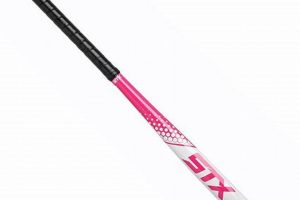
An implement specifically engineered to optimize a player’s capacity to impede opponents, disrupt plays, and secure possession in the defensive zone. These sticks are characterized by features that enhance puck control, blocking ability, and overall defensive efficacy. For example, a stick with a higher lie angle might facilitate easier puck retrieval along the boards.
The judicious selection of such equipment is paramount to a team’s overall success, mitigating scoring opportunities and bolstering defensive stability. Historically, specialized models prioritizing durability and puck-handling proficiency have evolved, reflecting advancements in composite materials and player preferences, leading to enhanced performance and reduced risk of equipment failure.
The subsequent discussion will delve into the key characteristics that contribute to superior performance in this crucial aspect of the game. Considerations will include shaft composition, blade construction, lie, flex, and length and their impact on various defensive maneuvers.
Defensive Hockey Stick Selection
Selecting appropriate equipment is vital for optimal defensive performance. Understanding the nuances of stick characteristics can significantly enhance a player’s ability to protect the defensive zone.
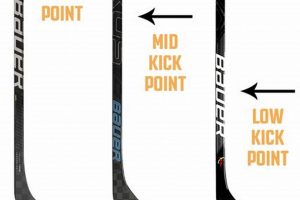
Tip 1: Shaft Flex Evaluation: A lower flex rating facilitates easier puck handling and quicker wrist shots, while a higher flex provides increased power for clearing the zone. Choose based on strength and playing style.
Tip 2: Blade Curve Assessment: A closed-face blade curve assists in lifting the puck quickly, crucial for clearing attempts. Open-face curves may offer enhanced puck control for breakout passes, but can be less effective for quick defensive plays.
Tip 3: Stick Length Determination: A stick that extends to the collarbone while standing on skates typically provides optimal balance between reach and control. Shorter sticks offer improved puck handling in close quarters, whereas longer sticks increase defensive reach.
Tip 4: Lie Angle Selection: The lie angle, determining how the blade rests on the ice, influences puck control and shot accuracy. A flatter lie is suited to players who skate with their stick further away from their body, while a more upright lie suits those who keep the stick closer.
Tip 5: Material Composition Examination: Composite sticks offer a balance of lightweight design and durability. Wood sticks, though generally more affordable, may lack the responsiveness and longevity of composite models.
Tip 6: Grip Considerations: Applying grip tape strategically enhances control and prevents slippage. Experiment with different patterns to find a comfortable and functional configuration.
Tip 7: Balance Point Analysis: A well-balanced stick reduces fatigue and promotes quicker reactions. Evaluate how the stick feels in hand to ensure a comfortable and efficient playing experience.
Prioritizing these factors enables a defender to improve puck control, shot blocking, and overall effectiveness. Careful equipment selection directly contributes to enhanced performance within the defensive zone.
The following sections will consider the integration of these stick characteristics with specific defensive strategies.
1. Shaft Flex Rating

The shaft flex rating, measured in units typically ranging from 50 to 100+, denotes the stiffness of the stick shaft and profoundly influences its performance characteristics. As a component of what makes the equipment desirable, the flex rating directly affects a player’s ability to load and release energy during a shot or pass, impacting both power and accuracy. For defensive specialists, an appropriate flex rating is essential for efficient puck clearing, precise passing, and controlled defensive zone exits. A flex rating that is too stiff can hinder a player’s ability to effectively load the stick, resulting in weaker shots and less accurate passes. Conversely, a flex rating that is too soft may cause the stick to feel whippy, reducing control and accuracy during critical defensive plays.
For instance, a defenseman primarily focused on shot blocking and quick zone exits might benefit from a higher flex rating (85+), providing the necessary stiffness for clearing pucks along the boards or delivering forceful slap shots from the point. In contrast, a defenseman known for their puck-moving abilities and crisp breakout passes may prefer a lower flex rating (75-85), allowing for quicker release and enhanced control when making short, accurate passes to teammates. Real-life examples demonstrate this principle across professional leagues, where defensive players often customize their sticks with specific flex ratings that align with their individual playing styles and physical attributes.
Therefore, understanding the significance of flex rating is crucial when selecting suitable equipment. Optimizing flex rating enhances overall defensive capability by improving puck control, increasing shot power, and facilitating accurate passing. Selection should balance physical strength, playing style, and position responsibilities to achieve peak performance and maximize effectiveness within the defensive zone, making flex rating a factor in achieving “best defensive hockey stick”.
2. Blade Curve Type
The blade curve is a critical determinant in achieving optimal defensive performance. Its design dictates the trajectory and control afforded during puck handling, shooting, and passing scenarios, impacting overall defensive zone effectiveness. Selecting an appropriate blade curve is therefore integral to maximizing defensive capabilities.
- Heel Curve for Quick Release
A heel curve, characterized by its bend closer to the heel of the blade, facilitates a quicker release of the puck. This is advantageous for defensive players needing to rapidly clear the puck from the defensive zone, minimizing pressure from opposing forwards. For example, defensive players renowned for their powerful slap shots often employ a heel curve to generate maximum force with minimal wind-up.
- Mid-Curve for Balanced Play
Mid-curve blades, with a bend located near the middle of the blade, offer a balance between puck control and shooting accuracy. This type is suitable for defensemen who participate in offensive plays and require versatility in both shooting and passing. A practical application involves making precise breakout passes to teammates initiating offensive rushes, facilitating zone transitions.
- Toe Curve for Elevated Shots
The toe curve, featuring a curve near the toe of the blade, allows for rapid elevation of the puck. This is particularly useful for clearing the puck over opponents or quickly lifting the puck to avoid blocked shots. Defensemen facing persistent forechecking pressure might choose a toe curve to execute quick flips and clear the puck high out of the defensive zone, reducing the risk of turnovers.
- Flat Curve for Puck Control
A flat curve blade offers enhanced puck control and accuracy, often preferred by players who prioritize passing accuracy. This flat curve facilitates precise saucer passes and short breakout passes to teammates. This curve excels in maintaining possession and supporting teammates for offensive transitions, emphasizing strategic play.
In summary, the optimal blade curve directly influences a defensive player’s proficiency in puck management, shooting, and clearing maneuvers. Selecting the curve that aligns with individual playing style and zone responsibilities maximizes effectiveness and contributes significantly to achieving what can be considered excellent equipment choice for the position. The integration of a well-chosen blade curve ensures that a defensive player is well-equipped to handle diverse game situations, ultimately bolstering team performance.
3. Stick Length Optimum

The stick length has a demonstrable impact on a defensive player’s efficacy, positioning “stick length optimum” as a critical component. An inappropriate stick length compromises reach, puck control, and body positioning, directly influencing defensive capabilities. If the implement is too long, it inhibits close-quarters puck handling and increases the likelihood of penalties due to high-sticking. Conversely, a stick that is too short limits reach, reducing the ability to intercept passes and effectively clear the defensive zone. The optimal length, therefore, presents a balance, maximizing both reach and maneuverability.
Practical examples illuminate the importance of this balance. Consider Zdeno Chara, a defenseman known for his exceptional reach and defensive prowess. His height necessitates a longer stick than that used by a player of smaller stature. The stick length enables him to disrupt plays, block shots, and maintain a significant zone of control. Conversely, players known for their agility and puck-handling skills in the defensive zone, tend to prefer a shorter stick. These configurations facilitate quicker turns, tighter control, and faster reactions, compensating for reduced reach with enhanced agility. Choosing proper equipment involves a player’s ability to test, experiment, and receive professional assessment from coaches or equipment managers who can offer objective advice based on playing style and body metrics.
In summary, determining the optimum length is not a fixed science but an individualized process that substantially contributes to defensive performance. Compromising this component diminishes a player’s ability to execute fundamental defensive plays, negatively impacting overall team performance. The integration of a properly sized stick, tailored to individual physique and style, reinforces a defender’s capacity to effectively control the defensive zone.
4. Lie Angle Preference

The lie angle, measured numerically, dictates how the blade of the stick rests on the ice surface when a player assumes their typical hockey stance. The correct lie angle is crucial in optimizing puck control, shot accuracy, and overall defensive effectiveness. Selecting the appropriate lie promotes consistent contact between the blade and the ice, facilitating efficient puck handling and accurate passing, thus contributing significantly to what an athlete would view as superior defensive equipment.
- Blade Flatness and Puck Contact
A lower lie angle (e.g., 4 or 5) is typically suited to players who skate with their stick further from their body, ensuring that the entire blade remains in contact with the ice. This full blade contact enhances puck reception, allows for smoother puck transitions, and facilitates accurate shots. For example, a defenseman with a wider skating stance might benefit from a lower lie to maintain consistent puck control during lateral movements along the blue line.
- Upright Stance and Efficient Puck Handling
Conversely, a higher lie angle (e.g., 6 or 7) is generally preferred by players who skate with a more upright stance, keeping the stick closer to their body. This configuration prevents the heel of the blade from lifting off the ice, maintaining consistent puck contact for quick passes and controlled stickhandling. Players who favor close-quarters battles in front of the net often find that a higher lie optimizes their puck retrieval and defensive capabilities.
- Impact on Shot Accuracy
The lie angle directly influences shot accuracy, particularly when executing wrist shots or snap shots. An incorrect lie can lead to inconsistent puck contact, causing the puck to be directed off-target. A defender, for example, attempting a quick wrist shot to clear the puck out of the zone may experience compromised accuracy if their lie angle does not complement their stance and stick handling style.
- Adjustment for Skate Height and Stance
Variations in skate height and individual skating stance necessitate adjustments in lie angle selection. Taller players or those with a more pronounced knee bend may require a different lie angle compared to shorter players or those with a more upright skating posture. Failing to account for these physical differences can compromise a player’s balance and control, reducing their defensive effectiveness.
In conclusion, lie angle selection, a facet of best defensive hockey stick, is a highly individualized process that hinges on a player’s skating style, stance, and physical attributes. Optimizing the lie angle promotes consistent puck contact, enhances shot accuracy, and facilitates efficient puck handling, contributing significantly to overall defensive performance. The effective integration of a tailored lie angle into equipment setup can enhance a defender’s capacity to manage the defensive zone effectively.
5. Material Composition

Material composition exerts a profound influence on the performance characteristics of equipment, directly impacting durability, weight, and responsiveness. The judicious selection of materials is paramount in determining the suitability of a stick for defensive play, thereby positioning material composition as a critical factor.
- Carbon Fiber Laminates: Weight Reduction and Responsiveness
Carbon fiber laminates are frequently employed in high-performance equipment due to their exceptional strength-to-weight ratio. Sticks constructed with carbon fiber offer reduced weight, enabling quicker reactions and enhanced stick handling. For example, a defensive player utilizing equipment featuring carbon fiber benefits from faster stick movements when intercepting passes or blocking shots, leading to improved overall performance. These composite materials offer optimal balance of strength, weight, and feel allowing for responsive play.
- Fiberglass Reinforcements: Enhanced Durability and Impact Resistance
Fiberglass reinforcements enhance durability and impact resistance, properties particularly valued in defensive play where equipment is subjected to frequent collisions and puck impacts. Sticks incorporating fiberglass exhibit increased resistance to fractures and structural failure, extending their lifespan and ensuring consistent performance throughout extended use. An instance includes a defenseman enduring repeated blocked shots without compromising the structural integrity. Fiberglass contributes to the structural robustness and impact resistance necessary for withstanding rigorous defensive play.
- Resin Systems: Structural Integrity and Energy Transfer
Resin systems play a crucial role in binding composite materials, influencing the overall structural integrity and energy transfer efficiency of the equipment. Advanced resin formulations enhance the transfer of energy from the player to the puck, improving shot power and passing accuracy. A defensive player using a stick with a high-performance resin system may experience increased shot velocity when clearing the puck from the defensive zone, contributing to more effective defensive plays. These advanced systems facilitate optimal energy transfer, enhancing puck control and performance.
- Wood Cores: Traditional Feel and Vibration Dampening
While less prevalent in high-end equipment, wood cores provide a traditional feel and inherent vibration-dampening properties. Equipment incorporating wood cores offers a more dampened feel, reducing vibrations transmitted to the player’s hands upon impact. This can be advantageous for defensive players who prioritize comfort and control over peak performance, providing stable puck handling during high-pressure defensive situations. Wood imparts a classic feel while mitigating vibrations, resulting in controlled performance.
In summary, the selection of materials is a critical determinant of a defensive stick’s overall suitability. These material choices ultimately impact a player’s performance, contributing to enhanced puck control, durability, and responsiveness on the ice.
Frequently Asked Questions
The following addresses common inquiries concerning equipment designed to optimize defensive play in hockey. The information aims to provide clarity and guidance for selecting appropriate equipment.
Question 1: What constitutes a “defensive” stick?
The term designates equipment engineered to enhance defensive zone play. Characteristics include features promoting efficient puck clearing, shot blocking, and effective passing. These may differ from equipment designed primarily for offensive purposes.
Question 2: How does stick flex influence defensive performance?
Stick flex affects the power and accuracy of shots and passes. A stiffer flex generally allows for more powerful clearing attempts, while a more flexible shaft may improve puck handling and short-range passing.
Question 3: Is a particular blade curve better suited for defensive play?
Blade curve preference is subjective; however, flatter curves may facilitate improved puck control and passing accuracy, while heel curves can enhance the speed and power of clearing shots.
Question 4: What is the recommended stick length for a defensive player?
A common guideline dictates that a stick should extend to the collarbone when a player is standing on skates. However, individual preferences and playing styles may necessitate adjustments to this standard.
Question 5: Why is lie angle an important consideration?
Lie angle impacts how the blade rests on the ice. The appropriate lie allows for consistent puck contact, improving puck handling and shot accuracy. This is influenced by skating stance and personal preference.
Question 6: How do different materials affect equipment performance?
Composite materials, such as carbon fiber, offer a balance of lightweight design and durability. Wood equipment may provide a more traditional feel, but typically lacks the responsiveness and longevity of composite models.
Selecting equipment necessitates a thoughtful assessment of individual playing style, physical attributes, and specific defensive responsibilities. Informed decisions contribute to enhanced performance within the defensive zone.
The following section will explore specific strategies for integrating equipment characteristics into practical defensive techniques.
Concluding Observations on Defensive Hockey Equipment
The preceding analysis has underscored the multifarious factors influencing the selection and utilization of what constitutes a high-performing implement. Considerations encompassing shaft flex, blade curvature, length optimization, lie angle preference, and material composition collectively determine the efficacy of this equipment in mitigating scoring opportunities and bolstering overall defensive stability. Thorough comprehension of these variables, coupled with rigorous assessment of individual player attributes, forms the bedrock of informed equipment procurement.
The pursuit of optimized equipment is not merely a matter of personal preference, but rather a strategic imperative with tangible implications for team performance. Continued research and development in materials science and biomechanics will undoubtedly yield further advancements, necessitating ongoing evaluation and adaptation to maintain a competitive edge. The judicious investment in appropriately configured equipment represents a tangible commitment to defensive excellence.