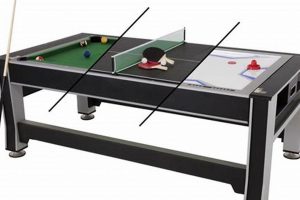
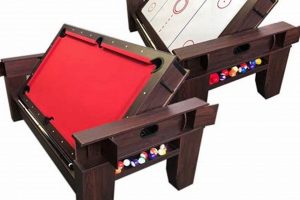
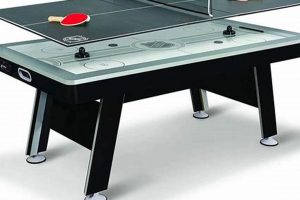
A multi-game surface provides the opportunity for diverse recreational activities within a single piece of equipment. This type of equipment typically features a primary playing surface designed for one game, such as air hockey, that can be easily converted for use in another game, such as table tennis. This conversion usually involves placing a secondary surface on top of the primary one. For instance, an air hockey table can be overlaid with a ping pong top to facilitate table tennis play.
The importance of a multi-game surface lies in its space-saving design and its ability to provide multiple entertainment options. This is particularly beneficial in environments with limited space, such as apartments or recreation rooms. The combination offers a convenient and cost-effective way to enjoy different games without purchasing individual tables. The concept has evolved over time, with manufacturers developing increasingly sophisticated designs that prioritize ease of conversion and durability.
The following sections will explore specific aspects of these convertible game tables, including design considerations, materials used in construction, factors influencing purchase decisions, and maintenance requirements for ensuring longevity.
Tips for Selecting and Maintaining a Convertible Game Table
This section provides practical guidance on choosing and caring for a multi-game surface, maximizing its lifespan and ensuring optimal gameplay.
Tip 1: Prioritize Table Stability: Assess the stability of the base structure. A robust frame minimizes vibrations during air hockey and ensures a level playing surface for table tennis. Steel or reinforced wood frames are generally preferable.
Tip 2: Evaluate Conversion Mechanism: Examine the ease and security of the conversion process. The method for attaching the ping pong tabletop should be straightforward, secure, and prevent slippage during play. Locking mechanisms are desirable.
Tip 3: Inspect Surface Quality: Scrutinize the quality of both the air hockey surface and the ping pong tabletop. The air hockey surface should be smooth, durable, and free of imperfections. The ping pong top should have consistent bounce and a non-glare finish.
Tip 4: Consider Space Requirements: Measure the available space prior to purchase. Account for ample room around the table for player movement and accessory storage. Foldable models offer space-saving advantages.
Tip 5: Check for Adjustable Levelers: Ensure the table features adjustable levelers. These are crucial for achieving a perfectly horizontal playing surface, particularly on uneven floors. Fine-tuning ensures fair gameplay.
Tip 6: Invest in Protective Covers: Use protective covers when the table is not in use. These shield the surfaces from dust, scratches, and direct sunlight, extending their lifespan.
Tip 7: Implement Regular Cleaning: Clean both surfaces regularly with appropriate cleaning agents. Avoid harsh chemicals that could damage the finish. Use a soft cloth or brush to remove dust and debris.
Proper selection and maintenance are essential for ensuring lasting enjoyment and optimal performance from a convertible game surface. Following these guidelines will contribute to the longevity and playability of the equipment.
The concluding section will summarize the key considerations discussed throughout this article and offer final recommendations.
1. Space Optimization

Space optimization is a critical consideration in contemporary recreational equipment design, particularly regarding multi-functional game tables. These tables are frequently deployed in residential environments where space is a premium. Therefore, the effective use of available area is paramount to their adoption and overall utility.
- Foldability and Vertical Storage
Foldability represents a direct approach to space optimization. Certain models incorporate hinges and locking mechanisms enabling the table to be folded into a compact form factor for storage. Vertical storage, facilitated by the folded configuration, minimizes the footprint occupied when the table is not in use. This feature is especially relevant in apartments, game rooms, or other areas with limited floor space.
- Multi-Game Functionality within a Single Footprint
The inherent design of a combination air hockey and table tennis unit consolidates two separate game experiences into a single physical structure. Were these games to be provided independently, each would require its own dedicated footprint. Combining them mitigates the need for multiple large pieces of equipment, thereby maximizing space utilization.
- Accessory Storage Integration
Effective space optimization extends beyond the table itself to encompass the storage of related accessories. Some models incorporate integrated storage compartments for paddles, pucks, and other game-specific paraphernalia. This eliminates the need for separate storage solutions, contributing to a cleaner and more organized environment. The proximity of accessories to the game surface also enhances user convenience.
- Convertible Surface Design and Minimal Clearance
The convertible surface design minimizes space requirements by utilizing a single playing area for multiple games. The design should minimize the extra space needed to convert from one game to the other. Designs that minimize the need for extra clearance around the table contribute to the optimization of space.
The foregoing facets underscore the significance of space optimization in the design and implementation of combination air hockey and table tennis tables. Through features such as foldability, multi-game functionality, integrated accessory storage, and minimized clearance, these tables provide a recreational solution that is both versatile and mindful of spatial constraints.
2. Surface Conversion

Surface conversion is a defining characteristic of combination air hockey and table tennis tables, enabling a single unit to support multiple recreational activities. The efficiency and user experience of this conversion process are critical determinants of the overall value and practicality of such tables.
- Overlay Tabletop Integration
The most prevalent method of surface conversion involves an overlay tabletop. This typically consists of a sheet of material, conforming to table tennis dimensions and regulations, designed to rest atop the air hockey surface. Secure attachment mechanisms, such as clamps or pegs, are essential to prevent slippage during play. The overlay must exhibit a consistent and predictable ball bounce for satisfactory table tennis gameplay. The design considerations often focus on balancing the need for secure fastening with ease of installation and removal.
- Hinged Surface Mechanisms
Alternative designs may employ hinged surface mechanisms. Here, the table tennis surface is attached to the air hockey table via hinges, allowing it to be flipped over or folded out when required. This eliminates the need for separate storage of an overlay tabletop but introduces potential complexities in the hinge design and structural integrity of the combined surface. Durability of the hinges and ensuring a perfectly level playing surface in both configurations are key engineering challenges.
- Surface Protection Considerations
Surface conversion necessitates careful consideration of protecting both the air hockey surface and the table tennis surface. The underside of an overlay tabletop must be designed to prevent scratching or damage to the air hockey surface. Similarly, mechanisms employed in hinged designs must ensure that the inactive surface is protected from damage during gameplay. Materials selection and surface treatments play a significant role in minimizing wear and tear during repeated conversions.
- Leveling and Stability During Conversion
Achieving a consistent and level playing surface after conversion is paramount. The conversion mechanism should not introduce instability or unevenness to the table. Adjustable levelers on the table legs are often crucial for compensating for floor irregularities and ensuring a true playing surface, particularly when transitioning between the air hockey and table tennis configurations. The design should minimize any potential for warping or sagging of the surfaces over time.
These facets of surface conversion highlight the design and engineering complexities inherent in combination air hockey and table tennis tables. The efficacy of the conversion mechanism directly impacts the versatility and user-friendliness of the unit. Successful implementation requires a balance between ease of use, structural integrity, surface protection, and consistent gameplay characteristics.
3. Structural Integrity

Structural integrity is a paramount consideration in the design and manufacturing of convertible game tables. This is directly linked to the product’s longevity, safety, and overall performance. Compromised structural integrity leads to instability, uneven playing surfaces, and eventual component failure, negatively impacting the user experience and potentially posing safety hazards. An example is a table with a weak frame that warps over time. This results in an uneven playing surface for table tennis or hinders proper air flow in air hockey.
The materials employed in construction play a crucial role in ensuring structural soundness. High-density fiberboard (HDF), steel, and reinforced polymers are frequently utilized for their strength and resistance to deformation. The thickness and quality of these materials directly correlate to the table’s ability to withstand the stresses of regular use and repeated conversions between game configurations. Poor material selection leads to premature wear. Consider a ping pong top that sags in the middle because it used low-quality material. This compromises game quality.
In summary, structural integrity is not merely a design consideration; it is a fundamental requirement for the functionality and sustainability of convertible game tables. Robust construction and appropriate material selection are crucial for ensuring user safety, long-term durability, and an optimal recreational experience. Future developments could explore innovative material science and advanced engineering techniques to further enhance the structural resilience and lifespan of these versatile game tables.
4. Gameplay Quality
Gameplay quality, pertaining to a multi-game surface, is a direct function of several interconnected factors, each contributing to the overall user experience and the perceived value of the recreational equipment. The performance of both the air hockey and table tennis functionalities must meet acceptable standards for engaging and competitive play.
- Surface Flatness and Levelness
A perfectly flat and level playing surface is critical for both air hockey and table tennis. Any deviation from horizontal can introduce unintended bias into gameplay, affecting puck or ball trajectory. Adjustable leveling feet are essential to compensate for floor irregularities and ensure a fair and consistent playing field. Imperfections in surface flatness compromise the integrity of both games.
- Air Hockey Airflow Consistency
In air hockey mode, uniform airflow across the entire playing surface is necessary for optimal puck movement. Inconsistent airflow creates dead spots or areas of increased friction, impeding smooth puck travel and disrupting gameplay. Blower motor performance and hole distribution patterns significantly impact airflow consistency. Uneven airflow affects the speed and predictability of puck movement, diminishing the air hockey experience.
- Table Tennis Ball Bounce Response
The table tennis tabletop must exhibit a consistent and predictable ball bounce. Variations in bounce height or rebound angle across the surface negatively impact shot accuracy and overall gameplay. Factors such as tabletop material, thickness, and surface coating contribute to ball bounce characteristics. Inconsistent ball response leads to unpredictable gameplay, hindering skill development and competitive play.
- Rail and Side Wall Construction
The design and construction of the rails or side walls surrounding the playing surface influence gameplay dynamics in both air hockey and table tennis. Air hockey rails should be smooth and resilient to allow for predictable puck rebounds. Table tennis side walls must be sturdy enough to withstand repeated ball impacts without deformation. Poor rail construction diminishes puck rebound consistency in air hockey. Side wall instability negatively impacts ball return predictability in table tennis.
These elements collectively define the gameplay quality of a convertible game table. A deficiency in any one area detracts from the overall experience. Manufacturers must prioritize these factors in the design and production phases to deliver a product that offers engaging and authentic gameplay across multiple recreational activities. Balancing the design for both games necessitates compromises, requiring careful engineering considerations and thorough quality control measures.
5. Material Durability

Material durability is a critical determinant of the lifespan and overall value of a combination air hockey and table tennis table. The constant use and potential for wear and tear associated with both game types necessitate the selection of robust materials capable of withstanding significant stress. The composition of the playing surfaces, frame, and other structural components directly impacts the equipment’s resistance to damage, deformation, and degradation over time. The choice of materials is not merely an aesthetic consideration; it is a fundamental engineering decision that dictates the product’s longevity. Consider, for instance, an air hockey surface constructed from low-grade particleboard. This material is susceptible to moisture damage, warping, and surface scratching, rendering the equipment unusable within a relatively short period. Conversely, a table tennis top fabricated from high-density fiberboard with a resilient coating exhibits superior resistance to impacts, scratches, and moisture, significantly extending its service life.
The frame, which provides structural support for the entire table, is another area where material durability is paramount. Steel frames offer excellent strength and stability, minimizing the risk of bending or collapse under load. Wood frames, while aesthetically pleasing, must be constructed from hardwoods and properly treated to resist warping and insect damage. Fasteners and joining methods also influence the overall structural integrity. Poorly designed joints or low-quality fasteners can create weak points that compromise the table’s stability and lead to premature failure. Therefore, a holistic approach to material selection, encompassing both the playing surfaces and the underlying structure, is essential for ensuring the long-term viability of a combination game table.
In summary, material durability is not an optional feature but a core requirement for combination air hockey and table tennis tables. Proper material selection translates directly into increased product lifespan, reduced maintenance costs, and enhanced user satisfaction. By prioritizing robust materials and construction techniques, manufacturers can deliver products that withstand the rigors of regular use and provide years of recreational enjoyment. The practical significance of this understanding lies in the consumer’s ability to make informed purchasing decisions, selecting equipment that represents a sound investment rather than a temporary novelty.
6. Storage Efficiency
Storage efficiency, in the context of combination air hockey and table tennis tables, is a critical design parameter driven by spatial constraints in residential and recreational environments. The size of such tables, even when designed for dual functionality, presents a storage challenge when the equipment is not in use. Inadequate attention to storage efficiency limits the practicality and market appeal of these multi-game units. A large, non-collapsible table occupies significant floor space, making it unsuitable for smaller homes or apartments. This lack of consideration directly impacts user convenience and the likelihood of purchase.
Foldable designs exemplify a commitment to storage efficiency. These tables incorporate hinges and locking mechanisms, enabling the playing surface to be collapsed and stored vertically or horizontally. This reduces the footprint when the table is not in use, freeing up valuable floor space. Models lacking such foldable features are less adaptable to varying spatial needs. For example, a convertible table without a folding mechanism may require a dedicated room or large storage area, restricting its practicality for many potential buyers. Integrated storage solutions for accessories such as paddles and pucks further enhance storage efficiency. By eliminating the need for separate storage containers, these designs contribute to a more organized and space-saving recreational setup.
Ultimately, storage efficiency is not merely an ancillary feature, but an integral component of combination game table design. Incorporating features that minimize the table’s footprint when not in use significantly enhances its practicality and appeal to a broader consumer base. The understanding of this principle allows both manufacturers and consumers to make informed decisions, resulting in products that effectively balance functionality with spatial considerations. The challenge lies in maintaining robust structural integrity and gameplay quality while maximizing storage efficiency through innovative design solutions.
Frequently Asked Questions
This section addresses common inquiries and misconceptions regarding combination air hockey and table tennis tables, providing informative answers to aid in understanding their functionality and suitability.
Question 1: What is the typical lifespan of a combination air hockey and ping pong table?
The lifespan is contingent upon several factors, including material quality, frequency of use, and maintenance practices. Higher-quality tables, constructed with durable materials and properly maintained, can last for several years. However, tables subjected to heavy use or neglect may exhibit reduced longevity.
Question 2: Can a combination unit provide the same gameplay experience as dedicated single-purpose tables?
While combination tables offer versatility, they may involve compromises compared to dedicated units. The design necessitates balancing the requirements of both air hockey and table tennis, potentially affecting gameplay characteristics such as air flow or ball bounce. Dedicated tables generally offer more specialized features optimized for a single game.
Question 3: What are the primary maintenance requirements for these tables?
Maintenance typically involves regular cleaning of the playing surfaces to remove dust and debris. For air hockey, ensuring unobstructed airflow through the perforations is essential. Table tennis surfaces require protection from scratches and moisture. Periodic inspection of the frame and leveling feet is recommended to maintain stability.
Question 4: How does the conversion process between air hockey and table tennis typically function?
The conversion process usually involves placing a table tennis tabletop over the air hockey surface. Some models may utilize hinged mechanisms that allow the table tennis surface to be flipped over. Secure attachment methods are crucial to prevent slippage during gameplay.
Question 5: What factors should be considered when assessing the stability of a combination table?
Stability is influenced by the frame’s construction, the quality of the materials used, and the presence of adjustable leveling feet. A robust frame minimizes vibrations and ensures a level playing surface. Adjustable feet compensate for floor irregularities.
Question 6: Is assembly typically required upon purchase?
Assembly requirements vary depending on the model. Some tables may arrive fully assembled, while others require partial assembly, such as attaching the legs or installing the air blower motor. Clear and comprehensive assembly instructions are essential.
In summation, understanding the nuances of construction, maintenance, and gameplay variations is vital for maximizing the value and longevity of a combination air hockey and table tennis table.
The concluding section will summarize the key considerations discussed throughout this article and offer final recommendations.
Conclusion
This exploration of the combo air hockey ping pong table has illuminated key aspects of its design, functionality, and suitability for diverse recreational settings. We have examined the critical considerations of space optimization, surface conversion mechanisms, structural integrity, gameplay quality, material durability, and storage efficiency. Understanding these elements is paramount to appreciating the value proposition and inherent limitations of this multi-game equipment. The analysis has revealed that while versatility is a key advantage, compromises in specialized gameplay characteristics may exist compared to dedicated single-purpose tables. Material selection and robust construction are shown to be fundamental for ensuring longevity and user satisfaction.
The viability of a combo air hockey ping pong table hinges on a balance of practicality and performance. Prospective purchasers should carefully weigh the outlined factors against their individual needs and spatial constraints. Continued innovation in design and material science holds the potential to further enhance the gameplay experience and storage efficiency of these versatile recreational units. A measured approach to selection, coupled with diligent maintenance, will maximize the value and extend the lifespan of a combo air hockey ping pong table, solidifying its position as a viable recreational option.
![Best Table Tennis Air Hockey Table [Deals!] | Your Ultimate Source for Hockey Updates, Training Guides, and Equipment Recommendations](https://ssachockey.com/wp-content/uploads/2026/03/th-549-300x200.jpg "Best Table Tennis Air Hockey Table [Deals!] Your Ultimate Source for Hockey Updates, Training Guides, and Equipment Recommendations")
![Best Air Hockey Table Tennis Table [Review & Guide] | Your Ultimate Source for Hockey Updates, Training Guides, and Equipment Recommendations](https://ssachockey.com/wp-content/uploads/2026/03/th-529-300x200.jpg "Best Air Hockey Table Tennis Table [Review & Guide] Your Ultimate Source for Hockey Updates, Training Guides, and Equipment Recommendations")