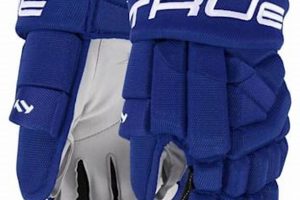
Protective gear designed to mitigate impacts to the lower arm during athletic activity on the ice. These devices generally consist of a rigid or semi-rigid material, often incorporating padding, that affixes around the distal forearm and hand, shielding it from pucks, sticks, and collisions. For example, a player might wear this equipment to reduce the risk of fracture after being struck by a slapshot.
The incorporation of specialized arm guards into a player’s equipment ensemble provides substantial benefits. Players wearing these safeguards experience reduced incidence of wrist and lower arm injuries, allowing for increased on-ice performance and reduced time lost to injury. Historically, such apparatuses have evolved from rudimentary padding to sophisticated, ergonomically designed units, reflecting an increased emphasis on athlete safety.
The following sections will delve into the various types of this protective equipment available, the factors to consider when selecting it, and best practices for its proper use and maintenance, ensuring players can make informed choices to safeguard themselves.
Essential Considerations for Lower Arm Protection
The following guidelines provide critical information to maximize the protective capabilities of arm guards on the ice. Adherence to these recommendations can significantly reduce the risk of injury.
Tip 1: Size and Fit Assessment. Ensure a snug, yet comfortable fit. Excessive looseness compromises protective efficacy, while excessive tightness can impede circulation. Conduct a fitting assessment at time of purchase.
Tip 2: Material Composition Evaluation. Prioritize materials exhibiting high impact resistance, such as high-density polyethylene or composite materials. These offer superior protection compared to softer materials.
Tip 3: Closure System Integrity. Examine the closure system straps, buckles, or hook-and-loop fasteners for durability and reliability. A secure closure prevents displacement during play.
Tip 4: Range of Motion Consideration. Verify that the equipment does not unduly restrict wrist or arm movement. Compromised mobility can negatively impact stickhandling and shooting ability.
Tip 5: Padding Distribution Analysis. Ensure adequate padding coverage over vulnerable areas, including the wrist bones, lower forearm, and any exposed areas between the glove and elbow pad.
Tip 6: Inspection for Wear and Tear. Regularly inspect the equipment for signs of damage, such as cracks, tears, or weakened closures. Replace damaged items immediately to maintain protective capabilities.
Tip 7: Proper Hygiene Practices. Implement regular cleaning and drying procedures to prevent the accumulation of moisture and bacteria, which can degrade materials and cause skin irritation.
Diligent application of these principles will enhance the safety and longevity of arm protection equipment, contributing to a safer playing experience.
The subsequent section will address the selection and maintenance of these crucial protective items in greater detail.
1. Impact Absorption

Impact absorption constitutes a paramount characteristic of protective equipment for the distal forearm in ice sports. The fundamental purpose of such a device lies in its capacity to dissipate kinetic energy generated by impacts, such as those from pucks, sticks, or collisions with the boards or other players. Insufficient impact absorption directly correlates with an elevated risk of contusions, fractures, and other musculoskeletal injuries. Therefore, the selection of materials and the design of the protective apparatus must prioritize optimal energy dissipation.
For instance, consider a player struck directly on the wrist by a slapshot. Without adequate impact absorption, the force would be transmitted directly to the underlying bone structure, likely resulting in a fracture. A well-designed wrist protector, constructed from materials such as high-density foam or specialized polymers, absorbs a significant portion of this energy, reducing the force transmitted to the wrist and substantially decreasing the likelihood of injury. The practical significance of this understanding is evident in the stringent safety standards implemented by sporting leagues and regulatory bodies, which mandate minimum impact absorption ratings for protective equipment.
The pursuit of enhanced impact absorption remains a central focus in the ongoing development of protective equipment. Challenges include balancing the need for high energy dissipation with the desire for lightweight and non-restrictive designs. However, the fundamental principle remains: effective impact absorption is non-negotiable in mitigating the risks associated with high-impact activities on the ice. It is critical to understand that materials, thickness, and design can improve impact absorption.
2. Ergonomic Design

Ergonomic design, concerning the interaction between humans and equipment, is of critical importance in the context of lower arm protection for athletes. Such design considerations directly impact the comfort, safety, and performance of the individual wearing the equipment. A poorly designed protector can impede movement, increase fatigue, and ultimately fail to provide adequate protection. A focus on ergonomic principles is therefore indispensable in the development of effective protective gear.
- Anatomical Conformity
Anatomical conformity addresses the extent to which the protective gear aligns with the natural contours of the arm. A design that mirrors the anatomical structure of the wrist minimizes pressure points, reduces friction, and promotes a more natural range of motion. Protective gear that is too rigid or improperly shaped can cause discomfort, restrict movement, and even lead to skin irritation. Conversely, a well-contoured design distributes pressure evenly, enhancing comfort and compliance.
- Weight Distribution
Optimal weight distribution minimizes fatigue and maximizes maneuverability. A design that concentrates weight in a single area can lead to muscle strain and impaired performance. Effective ergonomic design distributes weight evenly across the forearm, reducing stress on specific joints and muscle groups. This is particularly important during extended periods of activity, where fatigue can compromise reaction time and increase the risk of injury.
- Adjustability
Adjustability is an essential element in achieving a customized fit. Athletes possess varying arm circumferences and shapes, requiring protective gear that can be tailored to individual needs. Adjustable straps, buckles, or closure systems allow for a secure and comfortable fit, preventing slippage during activity. Inadequate adjustability can result in either excessive tightness, restricting circulation, or excessive looseness, compromising protective capabilities.
- Interface with Other Equipment
The ergonomic design must consider the interface between the lower arm protection and other pieces of equipment, such as gloves and elbow pads. A seamless transition between these components is crucial for maximizing comfort and minimizing gaps in protection. Poorly integrated equipment can create pressure points, restrict movement, and increase the risk of injury. A holistic approach to ergonomic design ensures that all elements of the protective ensemble work together harmoniously.
In summation, ergonomic design plays a fundamental role in the efficacy of lower arm protection. By prioritizing anatomical conformity, optimal weight distribution, adjustability, and seamless integration with other equipment, manufacturers can create protective gear that enhances comfort, safety, and performance. Continuing advancements in materials and design techniques will further refine the ergonomic characteristics of these protective devices, minimizing the risk of injury on the ice.
3. Secure Fit

The concept of secure fit is a cornerstone in the effectiveness of lower arm protective equipment during hockey gameplay. A properly secured protector ensures that the device remains in its intended position, maximizing its ability to absorb impacts and shield the lower arm from potential injury. Without a secure fit, the equipment may shift or dislodge during play, leaving the wearer vulnerable to direct impacts from pucks, sticks, or collisions.
- Retention During Impact
Retention during impact describes the protector’s capacity to stay firmly in place when subjected to sudden, forceful contact. A secure fit prevents the equipment from rotating or sliding away from the area it is designed to protect. This is achieved through appropriately sized equipment that is properly adjusted by the user. For instance, a slapshot impacting a poorly secured wrist protector may cause the device to rotate, exposing the wrist joint to potential injury. Conversely, a tightly secured protector absorbs the impact, safeguarding the joint.
- Adjustability Mechanisms
Various adjustability mechanisms contribute to achieving a secure fit. These mechanisms, such as straps, buckles, or hook-and-loop closures, allow the user to customize the fit of the protector to their specific anatomy. Effective adjustability ensures that the protector remains snug without impeding circulation or restricting movement. The quality and placement of these mechanisms directly impact the security of the fit. Inferior materials or poorly designed mechanisms may fail under stress, compromising the protector’s ability to stay in place.
- Interface with Other Equipment
The interface between the lower arm protector and other equipment, such as gloves and elbow pads, plays a crucial role in maintaining a secure fit. A seamless integration between these pieces of equipment prevents gaps in protection and ensures that the protector remains properly positioned. Incompatible equipment can create pressure points, restrict movement, and increase the likelihood of displacement. Therefore, selecting equipment that is designed to work together is essential for achieving a secure and effective fit.
- Material Properties and Design
Material properties and the overall design of the protector contribute significantly to its ability to maintain a secure fit. Materials with inherent gripping qualities can help prevent slippage, while a contoured design that conforms to the shape of the arm enhances stability. Furthermore, the design should minimize bulk and maximize flexibility, allowing for a natural range of motion without compromising security. The effectiveness of these design elements can be evaluated through rigorous testing and user feedback.
In summary, a secure fit is a multifaceted aspect of lower arm protection in ice sports. The ability of the protector to remain firmly in place during impact, the effectiveness of adjustability mechanisms, the integration with other equipment, and the intrinsic properties of the materials all contribute to the overall security of the fit. By prioritizing these considerations, athletes can maximize the protective capabilities of their equipment and minimize the risk of injury.
4. Durability
Durability, defined as the capacity of a protective device to withstand wear, degradation, and prolonged use, holds paramount importance in the context of lower arm protection for ice sports. Equipment subjected to the rigors of high-impact activities must exhibit resilience to ensure consistent performance and sustained protective capabilities. Compromised durability directly increases the risk of equipment failure and subsequent injury.
- Material Fatigue Resistance
Material fatigue resistance signifies the ability of constituent materials to endure repeated stress cycles without fracturing or losing structural integrity. This facet is particularly critical given the repetitive impacts sustained during game play. For example, a protector constructed from a polymer susceptible to fatigue may develop cracks or structural weaknesses over time, compromising its capacity to absorb impacts effectively. High-density polyethylene and composite materials are often selected for their superior fatigue resistance.
- Abrasion Resistance
Abrasion resistance pertains to the capacity of the external surface to withstand friction and wear resulting from contact with abrasive surfaces, such as the ice, boards, or other equipment. A protector lacking adequate abrasion resistance may experience surface degradation, leading to thinning and reduced impact absorption. Materials like ballistic nylon or reinforced polymers are frequently employed to enhance abrasion resistance and prolong the lifespan of the protector.
- Closure System Integrity
The integrity of the closure system straps, buckles, hook-and-loop fasteners directly influences the long-term functionality of the equipment. Closure systems subjected to repeated fastening and unfastening must retain their secure holding capacity. Failure of the closure system renders the protector ineffective, as it may shift or dislodge during play. High-quality buckles, reinforced straps, and durable hook-and-loop materials are essential for maintaining closure system integrity.
- Environmental Degradation Resistance
Resistance to environmental degradation encompasses the ability to withstand the adverse effects of moisture, temperature fluctuations, and ultraviolet radiation. Prolonged exposure to these elements can weaken materials, leading to premature failure. Protectors exposed to moisture may experience material degradation, while ultraviolet radiation can cause discoloration and embrittlement. Proper storage and maintenance practices, along with the selection of materials resistant to environmental degradation, are critical for prolonging the lifespan of the equipment.
The interrelated facets of material fatigue resistance, abrasion resistance, closure system integrity, and environmental degradation resistance collectively define the durability of lower arm protection. Equipment exhibiting superior performance across these dimensions provides enhanced protection, reduces the need for frequent replacements, and ultimately contributes to a safer playing environment. Therefore, the selection of durable materials and robust construction techniques is paramount in ensuring the longevity and effectiveness of these critical protective devices.
5. Range of Motion

The degree to which an athlete can move their wrist joint while wearing protective gear is a crucial consideration in the selection and design of lower arm equipment used in ice sports. Compromised range of motion can negatively affect stickhandling, shooting accuracy, and overall agility, potentially diminishing on-ice performance and increasing the risk of compensatory movements that may lead to other injuries.
- Wrist Flexion and Extension
This facet describes the ability to bend the wrist forward (flexion) and backward (extension). Restricted flexion can hinder a player’s capacity to cradle the puck effectively, while limited extension can impair the power and accuracy of shots. Designs that incorporate flexible materials or articulated segments in the wrist area can mitigate restrictions. For example, a protector with a hinged cuff allows for greater extension during a slap shot compared to a rigid, non-articulated design.
- Ulnar and Radial Deviation
Ulnar deviation refers to the movement of the hand towards the little finger side, while radial deviation refers to movement toward the thumb side. These movements are essential for stickhandling and puck control. A protector that constricts these movements can limit a player’s ability to make quick adjustments to their stick angle, reducing puck handling efficiency. Designs that minimize material bulk on the sides of the wrist facilitate greater deviation.
- Rotation (Pronation and Supination)
Although primarily a forearm movement, pronation (turning the palm down) and supination (turning the palm up) are indirectly influenced by wrist protection. A bulky or tightly fitting protector can restrict these movements, hindering a player’s ability to quickly adjust their hand position for receiving passes or changing stick angles. Designs featuring a streamlined profile and flexible materials can minimize interference with pronation and supination.
- Glove and Protector Integration
The interface between the wrist protector and the hockey glove is critical for maintaining optimal range of motion. A poorly designed interface can create pressure points, restrict movement, and leave gaps in protection. Designs that feature a seamless transition between the protector and glove allow for a more natural range of motion and prevent discomfort. For example, a glove with a flared cuff that integrates smoothly with the protector allows for greater wrist mobility compared to a tight-fitting glove that restricts movement.
The influence of the protective equipment on the freedom of motion is multifaceted, affecting diverse aspects of performance. Prioritizing designs that minimize restriction while maintaining adequate protection is paramount for optimizing both safety and athletic capabilities on the ice. Factors such as the choice of materials, the overall design of the device, and the integration with other equipment all contribute significantly to the overall effect on wrist mobility.
Frequently Asked Questions
The following section addresses common inquiries regarding the selection, use, and maintenance of protective equipment for the distal forearm in ice sports. The responses provided aim to clarify misconceptions and offer guidance on maximizing player safety.
Question 1: Does increased thickness of padding equate to superior protection?
While padding thickness contributes to impact absorption, material density and design are equally significant. A thinner layer of high-density, specialized foam may offer greater protection than a thicker layer of conventional padding.
Question 2: How frequently should lower arm protectors be replaced?
Replacement frequency depends on usage intensity and observed wear and tear. Any sign of damage, such as cracks, tears, or compromised closure systems, necessitates immediate replacement. Even without visible damage, protectors should be replaced every two to three seasons due to material degradation.
Question 3: Can arm protectors be modified to improve comfort or fit?
Modifications are generally discouraged, as they may compromise the structural integrity and protective capabilities of the device. Alterations void any manufacturer warranties and could increase the risk of injury. Consult with a qualified equipment specialist for fitting adjustments.
Question 4: Are all arm protectors designed for impact from pucks?
Not all arm protectors are specifically designed to withstand the impact of a puck. Some equipment are designed solely for slash protection. Verify that the protector is designed to protect from the impact of a puck and approved by an appropriate certification.
Question 5: Is professional fitting of arm protection necessary?
While not always mandatory, professional fitting is highly recommended, particularly for novice players. A qualified fitter can assess individual needs and ensure proper sizing and adjustment, maximizing both comfort and protection.
Question 6: Are less expensive arm protectors as effective as higher-priced models?
Price often reflects the quality of materials and construction techniques. While less expensive models may offer basic protection, higher-priced models typically incorporate advanced materials and designs that provide superior impact absorption, durability, and range of motion. A cost-benefit analysis, considering playing frequency and intensity, is recommended.
In conclusion, informed decision-making, encompassing considerations of material properties, fit, and maintenance, is paramount for ensuring the effectiveness of lower arm protection. Regular inspection and timely replacement are crucial for maintaining optimal safety standards.
The subsequent section will explore the technological advancements shaping the future of protective equipment in ice sports.
Wrist Protector Hockey
This exposition has thoroughly investigated critical attributes of protective gear designed for the distal forearm in ice hockey, identified here as “wrist protector hockey”. Emphasis was placed on key characteristics, including impact absorption, ergonomic design, secure fit, durability, and range of motion. Each characteristic contributes uniquely to a player’s protection from injury. Consideration of these features is paramount when selecting protective equipment.
The principles and recommendations discussed should inform equipment selection and maintenance decisions. Vigilance regarding wear, tear, and proper fit remains crucial. Ultimately, proper knowledge and application of these principles contribute significantly to player safety, mitigating the risks associated with on-ice activity. Continual advancements in materials and designs promise an even safer future for athletes engaged in the sport.