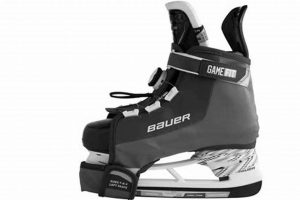
This equipment configuration for ice hockey footwear features a distinct blade design. Unlike traditional models with a single, continuous piece of steel, these skates incorporate a system where the blade is separate and replaceable, attaching to the chassis via screws. This design allows for blade swaps without requiring complete skate replacement.
The modular system offers potential advantages, including extended lifespan for the boot portion of the equipment and the ability to customize blade profiles and materials for specific playing styles or ice conditions. The technology gained traction as a possible innovation to improve player performance and reduce equipment expenses. However, considerations surrounding weight, rigidity, and impact resistance influenced its market acceptance.
The following sections will detail the technical characteristics of the replaceable blade system, compare its performance to conventional designs, examine the maintenance requirements, and consider its impact on skating technique and player experience within the sport of ice hockey.
Optimizing Performance with Replaceable Blade Systems
The following guidelines address the effective utilization of ice hockey skates featuring a T-shaped blade configuration to maximize on-ice performance and equipment longevity.
Tip 1: Select Appropriate Blade Profile: Blade profile significantly impacts skating characteristics. A longer profile promotes stability and gliding efficiency, while a shorter profile enhances maneuverability and agility. Assess individual skating style and positional requirements when choosing a profile.
Tip 2: Verify Secure Blade Attachment: Prior to each use, inspect all screws and fasteners connecting the blade to the chassis. Loose connections compromise energy transfer and can lead to instability. Tighten all components to the manufacturer-specified torque settings.
Tip 3: Maintain Blade Sharpness: Consistent blade sharpness is crucial for optimal edge control and power generation. Regularly sharpen blades using appropriate equipment and techniques. The frequency of sharpening depends on ice conditions and skating frequency.
Tip 4: Inspect for Damage Regularly: Examine blades for nicks, chips, or distortions. Damage can negatively affect performance and increase the risk of blade failure. Replace damaged blades immediately.
Tip 5: Consider Blade Material: Blades are manufactured from various steel alloys, each offering different properties. Softer steel requires more frequent sharpening but provides superior grip. Harder steel maintains sharpness longer but may offer less bite. Select material based on skating style and ice conditions.
Tip 6: Store Skates Properly: After each use, remove blades from the chassis, dry them thoroughly, and store them in a protective sleeve to prevent rust and corrosion. Store boots in a well-ventilated area to allow them to dry completely.
Adherence to these guidelines will ensure the safe and effective use of equipment, ultimately contributing to enhanced on-ice performance and extended equipment lifespan.
The subsequent sections will explore the comparative advantages and disadvantages of this system in relation to traditional models.
1. Replaceable Blades

The defining characteristic of “t blade ice hockey skates” is the integration of replaceable blades. Unlike traditional ice hockey skates where the blade is permanently affixed to the boot, these skates utilize a chassis to which blades are attached via screws or other fastening mechanisms. This modular design enables the exchange of blades without necessitating the replacement of the entire skate. The implementation addresses the frequent need for blade replacements due to wear, damage, or the desire to alter blade profiles for optimized performance.
The benefit of replaceable blades extends to cost-effectiveness and versatility. When a blade dulls, breaks, or the skater wishes to experiment with different profiles (e.g., for enhanced speed versus increased agility), only the blade itself needs to be replaced, significantly reducing expenditure compared to replacing the entire skate. Several blade profiles can be easily interchanged depending on ice conditions. One case exemplifies this by allowing a player to use a specific blade that fits a cold outdoor ice that has unique ice properties.
The use of replaceable blades introduces design considerations involving the chassis material, blade fastening security, and the overall weight and balance of the skate. The success hinges on a robust and reliable attachment mechanism that ensures efficient energy transfer and player safety. While offering advantages in customization and potential cost savings, the system’s longevity depends on addressing these engineering challenges to provide skaters with performance comparable to, or exceeding that of, traditional fixed-blade designs.
2. Blade Profile Options

The availability of diverse blade profile options is a salient feature of ice hockey skates incorporating replaceable blade systems, fundamentally altering the skating experience and affording customized performance characteristics. The capacity to interchange blades with varying radii of curvature introduces strategic advantages and necessitates a nuanced understanding of how these profiles influence on-ice dynamics.
- Radius of Curvature & Glide Efficiency
The blade profile’s radius of curvature directly impacts the contact area between the blade and the ice. A larger radius (flatter profile) results in increased contact, promoting enhanced glide efficiency and stability at higher speeds. This configuration is often favored by players prioritizing straight-line speed and endurance, such as defensemen or players focused on long skating strides.
- Radius of Curvature & Agility
Conversely, a smaller radius (more curved profile) reduces the contact area, facilitating tighter turns and quicker changes in direction. This agile configuration is advantageous for forwards and players requiring rapid acceleration and maneuverability in confined spaces. The trade-off involves a reduction in glide efficiency due to the decreased contact area.
- Blade Rocker & Pivot Point
The “rocker” of the blade, referring to the curvature along its length, dictates the pivot point and the skater’s balance. A more pronounced rocker allows for quicker transitions between forward and backward skating, while a flatter rocker provides a more stable platform for lateral movements. Experimentation with different rocker profiles allows players to optimize their balance and responsiveness to game situations.
- Customization & Player Preference
Replaceable blade systems enable players to fine-tune their equipment to match their individual skating style and positional requirements. Players may select one profile for practices focusing on speed and another for games demanding increased agility. This degree of customization provides a competitive edge by allowing players to adapt their equipment to specific ice conditions, game strategies, or physical limitations.
The strategic selection of blade profile options in replaceable blade systems empowers players to optimize their skating performance. The capacity to personalize blade profiles represents a significant advancement in ice hockey equipment, requiring informed decision-making based on skating style, positional demands, and a thorough understanding of the interplay between blade geometry and on-ice dynamics.
3. Chassis Rigidity

Chassis rigidity is a critical factor influencing the performance of ice hockey skates, particularly those employing a replaceable blade system. The chassis serves as the structural link between the boot and the blade, directly affecting energy transfer, responsiveness, and overall stability during skating maneuvers. Inadequate chassis rigidity can compromise performance and potentially increase the risk of injury.
- Energy Transfer Efficiency
A rigid chassis maximizes energy transfer from the skater’s leg to the blade. Minimal flex within the chassis ensures that a greater proportion of the skater’s effort is translated into forward momentum or directional change. Conversely, a flexible chassis absorbs energy, reducing efficiency and potentially leading to fatigue. Real-world examples illustrate the difference between a responsive, rigid chassis that allows for sharp turns and quick acceleration, and a more flexible one that feels sluggish and less precise.
- Blade Alignment and Control
Chassis rigidity maintains proper blade alignment under load. A flexible chassis can allow the blade to twist or deform during skating, reducing edge control and compromising stability. This is particularly important during high-speed turns or when applying significant force to the edges of the blade. A stable blade platform allows for predictable and controlled skating maneuvers, enhancing the skater’s confidence and ability to execute complex skills.
- Material Properties and Construction
The materials used in chassis construction significantly influence rigidity. High-modulus materials, such as carbon fiber composites, offer superior stiffness-to-weight ratios compared to traditional materials like aluminum alloys. The design and construction methods, including ribbing and reinforcement, also contribute to overall chassis rigidity. Skates designed for elite-level players typically incorporate advanced materials and construction techniques to maximize stiffness and minimize weight.
- Impact Resistance and Durability
While rigidity is essential for performance, the chassis must also possess adequate impact resistance and durability. A brittle chassis may be prone to cracking or failure upon impact with the boards or other players. The design must balance stiffness with the ability to absorb and dissipate impact forces, ensuring both performance and player safety. Regular inspection of the chassis for signs of damage is crucial to maintaining its structural integrity.
The interplay between chassis rigidity, energy transfer, and blade alignment underscores its significance in the overall performance of ice hockey skates equipped with replaceable blade systems. Optimization of chassis design, material selection, and construction techniques is essential to deliver a skate that maximizes performance, enhances control, and promotes player safety. Rigidity must be balanced with durability to ensure the longevity of these systems and continue to build confidence in their performance.
4. Weight Distribution

Weight distribution plays a critical role in the performance and feel of ice hockey skates, particularly those employing a replaceable blade system. Optimal weight distribution enhances balance, agility, and control, while imbalances can negatively impact skating efficiency and increase the risk of injury. In skates featuring the T-blade design, the location of mass relative to the foot and the ice surface assumes heightened importance due to the modular construction of the system.
- Fore-Aft Balance and Stride Efficiency
The distribution of weight along the longitudinal axis of the skate (fore to aft) directly influences the skater’s ability to maintain balance and generate efficient strides. A forward weight bias can enhance acceleration and agility, while a more neutral or rearward bias promotes stability and glide. Replaceable blade systems may alter the typical fore-aft balance due to the weight of the chassis and fastening mechanisms. Skaters may need to adjust their skating technique to compensate for these subtle shifts in weight distribution. For example, a skater transitioning from traditional skates might find they need to lean slightly further forward to achieve the same level of edge control.
- Lateral Stability and Edge Control
The lateral (side-to-side) distribution of weight affects stability during turns and edge control. A lower center of gravity, achieved by positioning weight closer to the ice surface, enhances stability and reduces the risk of ankle roll. The design of the chassis in replaceable blade systems can influence the lateral weight distribution. If the chassis is wider or positioned higher off the ice than in traditional skates, it may raise the center of gravity and reduce lateral stability. Players would notice this especially during sharp turns and quick stops, where maintaining a solid edge is critical.
- Impact of Chassis Material and Design
The material and design of the chassis significantly contribute to the overall weight and its distribution. Heavier chassis materials, such as certain steel alloys, can increase the overall weight of the skate and potentially shift the weight distribution. Lighter materials, such as carbon fiber composites, can reduce weight and allow for more precise control over weight distribution. Chassis designs that concentrate mass near the center of the foot can improve balance and responsiveness. For instance, a more streamlined chassis that minimizes excess material can lead to a lighter, more agile feel on the ice.
- Adaptation and Customization
Skaters can adapt to weight distribution characteristics through adjustments in skating technique, skate lacing, and potentially, aftermarket modifications. Tighter lacing around the ankle can provide additional support and compensate for any perceived instability due to weight distribution. Custom footbeds or shims can be used to alter the angle of the foot within the skate and fine-tune the weight distribution. Some skaters may even experiment with different chassis or blade configurations to optimize weight distribution for their specific skating style and preferences.
Understanding the nuanced effects of weight distribution in the replaceable blade context enables skaters to make informed decisions about equipment selection and optimize their performance on the ice. The location of mass dictates on-ice behavior, and appreciating this connection results in optimized skating technique. Through strategic adjustments and informed choices, athletes can leverage the unique characteristics to unlock their full potential.
5. Maintenance Requirements
The design of ice hockey skates that incorporate replaceable blade systems introduces distinct maintenance protocols compared to traditional designs. The modular nature of the “t blade ice hockey skates” necessitates regular inspection and upkeep of not only the blade sharpness but also the integrity of the blade attachment mechanisms. The frequency and scope of maintenance directly correlate with skate performance, longevity, and user safety. Neglecting these requirements can lead to diminished skating efficiency, premature equipment failure, and an increased risk of injury. A consequence of loose or corroded fasteners, for instance, includes blade detachment during gameplay, posing a significant hazard. Therefore, consistent and diligent maintenance forms a cornerstone of the skate’s long-term usability.
Specific maintenance procedures include routine tightening of blade mounting hardware to manufacturer-specified torque levels. This prevents loosening due to vibration and impact forces experienced during skating. Furthermore, cleaning and drying the blades and chassis after each use minimizes corrosion, particularly when skating on ice treated with salts or chemicals. Regular blade sharpening remains crucial, as with traditional skates, to maintain optimal edge control. The replaceable nature of the blades also mandates periodic inspection for wear, cracks, or distortions, necessitating timely replacements. A practical example involves a user who proactively tightens the chassis screws after every two ice sessions, significantly extending the life of the skate and mitigating performance degradation.
In summary, the maintenance requirements associated with the “t blade ice hockey skates” are more extensive and nuanced than those of traditional skates. Adhering to these practices preserves functionality, extends equipment lifespan, and reinforces skater safety. Overlooking these needs compromises performance and safety, underscoring the necessity for skaters and equipment managers to prioritize routine maintenance as an integral aspect of using these skates. The additional effort results in reliable equipment and a safe skating experience, making the diligence worthwhile.
6. Impact Resistance

Impact resistance is a critical safety consideration in ice hockey skates, especially in models employing a replaceable blade system. These skates, often referred to using the keyword phrase “t blade ice hockey skates,” must withstand substantial forces generated by collisions with other players, the boards, and even errant pucks. The modular design inherent in these skates introduces unique challenges in maintaining adequate impact resistance. Weaknesses in the chassis, blade attachment points, or the boot itself can compromise the structural integrity of the skate, increasing the risk of injury to the skater’s foot and ankle. A direct impact, such as a blocked shot, could cause a failure in the blade mounting system, leading to sudden loss of balance and potential for further injury. Therefore, meticulous design and rigorous testing are essential to ensure these skates meet stringent safety standards.
The materials used in the construction of “t blade ice hockey skates” significantly influence their impact resistance. High-strength polymers, composite materials like carbon fiber, and reinforced metal alloys are often employed to provide a protective shell around the foot and ankle. The chassis, which connects the blade to the boot, must be particularly robust to absorb and distribute impact forces effectively. Design elements such as reinforced sidewalls, strategically placed padding, and impact-absorbing inserts further enhance the skate’s ability to protect the skater from injury. A real-world example includes instances where skaters wearing less protective equipment have sustained fractures from collisions, highlighting the practical significance of robust impact resistance.
In summary, impact resistance is an indispensable attribute of “t blade ice hockey skates.” The modular design necessitates careful consideration of material selection, structural integrity, and impact-absorbing features to ensure player safety. While the replaceable blade system offers advantages in customization and maintenance, manufacturers must prioritize impact resistance to mitigate the inherent risks associated with the sport of ice hockey. Ongoing research and development in materials science and skate design are crucial to further enhance the protective capabilities of these skates and reduce the incidence of lower extremity injuries. The balance between performance and safety is paramount in this equipment design.
Frequently Asked Questions About T Blade Ice Hockey Skates
The following section addresses common inquiries and clarifies misconceptions regarding ice hockey skates featuring a replaceable blade system.
Question 1: Are “t blade ice hockey skates” inherently less safe than traditional skates?
Safety is not inherently compromised. When manufactured to comply with industry safety standards and maintained correctly, they can offer comparable protection. Safety depends on materials, construction quality, and adherence to maintenance protocols, not solely on the blade attachment method.
Question 2: Do skates using the replaceable blade system offer a performance advantage over traditional skates?
Performance varies based on individual skating style and preferences. The primary advantage lies in customization through blade profile options and convenient blade replacement. Some skaters report enhanced agility or speed due to specific blade configurations. However, no definitive, universally applicable performance advantage exists.
Question 3: Are all “t blade ice hockey skates” compatible with any replacement blade?
Compatibility is not universal. Replacement blades are typically designed for specific chassis models or brands. Refer to manufacturer specifications to ensure compatibility, avoiding potential performance and safety issues arising from mismatched components.
Question 4: Do these skates require more frequent maintenance than traditional skates?
Maintenance demands are generally higher. The blade attachment points necessitate routine inspection and tightening to prevent loosening. Regular cleaning is crucial to mitigate corrosion. While blade sharpening frequency remains similar to traditional skates, the additional maintenance of the chassis is necessary.
Question 5: Are skates with replaceable blades heavier than traditional skates?
Weight varies depending on the materials and design. Early models tended to be heavier, but advancements in composite materials have reduced this difference. Lighter models can be comparable to traditional skates in weight, but this should be a key consideration during purchase.
Question 6: Are “t blade ice hockey skates” more expensive than traditional skates?
Initial purchase costs can be comparable or higher, particularly for high-end models. However, the long-term cost can be lower if only the blades need replacing rather than the entire skate. Evaluate long-term replacement costs when making a purchase decision.
In essence, while the customizable system offers distinct benefits, it requires consistent maintenance and careful attention to compatibility. Proper usage preserves functionality, extends equipment lifespan, and reinforces skater safety.
The subsequent section will explore the comparative advantages and disadvantages of this system in relation to traditional models.
Assessment of Replaceable Blade Ice Hockey Skates
This exploration has elucidated the multifaceted characteristics of “t blade ice hockey skates.” The discussion encompassed the modular design, blade profile customization, chassis rigidity, weight distribution, maintenance imperatives, and impact resistance considerations. These skates present a deviation from traditional designs, offering potential advantages in adaptability and cost-effectiveness contingent upon informed selection and meticulous maintenance.
The evaluation of “t blade ice hockey skates” necessitates a discerning perspective. While the system offers customizable aspects, the user must appreciate that advantages come with added maintenance demands. As technology advances, one anticipates continued innovation in the design and materials of both traditional and modular skates, striving for improved performance and enhanced safety for all participants in the sport. Thorough research and consultation with experienced professionals are crucial before making equipment choices. The ultimate decision lies with the individual, balancing performance, safety, and budgetary constraints.