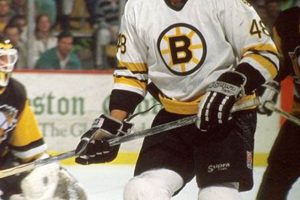
The accumulation of numerical value during a hockey game is achieved primarily through goals and assists. A goal is awarded when the entire puck crosses the goal line, legally entering the net. An assist is awarded to the player or players (maximum of two) who directly passed the puck to the goal scorer, contributing to the play that resulted in the goal. For example, if Player A passes the puck to Player B, who then shoots and scores, both Player A and Player B are credited with a point.
The significance of point accumulation extends beyond simple scorekeeping. It serves as a primary metric for evaluating individual player performance and contribution to the team’s offensive output. Historically, point totals have been used to determine league awards, negotiate player contracts, and assess a player’s overall impact on the game. High point totals often correlate with a team’s success, highlighting the critical role of offensive production.
The following sections will further elaborate on the specific scenarios that lead to goals and assists, the rules governing their assignment, and the strategic implications of maximizing scoring opportunities within a hockey game. The subsequent discussion will also address the nuances of point allocation and their impact on team strategy and player development.
Strategies for Maximizing Point Acquisition
Enhancing point accumulation in hockey requires a multifaceted approach, encompassing skill development, strategic awareness, and effective teamwork. The following strategies outline key areas for improvement.
Tip 1: Develop a Quick and Accurate Shot: Scoring opportunities often arise and vanish rapidly. A player with a fast and precise shot is better equipped to capitalize on these fleeting moments, increasing the likelihood of a goal.
Tip 2: Improve Passing Accuracy and Vision: Precise passing is essential for setting up scoring plays. Developing strong vision, the ability to anticipate teammate movements, allows for more effective puck distribution and assist generation.
Tip 3: Position Effectively in the Offensive Zone: Strategic positioning near the net, in the slot, or along the perimeter maximizes the chances of receiving a pass or creating a scoring opportunity. Understanding offensive zone coverage schemes is crucial.
Tip 4: Drive to the Net Consistently: Net-front presence disrupts the opposing goalie and creates rebounds. Driving to the net increases the likelihood of scoring a “garbage goal” or drawing a penalty that can lead to a power play goal.
Tip 5: Anticipate Rebounds and Loose Pucks: Being alert for rebounds and loose pucks around the net provides additional scoring opportunities. Quick reaction time and the ability to locate the puck are critical skills.
Tip 6: Enhance Puck-Handling Skills: Superior puck control allows a player to maintain possession in tight spaces, evade defenders, and create scoring chances. Dribbling, deking, and shielding the puck are essential skills.
Tip 7: Work on Power Play Efficiency: The power play is a prime opportunity to score, so being on the top power play unit will likely increase your scoring. It’s important to practice and work well with the other members of that unit.
Implementing these strategies, focusing on skill refinement and strategic play, leads to a marked improvement in individual point production and contributes significantly to overall team success.
The subsequent section will explore the rules and regulations governing point allocation, providing a comprehensive understanding of the scoring system in hockey.
1. Goal Scored

The act of scoring a goal is the most direct and fundamental method of obtaining points in hockey. It is the ultimate objective of offensive plays and a definitive indicator of a player’s scoring ability. Each instance of a legally scored goal results in the awarding of one point to the player who shot the puck into the net.
- Legality of the Goal
A goal must adhere to the established rules of the game to be considered valid. This includes ensuring the puck completely crosses the goal line within the confines of the net, without being illegally directed, such as by a high stick or a kicked puck intentionally directed into the net. If a goal is deemed illegal, it does not count towards the team’s score or the player’s point total.
- Goal Credit and Point Awarding
Once a goal is deemed legal, the player who last propelled the puck into the net is credited with the goal. This automatically awards that player one point in the game’s statistics. The point contributes to both the individual player’s season total and the team’s overall score, directly impacting standings and player performance metrics.
- Own Goals and Point Allocation
In the rare instance of an own goal, where a player inadvertently directs the puck into their own net, the goal is awarded to the opposing team’s player who last touched the puck. If no player from the opposing team touched the puck prior to the own goal, the goal is awarded to the opposing team’s captain (or designated player), and that player receives the point. This rule ensures a point is always awarded to the opposing team when a goal is scored.
- Empty Net Goals and Strategic Implications
An empty net goal occurs when the opposing team removes their goaltender in the final minutes of the game to add an extra attacker, hoping to score. Scoring into an empty net still awards a goal and point to the player. This strategic risk by the trailing team highlights the importance of shot accuracy and defensive responsibility, as a successful empty-net goal can seal the victory.
In summary, a legally scored goal is the cornerstone of point accumulation in hockey. The rules governing goal awarding, including considerations for legality, own goals, and empty-net situations, ensure a fair and consistent system for tracking scoring contributions, directly impacting individual player statistics and team success in pursuing point-based objectives.
2. Assist awarded

The awarding of an assist is intrinsically linked to how points are accrued in hockey. An assist represents a crucial component in the overall scoring process, directly contributing to a player’s point total. Specifically, up to two players who directly precede the goal scorer in possessing the puck are awarded an assist. This acknowledges their role in facilitating the scoring play, emphasizing teamwork and collaborative effort. For example, if Player A passes to Player B, who then passes to Player C, who scores, Players A and B are each credited with an assist, contributing one point to their individual totals. The impact of assist allocation extends beyond individual recognition, influencing player evaluation and team strategy.
The criteria for awarding an assist are typically interpreted by on-ice officials and scorekeepers, introducing a degree of subjectivity. Considerations include whether the pass was intentional, whether the pass directly led to the scoring chance, and whether intervening players significantly altered the play. For example, a pass that deflects off an opposing player but still reaches the goal scorer may still warrant an assist. Moreover, a player can receive an assist even if the goal is scored on a rebound. This system ensures that players who actively contribute to the scoring play are recognized, fostering a culture of teamwork and strategic playmaking. High assist totals often indicate strong passing skills, vision on the ice, and a player’s ability to anticipate their teammates’ movements.
In conclusion, the correct awarding of assists is an integral element in quantifying how points are distributed. It provides a mechanism to recognize and reward players who actively participate in goal-scoring plays. While some subjectivity exists in the allocation process, assists remain a vital statistic for assessing individual player contributions and understanding the dynamics of team success in hockey. A thorough understanding of the assist rule and its application is essential for players, coaches, and fans seeking to fully grasp the intricacies of scoring in hockey.
3. Offensive Strategy
Offensive strategy constitutes a critical determinant in the effective generation of scoring opportunities, directly influencing the number of points a team accumulates in hockey. A well-defined offensive strategy serves as the foundational framework upon which individual player skills and coordinated team movements converge to create goal-scoring chances. The implementation of structured systems, such as zone entries, forechecking schemes, and power-play formations, directly correlates with a team’s ability to consistently penetrate the opposing defense and generate high-quality scoring chances. For example, a team employing a successful cycle strategy in the offensive zone can maintain puck possession, tire out the opposition, and ultimately create openings for shots on goal, thereby increasing the likelihood of scoring. Conversely, a team lacking a coherent offensive plan often struggles to break through defensive pressure, resulting in fewer shots and reduced point accumulation. The selection of specific offensive tactics depends heavily on the team’s personnel, the opponent’s defensive strengths, and the game situation. The success of an offensive strategy is therefore intrinsically linked to the team’s ability to execute the plan effectively and adapt to changing circumstances on the ice.
The practical application of offensive strategy is evident in the contrasting styles of different hockey teams. Some teams favor a highly aggressive, forechecking-oriented approach, designed to create turnovers in the offensive zone and generate immediate scoring opportunities. This strategy often results in a high volume of shots and increased potential for rebounds, thereby amplifying the chances of scoring. Other teams prioritize a more patient, possession-based approach, focusing on controlled zone entries and deliberate puck movement to create high-percentage scoring chances. This strategy emphasizes precision and minimizing turnovers, often leading to fewer but more strategically valuable shots. Furthermore, specialized offensive strategies are crucial for maximizing scoring opportunities during power-play situations. Effective power-play formations, combined with skilled puck movement and shooting, can significantly increase a team’s point production. The use of specific set plays, designed to exploit weaknesses in the penalty-killing unit, often leads to direct scoring chances. The strategic deployment of offensive players in specific roles, such as net-front presence or point shots, also contributes to the overall effectiveness of the power play. The successful execution of these diverse offensive strategies necessitates a high level of coordination, communication, and skill among team members.
In summary, a meticulously crafted and effectively executed offensive strategy forms the bedrock for consistently generating scoring opportunities and maximizing point accumulation in hockey. The strategic choices a team makes regarding zone entries, forechecking, power-play formations, and overall offensive philosophy directly impact its ability to penetrate the opposition’s defense and put the puck in the net. Although challenges arise in adapting to various opponents and game situations, a strong understanding of offensive strategy and its practical implementation is essential for achieving sustained success. By focusing on creating high-quality scoring chances and effectively converting those chances into goals, teams can significantly improve their point production and enhance their competitiveness in the broader landscape of professional hockey.
4. Power play goals

Power play goals represent a significant avenue for point accumulation in hockey. When a team gains a power play advantage due to an opposing player’s penalty, the resulting offensive opportunities often lead to goals, directly contributing to the team’s overall score. A successful power play unit, characterized by strategic puck movement, effective shooting lanes, and strong net-front presence, significantly increases the likelihood of converting the advantage into a goal. For example, the Tampa Bay Lightning’s consistently high power play conversion rate in recent NHL seasons exemplifies the direct correlation between power play effectiveness and point production. More power play goals translate directly to increased scoring, thus a higher probability of winning the game and earning points in the standings.
The connection between power play goals and scoring extends beyond simply adding to the score. Power play goals often shift momentum within a game, demoralizing the penalized team and galvanizing the team with the man advantage. Successfully capitalizing on power play opportunities necessitates specialized strategies and player deployment. Teams often designate specific players to key roles, such as quarterbacking the power play from the point, screening the goaltender, or executing one-timers from scoring positions. The effectiveness of these strategies hinges on factors such as puck possession, passing accuracy, and the ability to exploit weaknesses in the penalty-killing formation. Failure to convert power play opportunities can represent a missed opportunity to gain a significant advantage, potentially affecting the outcome of the game.
In summary, power play goals are a crucial element in accumulating points in hockey. The ability to consistently capitalize on power play opportunities signifies a team’s offensive prowess and strategic depth. The conversion rate on the power play can be the deciding factor between winning and losing games, directly impacting a team’s position in the standings and overall success. Understanding the nuances of power play strategies and player deployment is essential for maximizing scoring opportunities and converting power plays into valuable points.
5. Rebound conversions

Rebound conversions represent a critical element in offensive hockey, directly impacting point accumulation. The ability to capitalize on rebounds, loose pucks generated from initial shots on goal, often determines a team’s scoring success. Effective rebound conversion strategies and player positioning are crucial for maximizing scoring opportunities and, consequently, increasing point totals.
- Net-Front Presence
Establishing a strong net-front presence is paramount for rebound conversions. Players positioned near the goal obstruct the goaltender’s vision and are best situated to capitalize on rebounds. This presence disrupts the goalie’s positioning and creates opportunities for quick shots on loose pucks. A prime example is Tomas Holmstrom, whose career success was built upon his ability to screen goalies and convert rebounds.
- Quick Reactions and Puck Awareness
Converting rebounds necessitates quick reactions and keen awareness of the puck’s location. Players must anticipate rebounds and react instantaneously to redirect the puck into the net. This skill is honed through practice drills that focus on rapid puck retrieval and shooting from close range. Players like Phil Esposito, renowned for his goal-scoring prowess, demonstrated exceptional ability in this area.
- Strategic Positioning
Strategic positioning around the net is essential for maximizing rebound opportunities. Players should position themselves in areas where rebounds are likely to occur, such as the sides of the net or in the slot. Understanding goaltender tendencies, such as where they typically direct rebounds, allows players to anticipate puck placement and gain a competitive advantage.
- Shot Selection and Technique
Shot selection plays a vital role in creating rebound opportunities. Low shots directed towards the pads of the goaltender are more likely to generate rebounds than high shots aimed at the glove. Employing techniques such as deflections and tip-ins can also increase the likelihood of rebound conversions. Players like Wayne Gretzky and Mark Messier, known for their playmaking skills, also excelled at positioning themselves for rebounds and directing pucks towards the net.
In conclusion, the ability to convert rebounds is a pivotal factor in how points are obtained in hockey. The strategic implementation of net-front presence, quick reactions, astute positioning, and deliberate shot selection amplifies the potential for rebound conversions, thereby significantly enhancing a team’s offensive output and overall point accumulation. Teams that prioritize these skills consistently exhibit higher scoring rates and achieve greater success on the ice.
Frequently Asked Questions
The following addresses common inquiries regarding how points are earned during a hockey game.
Question 1: What constitutes a goal in hockey?
A goal is achieved when the entire puck completely crosses the goal line and enters the net legally, as determined by the on-ice officials. This includes adherence to rules regarding high-sticking, kicking motions, and other potential infractions that could negate the goal.
Question 2: Who receives credit for an assist?
Up to two players on the scoring team who directly pass the puck to the goal scorer prior to the goal being scored may be credited with an assist. The pass must be a significant factor in the play that led to the goal.
Question 3: Can a player receive a point if the goal is an own goal?
In the event of an own goal, the last player on the opposing team to touch the puck is credited with the goal. If no player on the opposing team touched the puck, the goal is awarded to the opposing team’s captain (or designated player).
Question 4: Is there a limit to the number of assists that can be awarded on a single goal?
No more than two assists can be awarded on any single goal. This limitation ensures the recognition is distributed to the most direct contributors to the scoring play.
Question 5: If a player is penalized, does it affect the number of points they can score in a game?
Being penalized does not directly affect a player’s ability to accumulate points. However, time spent in the penalty box reduces the amount of time a player is on the ice, thereby potentially limiting their opportunities to score goals or record assists.
Question 6: Are there specific strategies to maximize point accumulation?
Effective strategies include developing a quick and accurate shot, improving passing accuracy, positioning effectively in the offensive zone, and consistently driving to the net to create scoring opportunities and rebounds. Power play efficiency is also crucial.
Understanding the rules governing goal and assist allocation is crucial for appreciating the dynamics of point accumulation in hockey.
The following section will provide a conclusion to this examination of point-scoring in hockey.
Conclusion
This article has provided a comprehensive overview of how do you get points in hockey. The primary means of accumulating points are through scoring goals and earning assists. Effective offensive strategies, particularly on the power play, and the ability to convert rebounds are key factors influencing point production. The rules governing goal and assist allocation are designed to recognize direct contributions to the scoring play, providing a framework for evaluating individual and team performance.
A thorough understanding of point accumulation, encompassing both the rules and strategic implications, is essential for appreciating the intricacies of hockey. Continued analysis of scoring trends and the evolution of offensive tactics will further illuminate the dynamics of this fundamental aspect of the game, fostering a deeper appreciation for the sport and its competitive landscape.