Exercises designed to improve the skills and tactical awareness of defensive players in ice hockey are a critical component of player development. These structured activities focus on enhancing skating agility, puck-handling proficiency, defensive positioning, and effective gap control. A standard example includes repetitive skating patterns focusing on backwards mobility and lateral movement, often combined with puck retrieval and distribution.
The execution of effective defensive plays is vital to team success, minimizing scoring opportunities for the opposition. Consistent training in specialized techniques fosters improved reaction time, spatial awareness on the ice, and the ability to make sound decisions under pressure. The development of these specialized skills can be traced back to formalized coaching methodologies implemented as hockey evolved as a professional sport.
Building upon this foundation, the following sections will delve into specific examples of on-ice training regimens, off-ice conditioning programs, and tactical simulations that contribute to the holistic development of a proficient and reliable rear guard.
Effective Training Strategies for Rear Guards
The following guidelines provide actionable strategies for enhancing the capabilities of ice hockey defensive players, promoting improved performance and tactical acumen.
Tip 1: Emphasize Agility and Skating Proficiency: Prioritize drills that focus on backwards skating speed, lateral movement, and quick transitions between forward and backward stances. Example: Shuttle runs incorporating pivots and controlled stops along the blue line.
Tip 2: Refine Puck-Handling Under Pressure: Incorporate exercises that simulate game-like scenarios where the player must maintain possession while facing forechecking pressure. Example: Partner drills involving tight turns, quick passes, and shielding the puck from an opponent.
Tip 3: Develop Positional Awareness: Conduct drills that reinforce correct positioning within the defensive zone, including staying between the puck and the net, and anticipating passing lanes. Example: Tactical exercises where the defensive pairing must react to simulated offensive plays and adjust their positions accordingly.
Tip 4: Hone Gap Control Skills: Implement exercises that focus on maintaining optimal distance between the defender and the opposing forward, preventing easy zone entries. Example: Drills where the defender practices skating backwards while maintaining a specific gap, then closing the gap to initiate a check.
Tip 5: Improve Breakout Execution: Train defensive players to make quick and accurate passes out of the defensive zone to initiate offensive attacks. Example: Repetitive passing drills from behind the net to designated targets at the blue line and center ice.
Tip 6: Enhance Physical Conditioning: Supplement on-ice training with off-ice exercises that build strength, endurance, and explosive power. Example: Interval training, plyometrics, and weightlifting exercises specifically targeting leg and core strength.
Tip 7: Utilize Video Analysis: Review game footage and training sessions to identify areas for improvement and reinforce proper technique. Example: Analyze defensive zone coverage and individual player positioning during games.
Consistently implementing these strategies will contribute to the development of well-rounded defensive players capable of excelling in all facets of the game. Their success hinges on deliberate practice and a focus on improving fundamental skills.
The subsequent sections will explore specific training methodologies and the long-term benefits of committed defensive development.
1. Skating Agility

Skating agility constitutes a foundational element within the training regimen for ice hockey defensive players. The ability to maneuver swiftly and efficiently on the ice directly impacts a defenceman’s capacity to effectively perform their duties and neutralize offensive threats. Dedicated exercises aimed at enhancing skating prowess are, therefore, a critical component of their development.
- Backward Skating Proficiency
Backward skating forms the bedrock of defensive positioning. Defencemen must maintain optimal positioning relative to oncoming attackers while facing their own net. Exercises designed to improve backward speed, stability, and pivoting skills are essential. Example drills include backward sprints, lateral shuffles, and transitions from forward to backward skating.
- Lateral Mobility and Edge Work
The capacity to move laterally with speed and precision allows defencemen to close gaps, contain attackers along the boards, and intercept passes. Drills focusing on cross-overs, mohawks, and tight turns enhance a player’s edge control and lateral agility. Real-world applications manifest in situations requiring rapid shifts to cover developing offensive plays.
- Pivots and Transitions
Seamless transitions between forward and backward skating are crucial for reacting to rapidly changing offensive scenarios. Exercises that emphasize quick pivots, turns, and changes of direction allow defencemen to maintain optimal positioning and react decisively. The ability to swiftly alter skating direction is a crucial element in intercepting passes and disrupting offensive momentum.
- Explosive Acceleration
The ability to accelerate rapidly from a stationary position or during a change of direction enables defencemen to close gaps quickly, win races for loose pucks, and initiate offensive breakouts. Drills that incorporate short bursts of speed, stop-starts, and agility ladder exercises contribute to developing explosive skating power. Success is measured by the capacity to outpace opposing forwards during critical moments.
These facets, collectively improved through targeted exercises, establish the fundamental connection between skating agility and effective ice hockey defensive play. The dedication to improving skating abilities directly translates into enhanced on-ice performance and increased defensive capabilities.
2. Puck Control

Puck control is a fundamental skill set directly impacting a defenceman’s effectiveness. Successful execution of defensive responsibilities often hinges on maintaining possession under pressure, executing accurate passes to teammates, and initiating offensive transitions. The exercises designed for rear guards invariably incorporate elements to improve this essential ability. A defenceman’s aptitude in puck management directly influences the outcome of crucial in-game scenarios. A botched pass from the defensive zone, for instance, can immediately lead to a scoring opportunity for the opposing team, underscoring the cause-and-effect relationship between puck security and defensive reliability. Possession, therefore, becomes a primary objective in drills designed to improve puck-handling capabilities under various pressure conditions.
Specialized activities focusing on puck retrieval along the boards, quick pivots while maintaining control, and precise passing to strategically positioned teammates exemplify the practical application of puck control exercises. These training activities are structured to simulate game-like intensity, forcing the player to make split-second decisions while sustaining possession. The use of resistance and pressure from simulated opponents during these sessions allows for the development of critical puck-protection and distribution skills. Furthermore, simulating forechecking scenarios necessitates quick decision-making, enhancing the defenceman’s ability to clear the zone efficiently and effectively.
Ultimately, enhanced puck control translates to a greater ability to protect the puck, make intelligent passing decisions, and contribute to offensive plays. This development is essential for mitigating defensive breakdowns and transitioning the team from defensive to offensive positioning. By continuously addressing the fundamentals of puck management within structured sessions, defensive players cultivate the necessary skills to perform reliably in high-pressure game conditions, significantly impacting overall team performance. Mastering these drills remains a constant challenge demanding consistent dedication and refinement.
3. Positional Play

Positional play, as it relates to training regimens for ice hockey defensive players, represents a crucial element in overall player development. Correct positioning within the defensive zone, relative to both teammates and opponents, drastically impacts the ability to effectively disrupt opposing offensive plays and protect the net. Therefore, specific exercises designed to reinforce sound positional habits are essential.
- Defensive Zone Coverage
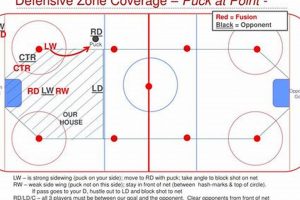
Defensive zone coverage dictates how defencemen position themselves to limit scoring opportunities. Effective coverage involves maintaining tight gaps on opposing forwards, blocking passing lanes, and supporting the goaltender. Positional exercises frequently simulate various offensive scenarios, requiring defencemen to react and adjust their positions accordingly. For instance, a drill might involve defending against a simulated cycle play, demanding that defencemen rotate and maintain coverage on the puck carrier while denying passing options to teammates. The inability to maintain proper positioning in such situations directly leads to increased scoring chances for the opposition.
- Neutral Zone Positioning
Neutral zone positioning impacts a defenceman’s ability to prevent zone entries and disrupt the opposing team’s transition game. Maintaining a solid defensive line, anticipating passing lanes, and stepping up to challenge puck carriers at the blue line are crucial aspects of neutral zone play. Training scenarios focusing on neutral zone positioning often involve defending against simulated rushes and odd-man breaks. Correct positioning forces the opposing team to dump the puck in, rather than gaining controlled entry, thereby limiting their offensive options.
- Support of Teammates
Defensive play relies heavily on coordinated teamwork. Positional play extends beyond individual actions to include providing adequate support to teammates. This entails covering for a pinching defenceman, anticipating a teammate’s pass, and communicating effectively to maintain defensive structure. Drills designed to emphasize support often involve simulated breakouts and defensive zone transitions, requiring players to anticipate and react to their teammates’ movements. A defenceman failing to provide adequate support can leave teammates vulnerable, creating scoring opportunities for the opposition.
- Box-Plus-One Coverage
Box-plus-one coverage represents a specific defensive strategy used during penalty kills. This requires four players to form a “box” in front of the net, while one player applies pressure to the puck carrier. Effective execution of box-plus-one coverage hinges on all players maintaining their designated positions and responsibilities. Drills designed to practice box-plus-one coverage typically involve simulating penalty-kill scenarios, emphasizing communication and positional discipline. A breakdown in positional discipline during the penalty kill can result in power-play goals against.
These interconnected facets, each refined through targeted training, underscore the intrinsic link between positional play and effective ice hockey defensive performance. Commitment to correct positional habits dramatically reduces defensive breakdowns and enhances the overall effectiveness of the team’s defensive efforts. The diligent repetition of drills designed to reinforce proper positioning translates directly to improved in-game performance and fewer scoring opportunities for opposing teams.
4. Gap Management

Gap management, a critical skill for ice hockey defensive players, dictates the distance maintained between the defender and the opposing forward. Effective gap control limits the forward’s time and space, disrupting offensive opportunities. Training activities directly target refining this skill, improving defensive capabilities.
- Closing Speed
Closing speed refers to the rate at which a defenceman reduces the space separating them from an approaching forward. Effective closing speed disrupts the forward’s momentum and forces them to make hasty decisions. Drills focusing on closing speed involve backward skating with rapid acceleration to close the gap. In a game scenario, a defenceman with poor closing speed allows the forward to maintain control and potentially generate a scoring chance.
- Maintaining Optimal Distance
Maintaining optimal distance requires a delicate balance. Too much space allows the forward to dictate the play; too little space can lead to the defenceman being easily beaten. Drills emphasize maintaining a consistent gap, typically a stick’s length or slightly more, enabling the defender to react effectively. Failing to maintain this distance leaves the defender vulnerable to quick changes in direction or speed.
- Angling Techniques
Angling techniques involve strategically positioning the body to guide the forward towards a less advantageous area of the ice, such as the boards or away from the net. Effective angling limits the forward’s options and allows the defenceman to regain control of the puck. Drills incorporate simulated rushes where the defenceman must use body positioning to direct the forward along a specific path. Poor angling allows the forward to maintain a direct path to the net.
- Active Stick Work
Active stick work complements gap management by using the stick to disrupt the forward’s puck control and passing lanes. A well-positioned stick can prevent zone entries, intercept passes, and force turnovers. Drills focus on maintaining a low, active stick while maintaining proper gap control, constantly applying pressure on the puck carrier. Inadequate stick work allows the forward to maintain possession and create scoring chances.
Collectively, these facets of gap management, honed through dedicated training exercises, contribute significantly to a defenceman’s effectiveness. The consistent application of these skills results in a more reliable defensive presence and a reduction in scoring opportunities for the opposing team.
5. Defensive Breakouts

Defensive breakouts, a fundamental element of ice hockey strategy, are inextricably linked to the scope and purpose of hockey defenceman drills. Breakouts represent the orchestrated effort to transition the puck from the defensive zone to the offensive zone, initiating an attack and relieving pressure on the defending team. Drills designed for defencemen, therefore, must incorporate specific activities that develop the skills and decision-making required for successful breakout execution. The ability to initiate a clean and efficient breakout directly impacts a team’s ability to generate scoring opportunities and control the flow of the game. For instance, a well-executed breakout can quickly turn a defensive situation into an offensive advantage, creating odd-man rushes and high-quality scoring chances. A failure to execute a breakout effectively, conversely, often results in turnovers within the defensive zone, leading to sustained offensive pressure from the opposition.
Specific drills focus on developing several key skills necessary for effective breakouts. These include making quick and accurate passes under pressure, identifying optimal passing lanes, supporting teammates, and skating the puck out of the zone when appropriate. Commonly used drills involve simulated forechecking pressure, forcing defencemen to make split-second decisions regarding passing options and puck protection. Furthermore, defencemen are trained to recognize and react to different forechecking schemes, enabling them to adapt their breakout strategy accordingly. A defenceman’s ability to read the play, make decisive passes, and support the forwards during breakouts is a direct result of repetitive training within these specialized activities. Proper breakout execution can then be observed in game situations through controlled zone exits and fluid transitions to the offensive end.
In summary, the connection between defensive breakouts and hockey defenceman drills is a direct cause-and-effect relationship. Effective breakouts are not simply a matter of chance, but rather the result of consistent and targeted training. Defenceman-specific drills must address the critical skills required for successful breakout execution, enhancing a team’s ability to transition from defense to offense and control the game’s tempo. The integration of breakout-focused activities into the training curriculum remains essential for developing well-rounded defensive players who can contribute both defensively and offensively.
Frequently Asked Questions
This section addresses common inquiries regarding training exercises specifically designed for ice hockey defensive players.
Question 1: What constitutes an effective warm-up prior to engaging in rigorous hockey defenceman drills?
A comprehensive warm-up should incorporate both cardiovascular and dynamic stretching components. Light jogging or cycling elevates heart rate, while dynamic stretches, such as leg swings and torso twists, prepare muscles for intense activity. Static stretching is generally discouraged prior to high-intensity exercises.
Question 2: How frequently should players engage in hockey defenceman drills to maximize skill development?
The optimal frequency depends on the player’s age, skill level, and training schedule. Generally, 2-3 focused training sessions per week dedicated to defensive skills are beneficial. Overtraining can lead to fatigue and injury, so adequate rest and recovery are crucial.
Question 3: What is the significance of off-ice conditioning in relation to on-ice hockey defenceman drills?
Off-ice conditioning is vital for building strength, endurance, and agility, which directly translate to improved performance on the ice. Strength training, plyometrics, and cardiovascular exercises enhance skating power, balance, and overall physical resilience, allowing players to execute drills with greater intensity and precision.
Question 4: How can coaches effectively provide feedback during hockey defenceman drills?
Feedback should be specific, constructive, and timely. Coaches should focus on correcting technical flaws, reinforcing proper technique, and providing positive reinforcement for effort and improvement. Video analysis can also be a valuable tool for visual feedback.
Question 5: What are the key indicators of a successful hockey defenceman drill?
Success is measured by improved execution of fundamental skills, enhanced tactical awareness, and increased confidence in game-like situations. Measurable improvements in skating speed, puck control, and decision-making are indicative of effective training.
Question 6: How can coaches adapt hockey defenceman drills to accommodate varying skill levels within a team?
Drills can be modified by adjusting the complexity of the exercise, altering the intensity level, or providing individualized instruction. Breaking down complex drills into smaller, manageable steps can help less experienced players gradually develop the necessary skills.
These FAQs highlight critical aspects of exercises and development. Implementing these considerations can lead to substantial enhancements in player capabilities and overall team performance.
The following section explores common pitfalls to avoid when conducting the training sessions.
Conclusion
The preceding analysis underscores the paramount importance of targeted training exercises for ice hockey defensive players. Key elements, including skating agility, puck control, positional play, gap management, and defensive breakouts, form the cornerstones of a well-rounded training regimen. Consistent application of specifically designed drills, tailored to individual player development needs, remains essential for achieving optimal performance. The effectiveness of “hockey defenceman drills” rests on a deliberate, structured approach to skill enhancement.
The pursuit of excellence in defensive performance necessitates a continued emphasis on refining fundamental techniques and fostering tactical acumen. This commitment, paired with a data-driven approach to training and performance analysis, promises to elevate the standard of defensive play within the sport. The future of hockey defenceman development lies in innovative training methodologies and a relentless pursuit of continuous improvement.