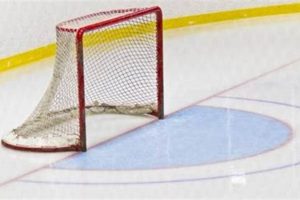
In ice hockey, a score is achieved when the entire puck crosses the goal line, entering the net. This act results in one goal being awarded to the team whose player propelled the puck into the net. An assist is awarded to a player or players (maximum of two) who directly contributed to the goal by passing or handling the puck prior to the goal scorer’s shot. A single goal, or a single assist, contributes one unit to a player’s cumulative statistics. Thus, a player earns one unit, or point, for each goal scored or assist credited.
Accumulating scores and assists is a primary indicator of a player’s offensive contribution to the team. These statistics are frequently used to evaluate player performance, determine team strategy, and influence player compensation. Historically, the ability to consistently generate goals and assists has been highly valued, shaping the composition of teams and driving player development initiatives.
The subsequent sections will delve into specific scenarios that lead to the accumulation of goals and assists, including power play opportunities, short-handed situations, and even-strength play. Rules governing the awarding of assists, including instances of deflected shots and own goals, will also be examined to provide a complete understanding of point attainment in this sport.
Strategies for Enhancing Scoring and Assist Potential
Optimizing offensive contributions in ice hockey requires a multifaceted approach centered on skill development, tactical awareness, and strategic positioning. The following guidelines are designed to improve a player’s ability to generate goals and assists, thereby maximizing potential.
Tip 1: Enhance Shooting Accuracy and Power: Consistent practice to improve the precision and force of shots is paramount. This allows for a greater chance of scoring directly or creating rebound opportunities.
Tip 2: Improve Puck-Handling Skills: Mastery of puck control enables players to maintain possession in offensive zones, execute skillful passes, and navigate through defensive pressure effectively.
Tip 3: Develop Passing Proficiency: Accurate and well-timed passes create scoring opportunities. Focus on passing to open teammates in high-scoring areas and anticipating their movements.
Tip 4: Increase Skating Speed and Agility: Superior skating allows players to create separation from defenders, drive to the net, and track down loose pucks in offensive situations.
Tip 5: Improve Situational Awareness: Understanding the positioning of teammates and opponents on the ice facilitates better decision-making regarding passing, shooting, and offensive zone entries.
Tip 6: Maximize Power Play Opportunities: Power plays offer increased scoring chances. Players should be adept at executing pre-determined power play strategies and capitalizing on numerical advantages.
Tip 7: Focus on Net-Front Presence: Positioning oneself effectively in front of the opposing team’s net increases the likelihood of deflections, rebounds, and screens, all of which can lead to scores.
Implementing these strategies, combined with consistent effort and strategic positioning, will enhance a player’s offensive capabilities and lead to increased contribution.
The ensuing section will address the specific rules regarding assist allocation, further clarifying the process for accumulating points.
1. Goal

In ice hockey, the “Goal” represents the fundamental unit of offensive accomplishment and is intrinsically linked to earning credit. It signifies the successful culmination of offensive play and is the most direct method of point acquisition.
- Direct Point Allocation
A player who shoots the puck directly into the opposing team’s net is awarded one point. This direct relationship between scoring a goal and receiving a point is straightforward and universally recognized within the sport. For example, if a forward fires a wrist shot that beats the goaltender, that forward is immediately credited with a goal and a unit.
- Impact on Team Score
Each legally executed goal adds one point to the team’s overall score, contributing directly to the game’s outcome. This contribution emphasizes the importance of goal-scoring in achieving victory. For instance, if a team scores three goals while the opposing team scores two, the team with three goals wins the game.
- Influence on Player Statistics
The number of goals a player scores significantly impacts their individual statistics and is a key metric for evaluating offensive performance. High goal totals often lead to recognition and opportunities for players. Consider a player who consistently scores goals throughout a season; they are likely to be viewed as a valuable offensive asset.
- Goal as a Catalyst for Assists
The scoring of a goal creates the opportunity for assists to be awarded to players who contributed to the play leading up to the goal. While the goal scorer receives the primary unit, the assist-earning players also benefit from the scoring sequence. In a scenario where a defenseman makes a breakout pass to a forward who then scores, the defenseman may be awarded an assist, contributing to their overall credit.
The goal, therefore, is central to point acquisition in ice hockey. It not only provides a direct contribution to a player’s credit but also sets the stage for assists to be awarded, highlighting its crucial role in the sport’s scoring dynamics.
2. Assist (Primary)

The “Assist (Primary)” is a direct contributor to a player’s point total in ice hockey. Its impact is manifested when a player executes a pass or makes a play that directly enables a teammate to score a goal. To achieve this primary attribution, the pass or play must be the last action by a teammate before the goal scorer’s successful attempt. The cause-and-effect relationship is clear: a well-executed primary assist immediately precedes and enables a scoring play. Without this direct contribution, the scoring opportunity might not materialize, underlining the critical role of the primary assist.
Consider a scenario where a center intercepts a pass in the neutral zone, evades a defender, and delivers a precise pass to a winger streaking toward the net. The winger receives the pass and scores. In this instance, the center is credited with the primary assist because their pass was the final action taken by a teammate that directly led to the goal. The importance of this assist is reflected in the point awarded to the assisting player, effectively acknowledging their crucial role in the scoring sequence. Practically, understanding the conditions for receiving a primary assist encourages players to prioritize making decisive, impactful plays that directly set up scoring opportunities.
The understanding and execution of plays that generate primary assists are paramount for optimizing offensive output. While scoring goals is the ultimate objective, the ability to consistently deliver primary assists signifies a player’s vision, skill, and hockey sense. Primary assists not only contribute to individual statistics but also facilitate team success by maximizing scoring opportunities. These successful actions reflect the interconnectedness of teamwork and individual skill in contributing to the overall scoring objectives of the game. Players actively seeking to improve their offensive impact should focus on improving passing accuracy, anticipating teammates’ movements, and making quick, decisive plays that result in primary assists.
3. Assist (Secondary)

The secondary assist constitutes another avenue for earning a point in ice hockey, albeit less directly than scoring a goal or recording a primary assist. A secondary assist is awarded to the player who made the pass or carried the puck to the player who subsequently made the primary assist pass. Its effect on a player’s statistics mirrors that of a primary assist: it adds one credit to the player’s point total. While less impactful than the primary assist, it recognizes the contribution of a player to the sequence of events leading to the score. For instance, if Player A passes to Player B, who then passes to Player C, who scores, Player A receives the secondary assist, indicating their involvement in initiating the play.
The importance of the secondary assist lies in its recognition of the broader teamwork involved in generating scoring opportunities. It acknowledges that goals are often the result of multiple players contributing to a successful offensive play. Understanding the mechanics of the secondary assist can influence player behavior, encouraging them to make smart, anticipatory plays that set up their teammates for success. Consider a defensive player who makes a crisp outlet pass to a forward exiting the defensive zone. This pass may initiate a series of passes culminating in a goal. Although the defender is removed from the immediate scoring play, the secondary assist recognizes the significance of their initial pass in starting the offensive sequence.
In summary, the secondary assist provides a means of acknowledging contributions beyond the immediate pass leading to a goal. While its impact on individual player statistics is the same as a primary assist (one point), its recognition underscores the collaborative nature of the sport. Though challenges exist in subjectively assessing the true impact of a secondary assist in every situation, it remains a valuable component of how players accumulate points, promoting teamwork and strategic play. The allocation of secondary assists, alongside goals and primary assists, provides a comprehensive view of offensive contributions on the ice.
4. Legal Shot

The “Legal Shot” is a fundamental element in ice hockey, directly impacting the acquisition of scoring credits. It delineates the conditions under which a player’s attempt to score is considered valid, influencing the determination of goal attribution and subsequent point allocation. A comprehensive understanding of the legal shot is therefore crucial for comprehending how scoring units are obtained.
- Definition and Requirements
A shot is deemed legal when the puck is propelled toward the opposing team’s net by an offensive player, in accordance with established rules. The stick must be below shoulder height when the puck is struck, and no illegal actions, such as using a hand pass directly to oneself before shooting, can occur. A shot failing to meet these criteria will be deemed illegal, nullifying any potential score. For instance, a shot where the player’s stick is above their shoulder is disallowed, regardless of whether the puck enters the net.
- Impact on Goal Validation
The legality of a shot directly affects whether a goal is awarded. If the shot is deemed illegal, the goal is disallowed, and no units are assigned to the player. This emphasizes the importance of adhering to the rules when attempting to score. A clear example is a shot taken after the whistle has blown; regardless of whether the puck enters the net, the goal will not count.
- Influence on Assist Eligibility
Even if a shot is initially deemed legal but is subsequently challenged and overturned, any assists associated with the play may also be rescinded. This highlights the interconnectedness of various aspects in determining credit allocation. For example, if Player A passes to Player B, who then scores with an illegal high stick, both the goal and the assist will be disallowed.
- Distinction from Deflections
A legal shot must originate from the stick of the offensive player. If the puck is deflected off another player, including a defensive player, into the net, the shot is still attributed to the player who initially propelled the puck, provided the initial shot was legal. This distinction is important for determining which player receives credit. If Player A shoots the puck, and it deflects off a defender into the net, Player A is still credited with the goal, assuming the initial shot was legal.
In conclusion, the concept of the “Legal Shot” is vital for understanding the process of obtaining scoring units in ice hockey. It establishes the framework within which scoring attempts are evaluated, directly influencing the determination of goal attribution and subsequent point allocation. Adherence to the rules governing the legality of a shot is therefore paramount for maximizing scoring potential.
5. Puck Entry

The concept of “Puck Entry” is intrinsically linked to scoring opportunities in ice hockey, serving as a critical precursor to generating goals and assists. A successful puck entry into the offensive zone is essential for establishing offensive pressure and creating the scoring chances necessary to accumulate points. Effective entry strategies dictate the likelihood of generating those key units.
- Controlled Entry and Sustained Offensive Pressure
A controlled entry, where possession of the puck is maintained while crossing the offensive zone blue line, allows a team to set up its offensive structure, increasing the potential for sustained pressure. This sustained pressure often leads to scoring opportunities, which translate directly into points. For example, a forward carrying the puck across the blue line with speed and support from teammates is more likely to create a scoring chance than a simple dump-and-chase. This method increases the chances of generating opportunities for point accrual.
- Entry Strategies and Defensive Response
Different entry strategies, such as carrying the puck, chip-and-chase, or dump-and-chase, have varying degrees of success depending on the defensive setup of the opposing team. Understanding and adapting to the defensive response is crucial for maintaining possession and creating scoring opportunities. A failed entry, resulting in a turnover, reduces the potential for generating offensive chances and therefore reduces opportunities to accumulate statistics.
- Entry Location and Shooting Opportunities
The location of the puck entry on the offensive zone blue line influences the types of scoring opportunities that can be created. Entries that allow for quick shots on net or create passing lanes to high-scoring areas significantly increase the chances of scoring, contributing to point accumulation. An entry on the boards may limit immediate scoring chances compared to an entry through the middle of the ice.
- Offside Considerations
A successful puck entry must adhere to offside rules to be considered valid. An offside entry negates any potential scoring opportunities that may arise, as the play is immediately stopped. Avoiding offside infractions is therefore crucial for maintaining offensive momentum and maximizing scoring potential. Players must ensure that the puck precedes them across the blue line to remain onside and preserve the scoring possibility. Therefore, a player must respect the rules and laws within hockey.
These elements of puck entry collectively influence the ability to establish and sustain offensive pressure, create scoring chances, and ultimately increase the likelihood of accumulating goals and assists. A team’s effectiveness in this area is directly correlated to its scoring output and overall success on the ice.
6. Official Credit

The allocation of “Official Credit” is the definitive step in the process of “how do you get a point in hockey.” It represents the formal recognition and assignment of goals and assists to individual players, directly impacting their statistics and overall evaluation.
- Scorekeeper Discretion
Official credit is assigned by the game’s official scorekeepers, who evaluate the play based on established league rules and guidelines. This process inherently involves a degree of subjective interpretation, particularly in complex or ambiguous scoring situations. For instance, determining whether a player significantly contributed to a goal in a net-front scramble requires careful judgment. Scorekeepers must apply consistent standards to ensure fair and accurate allocation of statistics, influencing both individual player recognition and team performance assessments.
- Review and Amendment Processes
Mechanisms exist for reviewing and potentially amending initial credit allocations. Coaches or team personnel can appeal decisions in certain circumstances, typically involving disputed assists or questionable goal attributions. This review process helps ensure accuracy and fairness, particularly in high-stakes games where statistical data can significantly impact player evaluations and strategic decisions. An example would be a situation where a team believes a player was wrongly denied an assist due to a missed pass.
- Impact on Player Statistics and Awards
The official credit assigned to players directly contributes to their cumulative statistics, which are used to evaluate performance, determine eligibility for awards, and influence contract negotiations. Accurate and fair credit allocation is essential for maintaining the integrity of these processes. A player vying for a scoring title, for example, relies heavily on the accuracy of official credit assignments to determine their final ranking and potential accolades. The outcome of the game is not changed, but individual metrics are altered.
- Influence on Team Strategy and Line Combinations
Coaches often utilize official statistics, derived from credited goals and assists, to inform their strategic decisions and line combinations. Player performance, as reflected in their point totals, can influence ice time allocation and deployment in key game situations. Therefore, the accuracy of official credit allocation indirectly affects team performance and strategic planning. A coach might favor a player with a higher assist total on the power play, based on the belief that this player excels at creating scoring opportunities.
In summary, the assignment of official credit is the ultimate determinant of how goals and assists translate into tangible statistics for players. While subjective elements and review processes are involved, the integrity and accuracy of these allocations are paramount for fairly evaluating player performance, informing strategic decisions, and maintaining the competitive balance within the sport.
Frequently Asked Questions Regarding Point Acquisition in Ice Hockey
The following questions address common inquiries regarding the methods of obtaining scoring units in the sport of ice hockey. Clarity on these issues is crucial for understanding player statistics and evaluating performance.
Question 1: What constitutes a goal in ice hockey?
A goal is achieved when the entire puck crosses the goal line and enters the net, as a result of a legal shot by an offensive player. The goal must be validated by the game officials to be considered legitimate.
Question 2: How are assists awarded?
An assist is awarded to a player or players (maximum of two) who directly contributed to the goal by passing or handling the puck prior to the goal scorer’s shot. The last player, or the two players before the goalscorer who touched the puck, will be credited for assist.
Question 3: What is the difference between a primary and secondary assist?
The primary assist is awarded to the last player to touch the puck before the goal scorer. The secondary assist is awarded to the player who passed the puck to the player who received the primary assist. There can only be 1 player being credited with the primary assist.
Question 4: Can a player receive an assist if their shot is deflected into the net by another player?
If a player shoots the puck toward the net and it is deflected off another player (either an offensive or defensive player) into the net, the player who took the initial shot is credited with the goal, not the player who caused the deflection, as long as the initial shot was deemed legal.
Question 5: What happens if a goal is scored on an own goal (deflected in by a defensive player)?
If a defensive player inadvertently deflects the puck into their own net, the goal is awarded to the last offensive player to touch the puck before the deflection. If no offensive player touched the puck, the goal is awarded to the nearest attacking player.
Question 6: Can a player receive a point if they are penalized on the play?
Yes, a player can still receive a credit or an assist even if they are penalized on the same play, provided the goal is scored before the penalty stops play. The penalty does not negate the previously accrued unit.
In summary, the intricacies of goal and assist allocation require a thorough understanding of the rules and guidelines governing play. Accurate application of these rules is essential for maintaining the integrity of player statistics and performance evaluations.
The next section will provide a comprehensive conclusion summarizing the various elements discussed in this discourse.
Conclusion
This exploration of “how do you get a point in hockey” has illuminated the multifaceted mechanisms by which players accumulate scoring units. The attainment of goals and assists, the critical components of point totals, is governed by specific rules, strategic maneuvers, and the objective assessment of on-ice events by officials. Understanding the conditions for awarding a legal shot, the nuances of primary and secondary assists, the significance of puck entry, and the finality of official credit assignment provides a comprehensive perspective on the process of accumulating these statistics.
The pursuit of maximizing point totals is an ongoing endeavor for players seeking to elevate their performance and contribute to their team’s success. A continued focus on skill development, tactical awareness, and strategic positioning, coupled with a thorough understanding of the rules governing point allocation, will empower players to achieve their offensive objectives and enhance their overall impact on the game.